Learn the Guitar
by JUNE JOHNSON CALDWELL
The author of several short stories, JUNE JOHNSON CALDWELL now makes her home in Tucson, Arizona.
I WANT to play the Spanish guitar. On the surface that may sound like a loo simple and everyday desire, But notice, I don’t say I want, to learn to play the Spanish guitar. I just want to play it. I want to he transformed. I want to be transformed from what I am into a guitarist of consummate suavity and skill.
I want to hear a tune and pick it off. “Can I play the what? Just hum the first few bars, please.”
I want to sit around campfires and play mournful melodies, and sing French art songs in the living rooms of my friends. I want to have memorized most of the popular songs, a number of the old ones; to have a considerable repertoire of folk ballads, of incidental music to strum while I explain the next number I am going to play and sing, and a few concert pieces. I also want to be able to tune the thing, casually but meticulously, between pieces as I go along, instead of having to take it back to the store where I bought it.
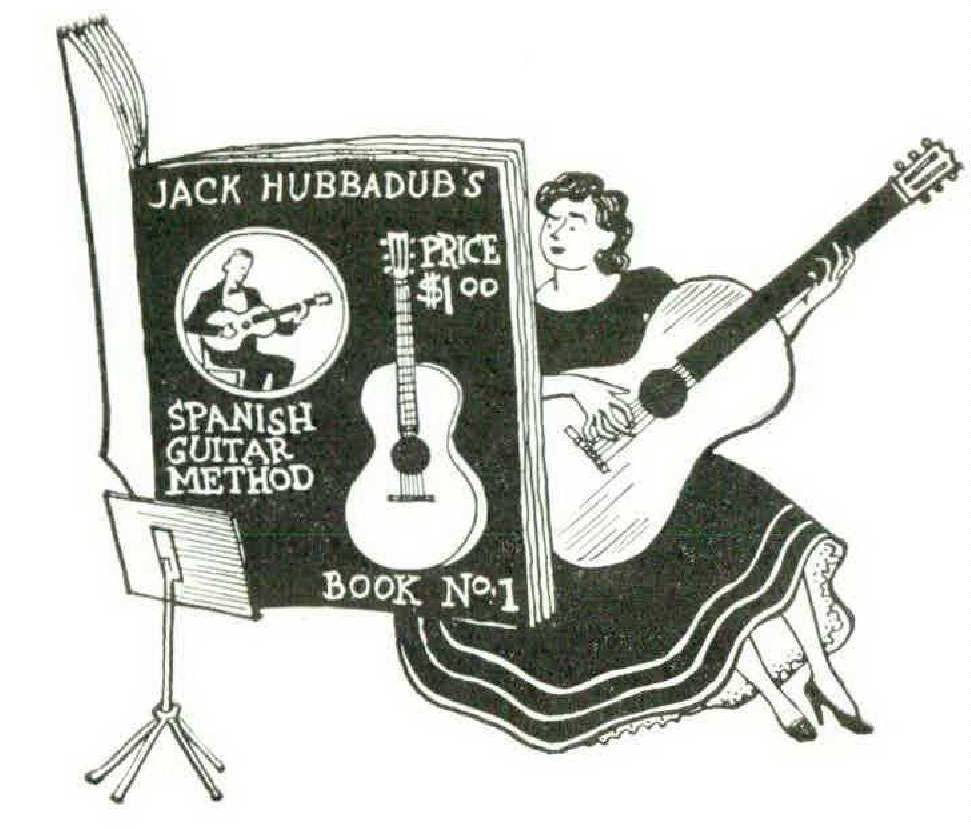
I own a very good secondhand guitar. I own the guitar and Jack Hubbadub’s Spanish Guitar Method, Book No. 1.
“After you learn to play the guitar, you can get a teacher,”the salesman told me, apparently unaware of any paradox in that statement. “There’s plenty in this little book to keep you busy for a long time.”
When I asked him how long he thought it would take to learn a half dozen songs, he said, “Well, I know a fellow who bought a guitar a year ago, and he makes it a point to practice a half hour every day. After about a year, he can play pretty well. Not very good, but pretty well.”
“Good enough to have a teacher?”
“He might be about ready for that, I don’t know.”
Well, that’s been quite a while ago. I am now on page 19 of Book No. 1 — and, if anything, far from alleviating a suppressed desire, this method of approach aggravates it.
French art songs? Folk ballads? Even incidental music to strum while I explain that my next number is going to be an exercise on the third string in which I put my finger in two different places on it, sounding two different notes which I call out. as I do so? No. I might be able to hold the attention of a small group, not of intimate friends but of polite strangers, while I showed them the three positions in which a guitarist can play: standing up, sitting down, and the left foot resting. The seven ways of holding a guitar, four of them wrong. The two ways of holding the pick, one of them wrong.
More than that, under the present arrangement I am bound by a loyalty I do not feel for the compositions of my textbook instructor. The stripe of Mr. Hubbadub is that of all “how to” authors, primarily in music and literature, who take their books as opportunities to publish their own stuff, filling in with other selections carefully ascertained to be in the public domain, out of copyright, free from royalties. So that I, in my repertoire, look forward to the inclusion of “Old Black Joe,”“Massa’s in de Cold, Cold Ground,” and “The Old Oaken Bucket,” plus the “Empress,” “Lisa,” “Moonlight,” “Teatime,”“Suzette,”and “Meditation” waltzes by J. Hubbadub; the “Lancers” and “Guard of Honor” marches, “The Meadow Lark,”and “The Voung Beginner"—which, as I am in my thirties and it is on page 43, will probably be most inappropriate for me when I arrive there.
If anyone were to ask me for “Home on the Range,”even, I would have to substitute “ Homesick” by Jack Hubbadub. If someone should request a little flamenco music, I have “El Gitano” by Jack Hubbadub. I might, carry it off by going quickly then to “Czardas” by Jack Hubbadub, “The Fountain” by J. Hubbadub, “The National Guard March” by J. Hubbadub, and “Serenade” by Hubbadub. But in there somewhere, I feel something else might be carried off first. Me.