Baseball in Spain
After his graduation from Trinity College in 194-9, ROBERT H. BOYLE took an M.A. at Yale and served for two years as an officer with the Marines. On leaving the service he lived in Barcelona for a year, and he is now a Sports writer for the United Press in New York.
by ROBERT H. BOYLE
How I ever got to play ball base, or baseball, with a team chartered by the late King Alphonso XIII of Spain is something which I have difficulty understanding even now. And as if to complicate things, a question of ethics has arisen, and I don’t just know what to do. The whole affair started while I was studying in Barcelona last year.
I was sitting in the dining room of my pensione trying to digest the remnants of an octopus fried in its own ink and a liberal dose of olive oil when Dulec, the maid, entered to announce that a señor wished to speak to me. She placed a visiting card on the table. Translated it read, “Ramón, the Count of Gervasio,”and engraved in the lower left-hand corner was the additional title, “The Captain of the Ball Base.” A moment later, Dulce returned with an elegant young man wearing a razor-thin mustache and a pair of dark glasses, the hallmarks of the well-to-do Spaniard. He began to apologize for interrupting my lunch, and to set him at ease I asked him to be seated and have some wine. He introduced himself as Count Ramón, again begged pardon for the interruption, and explained he was most interested in having me play for Real Español, the Royal Spanish Ball Base Club of Barcelona.
Puzzled, I asked if pelota base, meaning ball base, was American baseball. The count said it was and added he had obtained my name from the American Consulate. He tapped his breast pocket, significantly and withdrew what shortly proved to be a contract. I expressed my surprise at the existence of ball base in Spain, but in polite Castilian Count Ramón informed me pelota base had been played in Catalonia ever since its introduction by some Cubans nearly thirty years before. Spurred on by the wine, questioning elicited the information ball base was may snob. It was the game of the upper-middleclass Catalan and the aristocracy. Not everyone, I learned, could afford the price of a ball or bat, much less a glove. Ball base was not a game for los peones.
Count Ramón went on to tell me his club was one of four teams in la primera división of la Liga Catalaña. Eight other teams — composed for the most part, I gathered, of social climbers, inept barons, and a few aspiring textile executives — comprised la segunda división.
There also was a first-class league in Madrid, but in the international match against Italy the previous fall, the count said, almost all the Spanish players had been from the Catalan League; and what’s more, three of those Spanish players, including the pitcher, had been members of Real EspaTiol. Spain won, 7 to 3. The Imizador or pitcher from Real EspaTiol had been very fast, but now that was exactly the difficulty.
“ Que dificultad?” I queried.
The pitcher, a South American, the count said, had had to go back home. An assassin had shot his father, and the pitcher had taken over his father’s post in the cabinet. Naturally it had been illegal to use a nonSpaniard, but then the Italians had used an American third baseman. If I cared to play, there would be no questions. They would say I was a Basque. There were many blond Basques. Besides, Spain would get even with the Italians for using an American. The count beamed and poured himself another glass of wine.
I told the count I hadn’t played ball base in over four years. That didn’t bother Count Ramón. He asked which position I had played. I said I had been a pitcher, un lanzador. The count became excited. He waved the paper he had taken from his breast pocket in front of my face. “But your mercy must play! He must!” he cried. Several of the other diners looked up. Count Ramón guiltily subsided and eagerly whispered that the paper was a contract to play ball base for Real Español. He regretted no salary was involved, but the king himself had chartered Real Español!
I was very much flattered. Here was a stranger, and a count at that, who apparently held the highest regard for my pelota base ability. I thought it over for a minute and then, after reflecting upon the vicarious revenge 1 would be able to inflict upon a certain New England Varsity coach who had long derided my attempts to catch a ball, much less pitch one, I decided to sign.
But no sooner had I signed than I realized I had made a dreadful mistake. I had signed with my full name, Robert Hamilton Boyle. The count looked at the signature questioningly.
“But the name of your mercy is Boyle, is it not?”
“Yes.”
“Not Ilamilton?”
“No. Not Hamilton.”
I knew what he was driving at. I had been through this sort of thing before with other Spaniards. I explained that in the United States, or “States United” as they say in Castilian, a person’s real name is his very last name — the middle one merely is a decoration. The count appeared to understand. Spaniards are wary of questioning another’s legitimacy.
Count Ramón said there would be a game two weeks from Saturday. It would be with an American Air force team from Germany which, for the sake of international amity, shall remain nameless, and Real Español would be most pleased if I would pitch. I asked about practice, and the count assured me he would telephone with all the necessary details. Both the practice sessions and the game would take place in the futbol stadium of Real Español. The field was located in Sarria, a suburb of Barcelona about four miles out on the trolley, but I would be able to reach it easily. I only had to transfer at la Avenida de Generalissimo Francisco Franco and the Paseo de Gracia. It would take about a half hour.
I thanked Count Ramón for the contract and the information, said I would look forward to his call about practice, and bade him adios.
Each day I waited for Count Ramón to call, but no call came. On the Thursday before the game, I was almost ready to write h off as a hoax, when I saw a rather large write-up of the impending game in FI Deportivo del Mundo, a half-cenl daily usually devoted to the bullfights and futbol. A second reading disclosed my name in the Real Fspauol lineup. It read, “ I lallminton, el lanzador, a chico popular who has played for los Dodgers del Brooklyn.”
This obviously was the work of Count Ramon. He had yet to get my name straight, much less spell it correctly, and to top it off, he had misinterpreted my enthusiasm for the Dodgers. I telephoned the sports paper and got the count’s telephone number, a feat which had hitherto eluded the best efforts of the señoritas connected with information in the Barcelona Telephone Company, S.A.
Count Ramon didn’t sound the least bit disturbed. He said of course the ball base game would be Sudd as scheduled on Saturday. He asked me to show up at the home dressing room at three o’clock. Unfortunately there could be no practice either Friday or Saturday morning. The Real Español futbol team had to practice before the big game in Valencia over the weekend. Then he abruptly hung up.
On Saturday I ate lunch early, at about one o’clock, and managed to alarm a good many of the other patrons in the pensione, who wondered aloud as to what madness the American student would give in to next. 1 gulped down two tangerines, drank a glass of white wine, and raced to the trolley stop.
I got off in Sarria an hour later. Count Ramón had underestimated the time. At first the guard on the players’ gate refused to let me in. In my rush I had left my portion of the contract back in my pensione. Finally, after a number of unsuccessful pleas, I gave in and told him my name was Hallminton and that I was the lanzador for Real Español. He bowed and clapped his hands. A gypsy urchin appeared from inside the booth and led me to the dressing room.
Count Ramón was the first person I saw when I entered.
“Senor I lallminton!" he called out.
The players instantly thronged around me. They appeared cpiite happy to see me. I noticed everyone was tuing, or t boiling, me. The formal listed had no place among teammates. I felt at home.
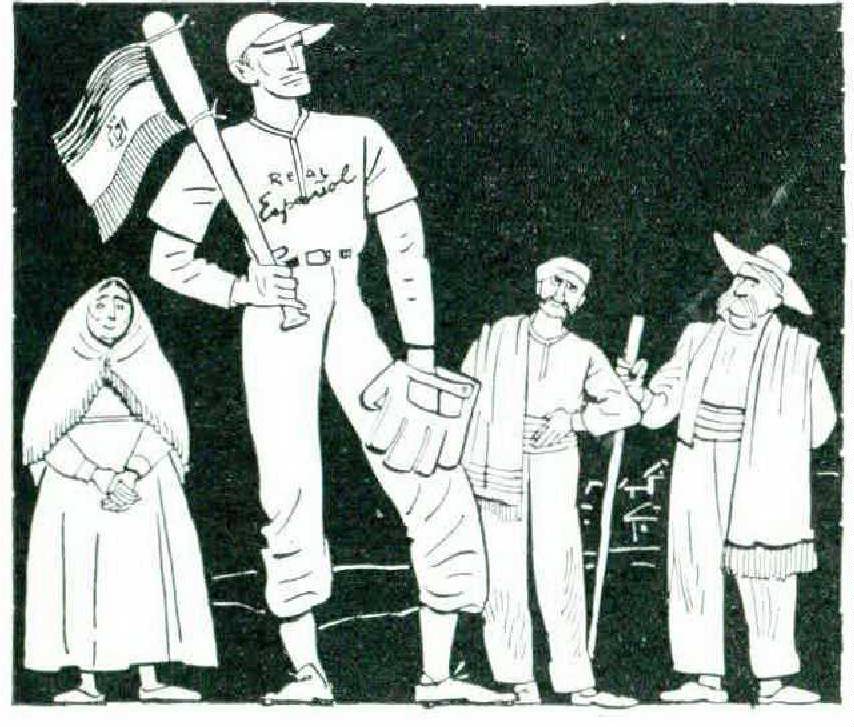
After the tumult quieted, the count discovered that I was without a uniform. Apparently this was one occasion on which Spaniards disregarded their ordinarily unhurried attitude in a race to don the uniforms available. From what I gathered, just wearing the uniform was half the reason for showing up at all. But Count Ramón was unabashed. “Lopez!" he yelled at a rotund figure poking in a duffel bag. “Thy pantalones!” Lopez sat down on a bench and unhooked his bell with a resigned air. And then, as if to show good sportsmanship and hospitality, he handed me his cap along with the pants. Another player contributed an undershirt, another his jacket (with “Real Español,” capped by the royal crown in red and gold, written in blue script across the front), and still another his socks.
I now had everything but shoes. A pair of los spikes appeared from somewhere, and I was soon ready to play. We clattered out of the dressing room, up the ramp, and onto the playing field of the stadium.
A cheer went up. I read in El Deportivo the next day that about seven thousand persons attended. The stadium holds about forty thousand, but our crowd wasn’t bail, especially considering the lack of publicity about the game. Some twenty-five thousand fans had attended the SpainItaly ball base game in Rome Live months before.
I paired off with the catcher, a giant Negro from Cuba, to warm up. Count Ramón came over to watch us. The count, who had his cap pulled potlike down against his ears, cautioned me to slow up, I eased off with my delivery. Count Ramon flared his nostrils and breathed deeply with anticipation. “Ah, si, si. May suave. May suave.” My arm felt loose, and I enjoyed warming up before the crowd. The Cuban told me I was the star attraction for Real Español.
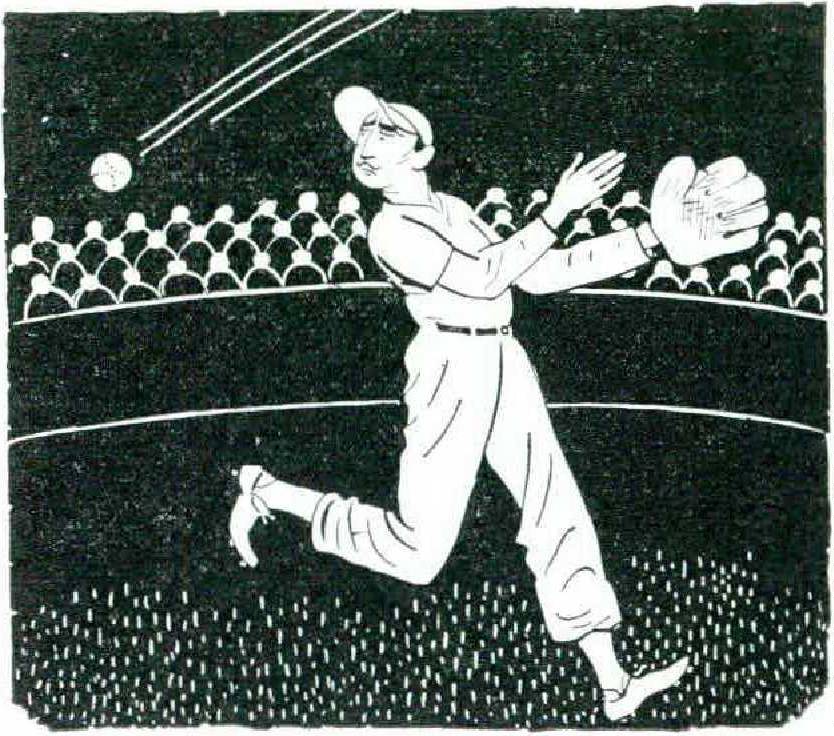
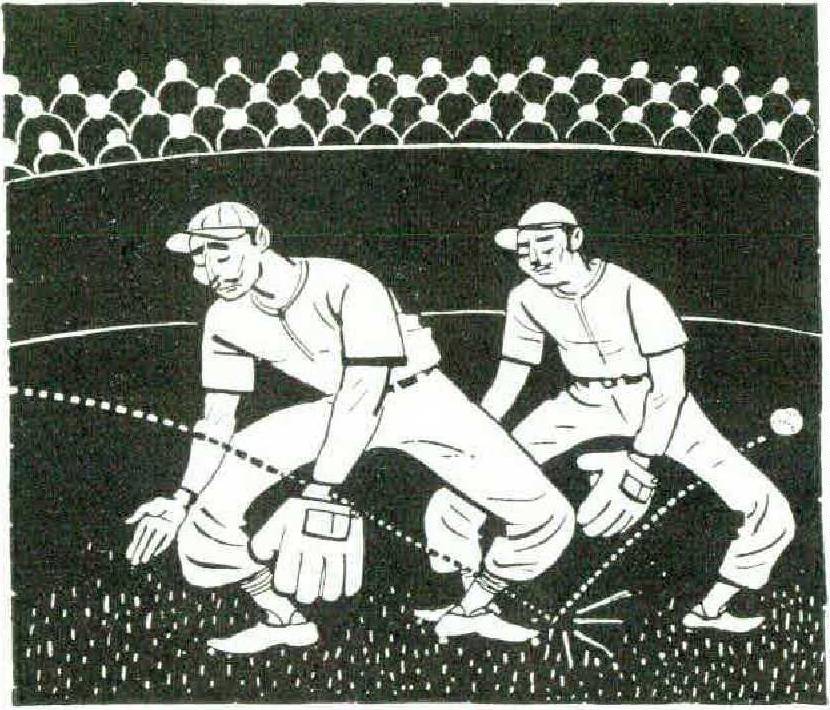
I threw about thirty pitches. Then the count told me to do a little running in the moutfield. He jogged in place as if to show me how. I joined the rest of the team in shagging Hies. It was then I realized Real Fspauol wasn’t going to win, at least not this game. My teammates dropped one fly ball after another amid frenzied exclamations of “La tengo!” or “I’ve got it.” But no one had it.
A few of the Air Force players were standing near by.
“Jeez, they’re sad bastards,” one said.
“Yeah, we’ll whip their tail for sure.”
One of my teammates turned to me. “What are they saving about us? ”
“They believe the game will be a very difficult one to decide,” I replied.
I felt embarrassed for the Spaniards, and I hoped there was something I could do to make it up for them. I got my chance a moment later. A towering fly came my way, and I backed up and look it without any trouble. Then, just as if to show my determinal ion, I threw it into the fungo hitter with all my strenglh. Something went in my arm. What it was, I didn’t know, but a sharp pain stung my elbow. I raised my arm to flex if, but it only was worse. I knew I wouldn’t pitch for Real Español that day.
I ran in to see the count. I winced when he rubbed the elbow. I was out of condition for exercise of this sort anyway, and the count’s kneading only made me feel more the fool. I tried to throw to show him, but the pain returned. Reluctantly, Count Ramón called to the Cuban and told him he would have to start the game instead of me.
The Cuban began to warm up with a substitute catcher just as a bugle sounded. It was the signal to line up for the game. We stood abreast along the third base foul line, the Americans on the left, we Spaniards on the right. The Cuban continued to warm up at home plate. Newsreel cameramen and photographers began grinding and popping away at us. I smiled wanly. Before us were the American and Spanish flags, draped side by side on a field box. I saw several persons I knew from the Consulate sitting there.
Another blast from the bugle. We came to attention. A Spanish army band played the Himno de Riego and America the Beautiful.
My arm ached even more as I trudged to the Beal Español and slumped down. The Americans batted first, and it was horrible. The first four men walked, the fifth doubled, the sixth homered, and the next five or six did God knows what, but it was enough to make the score 9 strokes to nothing, as the Spanish put it.
While all this was going on, an announcer explained the plays and rules over a loudspeaker. A hit was un tocar or a touch. First base was la primera base, and center field was el campo centro. The catcher was el recibidor. A base on balls was simply un walk.
Beal Español came to bat in the last half of the first and took the field again without one tocar or even un foul gigante por el recibidor. The carnage continued, and at the end of the fourth, the score was Americans 15 strokes, Spaniards no strokes.
In the beginning of the fifth, Count Ramón asked me to warm up. But it was no go. The arm still ached. Regretfully, I told him it was useless to put me in. He was unhappy but agreed. He asked me to let Lopez put on my uniform and los spikes. Even my chance of hitting a jonrón vanished. Lopez and I went into the dressing room, where he happily reattired himself. I returned to the bench in street clothes, while he waited his chance to strike out as a pinch hitter.
Surprisingly, my teammates were not at all put out about the score, which now slood 19 strokes to nothing. No one, I heard them saying on the bench, had ever lost by so much before in Spain. It was certain to be a record.
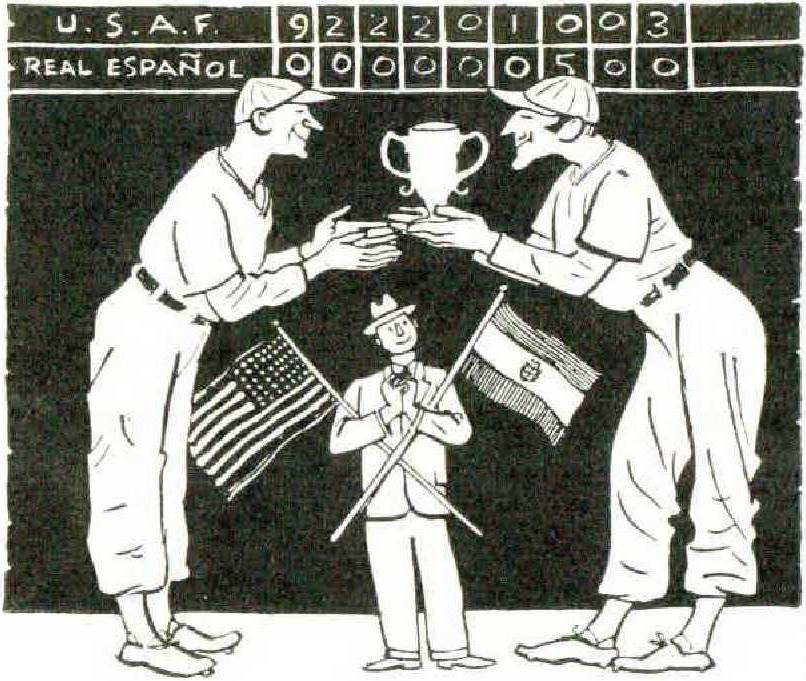
The game finally ended 19 to 5, Real Español scoring all their strokes in the home half of the seventh. The bugle blew again as the last out was made, and once more we made our way to the third base foul line. Several officials from the Consulate and the count presented the American team with a magnificent silver trophy, purchased, I heard, with donations from Real Español players. On it was inscribed in English, “To the victorious — American Air Force Team. Barcelona. March. 1953.”
I felt a little better about letting the team down after I saw the inscription in English. Count Ramón made a short speech in which he said he hoped the American team would return every year to play for a new cup. The game today, he said, merely was the first of a long series yet to come.
I stayed around the dressing room just long enough to congratulate the Real Español players I had come to know on the bench. Then I went back to my pensione.
Two weeks later I had to return to the United States, but before I left Barcelona I managed to say good-by to the count. He didn’t sound the least annoyed at my failure to come through for his team; in fact, he reminded me that should I return, there always was a place for me on the roster of Real Español.
After I arrived back in New York, I tried to tell a few friends about how I’d played baseball in Spain, but it appeared no one believed me. I’m sure I’d have forgotten all about it myself if it hadn’t been for a letter I received from Barcelona last week. It was from Skidworth, a twenty-dollar-amonth remittance man I knew there, and in it he enclosed an embroidered seal of Real Español handsomely sewn in red and gold thread. Skidworth says it’s in memory of old times and, true to his somewhat snobbish tendencies, suggests I wear it on my blazer.
I have half a mind to do just that. But, frankly, I do have qualms about what my old teammates would say if they knew. Do you think they’d mind?