Europe Instantly!
by CARL ROSE
DEAR MR. MORTON: AS you might guess, the writer of this letter has a slightly more than academic interest in your dissertation (January Atlantic) on the speed of aerial transportation in the presumably near though still indefinite future. He cannot deny that by the present day’s rather prosaic standards one or two thousand miles an hour sounds impressive. But to a sampler of science fiction the vehicles you describe are poky little buggies, struggling through the impeding atmosphere like ants slogging across a batch of molasses.
For to the science fictioneer working in a time zone rarely earlier than the twenty-second century, and on to perhaps as late as A.D. 1,000,000 —a twoor three-hour trip to India is no more than a leisurely amble to the corner drugstore. True, as of today, a velocity of a mile or so per second is more easily envisaged than thirty or forty thousand miles per second. Yet only a century ago both speeds were equally inconceivable to, say, Robert E. Lee or Ulysses S. Grant. Hannibal, pushing his elephants across the Alps, would have expressed something more than incredulity had his aide-de-camp suggested a conveyance as mundane as our little garden-variety jeep.
Today, in any science-fiction magazine, a two-hour journey to Europe is a slow crawl. Mention was made of forty thousand miles a second a few lines ago. Even that is a walking pace for a seasoned interstellar traveler intent on making the next galaxy but two before supper. Those galaxies are a couple of million light-years apart, sir, and SF writers cannot afford to confine their characters to the easygoing velocity of light. A mere hundred and eighty-six thousand miles a second, or six trillion miles in a year, would get a man nowhere in a short lifet ime of two or three hundred years (life expectancy will advance considerably in time to come, too).
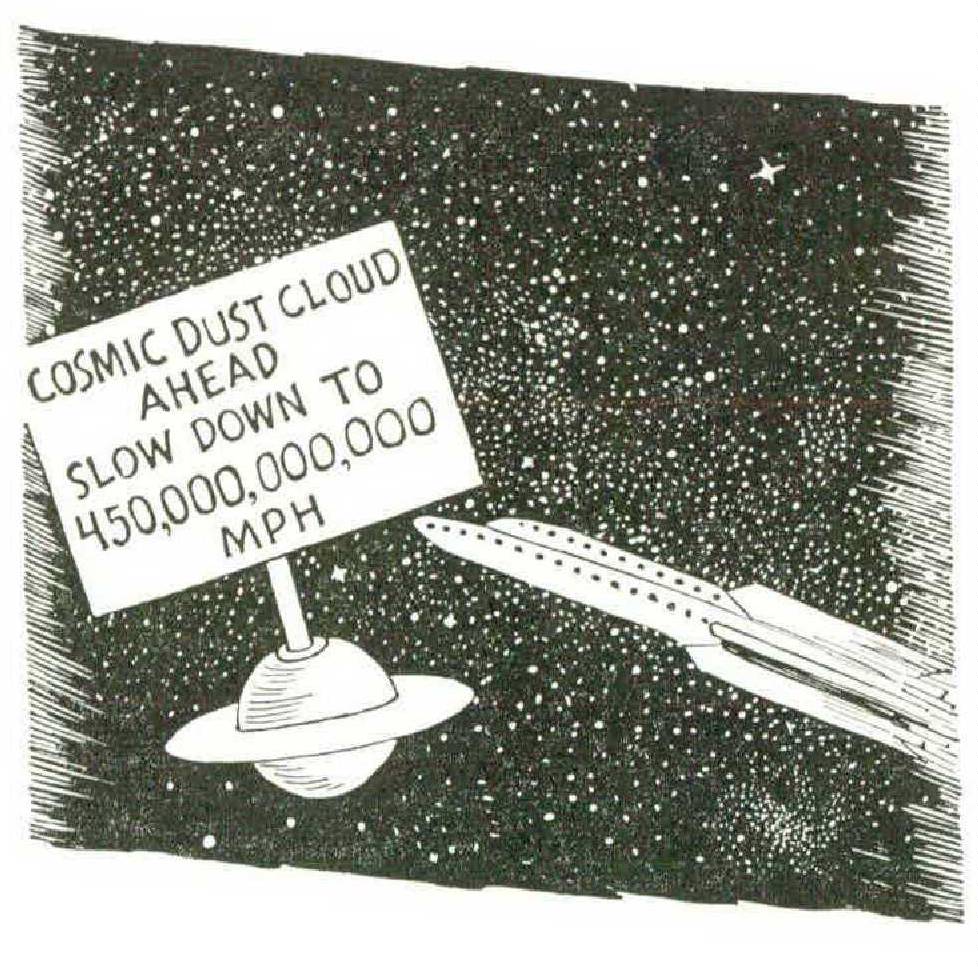
Handy little concepts have been developed to overcome these drawbacks; they’re called space warps, hyperdrive, superdrive, or FTL (faster than light). They involve intricate use of four or more dimensions and are explained passingly in a wholly incomprehensible and implausible fashion. Incomprehensibility is the reader’s fault — if you’re not smart enough to follow the writer’s reasoning, he cannot be responsible. As for implausibility, your author need only point to the implausibilities in the structure of the atom. That ‘ll slop the carpers every time.
Fuels for interstellar space ships are as esoteric as the principles of propulsion. Generally they are ingenious adaptations of the forces in the convenient little atom, although in intrasolar, or suburban, hops, forms of stored solar energy or knowingly contrived combinations of methane and ammonia — and in some cases even plain ordinary water — may be used. One thing is sure: in a cosmos as vast as ours, it. would take an ordinary sentient Terran being (that’s sciencefiction talk, meaning man or guy) three or four billion years to encompass its known or Einsteinian boundaries, and a writer doesn ‘t have the time to explain the facts of propulsion to ordinary, semi-sentient Terran beings. His characters get there and most of them come back. What more do you want?
Once you accept the premise of faster-than-light velocities, you’re all right, and can take in your stride such passages as: “The great ship hurtled forward through the black abyssal depths of space at incredible multiples of the speed of light.” It may have been in the same story that the captain turned to his navigator (no, not navigator, astrogator!) and the following dialogue took place: —
“ ‘How far arc we from that cluster, Mr. Jones?’
“The astrogator rapidly scanned his telescopic video screen, punched his data into the galactic distance computer, and within seconds read the tape to the captain. ‘About eighty light-years, sir.’
“‘Huram Only three hours more, I should say.’”
They were making time that day.
Indeed, velocity and propulsion are minor factors in the logic of a capable space-opera writer. In one story, which took place on an off-the-beatentrack planet belonging to a minor sun in an obscure galaxy, the intelligent inhabitants had decided, eons ago, that gravity was nothing but a state of mind, and had proceeded, by sheer mind power, to overcome same. Understand, it wasn’t sudden — it took long millennia . . . but by the time our travelers made planet-fall, the natives were scooting through their atmosphere like so many May flies. They had no wings, nor did they flap their arms; they just willed themselves off the ground and placed themselves wherever they wanted to be, with no more trouble than you or I would have reaching across the table for a Martini. What need for Dynaflow, or tubeless tires, or highoctane gasoline?
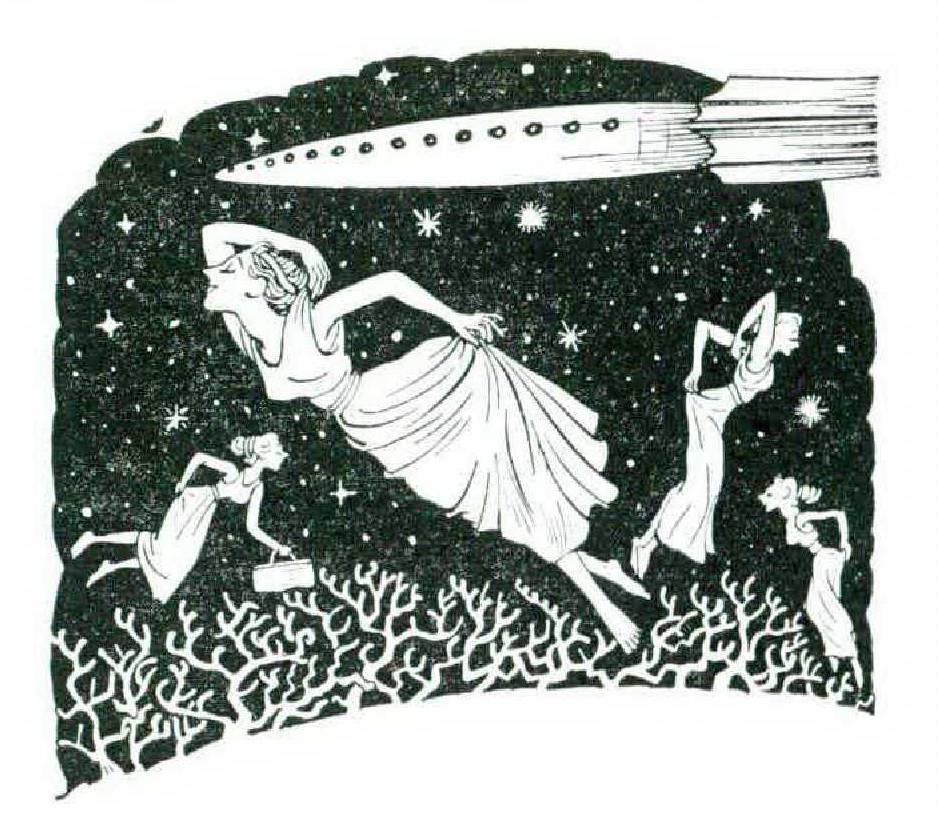
This particular planet was unusual in other respects. It seems in the long, dim corridors of evolution, when Life first began its struggle toward sentience, plant life got the jump on the animal kingdom and acquired mobility and intelligence. The creatures consequently grew a humanoid form, and eventually developed into beauteous women, albeit their complexions were a light but pleasant shade of green, and chlorophyll coursed through their veins instead of blood. All were women, remember — this was a manless world. They reproduced by parthenogenesis and sustained themselves by ordinary photosynthesis: simply allowed the sun to shine on them and drank water conveniently, laced with plant nutrients like superphosphates, nitrate of ammonia, and whatever other elements keep our own terrestrial petunias blooming and happy.
This sort of existence should have been an uncomplicated one. Of course, it wasn’t. The outstripped protein-producing animal life of the planet — rooted to the ground though it was, just like the vegetation on our own globe—had developed a primitive cunning and was exercising a subtle dominance over its infinitely more intelligent planet-mate. Naturally, the visitation of the human travelers caused some trouble, but our males passed a chemical miracle which resulted in freedom for the beautiful herbal natives and all ended happily. In fact, romance developed between a couple of the latter and our earthy heroes (they elected to stay on the planet although they had to drink distilled water for the rest of their lives), but the story ended before one could learn more of this unusual form of miscegenation. One does learn this, however: should Mother Nature ever run out of ideas, any number of our going SF writers could act as her gagmen without turning a typewriter ribbon.
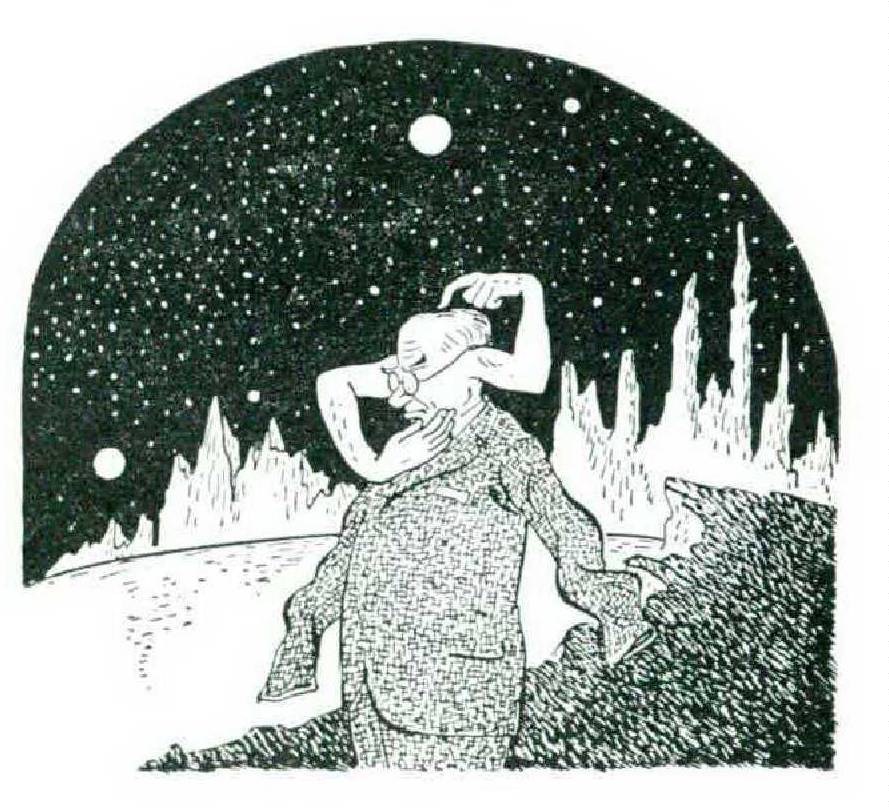
To get back to our original topic, one other and very important type of science-fiction transportation must be mentioned. This is the instantaneous transmission of matter — or, in SF jargon, teleportation. There you sit, Mr. Morton, in your office, Room 202, at 8 Arlington Street, in the city of Boston, Massachusetts. In the next infinitesimal fraction of a second, you find yourself — greatly surprised, no doubt — on a blue rock overlooking a saffron sea roiling about the surface of a planet circling around a class G star in the Andromeda Nebula.
There’s not much use in asking how you got there; you couldn’t possibly begin to untangle the web of circumstances that put you in this fix. Your science fictioneer cun explain only in very general terms: your body had probably disintegrated into its constituent atoms; and in the same instant, the atoms available on that remote world had shaped themselves into an exact duplicate of you, complete with cerebral memory cells, a six-hour growth of beard, the spare change in your pocket, and even your tweed suit and Argyle socks.
You will concede that this is a very fine operation indeed. For some strange reason, it never misses. Conceivably, a few of the atoms could become confused in their massive task of re-creation; hands may protrude from skull about where ears should be, and it would be better not to locate the cars at all — eventually you might find them in the vicinity of the shoulder blades. Such a thought may bring the light of inspiration to the eyes of a Dali; it would only evoke a snort of contempt from any self-respecting SF writer. When you get teleported, you arc teleported complete and entire, just exactly as you are, and no nonsense about it. The forces that can bring about such a phenomenon are necessarily obscure but teleportation has gotten more science-fiction characters out of more hopeless predicaments than you can shake a force field at.
In view of such modes of transportation facing us in the far future, don’t you think it would be better to settle for the slow, old-fashioned atmospheric hoppers of the next few decades? Plodding along at a glacial thousand miles an hour seems so much preferable to a physical disintegration here on earth in order to make a live o’clock cocktail date on far Andromeda.
By the way, where did they hide the heat control in this stuffy Pullman roomette?
Sincerely yours,
CAUL ROSE