German Hotel
PLEASURES AND PLACES
by JOSEPH WECHSBERG
Traveler, musician, and journalist, JOSEPH WECHSBERO is the author of many books and articles. He spends most of his time traveling in Europe, with occasional intervals in this country.
AT the Hotel Vier Jahreszeiten in Hamburg your slippers are always placed on a white towel in front of your bed. The bed is made up “hard,” “medium,” or “soft, “ as you wish. The chambermaid puts a thermometer in your bath water, and the Hausdiener, or floor valet, puts spans in your shoes. The first morning, when you phone for breakfast, the floor waiter greets you correctly by your name — though there were seventeen new arrivals on the floor last night —and asks how you like your coflee made. Do you prefer your rolls dark or lightly baked? Your softboiled egg three minutes or three and a quarter? Breakfast is served on a leather tray, to avoid noise. Coffeepot and egg are covered with cloth.
All wishes, whims, and preferences are marked down in a special guests’ file. The next time the guest comes back to the hotel, no questions will be asked, but his bed, bath, breakfast, will be exactly to his liking. Everybody comes back. One rich German from Mexico City came for two weeks and stayed for two years.
By such attention to minute detail, the Vier Jahreszeiten (“Four Seasons”) has become a serious competitor to the greatest hotels in Switzerland, France, Italy, London, and America, The best hotels always reflect the mood of their country. What the Swiss do by tradition, the French by charm, the Italians by elegance, the British by tact, and the Americans by efficiency, the Germans achieve by sheer organization.
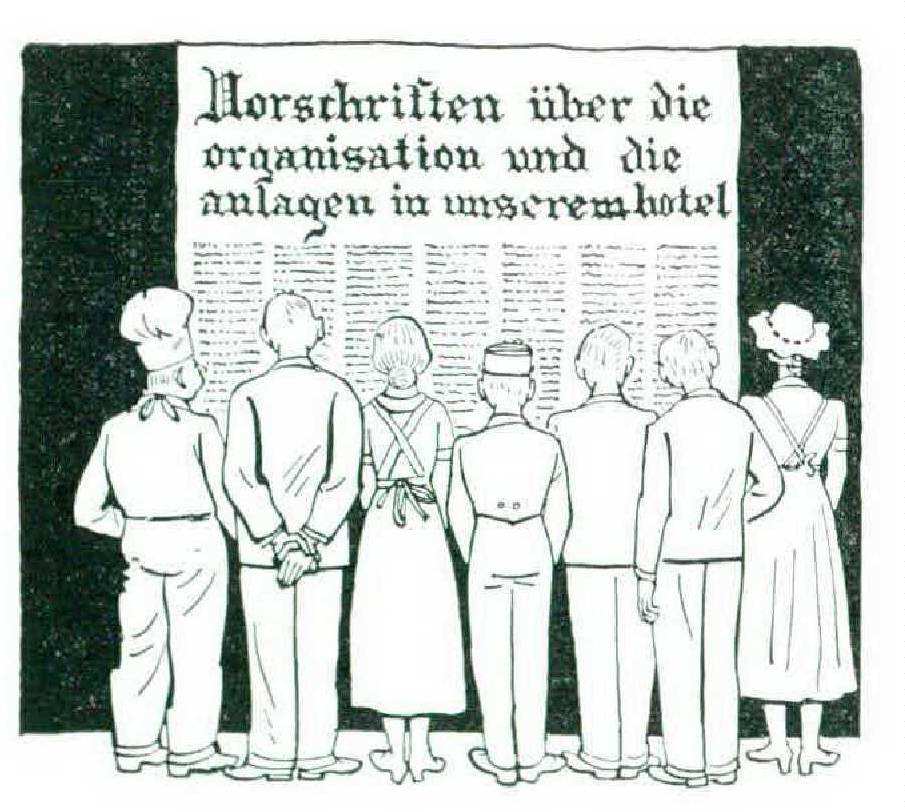
In a Swiss hotel, the secrets of making coffee or polishing silver are passed on from father to son. In Germany, they are drilled into a man’s subconscious. The Vier Jahreszeiten has 210 rooms (300 beds) and 520 employees —1.73 employees for each guest. Each month, the employees get mimeographed “Instructions about the Organization and the Inst alia! ions to our Hotel.”They start with Ausstellungsvitrinert (“Supervised by Frau Vermehren, room 230, all goods on display for sale’) and end with Zeitungsstand, newsstand. Sample item, “Ironing Service for Guests: Articles received by chambermaid, forwarded by porter. Acceptable: laundry, men’s suits, women’s dresses, other apparel. Express service without special charge. On Saturday, items received until 14 hours, delivered until 17 hours. After 14 hours (and on Sunday until noon) articles ironed by tailor out of house. Such instructions exclude any misunderstanding.
The Hotel Vier Jahreszeiten is a microcosm of, and an object lesson for, Germany’s incredible recovery, in less than ten years, from a defeated, devastated country to the Continent’s major political and economic power. The recipe: organization + hard work + discipline. The management of the hotel never stops planning. Even human relations are carefully blueprinted. Every year a jubilees list is drawn up; employees of thirty and forty years’ standing are honored by certificates and gifts. The oldest employee, hall porter Karl Braun, has been with the house for forty-seven years. Long-term guests receive presents and flowers on their birthdays and holidays.
Technical improvements are mapped out one year in advance. “In a well-run hotel the sound of hammering must never stop,” says Herr Karl-Peter Littig, the manager. “ There’s always a need for repair and improvement. We have a technical Staff of sixty: electricians, upholsterers, painters, plumbers, woodworkers, paperhangers. If you don’t keep after a place all the time, it will be run down in no time.”
The management goes to unbelievable length to perfect the service. Guests arriving at the hotel for the first time are effortlessly handed over from voiturier to baggage porter to bellboy to reception desk to concierge to elevator operator and so on, until they find themselves comfortably installed in their rooms. “From the moment of arrival the guest must feel as though he’d come back to his home, a luxurious, well-run home,” it says in the Instructions. This precision is the result of hard, long training. The employees synchronize their movements as though they were members of the Boston Symphony’s first-violin section. The art of showing a friendly face is practiced as assiduously as Radio City’s Rockettes practice tap dancing.
Such service must be paid for. Room rates range from 14 marks ($3.50) for a single room without bath to 50 marks ($12.50) for a bedsitting room alcove with hath, plus 15 per cent service charge — which makes the Vier Jahreszeiten one of Germany’s most expensive hotels.
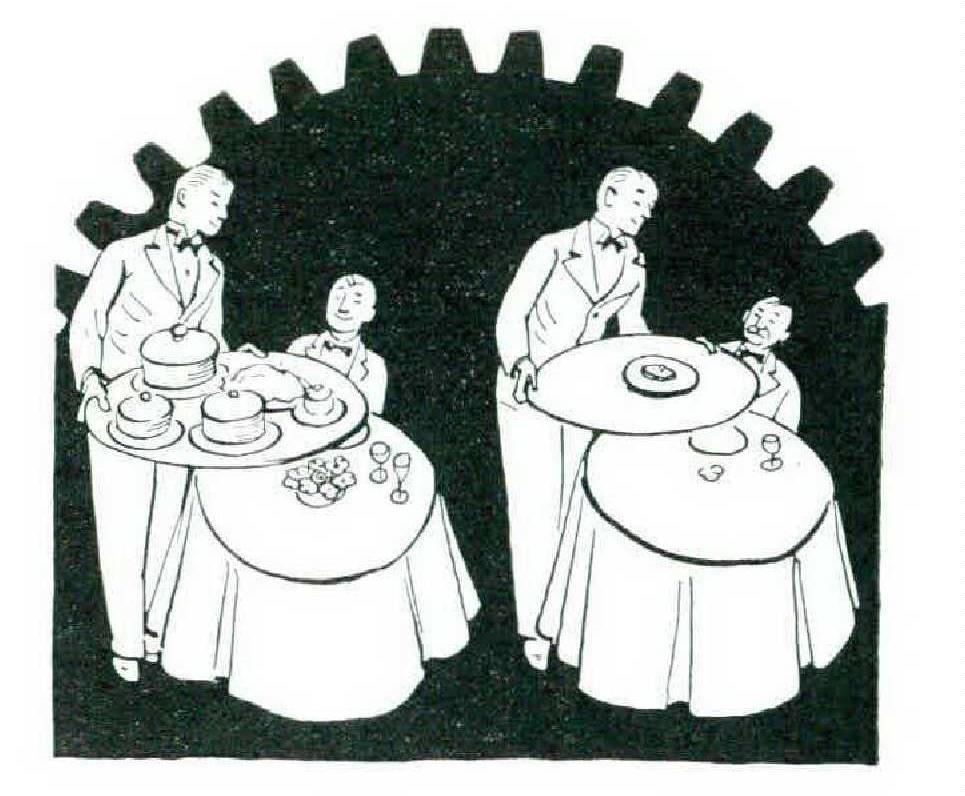
At the hotel’s restaurants, the waiters are always reminded to display the same deference toward the guest eating a sandwich and drinking a glass of mineral water as toward the man at the next table who ordered Vierländer Mastente, stuffed duck with oranges, and a bottle of Riidesheimer Berg Brcmnen T ree ken bee ren-Auslcse 19.30, at 65 marks ($16.25). And why not? The mineral-water connoisseur may tomorrow be an important customer. The British influence has always been strong in the Free and Ilansc Town Hamburg. To show off one’s wealth and prominence is considered bad form. In Hamburg, as in London and Boston, the rich are often dressed worse than the poor. Two shabby-looking men eating Kalbfleisehklöschen (meat balls) in the gobelin-decorated dining room of the Vier Jahreszeiten may well be two millionaire members of Hamburg’s patrician caste of merchant princes and shipping magnates.
For rich men who cannot afford to order simple food in their palatial homes, the management of the Yier Jahreszeiten puts every day a few Hausmmannskost (homo-cookecd) dishes on the menu: lentil soup, Snuten und Paten (pea soup with pigs’ feet), Sfrassburger Jiohnengericht (lamb, Princess beans, tomatoes, potatoes), Sauerbratcn with potato Klosse and baked fruit, Hamburger Pfannenfisch, Kalbshaxe (calf’s shin) biirgerUch. For particularly parsimonious plutocrats there is a 60-cent Börsenfriihstiick, or stock exchange lunch, which has turned out to be a good investment. Quite a few connoisseurs of the 60-cent blue plate special give sumptuous wedding parties, receptions, and holiday banquets at the hotel for as many as five hundred guests.
Bills for a hundred bottles of champagne are not rare. (Price of champagne’: 30 marks, $7.50.) Some hosts stipulate that the champagne must be served in water glasses. Hamburgers take a dim view of the new rich in the Rhineland who order second-rate wines in silver buckets so that the label can’t be seen.
For such banquets, all employees get mimeographed instructions which read like Orders of the Day for major army maneuvers. They specify the color of candles, the embroidered damask for the tables, the kind of flowers (“springlike”), the liqueurs to be served after the dinner (“Napoleon Brandy, to be followed by Rémy Martin, Cointreau, Drambuie, Hausmarke hell und dunkel ”), the cigars and cigarettes to be offered (“North States, Astor, Kyriazy, Gloria”), and include such details as ” Red carpet to be placed in front of side entrance at 1410 hours,” or “Musicians get three sandwiches per person, beer or fruit-juice, between 2330 and 24 hours.” The main banquet. room has an “invisible window” in one wall through which the guests are constantly observed. Their wishes arc often guessed before they are uttered.
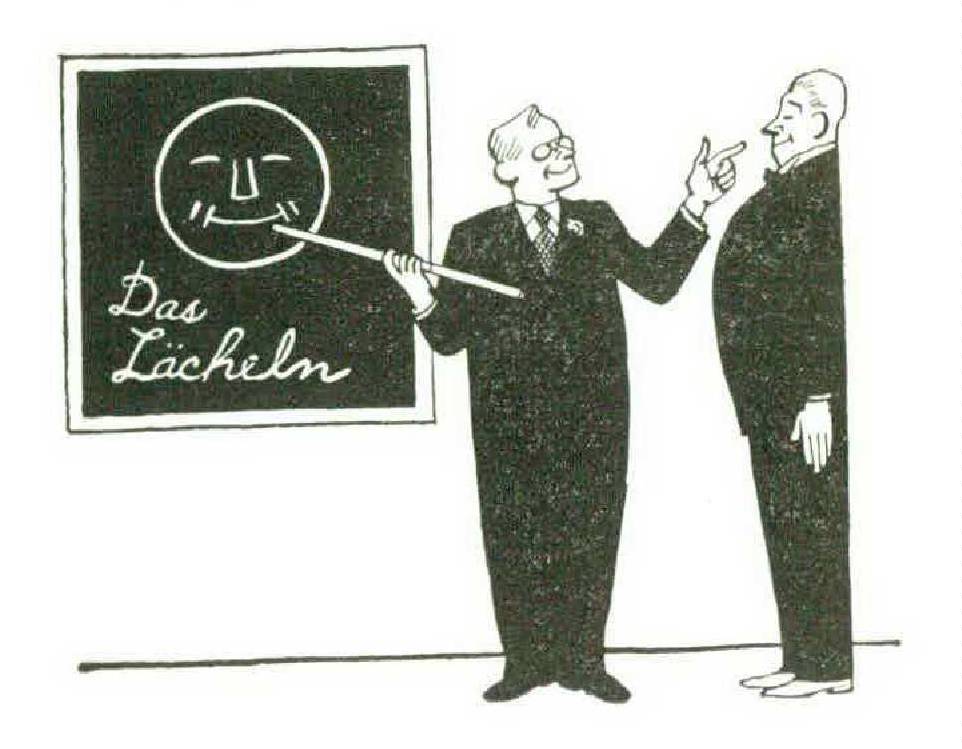
Regular instruction courses are given by all department heads at least once a week. The curriculum lists, among other subjects, a discourse on the fine art of meat cutting, how to recommend wines (“remind ladies that Moselle makes slim,” “with ham and asparagus suggest a good Franken wine in Bocksbeutel”), personal hygiene (“after eating fish, always rinse your mouth carefully so guests will not be offended by your breath”), and The Technique of the Friendly Smile (“must never appear strained ”). The management bravely faces up to the fact that not everybody has been endowed by nature with tact and charm, but it insists that everybody can learn to be friendly and polite. Among the employees are seventy-five apprentices who have to learn their trade for three years, getting only board and room and a few marks pocket money. At the end of their apprenticeship they have to pass a stiff examination before they are accepted as regular employees. They don’t mind, knowing that a Lehrzeugnis (certificate) from the Vier Jahreszeiten in Hamburg will open the door to any personnel office in Germany and elsewhere.
The average salary at the hotel is 100 marks ($25) a week, which is considered good money in the German hotel trade.
Compared with the venerable Palaces, Ritzes, and Plazas on both sides of the Atlantic, the Vier Jahreszeiten is something of an upstart. In 1897, Herr Fritz Haerhn, having made a fortune in business, added the Hotel Stadt London to his investments. It wasn’t much of a place, but Haerlin, a man of vision, liked its location. It was on Neuer Jungfernstieg, the lovely lakeside promenade overlooking Hamburg’s Binnen-Alster. Haerlin renamed the hotel “Vier Jahreszeiten” and started to add wings and stories. The rebuilding job was finished only in 1928. By that time, the Hotel vier Jahreszeiten was a palatial white six-story structure, occupying a large part of the lake front.
Haerlin made it a truly elegant hotel. A white-bearded patrician, he had been awarded in 1909 the title Hofiieferant (court caterer) and right to display the coat of arms by His Highness Prinz Heinrich von Preussen, who was a frequent guest at the hotel.
The interior style has been described as Timeless Antique in bedrooms and sitting rooms, and Medium Moderne in bathrooms, kitchens, and laundries. Haerlin’s men went (and still go) to important auctions all over Europe, buying up furniture, rugs, paintings, gobelins. The rooms are furnished individually, conveying the warmth and discreet elegance of a civilized private home.
The hotel was taken over and damaged by the Wehrmacht during the Second World War. Further damage was caused during the week of the Allied saturation bombings in the summer of 1943. At the end of the war, Hamburg was second only to Berlin in the amount of destruction. Over 300,000 buildings were destroyed in the city — more than in the entire United Kingdom. The British Occupation Forces took over the Vier Jahreszeiten as an officers’ club on May 3, 1945, and kept it until January 30, 1951, when they released it to Fritz haerlin, Jr., the son of the founder.
Little was left of the civilized private home. The rugs were torn, the woodwork scratched, the old furniture broken. Many antiques and gobelins had disappeared. Even before the last Britisher moved out, the First of two hundred German workmen moved in. Working in shifts, eighteen hours a day, seven days a week, they finished the job in sixty-four days. On April 4, 1951, the Hotel vier Jahreszeiten was reopened, looking more civilized than ever.
The job of reconstruction had been planned a year in advance down to the smallest detail. A timetable had been drawn up for the workers. First, the rugs were removed and new cables were laid in the walls; while one group repaired broken furniture, another installed new bathrooms. Everything was replaced from doorknobs to drapes. While the painters moved in, electricians installed a new telephone exchange and teletype service, and personnel officers interviewed prospective employees. Of the prewar employees, only one third were available. Many of the porters, waiters, cooks, floor valets, and painters did not come back from the battlefields.
Among the few fortyish employees was my floor waiter, a tall, friendly man who had been at the hotel in the Thirties. Since then he had fought in the war, lived in prison camps, worked as steward on ships, and owned a small restaurant in the harbor which was bombed out. Now he was back at his old post. He was a perfect floor waiter. Once I mentioned briefly that I liked the breakfast rolls. On the following Sunday, when there were no fresh rolls, he brought me two which he had saved from the previous day and warmed up in the oven to make them crisp.
To please diet-conscious ladies and fat burghers, the hotel serves Gayelord Hauser dishes. When food became plentiful in 1948 after the lean years, too many people in Germany overate; now a reaction has set in. The hotel serves half portions in its restaurants, Tellergerichte (such as chicken ragout), and dietary dishes (scrambled eggs with crawfish, asparagus and salad). To please serious eaters, there is Oskar Behrmann, the head chef, a native Hamburger. Behrmann is an alumnus ot many German restaurants, the Hotel Negreseo in Nice, and several luxury liners. He is a perfectionist who is pained by the bad reputation of North German cuisine and has set out to improve it . For amateurs of local specialties he prepares Seemannslabskaus (a version of corned-beef hash), a summer dish called Bohnen, Birnen, und Speck (string beans, pears, and bacon), and Hamburger Aalsuppe (eel soup), Hamburg’s answer to Marseille’s bouillabaisse, made with fresh eel, fresh vegetables cooked in hambone soup, plums, thyme, and a great many other ingredients.
The keynote in Behrmann’s kitchen empire is German precision rather than French-style inspiration. He tolerates no compromise. Young string beans are never cooked in a copper pot, which would stain the beans. The Stubenküken (“room chicken”) must be only eighteen days old, 350 grams heavy, and raised on milk. The Kalbsstörfleisch comes from the youngest calves brought up on milk and eggs. Behrmann fabricates his smoked salmon himself in a special oven, using beechwood because of its mild smoke. He buys the finest Kateschinken (hams smoked for two months in small huts, or Katen, by 1 he peasants of the Limeburger Iloide), and Elbe sturgeon, which is so rare now that it costs $4 a pound.
“When the hotel opened, they had a rule that sturgeon must not be served to the employees more than three times a week,” Behrmann said, with a deep sigh. “Those were the days of house balls and pensionnaires. Now we have cocktail parties and transients. Some eighty people used to live at the hotel all year round. Now most guests stay a couple of days.
“The so-called Helgoland lobster comes from Norway, and the ‘genuine Rhine salmon’ is imported from Scandinavia. In the old days, a Hamburg Knackwurst made a knack in your mouth when you bit into it. Now it’s just wurst. Yesterday I talked fo a waiter who didn’t even know the difference between the various kinds of grapes grown in Germany, Riesling, Silvaner, Gutedel, Ruländer, Gewürzt rami tier, Trollinger, Elbling. . . . What a shame! W’hat will you have for lunch today? A North Sea Steinbutt (turbot)? Or a Senatorentopf? Three small steaks, garnished with ham-spaghetti, tomato cream sauce, fresh asparagus, peas, young cucumber salad —”

You can order anything but a Hamburger. That’s called Deutsches Beefsteak in Hamburg, and it isn ‘t our Hamburger.