Full Circle
A country editor widely known for the pungency of the columns he wrote for the Lisbon Fulls Enterprise, JOHN GOULD is also the author of many books and articles about life in Maine.
by JOHN GOULD
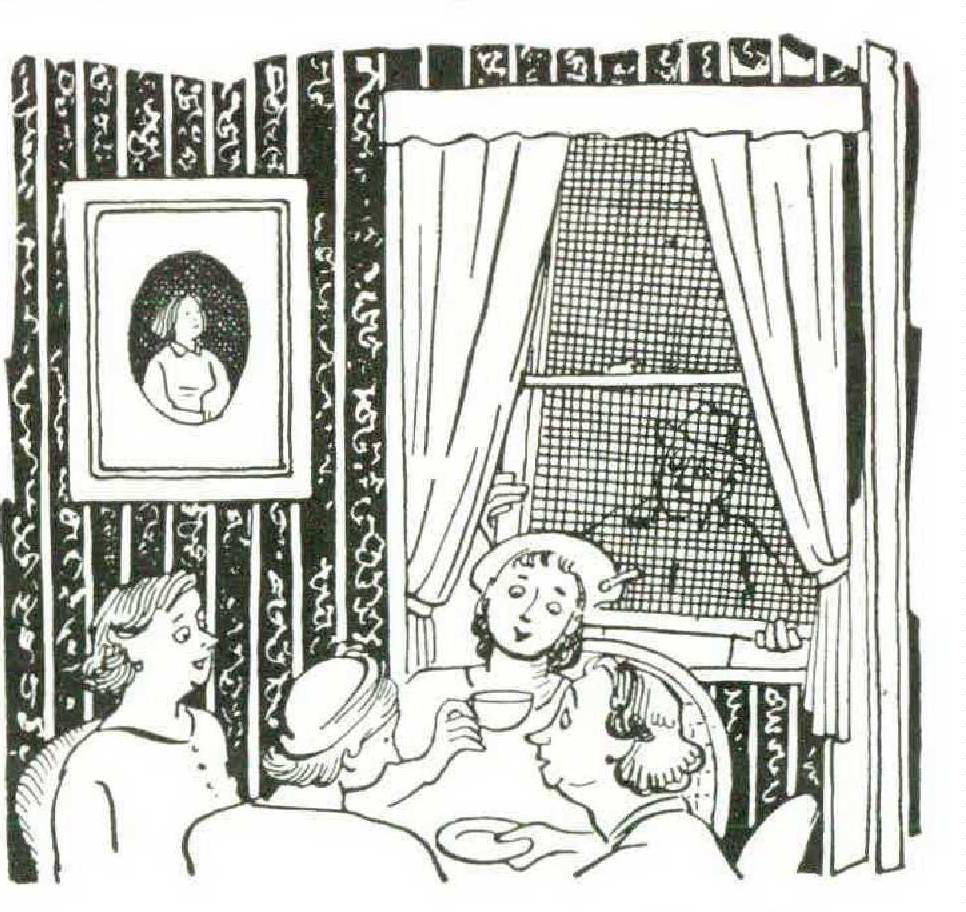
THE affinity among women, nonsense, and dreams has always appealed to me, and I did some research on it the other day. Several ladies were having tea and cookies in our sitting room, and I was trying to make a screen fit better. All at once 1 realized I had absorbed enough of their conversation so that I should pay closer attention.
The point, at which I realized this was when one of the ladies said, “I called up Lottie and Al answered.” This, definitely, is a female sentence. There is a logic to it, but a man would have to figure it out. Al had no business answering the phone when Lottie was being called, but he did answer, and the fact had to be accepted. Al, being a husband, is unavoidable, even though the listing is in Al’s name. The sentence implies that only a husband would answer a phone when the call is for his wife.
Then the lady went on, “I asked if 1 could speak to Lottie, and lie said she wasn’t there, she was out in the yard and was awful busy. I said never mind, I’d call again in a few minutes. . .
I can imagine Al’s clumsy efforts in this affair. He was trying to spare his wife the absurdity of coming away into the house to gossip, and doing it with ordinary male technique. He probably sounded guilty as could be, and probably knew it. He must have presumed that his remark led the lady to assume he was lying, that his wife was right at his elbow. This caused him to volunteer additional comment, to diplomatize the uneasiness under which he was now laboring. Because the lady next said, “Then Al said something, and I think he must have said Lottie was hanging out the washing, but the way it came to me, I thought he said they were going to Washington. Then he must have told me to call back at four o’clock, or not to call back until four, or maybe to call back before four, I don’t know which, but anyway I somehow understood him to say they were leaving for W ashington at four o’clock.”
By now I imagine Al was plunging around somewhat, trying to be discreet when he meant only to be determined that bis wife’s chores should not be interrupted for light and transient causes. I next heard the lady say, “So I said it was loo bail they didn’t go in cherry blossom time.”
This, assuming that Al was thinking about hanging out a wash, would seem irrelevant under ordinary scrutiny, but if we are right in picturing Al’s present confusion it probably didn’t register as such at the time. The lady added, “So Al said he thought the weather would let up, and anyway you always had to take those chances.” I feel reasonably sure the sequence seemed lucid at the time to both the lady and AL
But what it did to the lady was particularly feminine — the reference seemed to be to a four o’clock departure, which distracted her so much that she paid less attention to the rest of the conversation. Now I heard her say, “So I said they wouldn’t gel far the first night, and Al said one time was as good as another.” I can’t explain this last remark of Al’s, but it might be he thought the conversation was so far afield he might as well leave it there. The lady, however, was experiencing no such difficulty, for she said, “You can see how this all made sense to me.”
The lady went on, “So at four o’clock I saw them drive down the road, and I told my husband at supper that Al and Lottie had gone to Washington. My husband said they’d left wet clothes on the line and the barn doors open, but I was so sure of what Al told me that I figured there must have been some emergency. I couldn’t imagine why they’d leave clothes on the line. So the next morning I asked Edna Coombs why Al and Lottie went to Washington, and she said it must have been a quick trip if they did, because Lottie was home now and she’d just been talking to her. Well, I just couldn’t figure it out.”
I had the screen fitting perfectly by this time, but wild horses couldn’t have pulled me away. I knew what the next step would be—it would be to call Lottie and find out.
So she said, “So I called Lottie right up, and I said I thought they had gone to Washington. Well, Lottie must have thought 1 said something about her washing, where it had been raining all night, and she said it would probably clear off sometime. So I decided they’d called the trip off on account of the weather, and . . .”
I left at this point. The thing had run full circle, and the pertinent part was in my possession. I confess that several times that afternoon, as I went about my work, I would find myself wondering, dream-fashion, what Al and Lottie were going to Washington for. Somehow this recital of female deduction had convinced me — not, I’m sure, the wakeful, realistic, masculine me, but the subconscious part of me that is susceptible to dreams, nonsense, whimsy, women, and suchlike.