Verona
EDITH TEMPLETON served with both the United States and British forces during World War II as an interpreter. She is the author oj several novels and a book about Italy, The Surprise of Cremona.
by EDITH TEMPLETON
THE best hotel in Verona is called the Colomba d’Oro — which means the Golden Dove. And the fact that another hotel is called the Gabbia d’Oro, the Golden Cage, leads one inevitably to wonder whether, in the beginning, the golden dove might have lived in the golden cage and one day fluttered away to freedom and built an independent nest of its own. If so, the fabulous bird showed great wisdom in its choice, for the Colomba d’Oro, standing in a row of palaces of variously assorted ages, is an old palace in its own right whose inside has been scooped out and filled with all the comfort one can wish for. The only fault one could find with the enterprising bird is that its tastes are rather expensive: a full day’s pension, if one has a room with bath, will cost about £3.
My first evening at the hotel, I was shown into the dining room. I looked round the fine, stately room, the walls paneled in white and gilt, the lights supported by carved cherubs. “The ceiling will be a maze of stuccowork,” I said to myself and raised my eyes. There was no ceiling. I was looking at the dark starred sky of a calm June night.
“But what do you do when it rains?” I asked the waiter. “Do you get into a panic and rush round with waterproofs for each guest, and serve the meal beneath umbrellas?”
“No, madam, we press a button and the roof rolls over the room. This is our summer dining room. For winter we have another dining room, of course.”
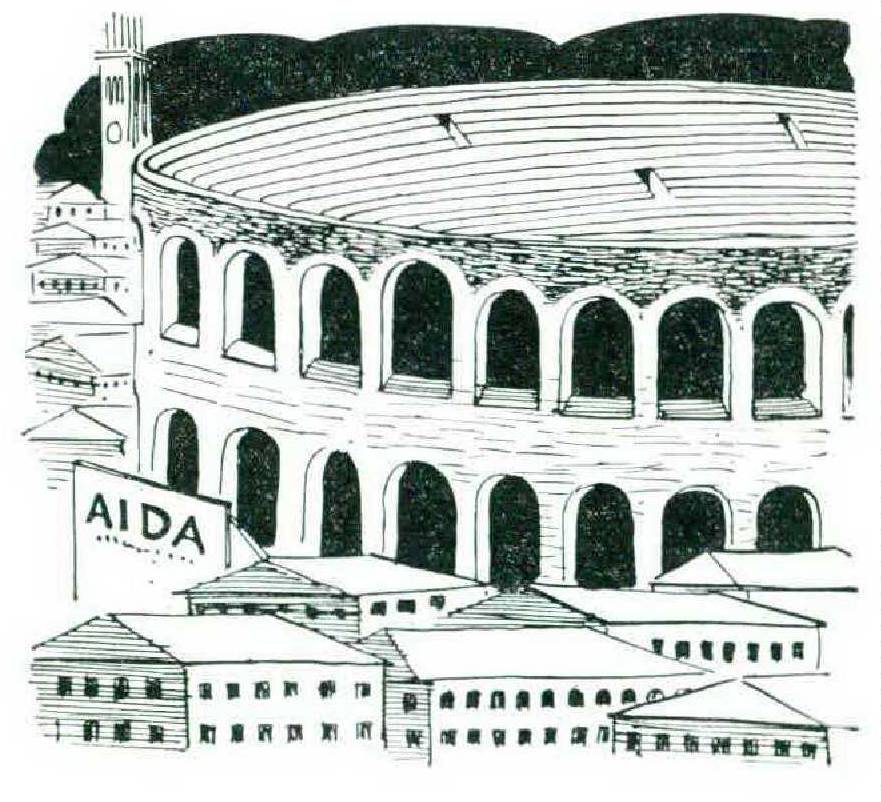
There are also one or two cinemas where the same principle is applied. But who wants to go to the cinema in Verona, which is the richest and most exquisite of all the little North Italian towns? Twice every summer, in June and August, the Veronese furnish a spectacle of great, magnificence, a week of grand opera in the Roman arena which is the best-preserved of its kind in the whole of Italy. Most of the singers are drawn from the Scala in Milan and they stage an Aïda to end all Aïdas, bathed in the light of a real full moon, accompanied by the pealing of real church bells, and enlivened by a troupe of real elephants.
Verona lies on the main railway line between Milan and Venice, and one can get into the Simplon Orient Express in Calais one morning and get out in Verona at noon on the following day. In the station there are plain solid blocks of green marble which serve as seats, instead of the usual wooden benches. One of (he delights of Italy is that it is a country where this luxurious stone is an ordinary commodity and where the quarries yield as many as a hundred different kinds of marble.
Outside on the square the carrozze are lined up — the carriages shaded by square white-fringed umbrellas and the horses wearing white sunbonnets against the heat, with their ears sticking out. As likely as not it is a feast day —festa — for the Italian year is generously sprinkled with memories of the saints; and as the carriage rolls towards the Corso, one is enchanted by the air of festivity, by the white paper flowers stuck among the dark crowns of the trees, by scarlet banners and crimson cloths streaming from window sills and draping balustraded balconies. Let him who can, I say, enjoy the saint’s day while he may; for soon he may want to change a check, and will find the banks closed — to do honor to the saint.
To reach the Corso, one has to pass beneath a rambling archway called the Porta Nuova. This New Gate is not exactly anyone’s idea of a new gate, dating as it does from the first half of the sixteenth century. Yet the name is appropriate because this gateway is new in comparison with the one called the Porta dei Borsari, which was built in Roman times at a spot which then lay at the outskirts of Verona. Now it lies in the heart of labyrinthal little streets and has been made part of them in such a fashion that its ancient arcades form a link between two houses facing each other.
And now we have entered the Corso. There is nothing to say against this corso; it is quite orderly and well-behaved as eorsi go, a tree-lined boulevard spacious and neat, with several modern hotels and apartment houses. In the manner of Italian corsi, it should be called Corso Vittorio Emanuele, after the first king of the house of Savoy who reigned over Italy united. But no. As far as Verona is concerned, Italy united can go to pot. I read the inscription high up on the wall, where such inscriptions usually are, shake my head, read again, shade my eyes, and spell out the same words at each freshly attempted reading: Corso Can Grande. Have the Veronese gone mad, to call their main street the Corso of the Big Dog? Or is my Italian so bad that I am led to believe that Can Grande means Big Dog, whereas in reality it means something much more poetical and much more elevated and much more glorious?
I open my guidebook and learn that “Can Grande” was a sort of glorified nickname, a publicity name, given to himself by one of the medieval lords of Verona. He belonged to the Della Scala family, more commonly known as the Scaligeri, who were in power for many generations. They were a tough, rough, grim lot, a breed of gangster princes and robber generals, the most formidable among the rulers of Lombardy. And it is they who made Verona — Verona as we know it today.
Surely the name Can Grande in itself is a giveaway. A man who calls himself deliberately the Big Dog when he could have chosen anything he pleased — such a man must have been a hard prince to serve. He had no time for all the blandishments and seductions of the court life of his age. Nor was he interested in the glorious, swanky, show-off part of warfare. Not for him such fancy titles as “Lionheart” or “the Magnificent.” Let others do the bragging and the posing. He had no time to waste. He was a Della Scala, he was a go-getter, he meant business. All he wanted was force and power — power to grab, and power to keep what he had grabbed, and power to grab more. That was all. And to be called the Big Dog was quite good enough for him.
The Corso opens into the Piazza Bra, which is the last bit of practical, common-sense, everyday Verona we are going to encounter. There are a pillared stock exchange, strings of open-air cafés on the pavement, and a centerpiece of scrolled flower beds — and the flowers have that disgustingly bright, glossy, sleek look which all flowers tended by municipal authorities have all the world over. But the piazza does not extend as far as one expects, because the Roman arena is cutting into its flank from one side, with a piece of curved wall strengthened by colossal arches, the stones weathered to a sandy yellow and blunted in outline — the whole fearfully majestic and not quite comfortable to look at, like an aged lion’s paw thrust forward while the beast is resting. But it seems that even the Scaligeri were in need of picnics and country air, and it is only natural that one should follow them and make an excursion to bake Garda, where they established one of their strongholds. Like most places, Lake Garda has a cheap side and an expensive side, and the best thing is to board one of the many coaches which run from Verona and make a tour of the whole lake and see which side one likes better.
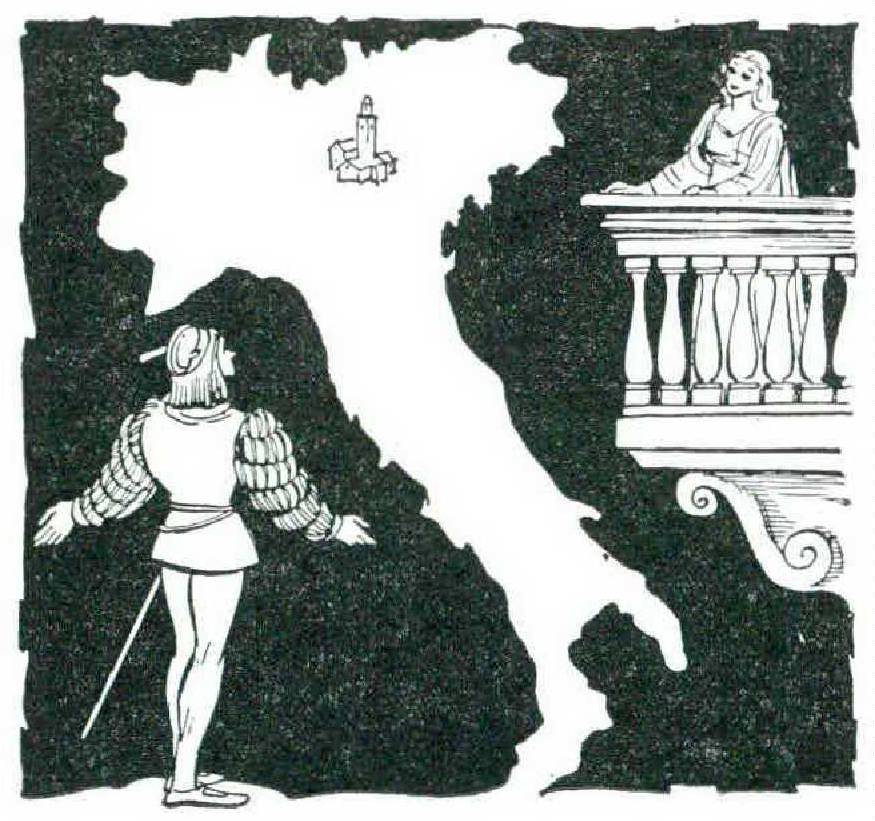
Walking past the arena, one comes to the Via Mazzini, which is filled with the luxury shops of the town. It is a narrow street, given over entirely to display and idling and watching; no traffic is allowed to enter, and one is able for a few minutes to enjoy the pleasures of life in a town without its anxieties. Till at last, slowly, one has traversed its length and is faced with the dilemma of what to see first. Should one go to the right and see the house in which Juliet lived and loved, with its famous courtyard with the two balconies, and speculate on which of the two Juliet used to stand when waiting for Romeo? Over the porch there is a plaque with the words: “This is the house where the young woman lived over whose fate the whole world has shed tears.”
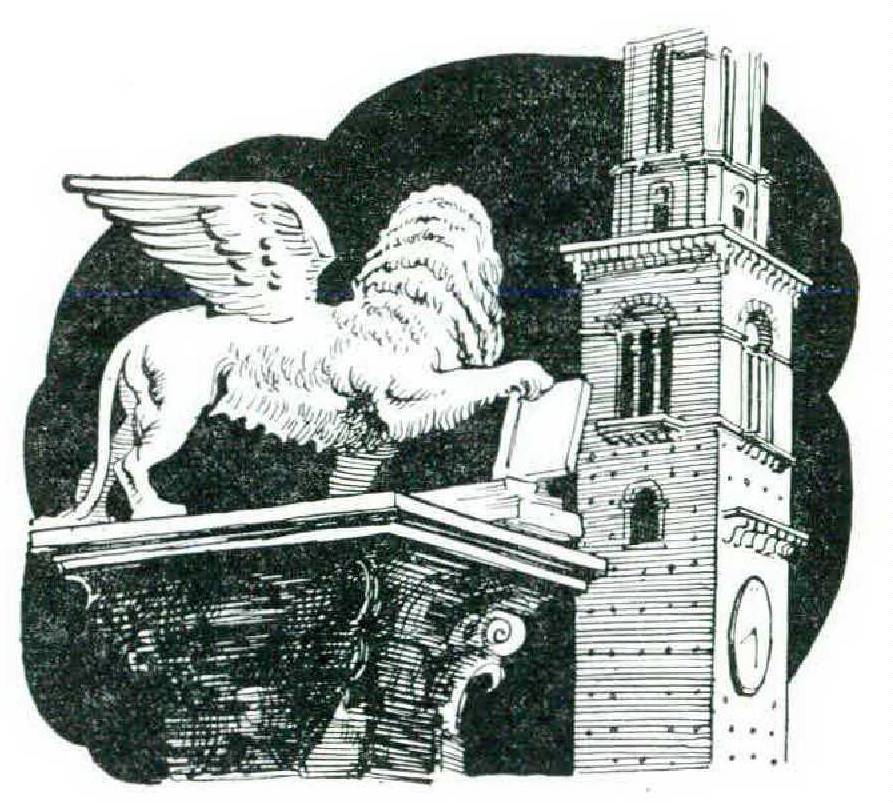
Or should one turn left, into the Piazza delle Erbe, where the vegetables are sold against a background of frescoed palaces? At one end stands a winged lion, the seal of Venetian conquest after the Scaligeri had lost their reign. At the other end, facing the lion, there is the touchingly humble statue of the Virgin, shrouded in the threefold jet of a fountain, as though hidden behind a watery curtain. Further away, dominating all the roofs around, is the tower from which a cannon is fired every time a tempest darkens the sky of Verona — to dispel the thunderclouds, according to an old belief.
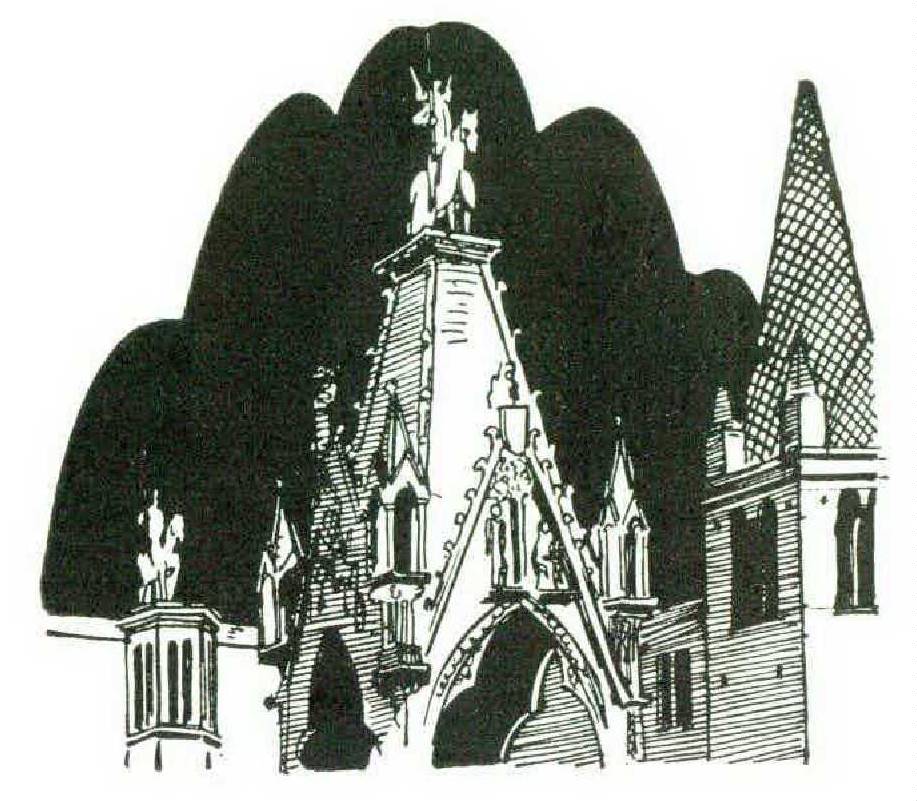
Best of all is to follow a trickle of people who have turned into a tiny dark, dank alley and to find oneself standing in the heart and pearl of Verona, in the Piazza Dante. It is the most beautiful small square I have ever seen. It is made up of five houses only; and of these, three are palaces; and each palace belongs to a different age and is perfect of its kind — one gray, one red, and one striped peach and ocher. And in the distant corner, fenced off by a filigree of wrought iron and sheltered by roofs of filigree of stone, are the tombs of two Scaligeri, surmounted by their knightly statues on horseback, broody, gloomy, savage, obstinate.
The Scaligeri statues are remarkable in themselves, but what makes them still more remarkable is the fact that, though they are situated outside a church, they form no part of it. They are more than sepulchral effigies: they exist in their own right as an embodiment of worldly power. They were built to impress the world with the prestige of the Scaligeri, as political propaganda. In the history of taste they are revolutionary; and when, some time later, Venice and other states built monuments of their leaders on horseback, they were merely following where the Scaligeri had led.
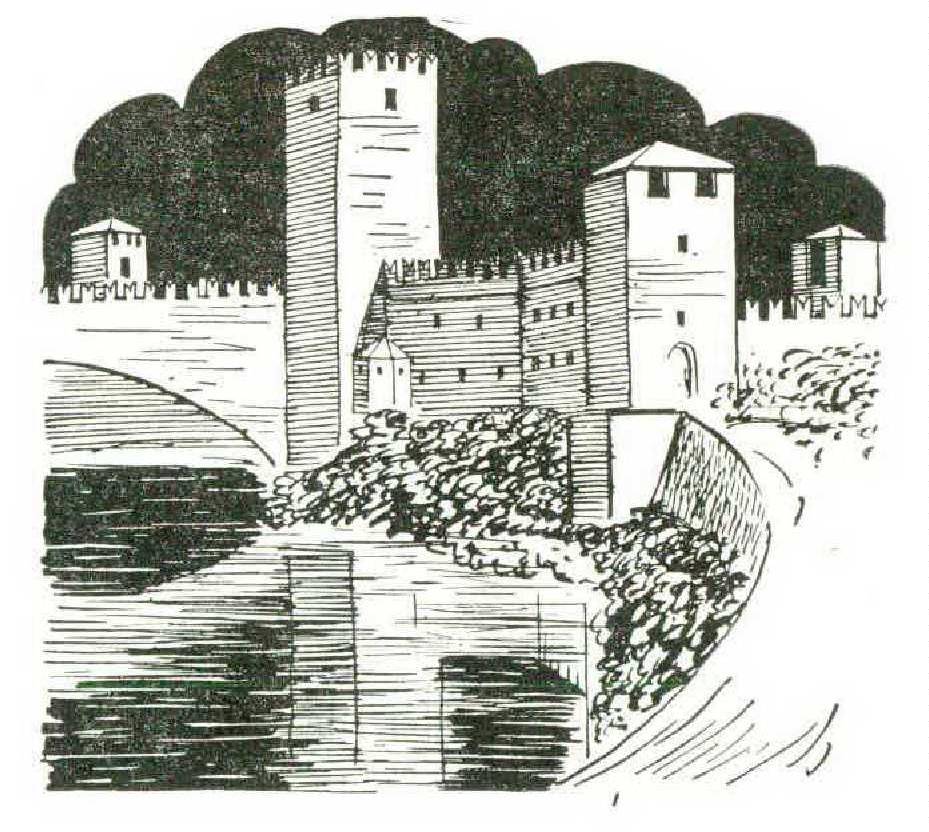
But it is not only here that the Scaligeri left a monument of their might; we find it in the Castel Vecchio, their fortified stronghold which dominates the bank of the gray fastcoursing waters of the Adige. And although today it has been turned into a picture gallery, one still has to cross the drawbridge to gain entrance. There is the bishop’s residence bristling with the same crenelations as the fortress — those fierce crenclations which are cleft down the center like snakes’ tongues. And they appear once more on the menacing old bridge, which was fortified too.
It is not astonishing that the churches take second place in Verona — how could it be otherwise? — and yet they are worth seeing. There is San Fermo — which is the oldest Romanesque church in Italy—with its famous bronze doors, divided into squares on which the craftsman has portrayed many incidents of Biblical history—a kind of charming sacred pieturebook which has lasted through the ages. There is San Stefano, which is really two churches, built one on top of the other, with a wooden ceiling ribbed and curved like the keel of a ship. And on the other bank of the Adige there is the little chapel built into the heart of a small Roman theater.
The cheap side has little villages dotted with naïve country churches, little inns with flowered balconies, and green hills rising toward the blue snow-topped mountains. It is this everlasting snow on the faraway ridges which lends a freshness and brilliance to the whole vast lake.
It is on the expensive side that one enters the famous tunnel road which is pierced by seventy arched windows, each framing an unforgettable view of lake and mountains. Here is the world of the big luxury hotels and princely summer houses, their parks rising in terraces above the high walls, and it is only by passing the arabesques of enormous ironwork gates that one catches a glimpse of radiating leafy avenues and flights of broad shallow stairs curving upward to tiers of urns and marble gods.
After bathing, one will probably sit in a garden overlooking the water, in the shade of lemon trees, and eat the local trout which is the pride of every innkeeper. I have never been to a place yet where the local trout was not supposed to be something unique, and I will say that the Garda trout is as unique as all others — no more, no less. I recommend it cold with mayonnaise.
The peculiar charm of Lake Garda lies in the contrast between the crispness of its mountainous girdle and the softness and luxuriance of its southern vegetation. And in its sparkling blue water there lie side by side the reflections of rugged stone, snowdrifts, glaciers, ripe oranges, cedars, laurel, and olive. It has a long tradition of pleasurable living. The Romans built summer houses on the shore, and in the seventeenth and eighteenth centuries aristocratic Venetian families established their princely residences. Mussolini used to live in a villa on the island of the lake. And today Gardone and Fasano are among the most elegant and exclusive resorts in Italy.
Now that one has fared so well treading in the footsteps of the Scaligeri, one must follow them still further afield, to what was once their vassal town—to Vicenza. Vicenza too lies on the main line between Venice and Milan, and like Verona it is in the heart of the sweet classical Italian landscape, of those dreamy blue hills which form the background of all the best-known old master paintings of the Madonna and angels. But here the resemblance comes to an end.
Despite their common history under Scaligeri and enetian rule, one must not imagine that Vicenza is Verona’s poor relation. Here is a town which has remained as it was during the happiest time of its history. Here one steps straight into the highlights of the Renaissance, breathing an air of ease and plenty far removed from the horrors of the battle. It is this little town which has given to humanity one of the finest gifts ever made: the first modern theater, the theater as we know it today. It was built in the sixteenth century by Andrea Palladio, one of the great architects of all time.
The Teatro Olimpico lies at the end of the main street. On entering, one is amazed at its miniature proportions; but pioneer undertakings are always on a small scale because they are new, untried, and still in the bud. Yet this theater is so perfect within its limitations, so right, so truly finished, that one never ceases to marvel. The auditorium is built in the shape of half an ellipse. The wooden seats rise in curved tiers to the balustrade which screens the gallery. It is bordered by statues of the noblemen who financed the building of the theater; they are portrayed as Greek gods and heroes. The ceiling is painted to resemble a night sky, starred and clouded. In front, there is a sunk pit for the orchestra, to render the musicians invisible. The stage is set with wings and backdrop showing a square in the city of Thebes, with seven streets radiating from it. It is a breath-taking experience to set foot on those boards and to find that they have shrunk by some inexplicable magic. How cramped it all is — and yet a minute before, how vast, how stately it seemed. Palladio in his supreme mastery was able to fake the perspective in such a way that the stage appears grander the further one is from it.
Another of the glories of Vicenza is the Villa Rotonda, which lies outside the town and is reached on foot in about twenty minutes. This country house is a landmark in the history of taste and is considered the most perfect domestic building of its kind. Its fame grew so great in the following centuries that it was copied innumerable times all over Europe. The best-known copies are the one in Chiswick built by Lord Burlington, the one in Marly near Paris, and the one in Pavlovsk in Russia built by one of the Czars.
In the main street of the town and in the cathedral close, there are several palaces designed by Palladio showing the entirely new manner in which this master builder handled the arrangement of columns and balustrades and statues. Palladio was a native of Vicenza, and one must be forever grateful that the saying, that no one ever is a prophet in his own country, proved to be untrue in his case. Palladio has made Vicenza into that pearl of beauty which throughout the ages has drawn travelers from all parts of the world, and I think that one must leave the last word to the greatest of all travelers through Italy — to Goethe: “The greatest difficulty with which Palladio, like all modern architects, has to contend is the problem of adapting columns to secular buildings: there is always a contradiction in the combination of columns and walls. But see how he has contrived the relationship, how he has imposed it through his art, and how he makes us forget that he is merely persuading us.”