The Renegade
RUTH CLAY PRICK was born in California and makes her home in Pasadena. This is her first appearance in the Atlantic.
by RUTH CLAY PRICE
FATE has always willed that I should fish with fly-fishermen — dry fly at that. My father would unpack all his fishing tackle every spring and examine each item from rods to last fly-feather, even though he no longer used them. Once I told him shyly that I had caught a trout in the creek at the foot of our hill.
“What fly did you use?” he asked with intense interest.
“A worm,”I replied.
“A worm!” His warm blue eyes turned icy gray and, for the first time, I felt the ire of the fly addict. “Oh well, I suppose it’s all right, you’re just a child.”
When I was seventeen my father took me to see a mine high in the Sierras. We left the train at Truckee and there he hired a horse and wagon and stored our baggage in back. I noticed his rod and fly-book. “Yes,” be smiled, “I haven’t wet a line for years. It’s time you learned to cast a fly.”
Never have I seen a rod so skillfully handled. The trip had only one flaw: I could not learn to cast a fly. We knew then that I was to be a disgrace to the family, a bait-fisherman.
“Well, you’re a girl,” he comforted me — and himself.
Then I married— a fly-fisher. Even on our honeymoon two trim little rods and a newfangled fly-box went along. While my husband whipped the length of the Carmel
River, unsuccessfully, with a series of multicolored flies, I happily captured sand fleas just where the blue ocean receded from the white sand bar at the river’s mouth. Sauntering lazily upstream, casting and hopping my sand fleas on pools under the willows, I landed the limit of rainbow trout. When my husband saw them I thought our honeymoon had ended. There is no jealousy like an angler’s.
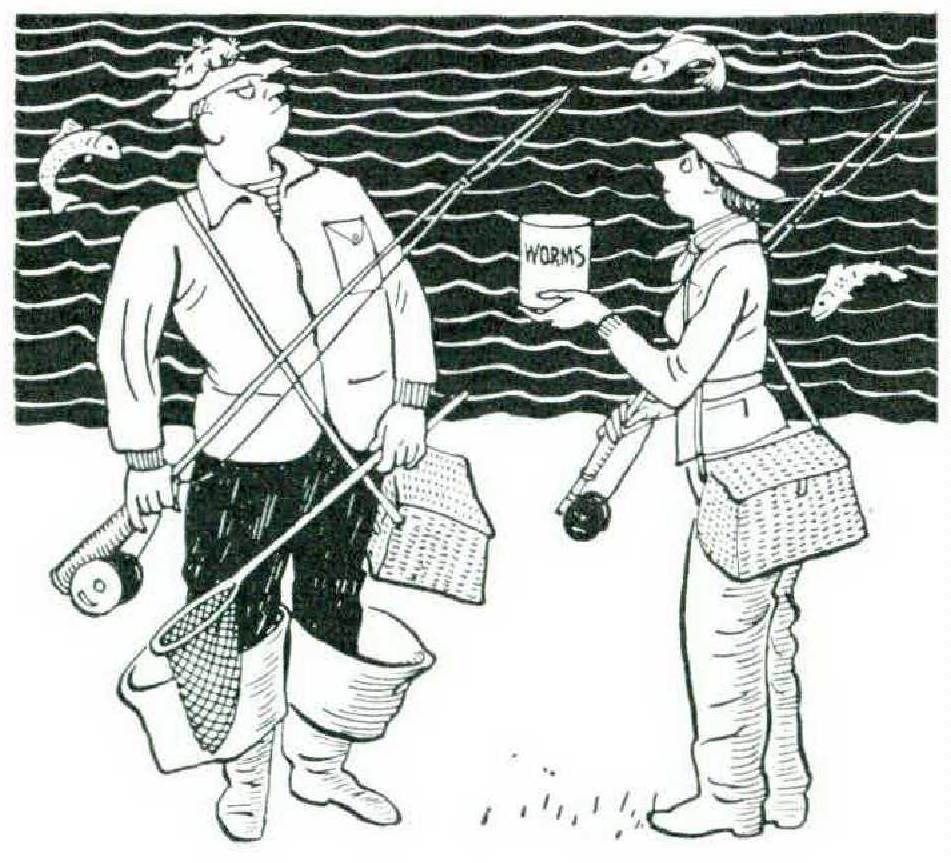
For years we fished up and down the Pacific coast. I heard all the alibis for an empty creel: full of the moon, dark of the moon; river too high, too low; too much food; too many fishing; wrong hatch. Meanwhile, with thought and ingenuity, I managed to acquire the right baits and catch our dinners.
Only once did my bait-fishing almost land me in the divorce court. We had camped late on the American River. After supper I wandered down to the river and caught enough trout for breakfast. When I came up the bank with them, I thought my husband was going to throw me into the water.
“Where did you get those fish?”
“Out of the river. Why?”
“After dark? Absolutely illegal in California — you — you — baitfisher!” There was no lower epithet in his angler’s vocabulary.
Together we went to the ranger and explained my ignorance. In guilty haste I handed him my fish; but in those days rangers were more friendly — their duties were not so exacting as now. He handed the fish back. “I know you won’t make that mistake again. By the way, what bait did you use?”
My husband taught our daughter to fish with flies; I taught her to fish with bait. The result has been bad — for me: she goes fly-fishing now, carrying all my bait. Once at a mountain camp above Bishop we met an old army officer — a fly-fisher — who expressed contempt for me, for all people who fish with bait. However, he was impressed with my daughter’s ability to cast. He often drove us to the high lakes. At one of these lakes I was fishing with salmon eggs — my creel was empty.
The Captain came over and asked, “Have you tossed out a few salmon eggs?”
“Chumming?” I asked with horror, knowing that it was unsportsmanlike and illegal.
“Oh no, never ‘chum,’ just thumb out an egg or two,” he advised.
The next day in the store I heard the Captain raising his voice and demanding, “Why didn’t you get the worms I ordered?”
When he came out I offered him my box of worms, asking, “Why do you want worms?”
He looked embarrassed. “Oh, sometimes I put a bit on the fly, just for fun.” I remembered the Captain last summer in Wyoming when I met a man who used only flies or spinners. Once, when I noticed a cricket on the spinner — a bait I had never tried — he looked embarrassed and said it was “just for luck.”
There is a definite skill in baitfishing which no fly-fisher will admit. This skill was demonstrated one morning long ago, in the High Sierras, when I watched my husband and my daughter use all their skill—and flies — in an attempt to catch a five-
pound rainbow. No success. Then I insisted that they try with my bail. No success. Now they would have no excuse if 1 were to catch the big fish; they could not say, “Oh, well, I suppose with bait. —”
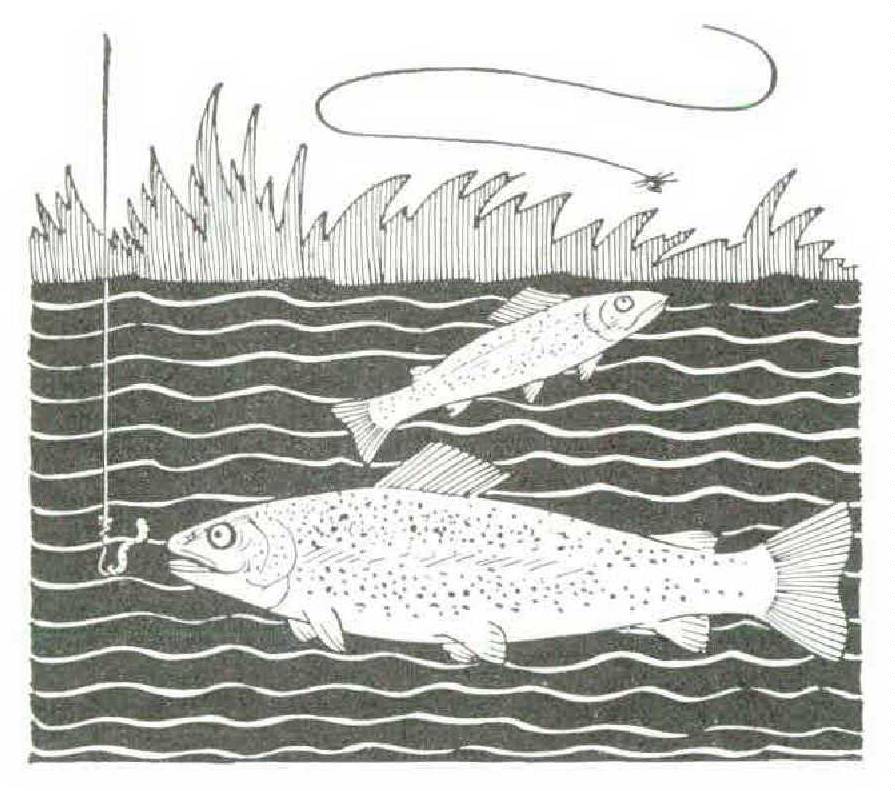
When they started down stream they said, “You’ll never catch that fish.” However, I wanted to try. As I waited for the stream to quiet and the fish to forget the annoying fishermen, I made my plans. The fly-fishers had cast carefully but they had stood — I would crawl. I did not want that fish to see me, so I removed my red sweater; my khaki would blend with the dry grass. I even took off my glasses —they would glint in the sun. I piled all my tackle on a log hidden in the forest.
Now I was ready to think about bait. Carefully I put a salmon egg on the hook, then rudely jammed it up the shank. This fish would never be caught in any of the approved manners; he was too familiar with them. Perhaps he would like a “sandwich”? Next to the salmon egg I threaded a small fresh worm—not with the usual dangling ends, however. It still looked unappetizing. I knew if I did not hook that fish on the first cast, I would not get him. He was a smart fish, never to have been fooled by a feather. I had discovered that wise fish will take grasshoppers only from their own locale, so I topped the sandwich with a tiny hopper from the meadow.
Now it was time to crawl silently to the edge of the stream. There I waited five long minutes by my watch before I dropped — not cast — my bait to the water. Bang! I had hooked my fish. With a yell, and in the most disapproved-of manner, I swung him onto the bank. When my husband arrived breathless, frightened by my scream, I was rolling on the bank with the rainbow clutched in my arms. The trout was lightly hooked and weighed much more than the five pounds I had expected.
Yes, bait-fishing is a fascinating skill, but last summer in Montana I seemed to lose my knack; I could not catch fish. During a four-day pack trip my. only fish was a golden trout caught by the desperate expedient of putting a ladybug on my hook, while my daughter was catching a daily limit with a fiy called “Wholly Worm”; true, a bit of night crawler was occasionally attached to the fly “for flavor.”
When I returned to West Yellowstone, I sneaked into a sporting-goods store and, glancing guiltily over my shoulder, made a purchase. The shame known to the fly-fisher who puts a worm on his hook, or to the spinner specialist who puts a cricket on his spinner, is nothing compared with the shame I knew as I, a lifelong bait-fisherman, purchased my first fly — a Wholly Worm.