Archaeology in Greece: An International Heritage
by GEORGE MYLONAS
1
THERE are few countries where the past and present fuse so completely as they do in Greece. A past that means so much to Western civilization and a present which we recognize at once as being derived from it. Beside the sundrenched airfield of Athens, where planes land and take off almost continually, the spade of the excavator recently uncovered the remains of a small settlement forty-five centuries old. A few miles away, the rock of the Acropolis with its Periclean buildings still stands. Throughout Greece, in almost every town and village, ruined buildings and broken columns, relics of a remote past, defiantly raise their slender shafts and weathered stones amid modern buildings and intricate machines. Small cupolas and gay, whitewashed towers enliven hills and valleys, silent landmarks of medieval Christianity, of an era of devotion and sacrifice.
The discovery, study, and care of these remains is considered a living activity, not a luxury, in Greece. This attitude did not arise in the modern era of universal nationalism, but came into being when the first fragment of the Hellenic world achieved freedom from Turkish rule. In 1837, four years after Athens was turned over to the Greeks, the Greek Archaeological Society was established, and the Greek Archaeological Law, regulating excavations and research, was enacted.
From the very beginning, the Greeks and their laws were generous to the non-Greek scholar. They extended the right to explore the antiquities of their country to qualified scholars of all nationalities and as a result, the excavation and study of Greek antiquities became an international endeavor and a field for international co-operation and understanding. Some of the most striking discoveries upon Greek soil were made by foreign scholars. It was Heinrich Schliemann who startled the world of scholarship by uncovering the cultural greatness of the mythical era of Greece, when he found the royal shaft graves of Mycenae in 1876, and it was Sir Arthur Evans who revealed the magnificent Minoan culture of the island of Crete. Foreign Schools of Archaeology were established in Athens one after another: first the French and German Schools, later the British and American, the Italian and Austrian, and most recently, the Swedish School, formed since the Second World War. Greece itself produced such great archaeologists as Chrestos Tsountas, Panaghis Kavvadias, Constantine Kourouniotes, Apostolus Arvanitopoulos, George P. Ockonomos, and Stephanos Xanthoudides.
During the first hundred years of excavation and research in Greece (1815-1915) many sites famous in literature and history were brought to light. American scholars concentrated their efforts on the excavation of old Corinth, the city of St. Paul. Thanks to their labors, the visitor today can follow the ancient road to the Forum built by Julius Caesar, or loiter in the vaulted shops and colonnades which surround its open square. He can stand on the speaker’s platform, the famous Bema, in front of which St. Paul stood to defend Christianity. He can visit a small pagan shrine where oracles were handed down and the miracle of turning water into wine was practiced, and he can see the famous Pirene fountain whose long history may be read in overlapping columns and vaults, and whose waters, according to tradition, came down from the top of the massive Acrocorinth which towers over the city. The source of these waters was created by the hoof of the winged horse Pegasus striking the rock on top of that mountain.
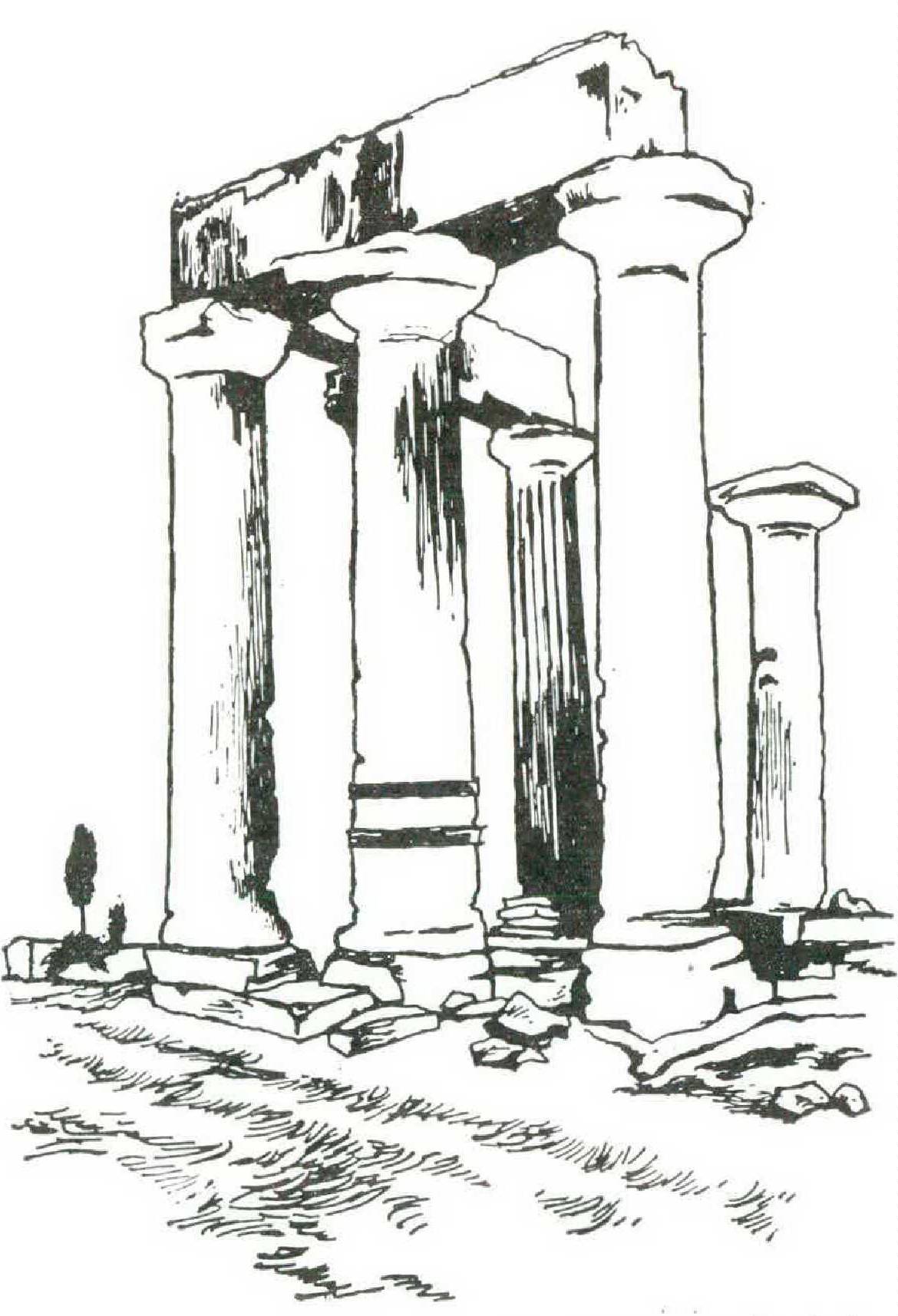
There is an excellent view of the center of Corinth from the small hill on which the columns of the Temple of Apollo stand proudly against a vista of green vineyards, blue skies and water, and of distant mountain peaks covered with snow. In Corinth, there is a museum, the gift of a New York philanthropist, which exhibits the vases, mosaics, and statuary unearthed in the region.
French scholars excavated Delphi and Delos, two of the most impressive sites of the ancient Greek world. In the folds of Mount Parnassus, overlooking the gorge whose pebbly torrent looks like the legendary Python coiling its way amid craggy precipices, stands the famous oracle of Apollo at Delphi. Here the visitor can purify himself in the crystal-clear waters of the Castalian spring, meditate under the thick shade of the plane trees which grow at the foot of the Phaedriades, visit the temple and its adyton, where once Pythia made known the will of the god; sit on one of the tiers of the perfectly preserved theater or in the stadium haunted by memories of the Pythian Games and of the poet Pindar.
In Delphi’s small but well-organized museum the works of art found in the excavations are kept: the Siphnian Treasury, with its elegantly carved façade and its two caryatids; the metopes of the Treasury of the Athenians, the bronze marvel of the Charioteer of Delphi. The sacred olive grove of Apollo and the waters of the Corinthian Gulf are unforgettable by moonlight. In the background, the snowy peaks of Parnassus, like a protecting canopy, raise their proud height against the sky.
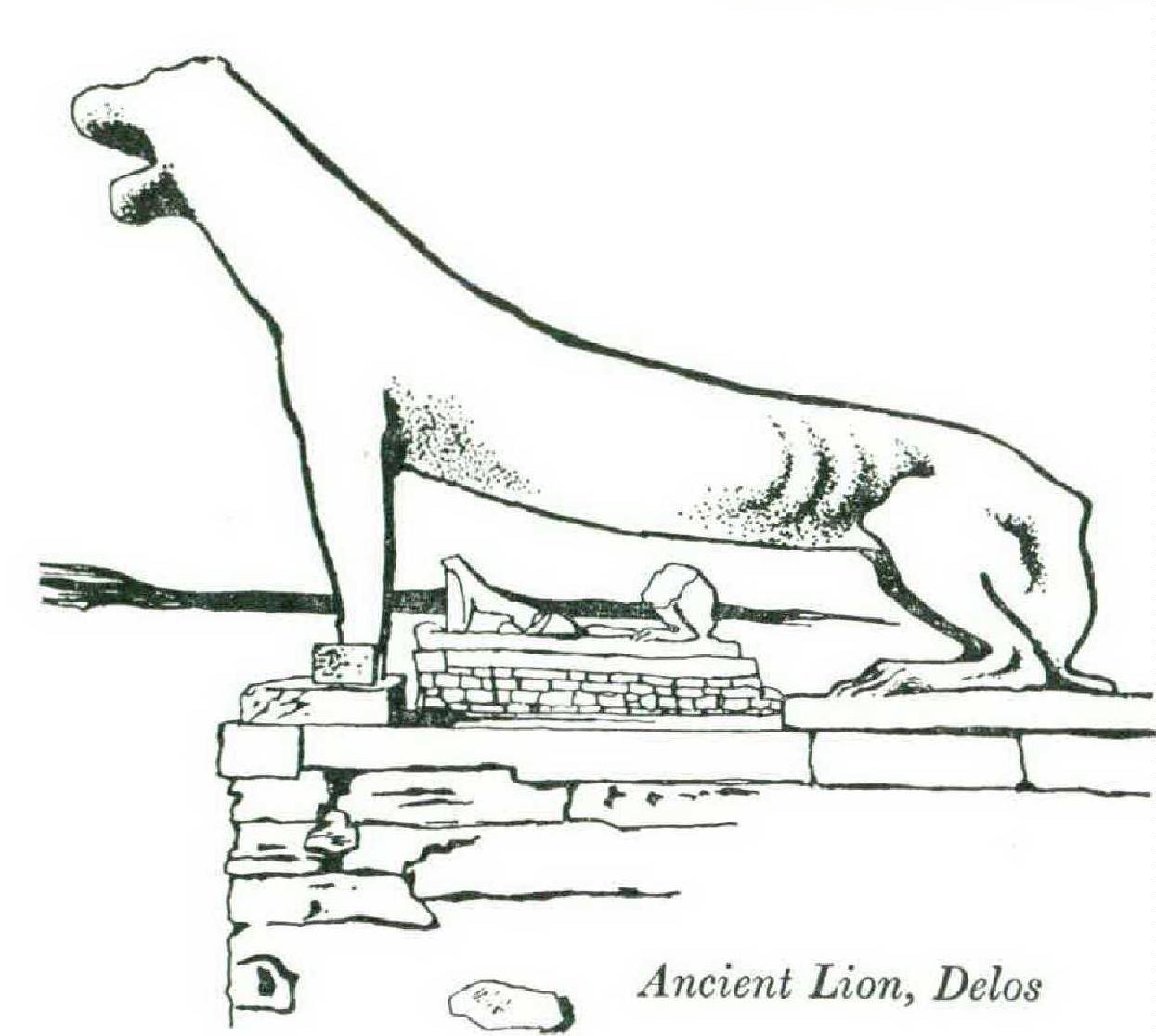
The second great site excavated by the French, the Sanctuary of Apollo on the small island of Delos, has an equally strong appeal. There, on a barren island, the magic spade revealed the sacred cave where Apollo and Artemis were born, and the temple of the god with its avenue guarded by marble lionesses. There, too, were found the merchants’ houses and the slave market of a later period.
In contrast to the blue vision of Delos is the green valley of the Alpheios river, where German archaeologists unearthed the remains of Olympia. Little survives of the Olympic stadium except its starting line and the Temple of Zeus is in ruins difficult to decipher. But their legends fill the air and surround us when we wander in the Grove of Zeus, the Sacred Altis, once peopled with statues of victors, or stand before the altar where they were crowned. In the cella of that temple once stood the gold and ivory statue of the god made by Phidias, one of the sculptured wonders of the ancient world. In the shade of the pine grove, as if growing from the green earth, are the remains of temples, stoas, treasuries, and public buildings; and in the small museum overlooking the site, the works of art found among these ruins are jealously guarded: the graceful Hermes of Praxiteles, the Victory of Paionios, and the Apollo from the western pediment of the Temple of Zeus, unmatched in strength and nobility. There, too, we find the story of the eternal struggle of civilization against barbarism in the marble composition of the fight of the Centaurs and Lapiths, and we can feel the playful and humane spirit of the pagan religion in the gaily colored terra-cotta group of Zeus and Ganymede.
Sparta, the chief antagonist of Athens, the mother of great soldiers and of the rigorous life, was explored by British scholars. Its ruins are too scanty to stir the imagination, but its long history comes alive as we stand on the banks of the Eurotas River and survey the mountain chain which surrounds the valley. At a short distance from the site, the hill of Mistra, of particular interest to lovers of medieval Christianity, dominates the roadway. It was cleared by Greek scholars and its ruins, as Greek ruins go, are comparatively modern. With its churches and shrines, decorated with paintings of saints, its narrow roads and squares, its delicate cupolas and crenelated battlements, and its princely palace, Mistra is a “frozen center” of thirteenth-century life.
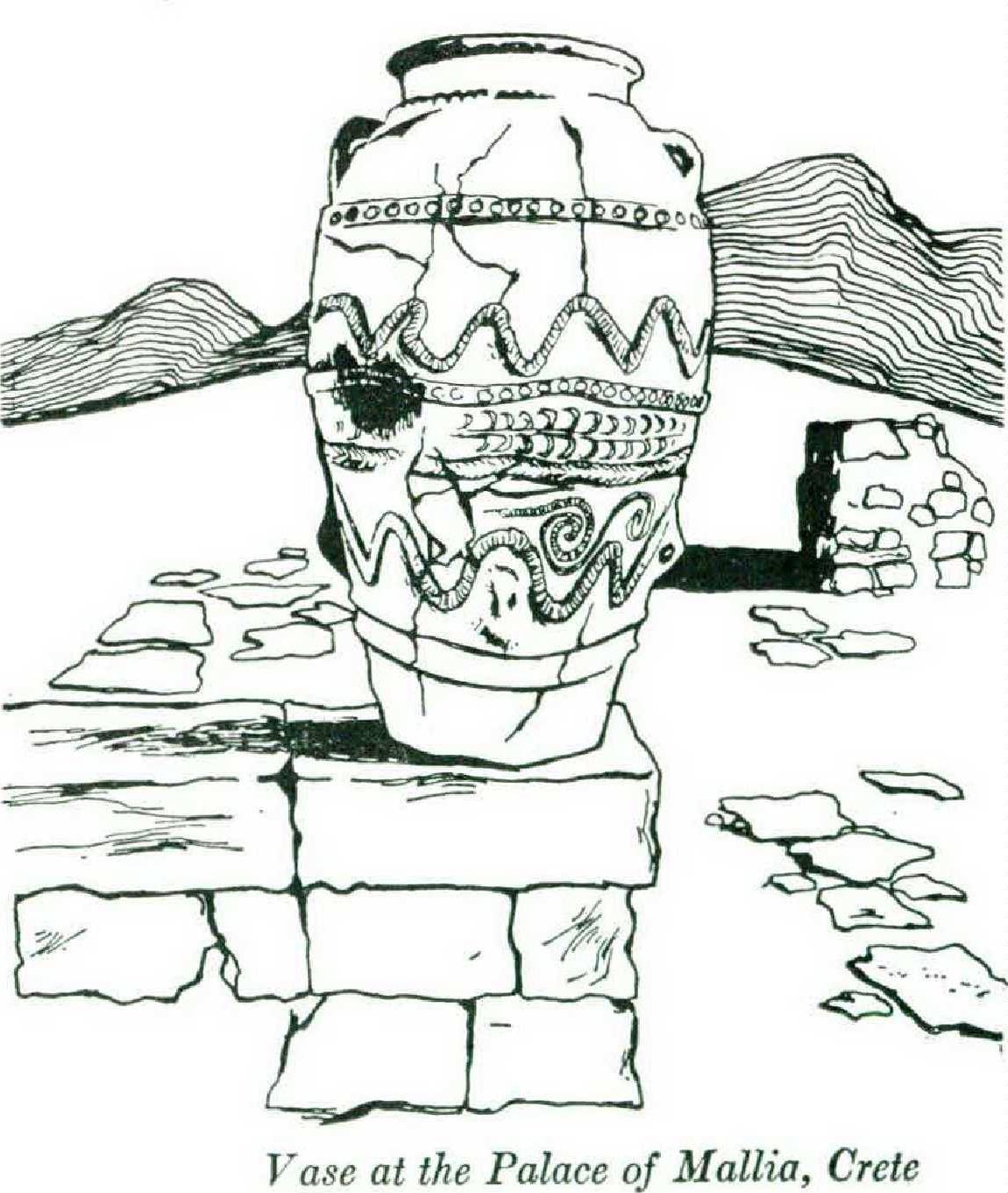
Across the Aegean lies the island of Crete. A short distance from the modern town of Candia, Sir Arthur Evans and his British colleagues disinterred the Labyrinth of the Minotaur legend and the palace of King Minos at Knossos. Its intricate plan, its long storerooms still filled with enormous jars, its courtroom and shrines, throne room and princely apartments, which rise as high as four stories and are brilliant with frescoes and filled with works of art, recapture an era of great antiquity. We may visit the very court from which Daedalus is said to have taken off in the first flying machine ever devised by human imagination.
On the southern coast of Crete, Italian scholars brought to light another palace at Phaistos and a royal villa at Aghia Triada. Not far from both are the Fair Havens where St. Paul took refuge, and near there the Church of Aghioi Deka, one of the oldest basilicas built by early Christians. Here was discovered the oldest Greek code of laws, inscribed on stone slabs which in medieval times had been used to roof a channel that brought water to a mill.
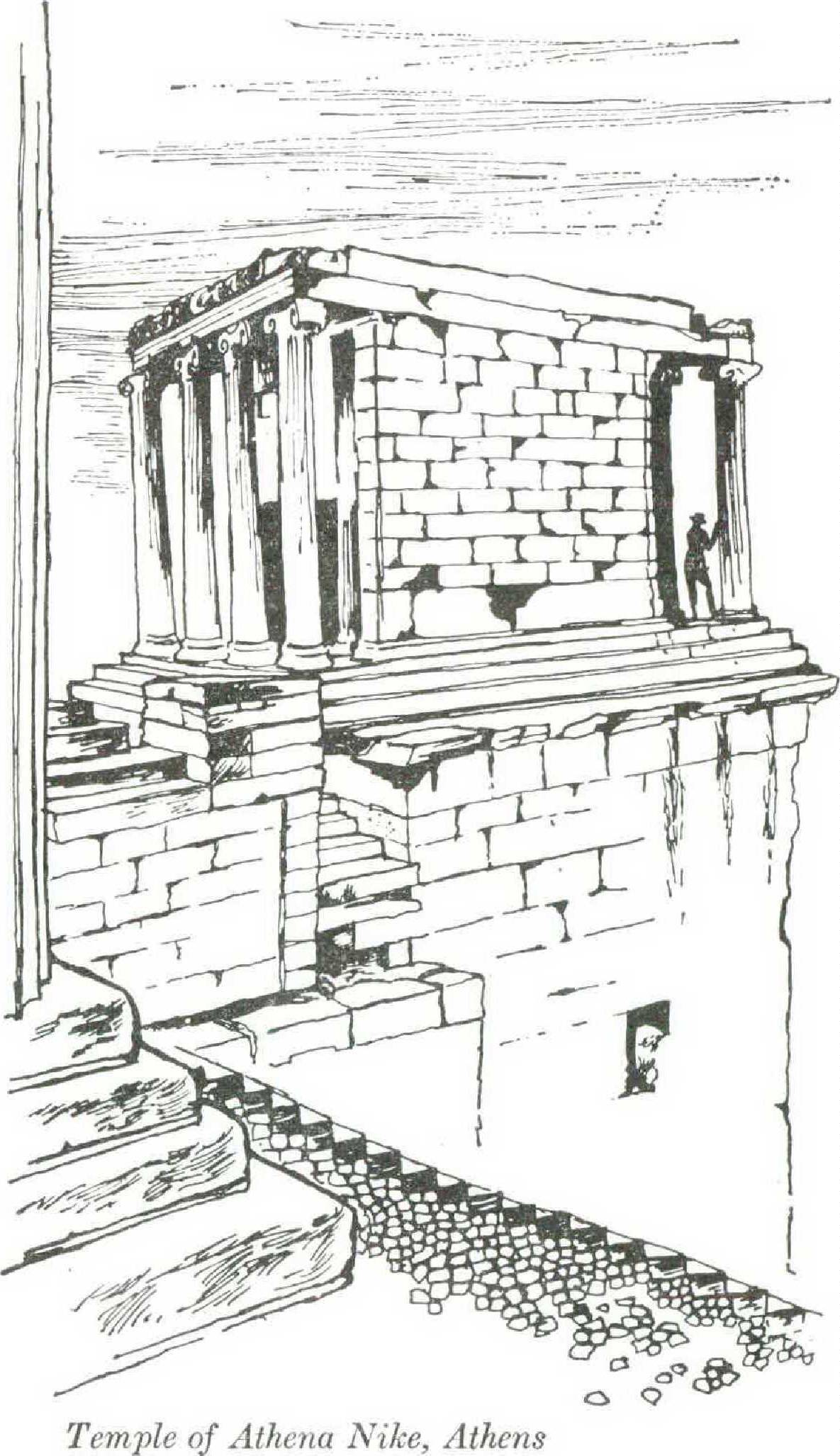
Greek scholars reserved for themselves the area of Athens and excavated the Acropolis. How can one describe the Acropolis in a few lines? — the Parthenon with its architectural purity and impressive monumentality, the elegant, elaborate, yet satisfying grace of the Erechtheum, the solidity and grandeur of the Propylaea, and the Temple of Nike — the smallest marble temple in existence — which like a jewel is set in the forefront of the sacred rock?
Below the Acropolis is a spot cherished by lovers of literature: the Theater of Dionysos, one of the first theaters of the Western world, where drama and comedy were born. The shades of Aeschylus, Sophocles, Euripides, and Aristophanes haunt the small orchestra and its stone tiers of seats.
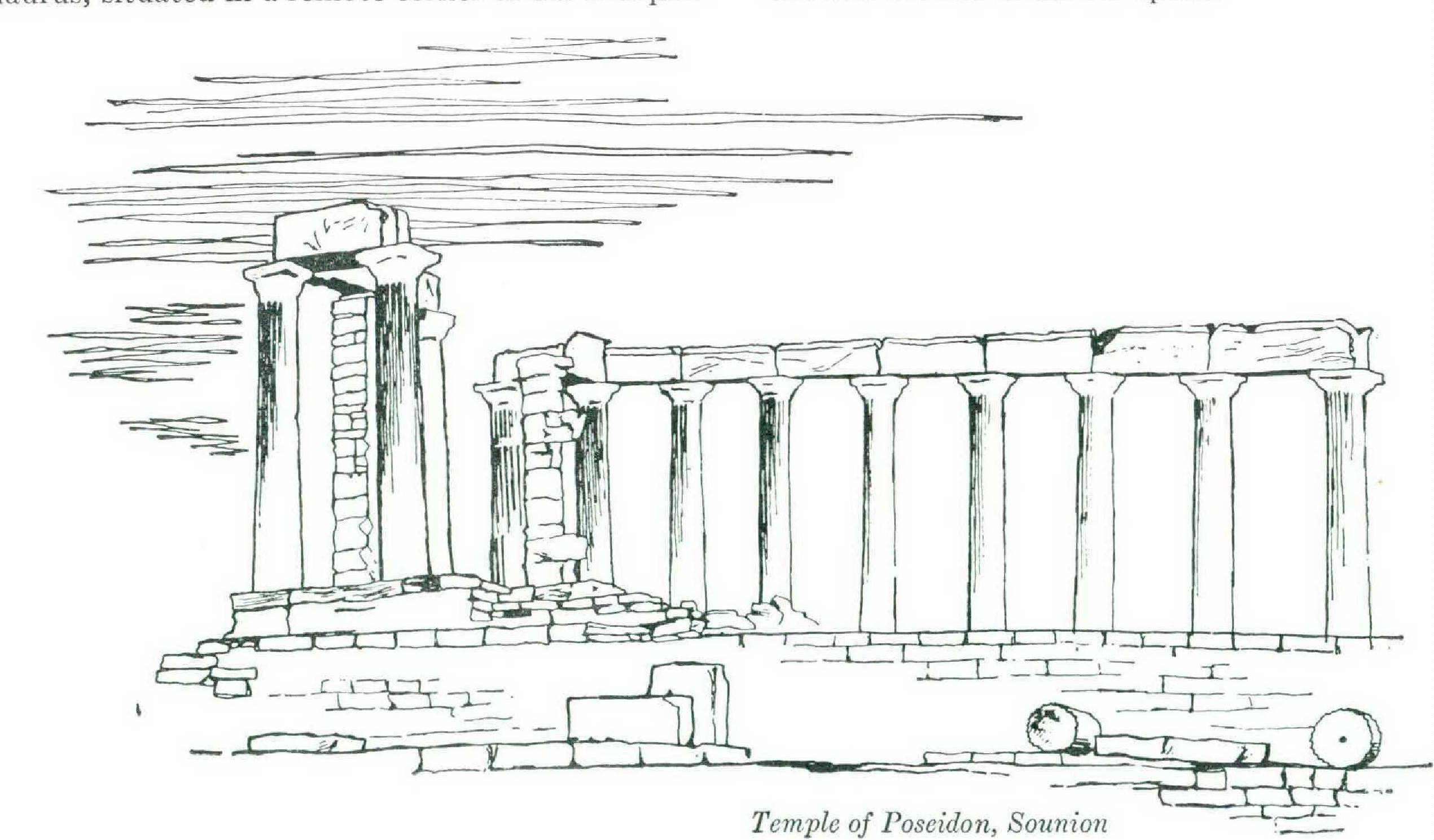
The slender columns of the Temple of Poseidon at Sounion, some thirty-nine miles from Athens, dominate the southern tip of Attica and command one of the most beautiful vistas of Greece. Barren mountains, a blue sky, the famed Aegean Sea, distant glimpses of the isles, multicolored sails, and small coves of white sands create a unique world of beauty. Byron chose this spot as the ideal Elysium.
Only fourteen miles to the west of Athens, Greek archaeologists found the great sanctuary of Demeter at Eleusis, where the Eleusinian Mysteries were held. We enter the sanctuary by its two marble gateways, visit the cave through which Persephone descended to the lower world, and ultimately find ourselves in the temple where the secret initiation rites were performed. Little is known of the Eleusinian cult which endured for almost two millennia.
Mycenae, the capital city of Agamemnon, the leader of the Greek expeditionary forces against Troy, was one of the great centers of culture, wealth, and power. Its vaulted tombs, the Cyclopean walls of the fortified citadel, and the Lion Gate with the coat of arms of Agamemnon and his ancestors are still standing. In 1876, Heinrich Schliemann discovered and explored the grave circle with its royal shaft graves, immediately south of the Lion Gate. Their rich contents—gold ornaments, cups, diadems, masks, bronze weapons, gaily painted vases, works of ivory, silver, and semiprecious stones — fill a huge hall of the National Museum of Athens and offer a striking picture of pre-Homeric Greek culture.
In 1952-54, about two hundred yards to the west of the Lion Gate at Mycenae, outside the fortified citadel, the Greek Archaeological Society unearthed another grave circle of the seventeenth century B.C. The skeleton of one of the kings, decked in his jewels and weapons, surrounded by vases once filled with provisions, had come back to life to tell the story of a period which had been completely forgotten even in Pericles’s time.
On top of the same citadel the late Chrestos Tsountas revealed the remains of the Palace of Agamemnon, destroyed by fire around 1130 B.C. Its calcined walls once decked with frescoes, the remnants of its hearth, the stately stairway which led to its throne room are still there. British archaeologists continued the exploration of this site, and gave us a detailed account of its life history and cultural activities. We are indebted to them for proof that the people of Mycenae were not illiterate in the days described by Homer, but recorded even business transactions on clay tablets.
Another important excavation restored the great medical center of the ancient Greek world, the Mayo Clinic of classical Greece. His located in a small secluded valley, at Epidaurus. There the god of healing, Asklepios, aided by his priests, performed cures which sound like miracles. The case histories of these cures, inscribed on marble slabs, are now in the museum. The ruins of the sanctuary, the famous stoa where patients awaited the visit of the god, the stadium, and above all the theater with its excellent acoustics, are among the outstanding remains of the center.
Numerous smaller excavations in all parts of Greece help fill in the picture of ancient Greek life. Greek ruins and works of art arr the foundations upon which our civilization is based. The legends which haunt them have delighted the Western world for untold generations.
The First World War ushered in the second century of archaeological research in Greece. Greek and foreign scholars resumed their activities, but American archaeologists now assumed the role of leadership: they explored Olynthus, the famous city over whose fate Demosthenes made his orations, Nemea, the Argive Heraeum, and Samothrace, the island on which the statue of the Winged Victory — one of the most valued treasures of the Louvre —was found. Their main efforts, however, were concentrated on the Athenian market place, the famed Agora. Still under way, that important excavation, will be a memorial to American generosity and scholarship. The crowning achievement of the American work in the Agora is the restoration of the immense stoa of Attalos and its transformation into a museum. Special reference should also be made, in this brief survey, to the work of American scholars, who with their Greek colleagues are unearthing the impressive remains of the Palace of Nestor at Pylos and a striking group of graves in the cemetery of Eleusis.
In this second era of archaeological work in Greece, a new chapter of research is being opened up the exploration of the floor of the Greek seas. It is well established that the Greek waters preserve a number of argosies, foundered ships, mostly Roman, with precious cargoes of works of art. As early as 1900, divers, looking for sponges, came up with fragments of statues from an ancient galley off the coast of Anticythera. An undersea exploration was organized and part of the cargo was rescued, including the Youth of Anticythera, a bronze statue of an athlete of the late fourth century B.C.
In 1925, a fisherman working in the hay of Marathon pulled out of the sea a perfectly preserved bronze statue of a youthful athlete, the Ephcbe of Marathon, a creat ion of the workshop of Praxiteles. A few years later, fishermen off the coast of Artemision, famous for the naval battle between the Greeks and the Persians, caught in their nets the bronze hands of an ancient god. Further search yielded the rest of the body. The pieces were put together and the completed statue is now exhibited in the National Museum of Athens; it represents the “father of gods and men,” Zeus, brandishing his thunderbolt, a masterpiece of about 460 B.C.
Excavating on land is a wonderful experience, but it cannot compare with the thrill experienced by the explorer of the deep. In the silent world of blue water, testing the sands which cover the ocean floor, archaeologists are seeking an ancient galley which may prove a veritable museum of art! A small beginning was made in 1952 in a combined endeavor by Greeks and Americans. At present, lack of funds is the only obstacle.
Excavating is expensive. But despite her privations in recent decades Greece prizes her heritage and one of the methods used to finance expeditions dates back to the formative years of the Greek kingdom, a perilous era of economic instability, when the budget was supplemented with a lottery. Part of the profits from this lottery were assigned by law to the Greek Archaeological Society, enabling it to train personnel and conduct research.
The interest in antiquities is widely felt by everyone. In Athens lectures on archaeology and art are attended by people from all walks of life. The open lectures offered annually by the Foreign Schools are always crowded and are often attended by Their Majesties King Paul and Queen Frederika.
Indeed, Greek archaeology is not simply the study of the past, but a study of the present in which the past plays a formative role. Some of the Byzantine churches, with their painted murals and golden mosaics, have been set aside as art monuments, but a great many are still used for services, as if nothing had intervened between their construction in the eleventh or twelfth century and today.
The vesper service held annually on Mars Hill, on the eve of the anniversary of St. Paul’s sermon to the Athenians, is an unforgettable event: as the sun’s rays light up the columns of the pagan temple of Athena, the chorus of the Metropolitan Church of Athens raises its massive voice in praise of a Christian God. Over the shrine of Eumenides, the words of the Apostle ring clear once more: “Ye men of Athens . . .”
People flock to this service in inspiring numbers. With equal enthusiasm they crowd the ancient theaters to attend concerts or the revival of an ancient Greek tragedy. The great theater of Epidaurus, situated in a remote corner of the Pelopon•ncsos, was filled repeatedly in the summer of 1954 during the presentation of Euripides’ Hippolytus. It was hot and dry, dust filled the air, the roads were packed and hard to negotiate, yet people traveled for hours to attend the performance.
All Greeks share this interest in the culture of their ancestors, “ STRIKE IN A DIG “ is always frontpage news. I remember when we were working at Mycenae, near the ruined tomb which is commonly called the Tomb of Clytemnestra. It was early in January during the Feast of the Epiphany and the priest, as is usual on that day, was blessing the fields and flocks with holy water. As he passed by our site, one of the laborers stopped him. “Father,” he said, “won’t you bless the tomb of Clytemnestra, so it may bring more tourists to our village?” And the priest replied sternly: “I, to bless the tomb of that murderess? Certainly not.”The feeling persists after three thousand years.
The ruins have a romantic or an impersonal, aesthetic appeal to all people but to the Greeks they are a living force. For the foreign visitor to the Acropolis, the caryatids of the Erechtheum are marble statues of great aesthetic and cultural interest, but to a Greek they are real princesses turned to stone, awaiting the day of their return to the world of the living. The one member of the group taken by Lord Elgin is not another statue exhibited in the British Museum, but a living form imprisoned in the foggy north. The modern Athenian likes to think that this rape and imprisonment has turned the dances, songs, and merrymaking of the group of princesses on top of the Acropolis into wailing and lamentations which can be heard when the sharp southwestern wind blows shrilly around the sacred rock of the Acropolis.