The Indirect Approach
by EDWIN O’CONNOR
EDWIN O’CONNOR gave up his work in broadcastiny in order to devote his full time to writing. His first novel, The Oracle, was published in 1951, and he has just completed his second. which deals with an Irish-American political theme.
FOR the past two weeks I have been getting the most out of television. It has been a period of complete satisfaction, and it came at the tail end of a long purgatorial experience, during which I watched television with fidelity and mounting gloom for five full years, not once realizing that I was watching all the wrong things. I was watching the programs.
This was unwise; worse, it was ignorant. The man who willingly watches the programs on television is like a savage who wanders into a banquet hall and willingly eats the napkins. Neither one realizes that infinitely better things are at hand. In the banquet hall, the food; on television, the commercials.
I have been watching nothing but commercials for two weeks now. I have found them refreshing, even exciting. Where the programs on television have degenerated into weary, predictable repetitions of each other, the commercials are fresh and vital, positively crammed with mystery and suspense.
Mystery! Suspense! Without these, the commercial would be nothing. Or, in other words, a program. For the commercial, to be really firstclass, must be an exercise in camouflage, a puzzle, a detective story. The successful television commercial is one which so baffles the viewer that down until the final seconds he has absolutely no idea of what the commercial is about. The commercial should be a frank challenge to the viewer to put together a few wildly misleading clues and come up with the right answer. It is not a whodunit; it is, instead, a whatisit. For example. . . .
On the television screen there appears a picture of a stalled car. It is a winter morning; snow is falling; the motorist, bundled up to the ears, tries stubbornly to get the motor to kick over, but with no luck. This is the beginning of a one-minute commercial, but — a commercial for what ? Anti-freeze? Motor oil? A new car? An old car?
No. It is a commercial for maple syrup.
The logic, once grasped, is actually impeccable. In the words of the announcer: “ Yes, friends, on these chilly winter mornings vour stomach just naturally demands a good hot cereal for breakfast. And what makes that hot cereal taste ever so much better, taste extra good ? That’s right, friends! It’s delicious maple syrup, poured over that piping hot cereal . . .”
Or there, is the commercial that begins with t he plot ure of a mountain in Peru. It appears to be deserted; as the camera comes closer, one can see the ruins of a temple of the Incas. From the ruins comes unearthly music, of tinkind now associated exclusively with the concert appearances of Miss Yma Sumac. The sounds rise and fall in weird lament; one can only wonder about the nature of the pitch to come. Has some enterprising importer cornered the llama market? Is someone selling the recorded songs of Miss Sumac? Is someone selling temple relics of the Incas?
None of these. Someone is selling fountain pen ink. The connection comes later: the ink is called “Inca Ink.”
One is brought home from llama land with a vivid pictorial exercise in statistics. A picture of a huge map of the United States is shown; just above it is suspended, throbbing and vibrating, the figure “2,000,000,000!” Obviously a statistic with some perceptible relation to the United States; just as obviously a statistic of some commercial significance. But again, what? Does the 2,000,000,000 refer to a portion of the estimated wealth? Is it a population figure for field mice or starlings?
A staccato phrase of explanation clears everything up in an instant. The figure concerns “ Blessed relief from acid indigestion.” There were, it appears, 2,000,000,000 of a particular brand of antacid tablets sold last year in the United States of America.
In a somewhat similar vein, there is a commercial which opens with a photograph of the Capitol in Washington, D.C. For one slow moment there is no sound accompanying this picture; one is given time for reverent associations to rise and to bear upon the solemn, silent sight. After this suitable interval, an exuberant voice is heard, paying eloquent if singular tribute to those who make our country’s laws.
“Life is really gay here in the capital! says the voice. “But when the gaiety is over, there’s always that morning after when stomachs need settling down. And that’s why the favorite of every party in Washington, D.C. is . . .”
Is, to be sure, another antacid. Which would lead one to believe that while patriotism may be, in the words of Dr. Johnson, the last refuge of a scoundrel, it is a fairly handy first step for the boys who deal in stomach powders.
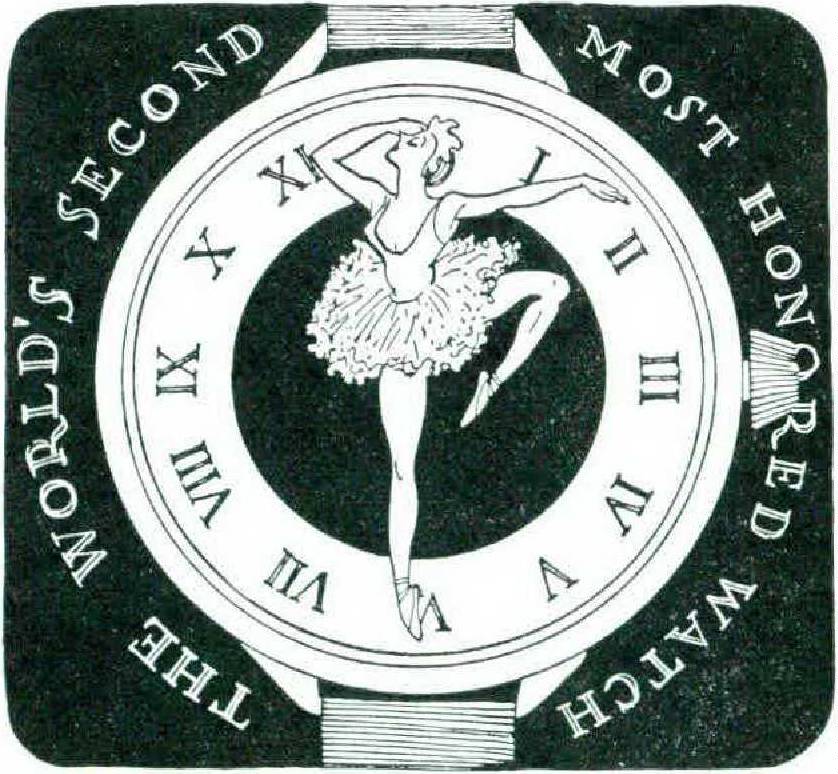
There are literally hundreds of commercials with the go-in which deceives. There is the old cowhand, with Stetson, chaps, and spurred boots; he is shown carefully inspecting his outmoded revolver. He is the commercial for the all-beef frankfurt. There is the ballerina who whirls out of the mists, pirouettes, and disappears; this is the prelude to the world’s most honored watch. Or is it the second most honored watch? It is, at any rate, high among the royalty of timepieces, and naturally, how else to present it but through the medium of a toe dancer?
I think my favorite of all television commercials is the one in which the announcer appears hand in hand with a psychologist. The psychologist is a stranger to the audience; the announcer is not. In another guise, under other circumstances, they have seen him before: he is television’s leading bartender. Now, however, with the psychologist in tow, and minus his customary pre-beer smile, he is clearly up to somber, mysterious business. The questions come thick and fast: —
“You are a practicing psychologist, Doctor?”
“Yes. That is right, sir.”
“I see. Now, in your profession, you must have a considerable knowledge of people?”
“Yes, sir. A knowledge of yooman nature is essential.”
“ I see ...”
And the audience wonders excitedly: What next? The role of the oldfashioned general practitioner on television is understood: he is there to sell cancer-proof cigarettes or toothpaste. But a psychologist?
The answer is furnished almost immediately: he is there to shave! It turns out that he had shaved once that day already and, smarty that he is, with all his knowledge of people, he thought he had removed every last bit of unsightly stubble. A fast once-over-lightly with a gleaming electric shaver, which the announcer forces upon him, punctures that balloon!
Whiskers fall like graphite shavings from the head of the razor; they are exhibited, under a magnifying glass, to a gaping television public; and one mortified psychologist slinks back to his couch, the victim of overconfidence.
There are, as I see it, two distinct morals to this commercial: —
1. Buy an electric razor.
2. Never go to your psychologist for a shave.
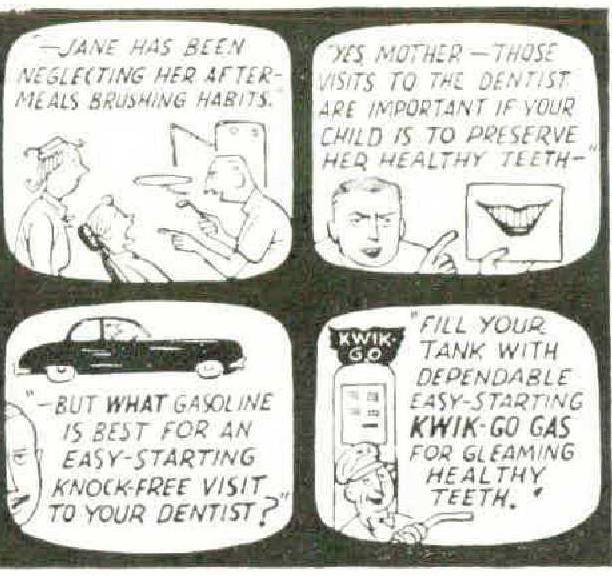
This about does it, save for my own television commercial, which I’ve been working over for the last hour or so, and which I think meets most of the requirements. It takes place in a dentist’s office. A little girl is sitting in the dentist’s chair; the dentist has just finished a thorough examination of her teeth; he turns to her anxious mother, who is standing on the other side of the chair. He frowns slightly, then speaks.
DENTIST: Well, Mrs. Brown, I’m afraid Jane has been neglecting her after-meals brushing habit!
This is the opening of my commercial; it is designed, naturally, to sell gasoline. The small connective tissues I will leave to someone else to furnish. One man can’t do everything.