Mobiles
by STEPHEN BARR
STEPHEN BARR is a free-lance writer who liven in Woodstock, New York, This is his first piece J’or Accent on Living.
THE trick about mobiles is that they don‘t move unless you push them or a breeze hits them. That is why they are called mobiles; otherwise they would be called automobiles, or self-propelled sculpture. This was tried once by a man called Pygmalion, and it worked out all right, but he didn’t do it again; once was enough.
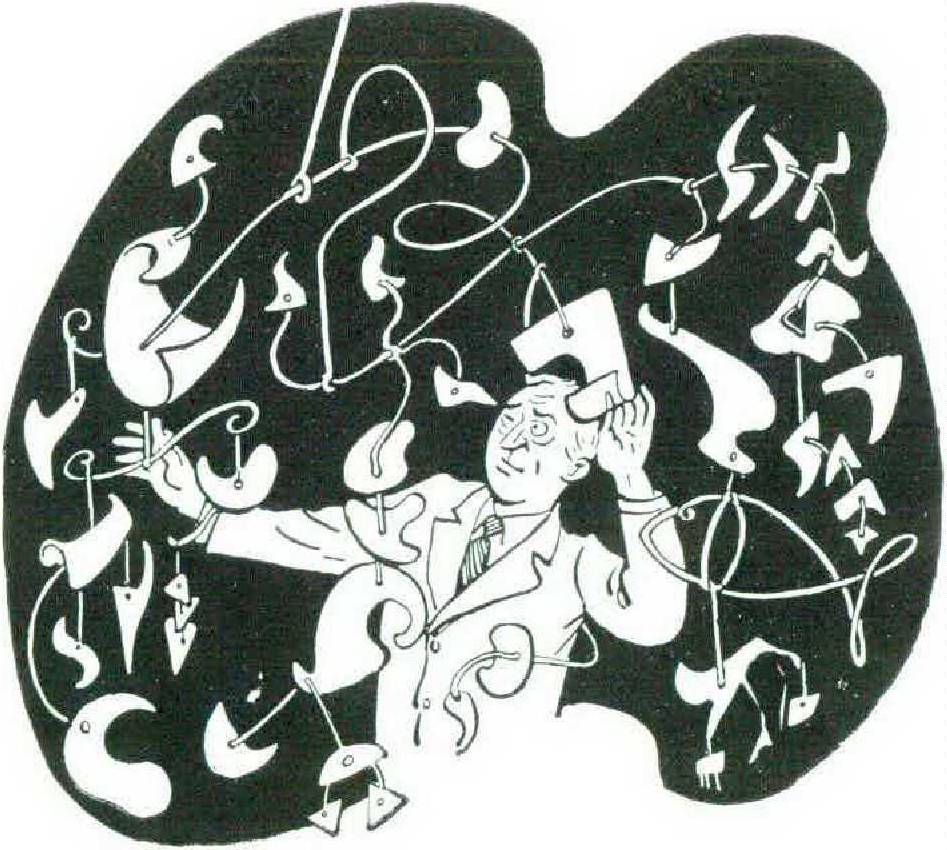
Regular or non-moving but movable mobiles come in various sizes and designs. The more delicate ones have a way of coming apart. This happened to a friend of mine while he was away for the Harvard-Princeton game. His valet saw a lot of curious shapes lying on the hall floor — it had been suspended from the ceiling before the joints parted — and being a tidy man he proceeded to sweep them up. This is not the thing to do with mobiles.
The giant economy-size, or alfresco, mobile doesn’t come apart. It stands, or hangs, with a vigorous, challenging look, just waiting to be pushed. If your enthusiasm for Art in Motion prompts you to do so, you will be well advised to give a quick decko behind you; otherwise a fifteen-inch sheet-iron flying fish will clip you one on the return swing. A certain nimble young man with a desire for action was trapped for hours in the inner orbit of one of these monsters in the back yard of a New York museum, dodging and moaning, desperately regretting his rashness. He’s probably still there, the fool.
Mobiles actually have a life of their own. I had one once, a tiny but very dear and complicated one — I use the past tense because it eventually flew away — that used to sit poised expectantly until you turned your back; whereupon it fairly whizzed. As soon as you turned around it stopped at once, trembling. Some mobiles have a way of adding to themselves by a sort of budding process, like hydra, the fresh-water polyp. The artist (designer? builder?) explains this by saying that new elements come to light as you get to know it better. You sec more in it, he says. He can’t tell me; it buds.
Mobiles have been mistakenly used in hospitals therapeutically, the idea being to take the patient’s mind off his troubles. This it does, but it also takes the patient out of his bed. Breathes there the man who is not in an overall plaster cast who can resist going over and helping a mobile? Anyway, art should never be used with kind intentions; it’s like being told that a certain kind of food is good for you. No; live dangerously and enjoy Picasso.
Actually mobiles are not as new as they look; the Japanese have been making them for centuries, out of glass and silk thread. You put them in windows and they are supposed to amuse the birds. Any member of the Audubon Society can tell you that birds are never amused at anything, except possibly bats — which they think are small, crazy men.
There used to be an object called a door harp, which played a repetitious little arpeggio and was hung on the door of the sewing room in the days of Wellington and William Henry Harrison. It, too, was a protomobile, but like the Japanese kind, it made noises, and I don’t think that’s the right idea.
Children, of course, have always made mobiles; and with the onset of reason — at about t he age of seven — the mobile becomes something in the nature of a pied bed or a bucket of water over the door.
The best of all possible mobiles, I believe, is when a man’s umbrella turns inside out just as he opens or flaunts it while the rest of us wights are beginning to get soaked. The mobile consists not only of the umbrella and the man, but also of us in a happy dance. Who wants shelter then?