Shop Talk
by DONALD PURCELL
DONALD PURCELL, a free-lance carpenter now living in Chesham, New Hampshire, taught English Composition for a number of years at Middlebury College in Vermont.
MY FRIENDS who are building houses, or having houses built, have always been able to unnerve me with certain tortuous semantic tactics. I join them in an inspection of the partially completed structure. “ Wonderful view!” I exclaim ecstatically. “And is this the kitchen?”
“The studs fool you there,” they answer, bringing to my mind, heaven knows why, a vision of a cornucopia spilling out a mass of pearl shirt studs on a green billiard table cloth; “but when we put in the plates” (I feel for my denture with my tongue) “you will envision things better. You are now standing in the sink.”
“How‘s the living-room ceiling going to be?” I counter. “Are those beams standing over there . . .” “The rafters will run north-south.” A third person — a real friend — interrupts. “Those? Well, what are you going to do about overlap?”
“Tenpenny nails,” I assert in an authoritative tone, but under my breath, as I disappear wisely down the cellar stair well.
Since this sort of thing has always mildly unnerved me, you can imagine my panic during my first few days after I recently took a job as a rough carpenter. “Would you spike up them joists,” the boss suggested on my first morning.
“You mean those thick boards just over by that pile of thinner boards?” I gulped.
“Toenail ‘em first!” Cryptically he walked away.
Uneasily, inside my sneakers I flexed digits. But things didn’t go too badly. I did what my eight or nine fellow workers did; and since nobody bothered me, I suppose it was all right.
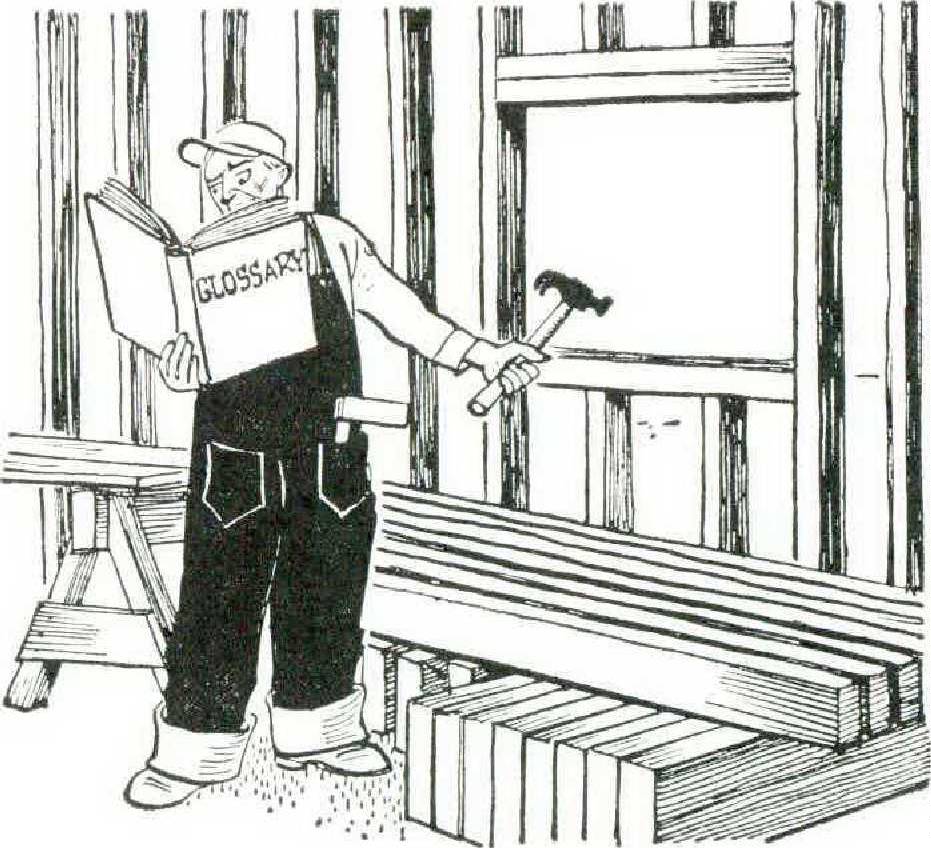
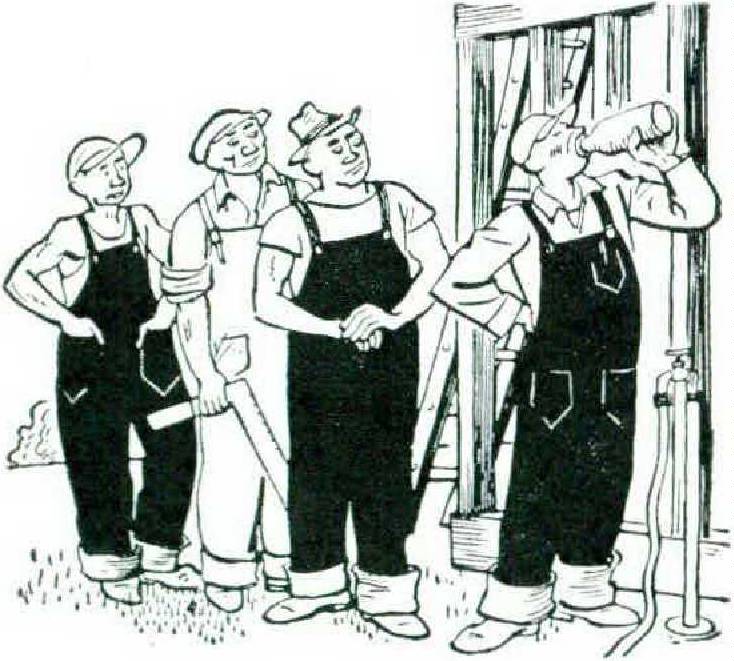
My only trouble was that for some days, until I had learned the secret, I felt rather lonely. Not only was I unable to talk to the other workmen, but I suspected that I was being ostracized. When we paused for refreshment, as we did every other
hour, my turn at the milk bottle of water was always last.
I decided one night on a bold policy. The next morning, after we had been at it for some hours, a carpenter (three from the last on the water bottle) asked me, “Didja get that shoe spiked down?”
Rejecting the impulse to glance down to see if my laces were untied, I stared at the horizon for ten full seconds, a cold intensity in my eyes. Finally I muttered irritably, “Who squared these ends, anyway?”
“Hah?”
“Should have thrown in a header,” I stated, the vision passing through my mind of a small boy being pushed headfirst from a dock. From there my mind flitted logically to the high school football team. I thrust an end of string into his hand. “Hold the line,” I told him, and very solemnly I walked to the other side of the building. “Hold it tight!” I insisted, jerking the end out of his grasp. I condescended to regain patience: —
“Just put her on the edge of that three by eight!”
“What three by eight?” he asked, apologizing for his ignorance with a quavering tone.
I‘d stepped into it, of course, but I came back fast. “I mean the corner post.”
This worked, even though there were no corners anywhere around him. He held the siring against something quite obediently, and I squinted along it. Then I let it go, shook my head sadly, and rejoined him. I spoke confidentially. “Since the war there aren‘t any real carpenters,” I said, and he mumbled in complete agreement as I returned to my task, which consisted of nailing certain boards from a certain pile to other boards from another pile in a certain way.
The boss, who has the visual equipment of a house fly, took all this in. I could feel it without looking at him, and I knew it at the next pause, when I was given my colleague s spot of third from the last on the water bottle.
In fact, during the afternoon I felt the boss circling around me suspiciously several times. Finally he drew me aside. He looked genuinely puzzled. “Say,” he said, “what kind of bridging would you get for under that platform?”
“Well,” I replied, “you got beaded boards on the floor. I‘d heard this not five minutes before.
He scratched his chin and peered at me, and suddenly I had the uneasy sensation that maybe he hadn’t been puzzled about the building but that he had been puzzled about whether or not to keep me.
I said casually, “Oh, keep ‘em happy; give ‘em whatever they think they want in their specifications.” And I sauntered back towards my hammer.
But I still sensed a dangerous indecision in his manner.
Then in one of those rare flashes I recalled a friend’s unfinished house in another part of the country in a near-forgotten time. “What kind of bridging?” I mused. ‘Must so long as you don’t let ‘em pass off any of that native hemlock on you!” I tossed over my shoulder.
At our next moment of rest, I was fourth from the end on the waterbottle line.