When Misfortune Smiles
by BEVERLY KELLER
BEVERLY KELLER is a housewife in Castro Valley, California, where she also writes a column for the local newspaper.
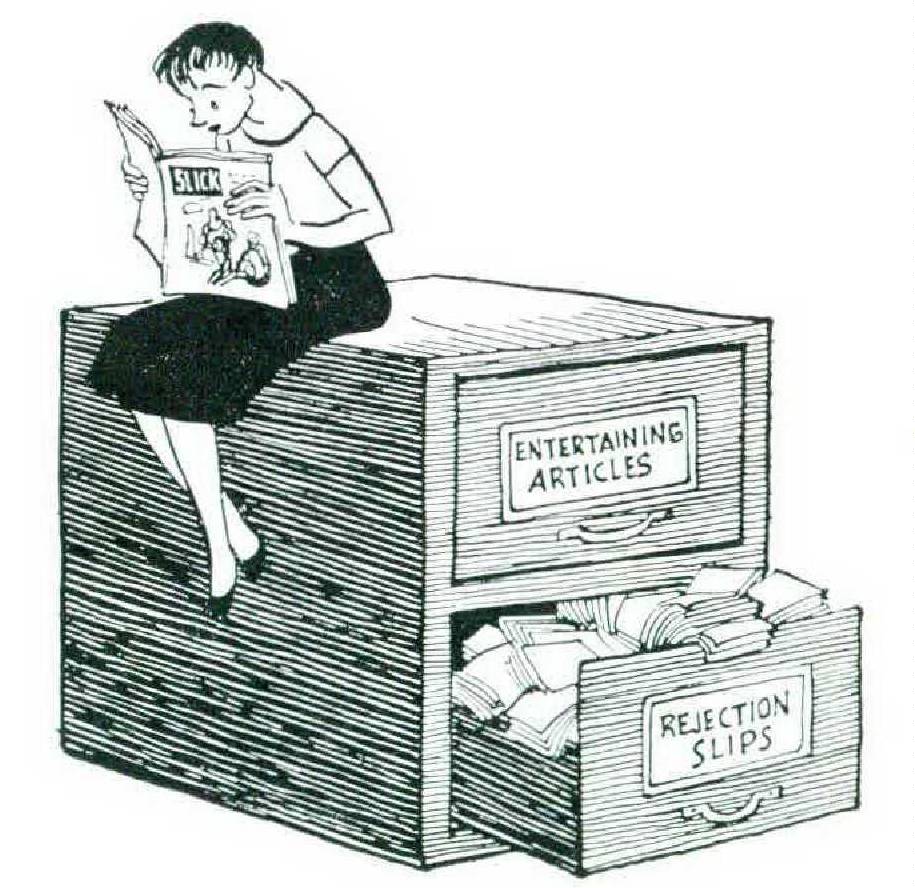
FOR three years I have been writing entertaining, informative articles for slick popular magazines. When the magazines send them back I sell them to the local newspaper for halfaccent a word.
After three years I have found out why I’ve been scrabbling around at half-a-cent a word. As a result, I am on my way to commercial success as a writer.
I began by asking myself a simple complex sentence. If magazines are not publishing my entertaining, informative articles, I asked, what are they publishing?
For the answer, I went to the source. I spent hours studying the magazine racks at the supermarket.
“In this issue, the heart-warming story of one family’s ordeal, ‘Our Baby Was Born Insufferable.’ ” “Now, the inspiring account of a young woman’s agonizing struggle, ‘I Live with My Yaws.’ ”
“What would you do if your adopted baby was a mandrill? Read how one courageous mother faced this problem in ‘Our Little One Hung from Trees.’ ”
‘My Husband and I Are Psychotic,’ the intimate story of a difficult marriage.”
“My Battle with Rocky Mountain Spotted Fever.” “I Fought the Licorice Habit. ...”
For a time I feared that I had nothing to say. I have the professional misfortune to be normal. I am allergic, myopic, a trifle neurotic — but would this leave a reader shaken? My husband is healthy, intelligent, and nice. Neither are my children usable; both of them are bright and beautiful. The older has a tendency to eczema, but it wouldn’t even show up in a photograph. Once I thought I had a brain tumor, but it turned out to be a sinus infection which cleared up within a week.
Then the eggs exploded.
I had left them boiling while I went to pick up my husband. We decided to eat out and then we took the kids to the movie, and when we got back the kitchen was hot and reeking and stippled with bits of white and yellow.
And I knew I had something to say.
“I Am Accident Prone.” Or, maybe, “I Am Living with Accident Proneness.” Or, “My Battle with Accident Pronation.”
I don’t know how I overlooked it. There was the time I sneaked up behind a smaller child with a snowball in my hand and fell over a fence, and there was the time when, in the first flush of young-womanhood, I washed the fuses. I can remember my mother pouring dishwater over me and saying, sibyl-like, that some man was fated to lead an exciting life while it lasted.
I can see my own personal excoriation taking form already. I might begin it with the time I almost killed my aunt with the mousetrap. She was hovering at death’s door to begin with. She seems to spend a great deal of time there, but I see no need to emphasize this. At the moment, it was asthma, since her best friend had recently recovered from pneumonia. When anyone she knew had an operation, she had trouble with her appendix. The day I broke out in measles, she developed hives. She had lordosis, astigmatism, neurasthenia, and chronic indigestion. This gave her something in common with almost everyone. I think this makes for tremendous reader-identification.
I will describe her, with all her female relatives preparing her for the doctor’s visit, brushing her hair, plumping her pillows, feeding her hot broth. And myself, young, with a capacity for spontaneous sympathy which was depleted after the first half-dozen crises and with a mystic faith that she would recover in time to have her annual October flu. I was painting my toenails.
“Would it be too much to ask you to pull up the shade?” someone asked. Hesitating only long enough to finish painting the toenails on my left foot, I went to the window. There was a radiator under the window and a mousetrap under the radiator. I remember my pain, my furrowed toenails, my screams. Someone spilled broth down my aunt’s frontage. The doctor, sprinting into the room, seized me and said calmly, “Let’s get this girl into bed first.”
As soon as she could speak, my aunt said, “That one’s going to be the death of me,”
She recovered before October.
From here I’ll go on with an intimate chronicle of the years which followed — the time I stepped behind my tennis partner to admire his serve, the afternoon I removed paint from a table by covering the table with paint thinner and lighting it, the day I monogrammed my thumb with the zigzag machine. . . .
For the uplift at the end, I thought it would be nice to say that after some particularly gruesome accident I made up my mind to break the habit entirely, and that after years of painful effort I reached the point where I can leave them alone, but that I know I can never relax, never indulge in that first sneaking little error. . . .
I realize that one problem remains.
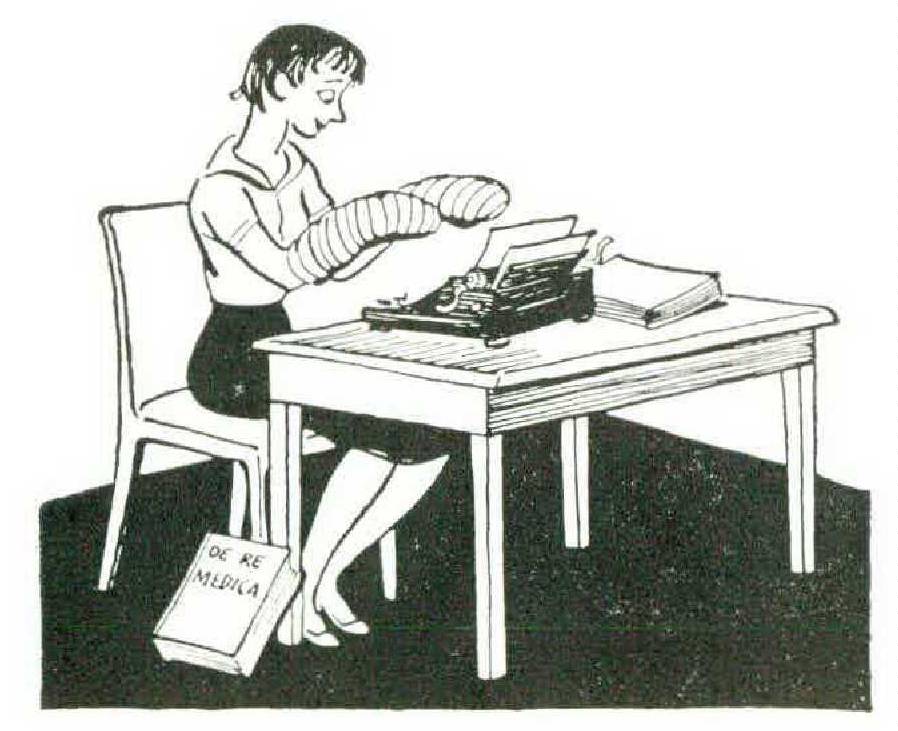
After one’s private hell has been set in type, one is written out. As soon as I send out my article, I must face the question of where I go from here. But I see no reason for panic. After all, something terrible may happen any day now.