Genius Wanted
JEAN THRASHERis a young Atlantan who got her degree at Wesleyan College, Macon, Georgia, in 1954 and is note doing graduate work at Northwestern University.
by JEAN THRASHER
THE tyger had roamed the jungle for many centuries. Then one day he said to himself, “I’ve been a primitive long enough. Everyone else is going urban, so I’ll just brush up my striped leggings and make a stab at it too. I’ll start with London.”
London it was, but no one noticed him — not the high society, the middle society, or the rock-bottom, nota-shilling-in-the-breeches-pocket society. Everyone was too busy with the Empire and the cost of mutton.
Then one day the tyger was strolling down by the Thames. He spotted a man sitting on the bank. The tyger straightened his shoulder pads and sauntered right up to Mr. William Blake. “Rraaww,” he said in his best, tiffin manner.
Blake dropped suddenly out of his mystic meandering and nearly toppled into the Thames. “Egad, don’t burn quite so bright in my direction, would you,” he said to the tyger. “You’re certainly a handsome chap. You’re a symbol. I would have spotted you anywhere.”
The tyger vibrated appreciatively.
“What am I a symbol of?” he asked proudly.
“Oh, almost everything. That’s the way it is with symbols, you know. You are the universal type. If I had a Iamb to match you with, you could he contrasted as experience and innocence, good and evil. In fact, I think I’ll write a poem about you.”
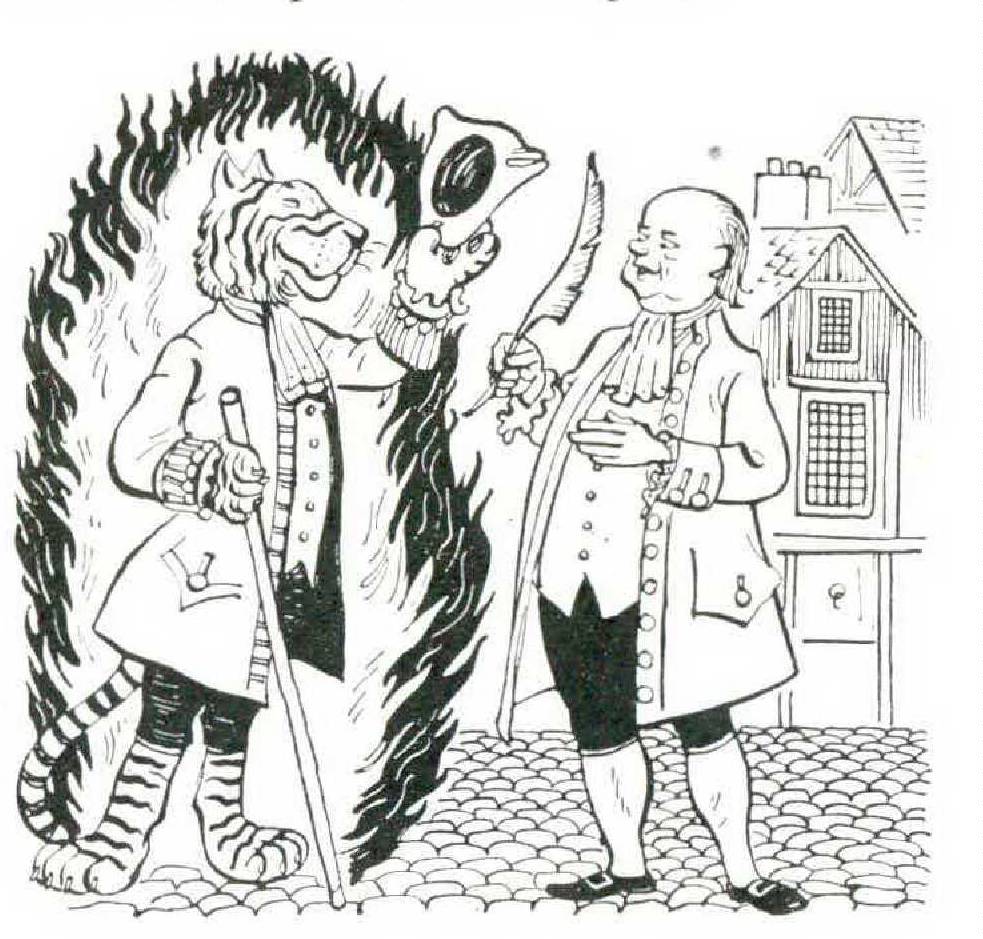
When the tyger read Blake’s poem, he growled happily because it caught the beauty in his ferocity. It went like this: —
In the forests of the night,
What immortal hand or eye
Could frame thy fearful symmetry? . . .
Did he who made the Lamb make
thee? . . .
The tyger and William Blake caused many a carriage jam on their daily promenades around London. And everyone looked at him and exclaimed, “That’s William Blake’s tyger. Isn’t his fearful symmetry just the glass of fashion!”
Then one day in 1827 Blake said to the tyger, “Look here, old fellow, I hate to be a promenade-pooper, but I’m just a little tired.” The next day Blake died, and the tyger was rudely pushed out of his little nest of notoriety. No one recognized him any more.
The tyger finally went to the library and curled up in Songs of Experience. He was determined to hibernate.
One day a man named Mark Schorer came in and nudged the tyger with his fountain pen. “My dear Mr. Blake’s tyger, would you mind disclosing the secret of your longevity?”
“Certainly not,” answered the tyger, pulling his right eyebrow down like a tassel. “‘The Tyger’ can be read in many ways — as the simple opposition of innocence and experience; as the paradox of the creation and of Christianity, the antithesis of love and wrath, good and evil; as the expression of delight and awe before the magnitude and variety of creation . .
Schorer scribbled down the tyger’s comments. It’s all in William Blake, The Politics of Vision on page 251.
When the book came into the library, the tyger almost fractured the binding laughing. He knew Schorer had a collaborator, but “William Blake’s Tyger” would have looked silly on the title page.
Another man cheeked out Blake s poems. The tyger peeped at the card. The name was T. S. Eliot.
When Mr. Eliot got home, the tyger crawled out and yawned. Eliot rubbed his back. “Nice pussy. Thereupon the tyger nipped him gently on the forefinger.
“Angels and ministers of grace defend us! Be thou a spirit of health or a goblin damn’d.”
(Hamlet, Act I, sc. iv, lines 39-40)
“Be thou T. S. Eliot, as I tIhink you are, or William Shakespeare, as I’m sure you’re not ?” the tyger answered.
“Thomas Stearns Eliot,” the man answered hollowly. ‟I intend to write an essay on Blake showing how the lack of religious tradition in his environment hampered . . .”
“Look, you write the essay. I’ll just sit here by ihe grate and sweat some of this yellow fog out of my system.”
The tyger listened to the first draft of the essay, later published in The Sacred Wood, but he wasn’t as cultured as he had pretended. Eliot was a genius, and who can argue with geniuses ? Everyone knows they have sharper teeth than tigers.
Then one day Eliot was writing a poem called “Gerontion.” He had gotten as far as lines 17-20.
The word within a word, unable to
speak a word,
Swaddled in darkness. In the juveuescenee of the year
Came Christ . .
He stopped writing.
“Did you have one too many mixed metaphors before dinner?” asked the tyger.
“I need a symbol.”
“Well, here I am burning straight at you.”
“All right, you’ll do.”
And the lyger did do. Eliot ended the line ”... Came Christ the tiger . . .” The tyger was the symbol of Christ and his redemptive fire. Of course, Gerontion was lost anyway because he could not reach the lifegiving fire.
The tyger smoothed his sideburns proudly. Once again he was an active symbol.
Then one day the tyger ambled in with tears running down his plump jowls.
“Now don’t you look ridiculous,” Eliot said.
“All my burning will tarnish in this London fog,” the tyger whimpered.
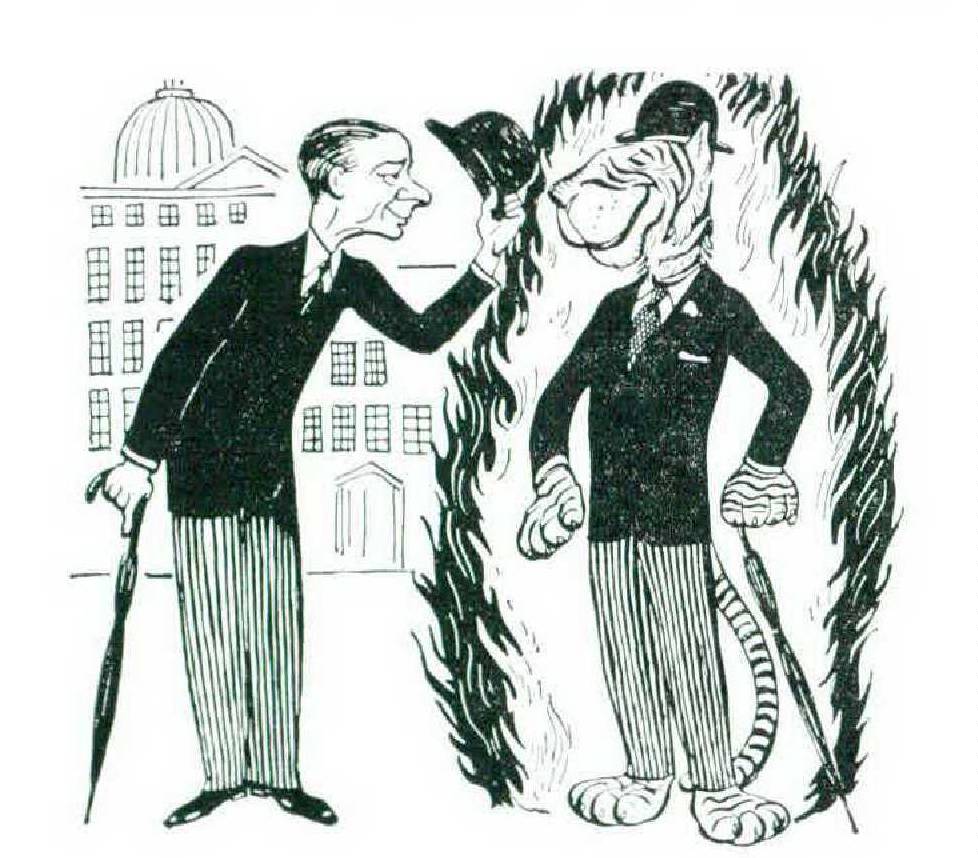
Eliot was certain the California sunshine would restore the tyger’s bright personality. He booked passage for him on the Queen Mary.
Now the captain wasn’t accustomed to having tygers in pin-striped suits pacing the decks. He gave the tyger all the travel folders on California, conducted him to his stateroom, and locked the door.
During the voyage the tyger decided Beverly Hills was the place for a celebrity of his caliber.
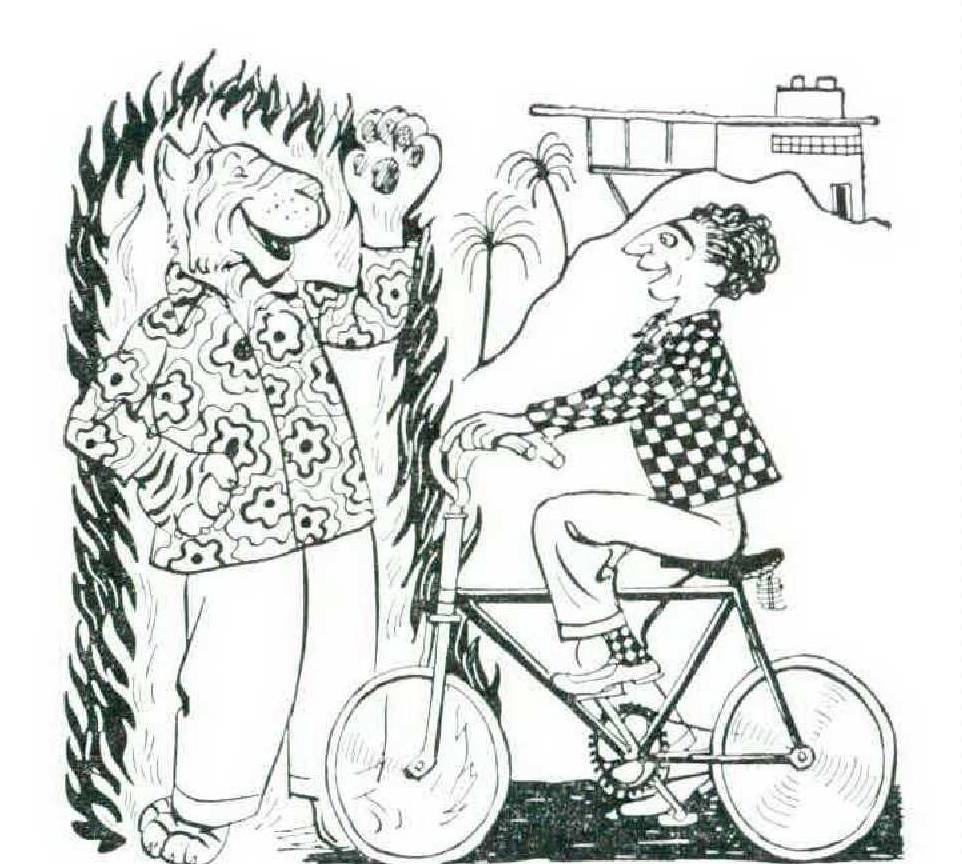
When he got to Beverly Hills, he took a bus tour. A man on a bicycle rode up beside the bus, saw the tyger in the window, and nearly fell in front of an ice cream truck.
The tyger got out and dusted off William Saroyan with his tail.
Saroyan said, ”I’m a genius and you’re a symbol. We could write such a beautiful book together.”
‟You don’t look like a genius, said the tyger, flicking his ears suspiciously. “What’s a genius doing riding a bicycle?”
“That’s why I’m a genius. Balance, you know.”
“In that case, I’ll be glad to cooperate.”
Saroyan told the tyger about William Tracy, a character who would just love to have an invisible tyger, that was really a black panther, except Tracy thought it was a tyger.
The tyger unraveled himself from the syntax and informed Saroyan that he didn’t know what else he was talking about, but he would only half consider being invisible. So they agreed. The lyger was invisible for only half of the book.
The tyger loved people. In Tracy’s Tiger he gave them love, and love gave them happiness — that is, if they recognized love and were not afraid of it. The psychiatrist says on page 73 just what the tyger would have said.
‟. . . Where is fun, where is play, where is imagination, where is magic? Psychiatry I hate. People I love. Mad people, beautiful people, sick people, broke people, ill pieees people. I love, I love. Why? W by is lost from people fun, play, imagination, magic? What for? Ah ha. Money? ... I think so. . . . No more fun. Work now. Tiger. Tiger.”
One hot afternoon the tyger went to the drugstore with Saroyan’s son, Aram. He ambled over to the lunch counter and perched himself nonchalantly on a stool.
The man beside him looked around terrified. Then the man laughed and said, “You’d make a perfect epitaph for an explorer. You know. ‘Tiger, Tiger, my mistake. I thought that you were William Blake.’”
The man laughed and the tyger laughed, and the man’s name was Ogden Nash. He published the couplet in Versus on page 82.
The last episode in the eventful life of Mr. Blake’s tyger is explained by a want ad in several metropolitan newspapers: —
WRITER WANTED
Reputable writer wanted. Must be genius or near genius and adept in using symbols. Excellent opportunities for advancement. Write Box 153, this newspaper.
WILLIAM BLAKE’S TIGER