Save Our Symbols!
by CARL ROSE
CARL ROSEhas illustrated the Atlantic’s Accent on Living pages for the past, twelve years. His article “Europe Instantly!" appeared in these pages just a year ago.
IN THE Atlantic Report on the World Today, “Science and Industry,” December, 1955, an item on the uses of the tape recorder begins thus: Cartoonists, notably conservative in their choice of symbols, still use the old-fashioned tin-man robot as the personification of advanced technology.In this electronic age a more appropriate symbol would be a long piece of plastic tape.
To one not unfamiliar with cartoon symbology, and also one who has been a persistent trend-spotter, this pronouncement is the latest manifestation in what appears to be a deliberate campaign, waged by burgeoning Science, to deprive the hapless cartoonist of his only staff — perhaps of his raison d’être.
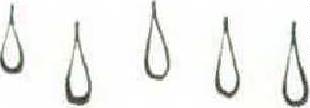
There have been other evidences of this creeping constriction. Not many months ago, a scientist emerged from a profoundly abstruse study of the subject to write an article for the Scientific American on the exact shape of liquid drops — rain drops, tear drops, oil drops. His findings were — and he had the photographs to prove them — that tear drops were not at all graceful little pear-shaped thingumbobs like this:—
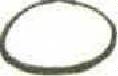
Like the Atlantic writer on plastic tape, he included an irascible sentence implying that notably conservative cartoonists would probably stick to their traditional and incorrect conception. Do you know what a scientifically approved tear drop looks like? Like a little hamburger bun.
Well, in the past half-century our cartoon symbols have been in a state of flux. Under the prod of Science we have been forced to discard, one after another, treasured and hardwon symbols; symbols which are instantly recognizable to readers of cartoons, and serve to prove that here at least is an art whose practitioners do not use a private language.
Where now is the cartoon symbol for great wealth, for Plutocracy? Some years ago, the Nabobs, the Robber Barons, the Vested Financial Interests, were portrayed as porcine individuals, silk-hatted, bulb-nosed, wing-collared, sphere-bellied. They wore dollar-signed vests around their uninhibited equators, and watch chains thick enough to secure an anchor swung in flamboyant catenaries around their fourth buttons. From these dangled appropriate ornaments — generally human skulls.
How now, in these heydays of Science, can one depict unseemly affluence? Certainly affluence has not disappeared from the human scene, especially if what we hear about Texas is true. A mere quarter of a century ago, it was easy: a silk hat, a fur-collared coat, a gold-headed cane, and you had a demonstrably rich man. Today’s Croesus wears a homburg (no fur collar, no cane) for which he may have paid two hundred dollars but which, for cartoon purposes, looks not a bit different from the tendollar homburg affected by the honest laboring man on lodge nights.
What has Science given us to replace that clearly comprehensible symbol for irresistible power, the mighty Juggernaut, and its smaller brother, the simpler but still pictorially effective steamroller? It has given us the Atom. The Atom, according to Science’s own description, looks like this: —
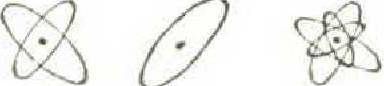
Hardly stirring, graphically, as a symbol for stupendous strength, especially since they come about 6,000,000,000,000,000,000,000,000, give or take a couple of trillion, to a spoonful — and only a teaspoon at that.
And so it goes. Physicists, psychiatrists, sociologists, economists, agronomists, chemists, paleontologists — all are taking their toll of the physical appurtenances by which a cartoonist could make a situation or an issue quickly identifiable to a reader confused by or impatient with the occasional intricacy of an editorial paragraph. No longer does the convict wear a horizontally striped garment. The sociologists have seen to that. No more is the tough guy characterized by the broken nose and the beetling brow; not since the plastic surgeons have moved in.
How is the cartoonist to depict a modern situational dilemma, once so easily pegged by a drawing bearing a caption something like “Between Two Stools”? Science has given us milking machines to replace the stool; and to portray, let’s say, a troubled politician sitting between a couple of milking machines (or lactators, as they are probably called) has no pictorial validity whatever for either the commentator or the commentated.
For that matter, the other reliable and well-tried method of picturing a predicament — the “on the horns of a dilemma" type of symbol — is also unusable under the stern eye of Science. With short-horned cattle being bred nowadays, a seat upon the head of the fashionably modern Hereford steer becomes no more than a comfortable, if rather odd, perch. Once, Unbridled Rapacity was represented by a well-fatted, unmannerly hog at a trough. Ah, but scientists aren’t breeding pigs for fat any more. Pork chops are becoming leaner, like the outlook for editorial cartoonists.
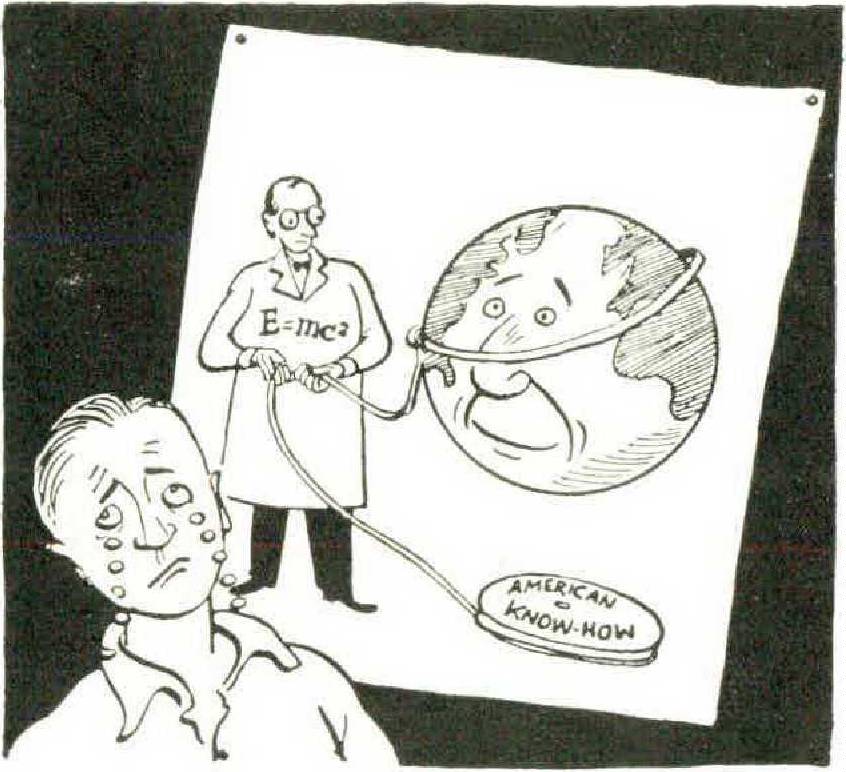
It takes little extrapolation to perceive the end result. Except for a few obdurate Amishmen, chin whiskers are relics of the past. Why, then, should Uncle Sam, the up-to-date, world-leading Uncle Sam, still sport that ridiculous, outmoded little goatee? And as for those striped pants with the strap under the arch, that outrageous beaver hat, that ludicrous 1820 tailcoat — uh! The future Uncle Sam—the Uncle Sam given the seal of approval by Science — will be a balding gentleman with horn-rimmed glasses, wearing a laboratory smock upon which is imprinted an arcane equation (E=mc2, while becoming a bit corny, looks durable enough to do for that nonce). In his hand he may be holding a longish length of plastic tape. Indeed, why not show him lassoing the world with his technical know-how (that would be symbolized by the tape, of course), the world symbolized by the usual sphere, assuming that Science still holds the world to be a sphere? Come to think of it, Uncle Sam would resemble, of all people, a physicist. This should certainly leave the scientist happy, but its effect on the cartoonist could best be symbolized by a drawing of his dolorous countenance with little hamburger buns streaming down his cheeks.