A Change of Outlook
SHEVAWN LYNAM is a young Irishwoman whose first novel, The Spirit and the Clay, was published in 1954 by Little, Brown.
by SHEEVAWN LYNAM
ENOUGH is as good as a feast” is a I proverb I was always hearing as a child, but I don’t think I had the faintest notion what it really meant until recently. I‘d decided I needed a change — not just a change of air and scene, but a change of outlook — and the place I‘d selected to seek it was Inishere. It’s the smallest of the three Aran Islands, which stand like sentinels across the mouth of Galway Bay in the west of Ireland.
“Aran’s the poorest place this side of Hell, a Dublin friend said when he heard where I was going. At first it certainly might seem so: a rock five miles in circumference, without a tree, a road, a wheeled vehicle, a telephone, a daily paper, a doctor, a policeman, or even a slip on which to land the islanders’ curraghs.
On a hot day you could imagine you were in the South Seas, with crystalclear sapphire water, a. long strand of pale sand dropping sheer into it, a haze hanging over the whitewashed cottages, and Anne, the old woman with whom I lived, exclaiming all day, “I’m roasted alive with the heat!”
That was how I first saw it — but the next day the whole landscape had turned to gray, and the island seemed to heel over in the wind. The western doors into the cottages were sealed against the gale and the eastern ones were opened, donkeys and cattle huddled together to leeward of the high stone walls, and I began learning how to lean on the wind as I walked, a habit it took me months back on the mainland to lose. Anne would frequently talk of the sea being “mountains high.” That night it was mountains high. Every time the bow of the little canvas boat plopped into the water on the far side of a massive wave, I assumed we were about to capsize. But gradually, as we continued somehow to survive from wave to wave, I grew curiously elated with the sensation of galloping a bucking horse across the ocean.
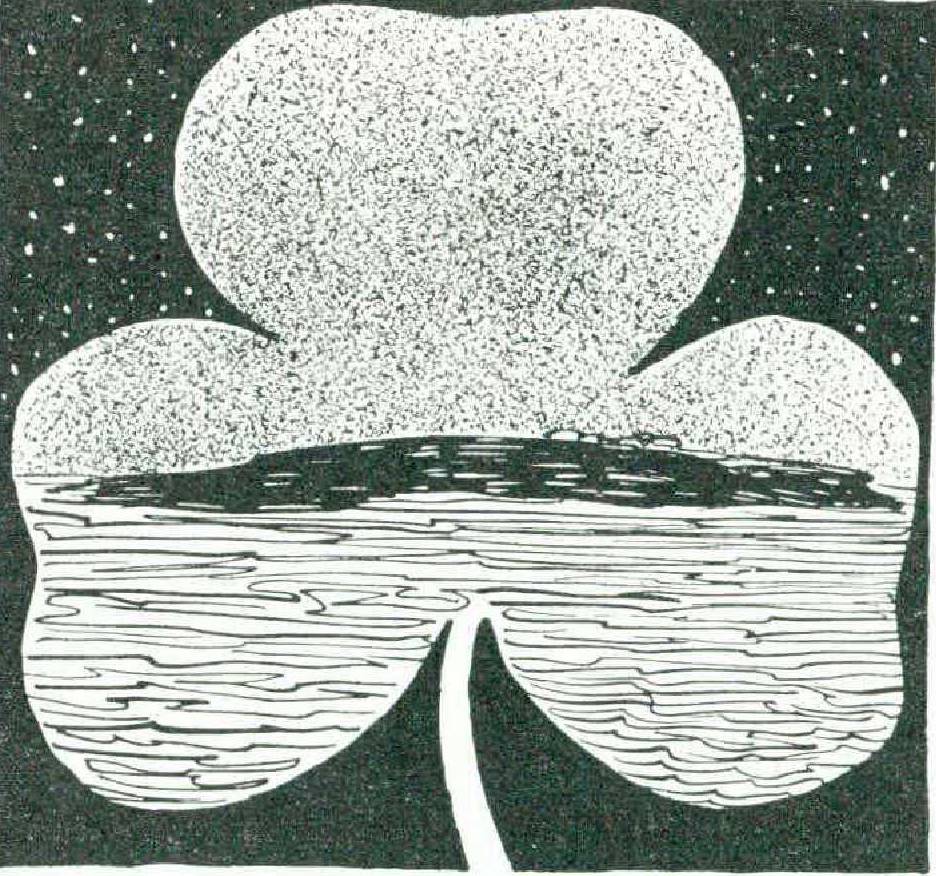
It was on one of these tempestuous evenings, after I’d been an islander for almost seven months, that I discovered how close I’d got to the change ol outlook I was seeking. I was just getting into bed when I heard a tap on my windowpane and voices calling me to come out. A large trawler had been sighted about three miles offshore, sheltering between the island and the mainland from the storm raging in the open Atlantic. One of Anne’s sons and two of his friends had decided to go out to get some deep-sea fish from the trawler, but they‘d guessed she must be foreign and were afraid not to be able to make themselves understood.
Within a few seconds I was running down the dark strand, still struggling into my clothes. Life on the island was always like that – tinged with expectancy. One was always scanning the horizon for the sails of a turf boat from Connemara, or for the weekly steamer from Galway, thirty miles away, or simply for a sign that there would be a sufficiently long lull in the storm for one to get to the next island or to the coast. There was always the possibility of sighting some timber from a wreck, or a trawler with deepsea fish, and then the boys would run to put out their boats and race for the prize.
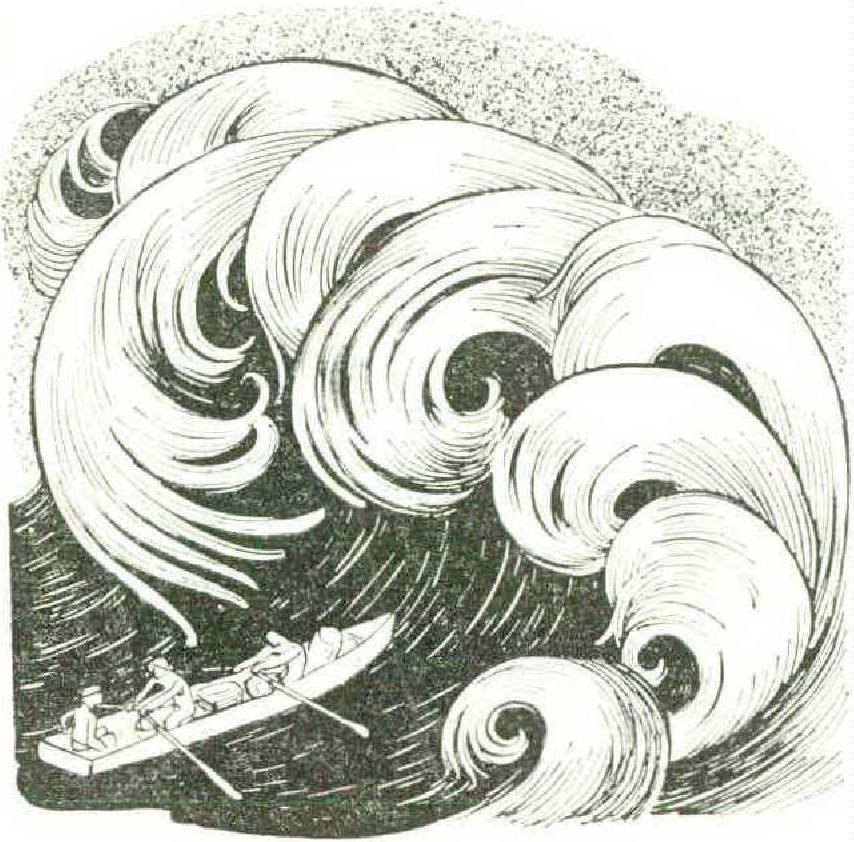
As we approached the trawler a searchlight began playing on us, and as we came alongside I could read the name of the port — Vigo — painted across the bows. I tried then to shout up to them in Spanish against the wind, while I was being pushed and hauled up a rope ladder which almost swung me into the water at each lurch of the boat.
Once aboard, we were handed pint mugs of Cadiz brandy and taken over the ship. Then, installed in the captain‘s cabin, the moment arrived for me, as the official interpreter, to state the purpose of our mission. The islanders, I explained, could not go out after deep-sea fish, such as plaice, in their small curraghs, and they wondered if the Spaniards had any to spare. But when the captain, with typical Spanish generosity, offered a few baskets of whiting, the Aranmen pulled faces and instructed me to explain that whiting was no good for salting down — and salting the fish they’ve caught in the season to sell on the mainland in the aulumn is the islanders’ main industry.
The ship was rolling and pitching. The brandy was leaping out of our mugs and making little puddles on the floor, and the chairs and tables were jazzing crazily 1o and fro across the cabin. The captain stared out of the port hole at the black outline of the island, which looked like some archaic monster crouching on the horizon, and he asked how many houses there were on it. 1 replied that there were eighlv.
The captain then became pensive, as if he were working out a complicated sum. He reached for the bottle and began to refill the mugs and to soak the floor alternately, sometimes pirouetting gracefully or suddenly running at full speed across the tilted room to keep his balance. And all the lime, he was calculating under his breath.
At last he said, 7#8220;Well, if each house contributed an equal share, the island could buy a trawler like this one, on a cooperative basis, and they could go out to fish wherever and whatever they liked.”
I conveyed all this to the islanders. They stood six foot one, two, and four, each as spare as a spruce, with chiseled features, curiously line little hands and feet, and the manners of mandarins. They murmured together in Irish, and then one of them smilingly explained: “We‘d rather each to be going out on his own hook.”
The captain‘s jolly, fat face dropped in astonishment and I found that subconsciously I’d been hardening against mainlanders; they obviously couldn‘t understand us. It seemed hardly worth explaining that the islanders grow their own clothes on their own sheep’s backs and that the island weaver weaves them; or that they make their shoes pampooties, they‘re called– from their own cows hides; or that they make their land with their own hands — they spread sand on the rock, fertilize it with seaweed, and produce some of the best potatoes in the world. They don‘t really care how the world outside does things — they do everything for themselves.
The captain had meanwhile been consulting his companions, and he came hack to the charge.
“Maybe they don’t understand,”he said persuasively. “Explain to them that they‘d make much more money this way.
But the islandmen only smiled gently and replied: “Haven’t vve enough the ways vve are?
Well, we left the captain flabbergasted, and in the end we look the whiting. The journey back was little different from the journey out until we reached the shore. But there we found enormous breakers hurling themselves at the strand which they’d turned into a high shell, and as they recoiled, the shingle withdrawing with them rumbled like thunder. Our little boat seemed like an animal at bay as vve prowled up and down, maneuvering to attempt a landing. We even thought of returning the three miles to the trawler, but the storm was growing worse. At last, almost in desperation, we swung the curragh around to face inland, and suddenly the wave we were trying to race rushed snarling after us and flung us onto the strand — capsized, but on land and smothered in whiting.
The next day, as so often happens, the sun was shining; the wind had swung around and we could hear the ocean humming gently on the far side of the island, like some giant machine that kept the whole life of the place turning.
I found Anne sitting in her rocking chair in front of the cottage, knitting; her only comment on the night‘s adventure was her disgust at hearing that the Spaniards spoke no English. After all, she explained, the islanders were Irish, but they spoke English as well as Irish. The Spaniards must be very uneducated people, like most foreigners, she felt — and for her that included mainlanders.
“Aren’t they forever composing lies at us about the places they‘re from?” she said, clicking her tongue disparagingly. “An island woman’d he out of her latitude entirely in thim places.” I knew well she wouldn’t change the island life for any other.
I can still see her sitting there, as neat as a pin in her long, red tweed skirt and velvet-trimmed bodice, as she rambled on in her picturesque English, translated literally from the Irish: “Musha, I‘d ever my fair share of trouble, Shevawn asthore. And if I had itself, hadn’t I ever my enough, too? And would you believe this, now — and there‘s no more lie in this than if I was going down to the grave today - I never was wance without my breakfast, never wance. Wasn’t that the great thing, now? Arusha, God was good, surely.
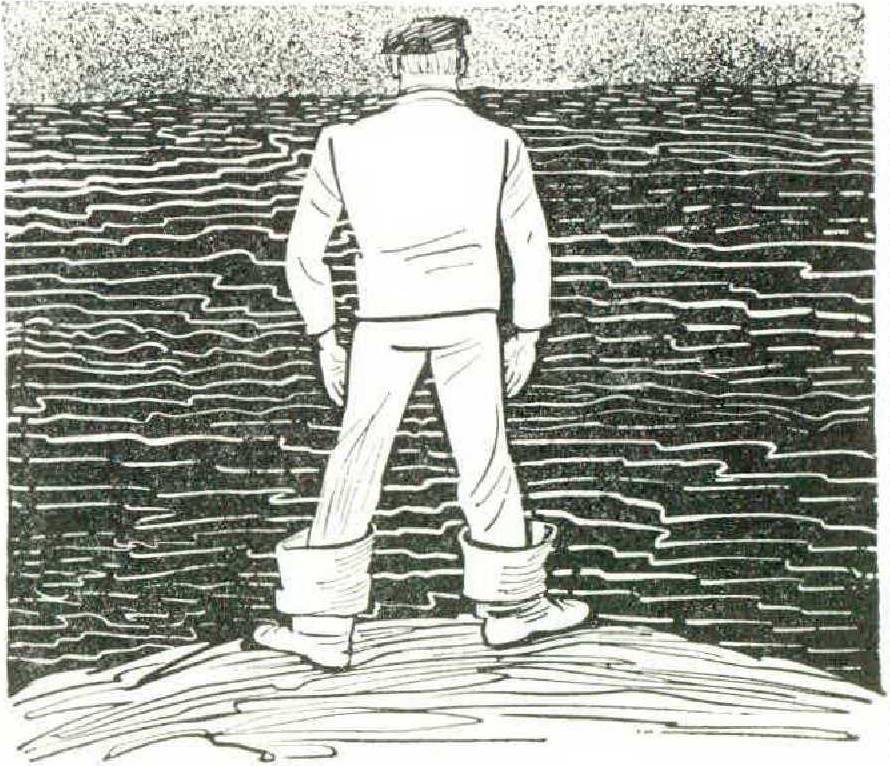
I think that’s what I remember most vividly about the island. As an islander myself, I‘d grown to think of it as one of the richest places on earth.