One Man's Wine
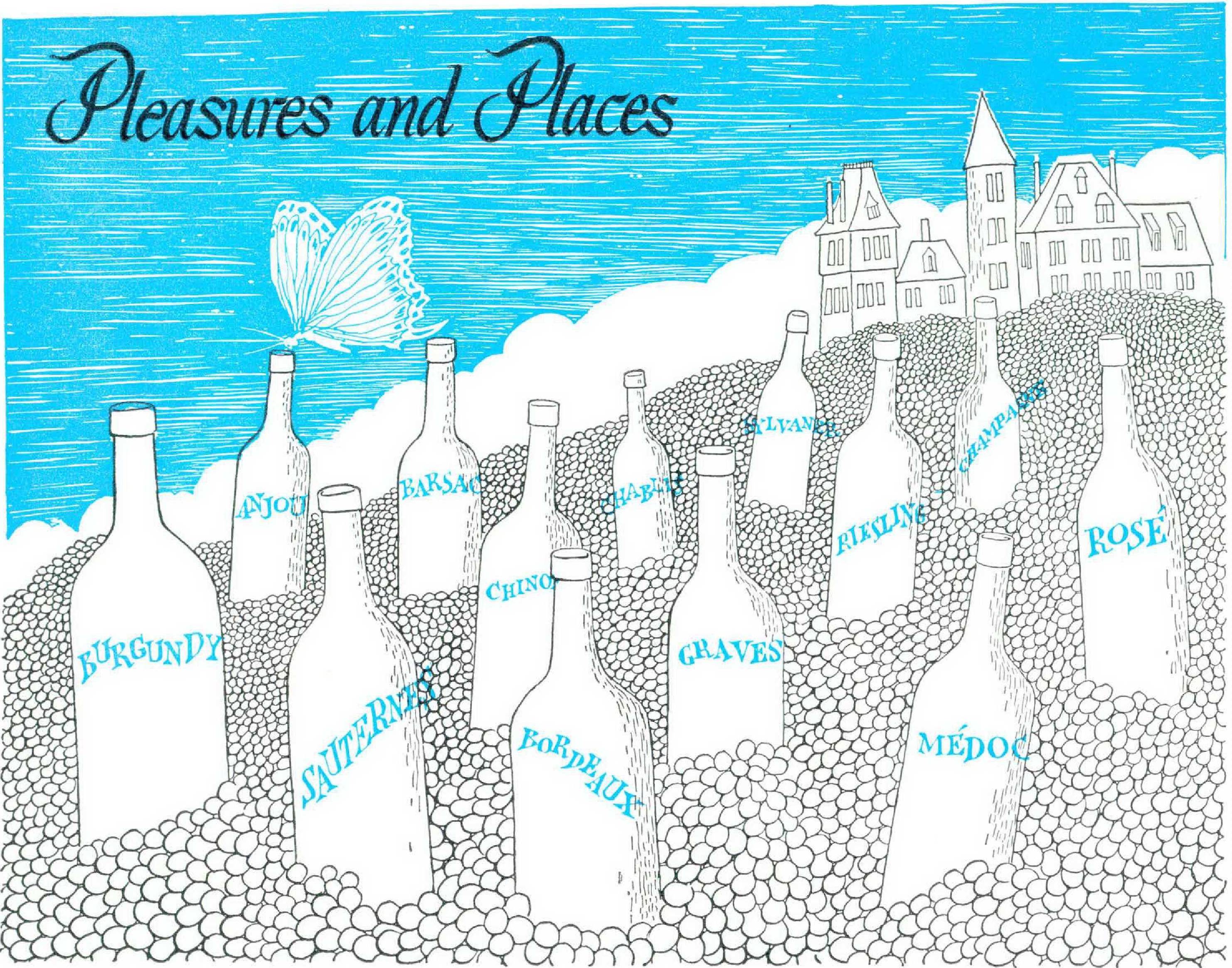
EACH year in spring, when the first American tourists come to France to look at the chateaux and wine cards, the citizens of Bordeaux go out to the château vineyards to look at the grapes and listen to the rumors. The rumors mature faster than the grapes. Winegrowers, brokers, shippers, merchants, and the rest of the community who make their living from growing, doctoring, improving, barreling, bottling, blending, and selling wine, start to guess what the new harvest will be and visit les vieux to get valuable tips.
Among the Old Ones are men like M. Dubos, the owner of Chateau Cantemerle, whose predictions are based on charts of every day’s weather going back almost a hundred years, with minute statistics of rain, sunshine, temperatures, and other climatic detail. These experts tell you as early as March, with a perfectly straight face, “The new wine is going to be like the 1900. If it s going to rain before July 10, it will be more like the 1928, only softer, rounder. Bad weather in September might turn the wine into the atrocity of 1927,” and so on. Such guessing is popular among the 1,800,000 winegrowers of France, where wine-making is the country’s number one industry, employing one person out. of seven. The French love to talk wine as much as they love to drink it.
With the assistance of these oracles speculators bought up futures of half the 1955 harvest as early as April, when they couldn’t possibly have any idea what the grapes would be like. The owner of a famous first-growth château in the Médoc had to sell part of his future harvest but covered himself by buying one third of the (future) harvest of another great château. Serious wine-lovers deplore such speculation as a dubious practice. The speculators take a considerable risk: one bad storm in late September might knock out the bottom of the wine market.
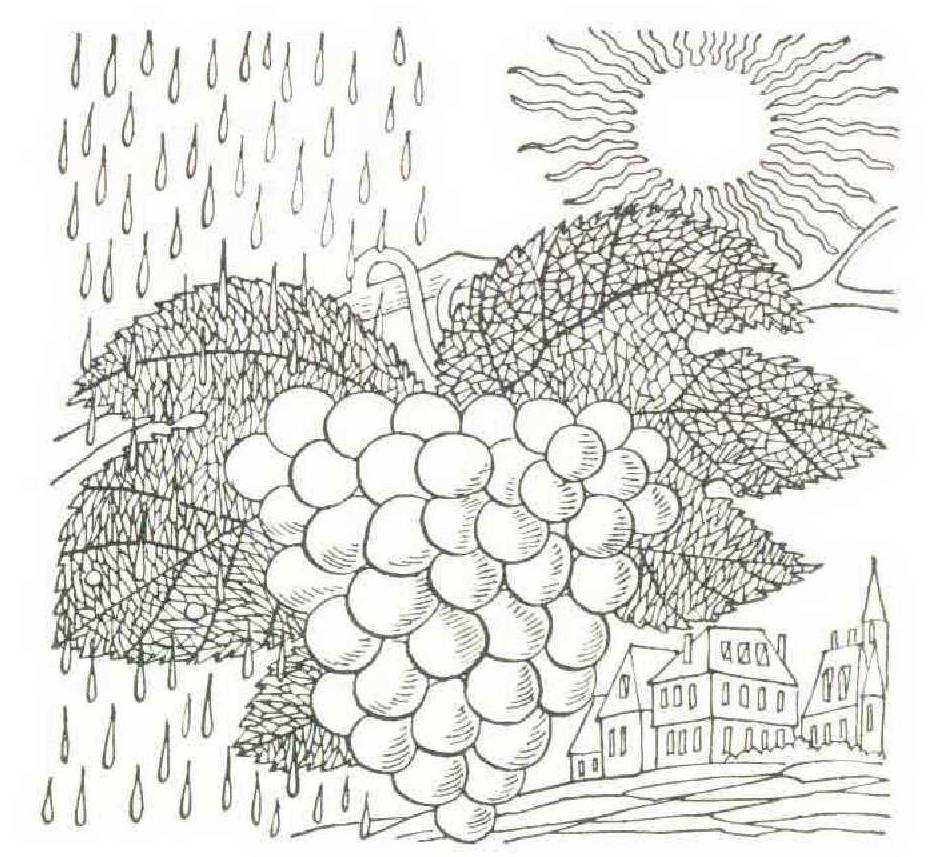
In 1955 they were lucky. After a fine dry spring and a hot summer with just a little rain once in a while that gave the grapes much-needed moisture, harvesting took place under almost perfect conditions. The 1955 wines are already hailed as one of the century’s great vintages, comparable to the 1900, 1929, or 1945. Its prices will be the highest in years. The speculators made a killing; the price of a. tonneau of a premier cru in the Médoc went up in a few weeks from 250,000 to 600,000 francs.
(In Bordeaux, prices are quoted in tonneaux, though there exists no such thing as a ton. The imaginary tonneau consists of 4 barrels, each containing 225 liters. The yield of a tonneau is 96 cases of 12 bottles each. In Burgundy the barrel is called pièce and contains from 226 to 228 liters, in the Mâconnais 215 liters, in the Beaujolais 216 liters, in Alsace 114 liters. In the Champagne it’s called a queue and contains 216 liters. In Algeria they keep the wines in 700liter barrels and sell them in 100liter units. It’s a perfect example of t he French sense of individualism and confusion.)
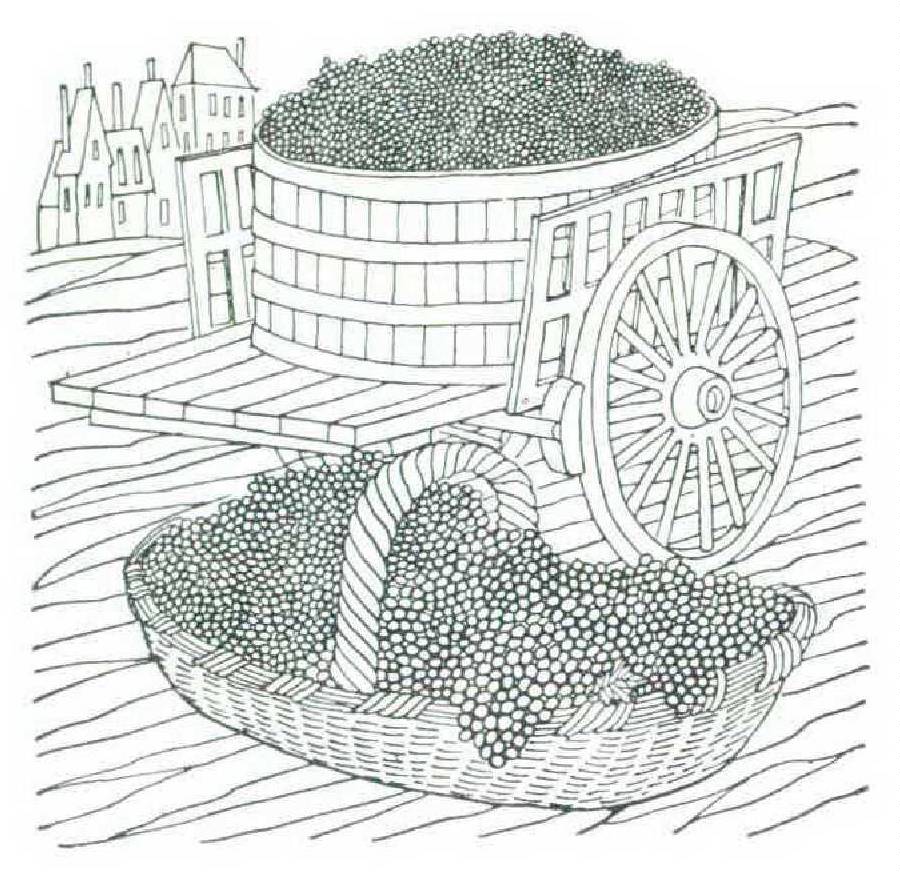
Harvest time in Bordeaux is a good time to visit. Throughout the great wine districts of the Medoc, St. Emilion, Pomerol, Graves, Sauternes, and Barsac, all available men, women, and children are recruited to pick grapes. There are never enough pickers. They get 500 francs ($1.40) a day, three square meals, and all the grapes they want to eat. Actually, the best grapes for wine-making are not very good for eating.
It takes three kilos of grapes to make one liter of wine. The bunches of grapes are cut by the pickers, filled into hampers, taken to the chai (shed), passed through the egrappoxr (a machine that tears off the stems), and emptied into 10-feet-high vats. There the grape juice ferments for a week or two, depending on the amount of sugar it contains. The alcohol in the juice dissolves the color from the skins of the grapes; the longer the skins remain in the grape juice, the darker will be the wine. To make red wines, I he skins are left there from ten to fifteen days; for roses from three to five. White wines are pressed at once. Most Champagne blends are made from “ black” grapes.
Speed is important. If the vats are not filled quickly, the air inside will cause oxidation of the grape juice. The owner gives a banquet to his pickers, and they in turn give him a bunch of white flowers. Everybody relaxes — for a moment. Soon there will be other problems. Should the vinification be short or long? When will the new wine be barreled and bottled? What if it gets sick? One mistake may ruin the harvest. Young wine demands as much care as a young child.
But harvest time also means long, pleasant meals with many bottles of fine wine and with the sort of talk that wane amateurs like best. French wine-people are more gregarious and hospitable than the average French. They welcome foreigners in their cellars and homes. They visit one another, taste the unbottled wines in their cellars — the last three years — [ and swap more rumors. Which one will be the outstanding “wine of the year”? In 1947 it was the Chateau Mouton-Rothschild, in ‘48 the Chateau Cheval Blanc, in ‘49 the Chateau Latour, in ‘50 the Chateau Cheval Blanc and Chateau Margaux; in 1951 there was none; in ‘52 it may be the Château Lascombes and in ‘53 the Château Lafite. Watch the ‘54s: they will be better than their reputation!
Chateau proprietors always serve good wines, some serve good food, and a few who are influenced by the Americans have installed sensible heating and plumbing. The American influence in the Médoc, and the most recent addition to the honored ranks of château proprietors, is a 46-yearold, Moscow-born, New York-educated American, Alexis Lichine, wine merchant, author, and raconteur on wine, who runs Château Lascombes, classified as a second growth, and the fourth-growth Chateau PrieuréLichine, in the townships of Margaux and Cantenac respectively. Lichine has upset the Old Ones, whose bible is the official classification of the great growths of the Gironde of 1855 which established the sixty leading vineyards in the Médoc. They left out. the great vineyards of St. Emilion and Pomerol, though today it is common knowledge that the great Château Cheval Blanc and Chateau Petrus are as good as any premier era. (The adoption of the word “chateau” was a smart publicity stunt; some of these “chateaux” certainly are no castles.)
“Prices in the Medoc are not always the result of supply and demand as elsewhere,” Lichine says. “The classification of 1855 is as obsolete as a woolen stocking and has become a convenient excuse for sloppiness. Complacent growers always talk of ‘tradition.’ They don’t bother with modern salesmanship methods because their grand-pere didn’t, do it and you mustn’t ever change things. They live on the reputation of their past. Some of the classified-growths vineyards no longer produce, and some are run down and ought to be reclassified. Of course they won’t be, because that would be a slap in the face of sacred tradition.”
A few chateau proprietors adopted American promotion methods and now get higher prices for their product. The second-growth Chateau Mouton-Uothschild is rated higher by the merchants than most first crus. Château Beychevelle, owned by Achillo-Fould, was classified fourth cru, is rated third by the trade, and is priced like a second. Several fifthcru vineyards — Château PonletCanet or Mouton d’Armailhaq — are as expensive as second-era wines. M. Dubos, the Old One who owns Château Cantemerle and the old weather charts, gets second-cra prices for the product of his vineyard, classified last of the fifth crus.
Though it is largely a myth, the classification is useful because it keeps up a standard of ethics and protects the customer. A chateau-bottled wine always has quality; in a bad year, t he conscient ions proprietor sells Ins wines under the anonymous label “Medoc” or “Bordeaux.” Officially, there exists no such appellation as “Haul Sauternes” or “Graves Supérieur”; if you see them, be careful.
There are a great many good vineyards in Bordeaux that were not listed by the 1855 classification and are not widely known. Bordeaux was always better at making good wines than at public relations. The Bordelais say you can’t propagate Bordeaux wines because the various districts produce so many diversified wines. Shippers who sell wines from all districts are reluctant to promote certain wines. A belated attempt at public relations was made in June, 1950, when growers, chateau owners, and shippers in the Medoc organized a promotional order called Lcs Compagnons du Bontemps. (Bontemps is the small wooden pail for the egg whites used to fine the wine, to remove particles and dregs front the young wine before it is bottled.)
Here a few random notes, jotted down in France late in 1055 for those who like wine for their everyday meals and a great bottle for a great occasion: —
Bed Bordeaux. Some of ihe great wines of 1945 and many of the 1047s are ready to be drunk (except the Graves, which arc stronger, harder, and develop slowly). Among the St. Emilion and Pomerol wines of’46 and ‘48, off years, a great many good bottles can be found. The 1040s are good and ready for consumption; 1950 was a large-quantity year, with good, not too expensive wines that should be drunk soon; 1951 was an average year — the wines are small, pleasant, everyday. Don’t drink the 1952s yet; they will be better in a year. The wines of 1953 are not yet ready; they mature slowly and will be coming into their own in five or six years. The 1954s will be drunk before the ‘53s. The ‘54s have a bad name because, it is said, the weather was bad. Actually, the 1954 wines arc better than average. The weather in the Médoc was bad until September 10, but sunny days followed and the grapes, harvested late, were much improved. Many ‘54s are considered good value — clean, pleasant, fastmaturing, and not expensive.
White Bordeaux. White Graves are always drunk earlier than red ones. Many of them arc considered good buys by the insiders. There are lesser whit e wines from the Entre-deux-Mers region, half-dry, pleasant, and reasonably priced. The sweet wines from Sauternes and Barsac, led by the magnificent Château d’Yquem, are strong, high in alcohol content, and will live for a generation. lit bad years the Sauternes are less sweet, but there’s no such thing as “dry Sauternes” (or “sweet Chablis”). Dry Sauternes is bad Sauternes.
Red Burgundy. The good, clean, fruity wines of 1946 and 1948 are good value. The 1945 and 1947 are great wines, the ‘47s to be drunk earlier. The year 1950 was disappointing, but the light, average wines are pleasant and should be consumed now; 1951 was poor. The 1952 wines are fine and should be drunk at once. The nines of 1958 arc full-bodied, with balance and bouquet, but don’t drink them yet — it’s too early.
White Burgundy. Often fine and fresh after two years, and the best mature within six years. The 1947s are said to be the best of the century — better even than the ‘45§ — but you’ll have to bribe the wine waiter to get one. Both the ‘46s and the '48s are good, clean, ready to be drunk, reasonably priced. In 19.50 the white Burgundies were better than the red; 1951 was a good year of small quantity. The ‘52s and '54s are pleasant and can be consumed now. (Chablis wines are somewhat different : ‘47 and ‘49 are excellent, '48 was a very good year, ‘.50 average, and '51 bad.)
Beaujolais. The only regional wine that is drunk all over France. There is a real Beaujolais craze now, and the wines are overpriced. “Beaujolais,”describing a large area, is no guarantee of quality. The wine is made from the prolific Camay grape, and much Beaujolais is “stretched by Algerian and Midi wines. (Vast amounts of Algerian wine are imported into France, but none of it is sold as Algerian wine; you can guess where it goes.) Good Beaujolais is light, fruity, not too dark, with a fresh aroma, and reminds me of liquid sunshine. The best comes from small vineyards in Juliéttas (the lightest), St. Amour, Flcurie, Morgon, and Moulin-à-Vent (less light). The experts claim it should be drunk young and slightly chilled; they drank the 1955 harvest at Christmastime, I still have a few bottles of Moulin-à-Vent 1945 and Julicnas 1949 which the great late Fernand Point gave me — he served Beaujolais in large carafes in his garden—and they are superb.
Mâconnais. These wines are firmer, less fruity, harder than Beaujolais, and less expensive pending their “discovery. They don’t mature as quickly as the Beaujolais. The best is the Pouilly Fuisse.
Rosés. To hear people talk of pink wines, you’d think they’re something new. They are considered the ABCs of wine drinking because they go with everything. In summertime, they’re pleasant, light, fruity, and should be fresh. Good* full-bodied rosés come from Tavel (Côtes-duRhône), and from Cassis, near (Marseille. Most rosés are vin du pays and should be drunk where they grow and when they’re young. The rosé from the Anjou district is slightly sweetish, light, and doesn’t travel well. Owing to the demand, roses are now also made in the Beaujolais district and in Bordeaux (where they must not be called “Roses de Bordeaux”).
Alsace. Best of these is the Riesling, if genuine. Beware of large shippers, and try to find a small grower who carefully, lovingly makes his own wine. Good Riesling should be clean, fresh, not too strong. Gewürztramincr and Traminer are too spicy, perfumed, and sweetish for me, which is exactly why many others like them. Least expensive is the Sylvaner, an average luncheon wine.
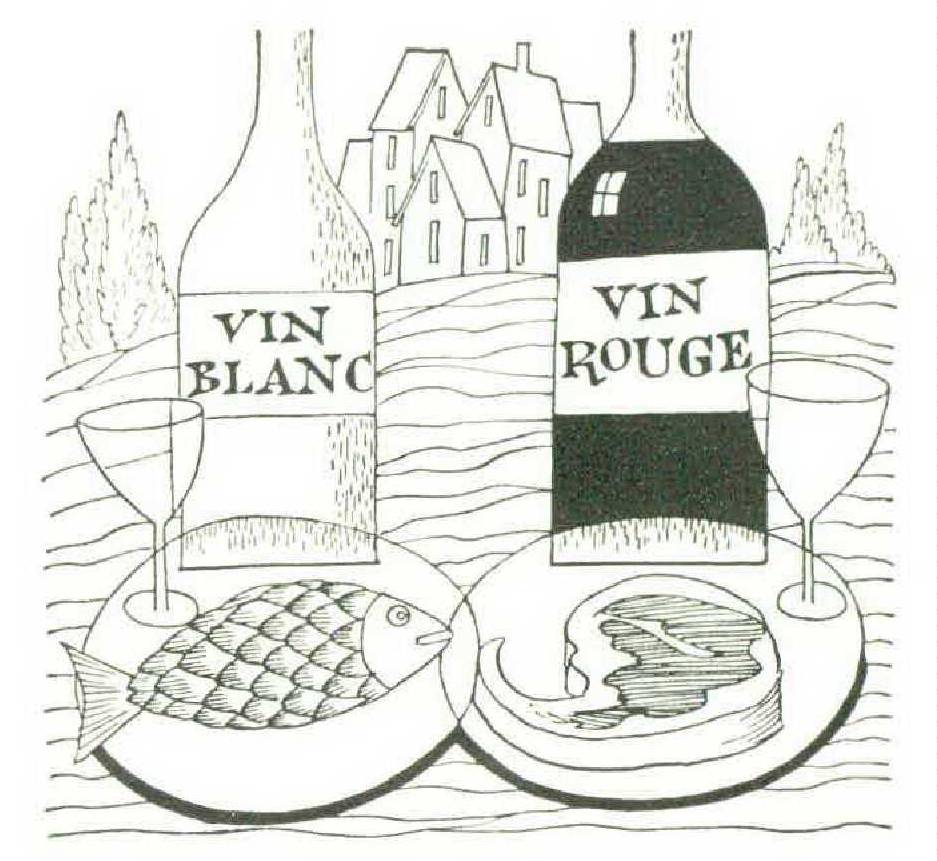
Addenda. For those who like their wines sweet, there are the cheaper Satiternes and Barsac and the pleasant wines from Anjou, the Quart de Chaume. Among soft whites are the wines from Vouvray that have a wide range from young and dry to old and sweet. They are best drunk where they grow, in the chateau country of the Loire. In many Parisian restaurants, the dry white wines from Saneorre are nowadays recommended with fish and oysters; but even the best of them are rarely as good as the medium white Burgundies. Also overpriced (when over 800 francs) are the Pouilly-Fumé wines from the Loire. Good value: the dry, light Muscadel wines. The red Loire wines of Chinon and liourgueil were the favorite liquid of Rabelais; good and inexpensive. For sturdy drinkers: the heavy, suncooked wines of the Côte Rôtie (Roasted Slope), rich, deep-red, fullbodied; the wines from Hermitage and Châteauneuf-du-Papc, provided they are genuine and not too young. Vintages are not important in the southern countries; as in California, every year is vintage year.
JOSEPH WECHSBERG