The Fletchwort's Secret
SCOTT COHBETT is a native Missourian now living in East Dennis on Cape Cod. He has written several books, the latest of which is The Sea Fox, due this month.
by SCOTT CORBETT
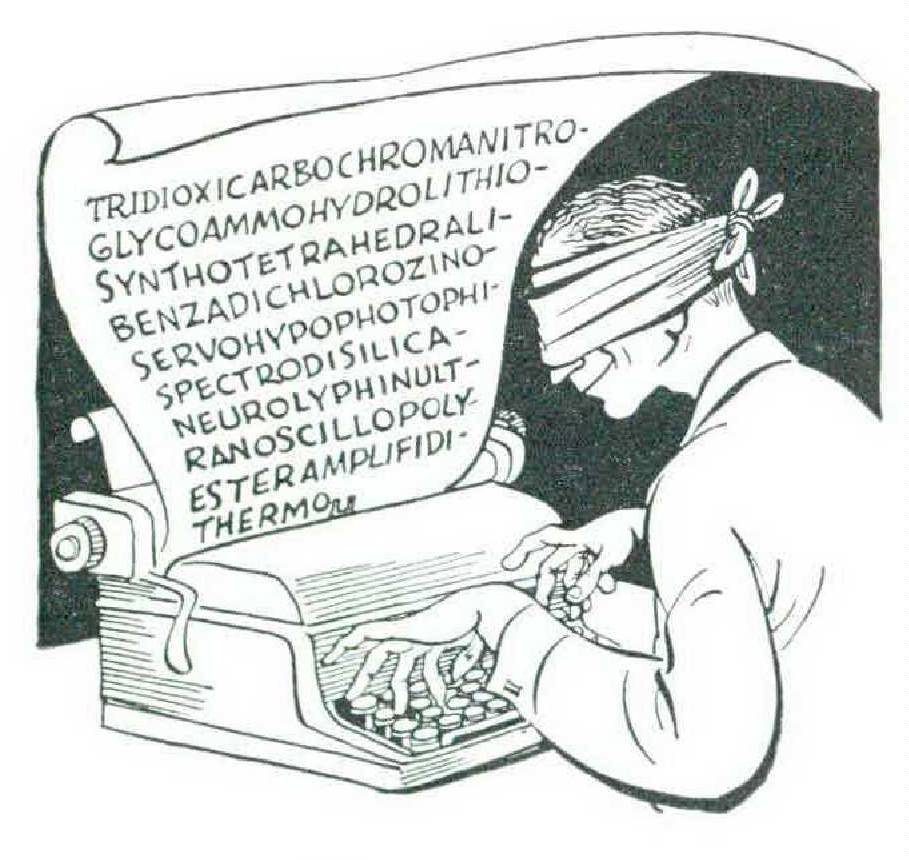
MY LUCKY day was the day I realized there must be thousands of men like me — men who enjoy stories full of technical know-how and professional jargon even though they have no idea what most of the terms mean.
My public!
What was to prevent me from writing technical stories for them? Who cared what the terms were, just so long as they were there? See if you don’t think I’m on the right track.
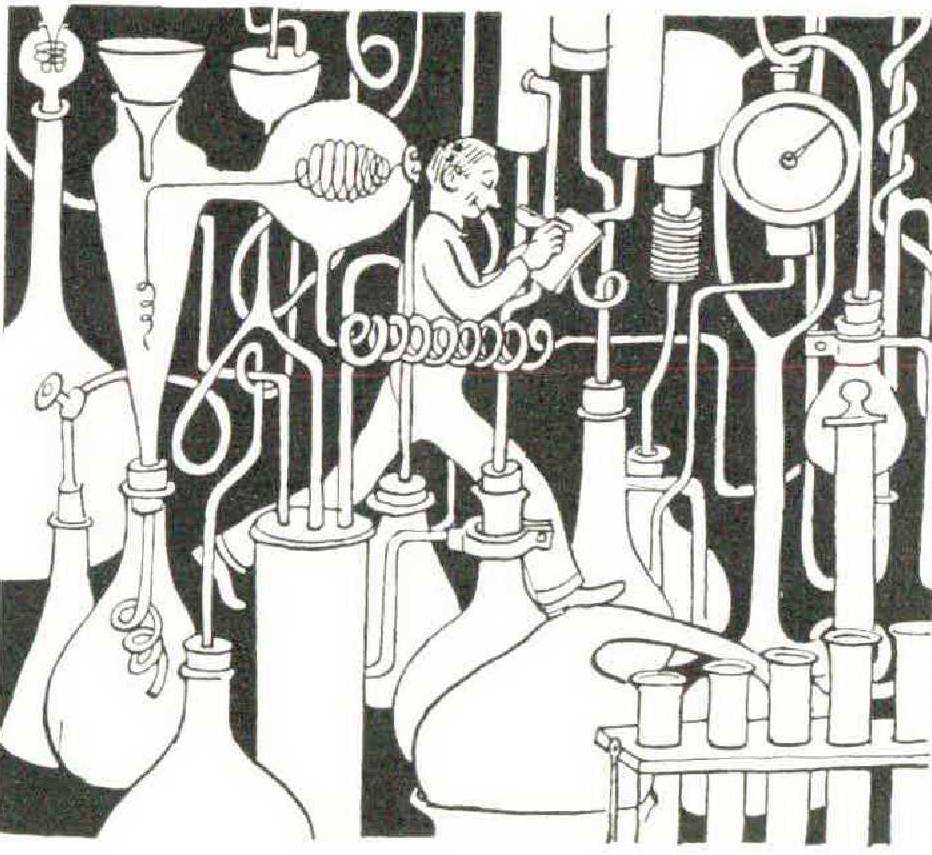
Dr. Mark Fairfield entered out of the black African night and blinked wonderingly about him. At last he was really here, in the Gneissen Research Laboratory, lost amid the swelt ering vastness of French Equatorial Africa!
It was like a dream to stand there, two thousand miles from civilization, and see a rack of gleaming flakestone synthesizers aligned with scientific precision above squat, thicksided quadritrobe reservoirs of the most advanced design. Quadritrobes! There were laboratories right in New York’s great medical centers that were still having to make do with dial robes. Only a man of Gneissen’s standing could have demandod and got so much out here. Gneissen, with his lion’s mane of iron-gray hair and his steel-blue eyes — eyes whose slight tintular aberrations hinted at chronic spatulosis of the calcyx, long a rumor in medical circles. Gneissen, giant among vasculomuscular orthodophenotists!
The great man set aside the dry beaker whose contents he had been studying and spoke, more to himself than to Mark. “Fletchwort. It grows everywhere here. It even grows in your shoes if you leave them under the bed at night. ‘Why?” He glanced up at Mark with a sigh. “Well, Doctor. Four assistants they have sent me, and four I have sent. back. You are the fifth. I hope you understand what you are in for. Here it is work! work! work!”
“I am ready, Dr. Gneissen.”
“Good. Now, first you must understand our problem. Do you know what we are after?”
Yes, sir. A cure for the disease the natives call n’gogo.”
More than that, Dr. Fairfield. We’re after m’gongo itself.”
Mark whistled softly. M’gongo, the dread safari disease.
“You have not been out here long. You have not been on safari to see m’gongo strike, so I wall describe it to you. A hundred — perhaps two hundred — ogahali boys, single file, each carrying his burden on his head, so, steadying it with his hands. Suddenly a man here, two there, another here — with no rhyme or reason — gets a dreadful itch in the middle of bis back. ‘Simba baku!' he screams. Scratch my back!’ .Burdens are thrown aside as men madly claw one another’s backs. Cries of ‘Swihli! — Maksu botto! — Maksu botto-botto! ‘ fill the air. ‘Over further! — Now down a little! — Down a little more!’ Each ogahali is afraid not to scratch the back ahead of him, because sometime its Owner may be behind him when in gongo attacks him. Now take a look at this.”
Gneissen picked up a stainguttered slide of the new triphozoid type and placed it on the surdbase of what looked like a standard spectrumated microscope.
On that slide is sfructus acrobat us, the little devil we suspect is responsible.”
As Mark sat down and Gneissen turned on the pinpointed Scan bush illuminator, an ogahah boy entered carrying two tall glasses on a tray. Suddenly he dropped the tray with a wild scream and burst from the room into the night, clawing awkwardly at his back and crying, “Simba baku!”
Mark glanced up at Gneissen.
“ M’gongo?
Gneissen shook his head.
“Merely ngogo. So you can imagine what m’gongo itself is like.
Mark tried not to shudder as he turned back to the microscope. He looked — and saw an enormous insect just, getting to its feet. It sprang into the air! With a cry of dismay Mark leaped off the stool, dropped to his hands and knees, and squinted along the floor.
“It jumped out here somewhere!” he cried, patting the floor all around him in a desperate search.
Gneissen’s chuckle was contemptuous. “Get up. You forget you were looking through the new, hyperpowered colossomicroscope VI developed by my old schoolmate, Gottwald Schmiirz. Struct us acrobat us is actually so tiny that if he jumped like mad it would still he an all-day trip to the edge of the slide for him, and even then the stainguttering would stop him. Of course, I realize that only a few schools have Gottwald’s ‘scope VI as yet.”
As he stumbled to his feet, Mark flushed at the reference to schools. He knew that men like Gneissen and Schmiirz, with their background of the Big Three, were snobs about other, ‘esser schools. He knew they looked down on his school, merely because it was a correspondence school. Well, he’d show them!
Gneissen picked up a long-necked container half full of clear amber liquid. “Now, then. Do you know what this is?”
“Certainly,” snapped Mark. “A steldrip of benzoidichloroxido -
“— bit iiminitclrantc,” nodded Gneissen. “Now watch.”
Carefully he lit. the BJerregaard burner — it burned mangasite at 4200 Beta, units per feyn instead of 3000 like the simpler Dufresne — and set the steldrip on it. Then he torquevented a litmusatured Gneissen Filter and thrust it into the bubbling liquid. The Gneissen Filter, known to every schoolboy, had been named in honor of the two men who collaborated on its development — Knot Gneissen and Clarence Filler—and now lie, Mark Fairfield, was act ually working side by side with one of them! In a boyish effort to cover up his excitement and appear casual, Mark leaned awkwardly against the wall. His arm bumped the dry beaker. It tumbled on its side. A cascade of fletchwort particles poured into the bubbling benzoidichlorox into the steldrip!
“Oh, you clumsy idiot! Two years of work!” cried Gneissen through the cloud of vapor that mushroomed up.
The Gneissen Filter was brightening and darkening through the entire spectrum; then its colors settled into a pattern that made both men gasp.
“Impossible!” breathed Gneissen.
He sniffed the mixture in the steldrip. Then he cooled it, while Mark watched breat hlessly. What had they stumbled onto? Could it be . . .? With infinite care Gneissen poured some of the mixture into a shallow receptacle and then picked up a silver instrument whose slender handle terminated in a small bowl.
“What’s that?” asked Mark.
“A spoon,” said Gneissen. With the fearlessness of a. dedicated scientist he tasted the mixture —and his hand went out to grip Mark’s arm.
“Dr. Fairfield, I want you to know I consider us partners in everything that may accrue from 1 his. We will get back to native diseases in due time. M’gongo will still be around, but meanwhile there’s a fortune in this. Where’s that ogahali boy? ‘fell him to firing us two bowls and a box of crackers. I don’t know yet exactly how we did it, but we’ve just produced the best damn Scotch broth I ever tasted!”
“I knew it the minute I saw the pattern on that Gneissen Filter,” said Mark simply as they shook hands. “My mother was a Macdougal — and that’s the Macdougal plaid!”