The Border Tortilla
by WALTER O’MEARA
WALTER O’MEARA is the author of many stories and several novels, the most recent of which is Minnesota Gothic.
IT IS a remarkable thing that perhaps the hardest, harshest, most brutal strip of habitable soil in North America— a land of desert, prickly pear, and drought-stricken cattle dying on their feet, with cholla cactus sticking to their muzzles — should have produced one of the lightest, daintiest, most delicate, and most delectable items of everyday fare on the continent. I refer to the border tortilla.
And please — I beg of you! — do not confuse this tortilla of the border with the ordinary corn variety made in “tortilla factories” throughout Mexico and even sold in tins from Texas. We are talking of two different things, señores y señoras.
This is not to disparage the corn tortilla too much. But when we speak of the border tortilla — eso es harina de otro costal. Or, as it would be understood in Pitiquito, that is a horse of another color.
1 have never encountered the border tortilla except along the ArizonaSonora line, but I believe it is known the length of the boundary. Deeper Mexico is regrettably a stranger to it.
In contrast to its maize relation, the border tortilla is made of high-gluten wheat flour. Whereas the former is about the size of a small plate, the border tortilla is as big as a Mexican hat. The corn tortilla is about as thick as a silver dollar; you can practically read through a border tortilla.
When my wife and I went on a picnic with our friends Ernesto and Florita, we ordered tortillas from Maria Cruz, who lived just “acrossaline.” She was still making them when, after a visit to the cantina in Mesquite, Ernesto and I arrived with a case of cold beer — the proper accompaniment to any Mexican meal.
She had a fire of mesquite wood going in her cookstove, and the kitchen of her little adobe house was drenched in the deliciously mingled odors of freshly baked tortillas and mesquite smoke. And if you have ever smelled a mesquite-wood fire, by the way, you know that neither hickory, applewood, nor New Mexico’s celebrated pinon can rival its wonderful fragrance or the delicious flavor it imparts to food.
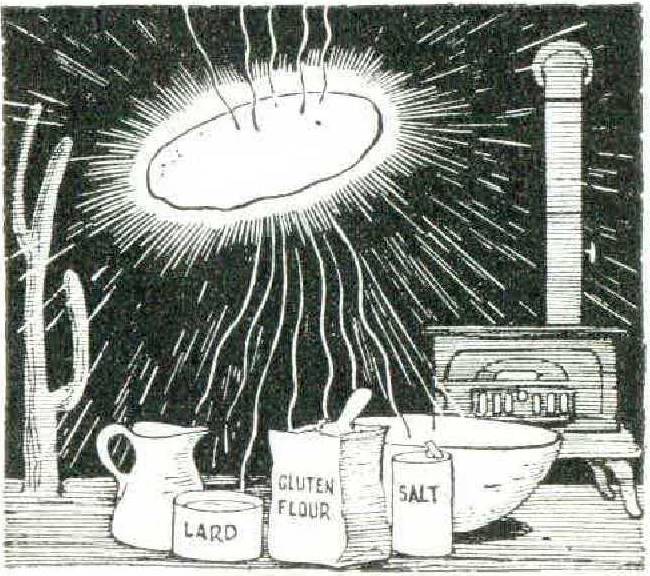
In a big wooden bowl called a batea, Maria had a lump of dough made of flour, lard, salt, and a little water. The lard had been worked into the flour, Florita explained; then the water had been added very carefully until the mixture “didn’t stick any more.”
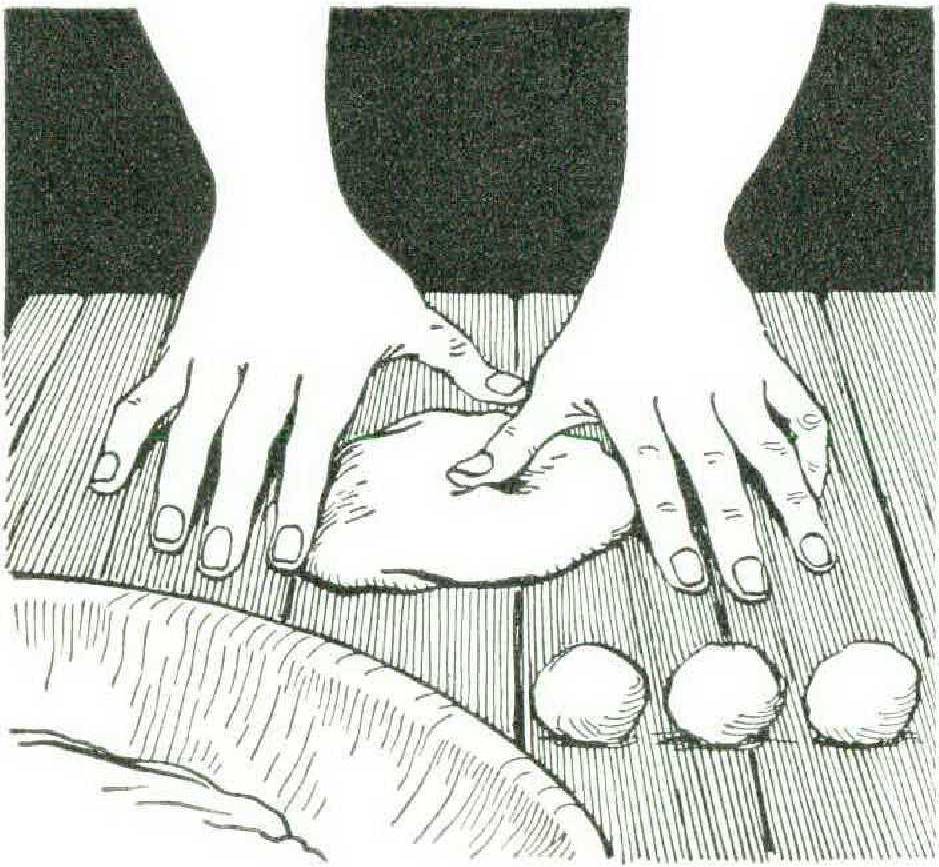
Grabbing hold of this lump of dough with her left hand, Maria squeezed until a little sphere about the size of a golf ball popped up in the circle of her thumb and forefinger. This she plucked off with her right, as one might pick a puffball in the field, and placed it on her scrubbed wooden table. When she had a dozen such balls in a row, as alike as sparrows on a telegraph wire, she scooped one up and began to pat it out.
“This,” Ernesto commented, “is the important part. A girl who can make good thin tortillas can always get a husband around here. It was when I first saw Florita making tortillas in Hermosillo that I fell in love with her.”
“You can see how much time it takes,” Florita said, ignoring this. “A woman is a fool to spend so much time, just to please a man’s stomach, no?”
As one watched Maria, it was certainly plain that time — and a lot of it — is an important ingredient of the border tortilla. And perhaps a smile, too, like Maria’s; and the particular jaunty rhythm with which she performed all she was doing.
Starting with the little globe of dough, she patted and pulled at it, flipping it from one palm to the other in flawless cadence, until she had made it into a disk about the size of a saucer. And this, you would have thought , was about the limit to which such a fragile sheet of dough could be stretched. But Maria, it appeared, was just warming up.
“Now comes the tricky part,” Ernesto said. “I have seen even Florita ruin a perfect tortilla at this point.”
Now the tortilla was growing, as if by some kind of magic, under the manipulation of Maria’s skillful brown hands. It was growing larger and larger, thinner and thinner; it was as large as a dishpan and no thicker than paper, and Maria was no longer flipping it from palm to palm, but from arm to arm. Only its continuous and rapid transference from one round forearm to the other, with a few lighlning pats between passes, saved it. from falling apart of its own weight.
“Ole!” Ernesto murmured appreciatively. “On the fire now, chica.”
She flung him a disdainful glance and finished off the edges to tissue thinness. Then with a sudden dancelike motion, she tossed the big disk — so fragile now that it almost floated on the air — onto a hot baking sheet. It puffed up immediately into an allover pattern of creamy bubbles and blisters. After perhaps thirty seconds, Maria made a lightning snatch at its curling edge with her bare fingers and flipped it over. A few seconds laterthe whole thing took little more than a minute, I’m sure — she plucked the tortilla from the fire, folded it neatly into a fourfold wedge, placed it on a stack of finished tostadas, and was patting out another puff ball of dough.
I said “tostadas,” and the border tortilla is often called that in its untoast ed state, but incorrectly. The real tostada is the border tortilla opened up to its full size, quickly toasted in a very hot oven or over live coals (preferably mesquite), then served warm in big, jagged, crackly fragments covered with golden blisters and glossy streaks of melted butter. Hombre!
And that’s the way we served Maria’s when — a couple of hours late, which is hardly anything in Mexico — we arrived at a cool boxcanyon in the Poso Verde Mountains and had our picnic with Ernesto and Florita. It was a lovely picnic. The Mexicans are lovely people. Didn’t they invent the tostada?