Art as Evidence of Freedom: Contemporary Painting, Sculpture, and Architecture
by ALBERT SCHULZE YELLINGHAUSEN
1
A COUNTRY’S art is not an isolated thing; it is the concert of all forces of its spirit. German art as a specific “color” of Western culture materialized in the nascent thirteenth-century Gothic, and ever since, a certain archaic inertia — in line with loyalty to the idea of the Reich — has been contending dialectically against the urge to find new graphic forms. When the latter prevailed, as in the Reformation and in expressionism, German art took forward strides. Time and again, long periods of consumption (but also of genius in putting finishing touches to forms found elsewhere we need only mention the golden age of the South German baroque!) were overtaken by abrupt advances. There is little steadiness to be observed in German art, but much sudden vigor in stormy departures.
And yet, it was a shockingly radical experience that marked the situation after World War II. This old, civilized country’s art was forced one day to make sure of its very existence as a strange gift, and to make a fresh start from a kind of Point Zero: 1945. There was a rubbing of eyes, a mournful rage at the frightening realization of huge losses, and yet there was wonder: the night of terror actually had been survived by some.
There had been iconoclasm in the past—even the Bible talks of breaking the images of neighboring pagan tribes — while the number of ruined altar paintings cannot even be guessed. But the Nazi fight against “degenerate art" — a term derived from Hitler’s personal resentment and applied to all art other than the most commonplace naturalism — had a quality all its own. It was lethally systematic. The despotism was not content to ban and destroy (and to sell abroad for foreign currency, where profit beckoned); it did not rage against the works of art alone. It went right into the studios proscribing professional and even wholly private artistic activities. Organized stool pigeons, recruited from the pseudo-artistic riffraff that is always found in the proletariat of art, served as a kind of “art police,” watching and controlling all artists who were aesthetically suspect and thus “injurious to the community.” A few individuals with sufficient nerve kept working in secret. Fritz Winter’s wartime series “ Triebkräffe der Erde” (“Driving Forces of the Soil”), a virtual compendium of searching imagination, consists of the smallest rice-paper scraps. The dimensions of Oskar Sehlemmer’s suite of “window visions,” created in an office building in Wuppertal, are similarly minute. Art, in those days, had to be easy to hide.
An oddly paradoxical compliment! Never before had fine art been taken so seriously by the philistine rabble—but then Hitler himself had begun as a painter of Kitsch. The authorities had the right idea : human freedom is now here as purely manifest as in martyrdom and in the works of fine art. Indeed, we may say it is actually embodied and made tangible in works of art. This suspicion, that art might show the whole system of power in jeopardy, brought the aversion of the mighty to the point of hatred and persecution mania. They felt potentially unmasked by art.
German art should not be ashamed of this persecution. It did more to maintain standards than if the evil system had pretended to magnanimity, feigning a liberalism it mocked in all other respects. Still, the awakening was difficult. The public had to be prodded into bringing the survivors out of hiding, showing interest in them, making use of them. Who was left to testify about Die Brücke, about the Blaue Reiter, about the fertile Bauhaus period? But let us glance at the past.
Old Emil Nolde, born in 1867, was near eighty, strictly forbidden to paint since 1941, vegetating on his farm near the Danish border. There he guarded the pathos of riotous colors which had made him and Kirchner the foremost masters of Die Brücke, forty years since. Kirchner had killed himself in Davos in 1938; his works remained sequestered in Switzerland. Jawlensky of the Blaue Reiter group, long paralyzed, had died in Wiesbaden early during the war. He had died in obscurity, although a few initiates held his late, icon-type abstractions (miniatures: half window crossbars, half visions of Christ) in high esteem.
Max Beckmann had emigrated to Amsterdam and been trapped by the German occupation, lie had survived with the help of friends and art dealers - chiefly valiant Gunther Franke of Munich; but now he was cut off from German life by the all but impassable frontier. Karl Hofer, the brittle classicist and bitter idealist, had survived in Berlin and set out to paint his bombed-out life’s work again, from memory; it turned into black visions of terror and torture.
Of the Bauhaus group hardly anyone had stayed in the country. Klee, after 1933, had sought refuge in his Swiss homeland and died in Locarno, in 1940. Kandinsky had emigrated to Paris and died there shortly after the liberation, in December 1944. Schlemmer also was dead; he and Willi Haumeister had hidden out in a paint factory. Haumeister, unbroken, took over the Stuttgart Academy of Art and was the first to exert a more than local influence. Itten, the Swiss, taught in Zurich; Feininger, the American, was back in his native New York; George Grosz had emigrated to the United States; Mucho kept going at the Textilsehule in Krefeld. Fritz Winter, one of the younger Bauhaus artists, was a prisoner of war in Russia.
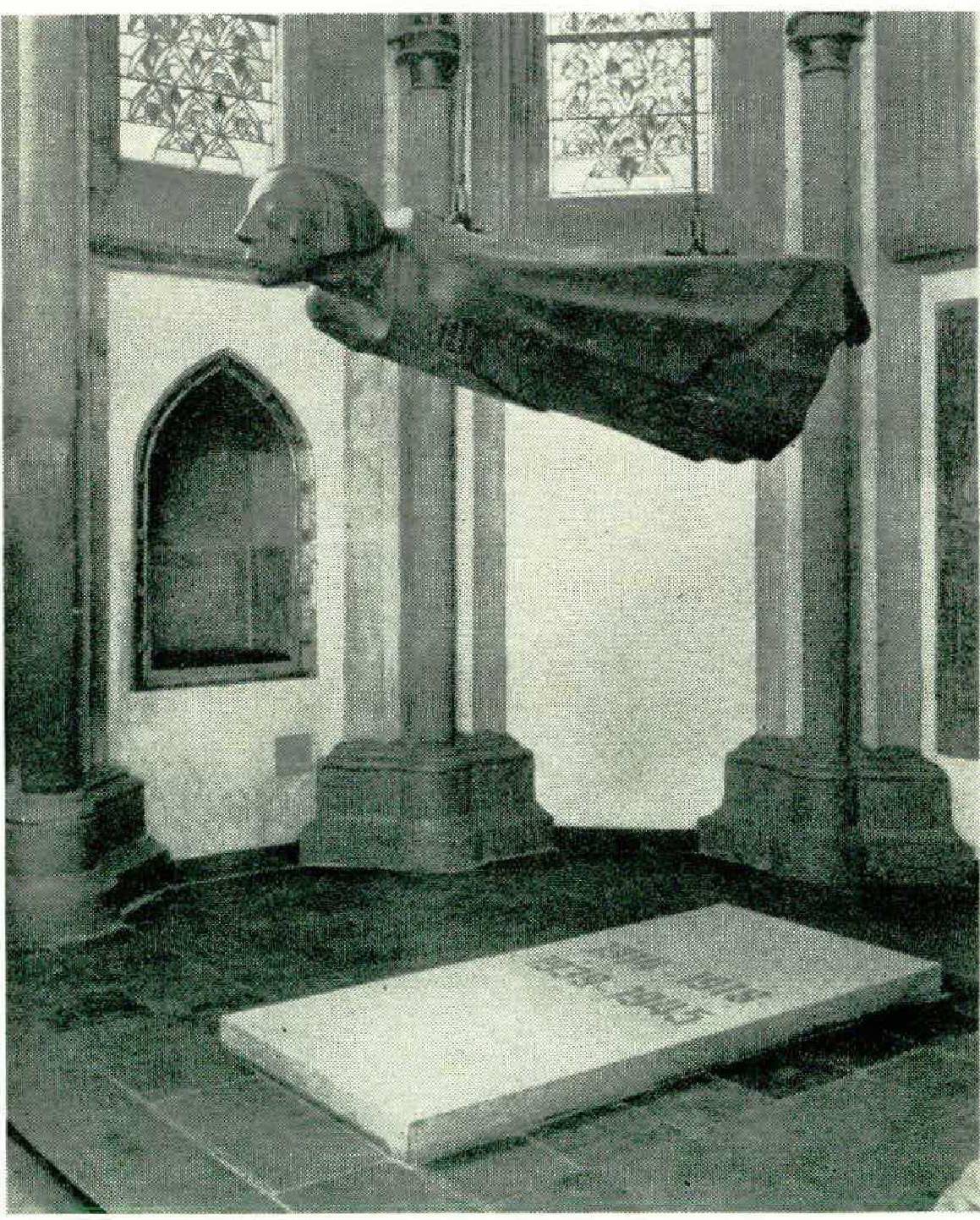
To mention sculptors: Mataré, proscribed by the authorities but aided by the farseeing Catholic Church, could now start working in the Lower Rhineland and became the friend and witty adviser of a circle of younger men. Gerhard Marcks, hard hit by the death of his sons, was living somewhere on the Baltic coast, in the Russian zone. Both were custodians of the knowledge of Berlin’s great years.
Let us end this rosier which cannot lay claim to completeness. It can only indicate how much this state of art resembled a landscape of scattered volcanic craters. There was no center anywhere. There were few interconnections, no newspapers, no signs of a public opinion. The need for food, clothing, and shelter, and the distress of the refugees came first. Resentments created confusion, adulterating the spontaneous sense of general relief.
The occupying powers, on the other hand — the United States, France, and England — started soon to assist the formation of opinion in this hazy vacuum by exhibitions of great modern art. There were astute men on the cultural staffs of the armies; they realized that the most urgent task was to procure objects of comparison. These exhibitions proved to be virtual “effective quanta,” to borrow a term from physics. Germans whose memory went back to the time before the terror could base their stand on them. The reaction was sensational; it was art that brought the first free breeze into the country. The expressionists, Bracque and Picasso, Feininger’s transparent lyricism, Paul Klee’s universe— all this came before the eyes of an unaccustomed, stunned, delighted, horrified public as on the day of creation. It was “a new world.”
2
ALREADY younger, hitherto unknown native figures were appearing. Georg Meistermann (born in 1911) had caught a breath of free air before 1933 as a student at the Düsseldorf Academy, and ecclesiastic backing had since enabled him to devote himself to the design of glass windows; now he came before the public with free, hopeful works. Hubert Berke (born in 1908), a Klee pupil who had taken up commercial art under the despotism, could again link up with the great past. Werner Gilles (born in 1894), a long-time resident of Italy, fascinated people with his abstract visions of southern geology. Ernst Wilhelm Nay (born in 1902), a protégé of Edvard Munch in the bad years, employed metallic hardness for the difficult transition from expressionist remnants to a more absolute color technique.
The work of Henry Moore, presented by the British in a comprehensive exhibit, furnished not only sculptors but painters with daring examples of how to break through more conventional forms of vision. Similar impulses came from Fernand Léger and the German-born Parisian, Hans Hartung.
With economic recovery, art centers again emerged. Stuttgart came to the fore, owing to Willi Baumeister’s influence. Baumeister, consistently building up his own non-objective but myth-inspired forms from picture to picture, found a comrade-in-arms in a collector named Domnick. In Berlin, old Karl Holer could give the academy he headed a vigorous profile by calling on new, younger men. He was especially successful in sculpture: Karl Hartung, the portraitist Bernhard Heiliger, and the metal-former Hans Uhlmann made of the island city of West Berlin a focal point of the search for sculptural forms. As painters, Theodor Werner (born in 1886) find young Heinz Trökes (born in 1913) lent the charm of their suggestive personalities to the politically awkward Berlin climate.
Munich, as the art center of the Third Reich, was burdened with all sorts of reactionary incrustations. It was fort unale to have art dealers such as Gunther Franke and the Stangl Galleries; working hand in hand with such museum directors as Ludwig Grothe (formerly of the Bauhaus) and Eberhard Hanfstaengl, they accomplished a relatively rapid cleanup of the ideological rubble. There was no new production of actual interest, however, until Fritz Winter came back from Russian captivity.
Another center, perhaps the decisive one, lies in the Rhenish-Westphalian cities from Gologne to Minister. In this area of heavy industry, precision mechanics, commerce, textile manufacture, and last but not least, capital concentration, art has to contend daily — “existentially,”as it were — with the realities. Cologne, as an ancient Christian metropolis, was always open to metaphysics in art; even in ruins it became a capital of the new trends, with a collector named Haubrich setting the pace. Then, still in the sign of reconstruction, young and old art dealers — the Spiegel, Rusche, and Moeller galleries — managed to gather so many productive individuals around them that an essentially artistic milieu of intrigues, competitions, and friendships grew apace. Such recognized artists as Maturé, Marcks, Meistermann, Berke, and the sculptor Ludwig Gies were joined by gifted new faces. Josef Fassbender (born in 1903) embodied the Rhenish inclination to surrealism — Max Ernst was born in a village near Cologne! — in a colorful, imaginative mixlure of drawing and painting. Another was Hann Trier (born in 1915) whose bold, extensive “handwriting” was soon to be noticed abroad.
In the textile towns of Krefeld and Wuppertal a thoroughly practical search for textile designing ideas had long since turned the silk manufacturers into avid collectors, chiefly of Klee and Kandinsky. Beside these older cities with their patrician traditions, the Ruhr coal-mining town of Recklinghausen shows a different pattern. Here labor festivals are held by the unions each summer with art shows that confront ancient and modern art and thus exert a great educational attraction on population strata heretofore removed from any art. As seat of the Junger westen society of artists, Recklinghausen has encouraged such promising new talents as Thomas Grochowiak, Emil Schumacher, M. L. Rogister, Hans Werdehausen, and Wilhelm Wessel.
The semi-official German Artists Federation, supported by the federal government, arranges annual shows which considerably illuminate the situation. Furthermore, a word must be said about German art journalism. It is anything but dull, and such papers as the Neue Zeitung — which was backed by the U.S. Department of State until 1955 — have done much lo remove misconceptions and to create understanding for the new age. Critics such as Professor Will Grohmann and Werner Haft maim have been invaluable molders of opinion. Documenta, the great exhibition in the summer of 1955 in Kassel, must also be cited here; thanks largely to the support of American museums, it was able to show the past half century of modern art comprehensively and emphatically enough to arouse uncommon interest and an enormous echo. As by magic, the power and quality of the objects assembled in Kassel broke the spell of prejudices left over from Nazi times.
3
WHAT, then, is the actual situation today, eleven years after the armistice? Self-confidently German standards have not been able to evolve as yet, for two reasons:
a. Berlin, the formerly unquestioned, even though not universally beloved capital of the Reich, has dropped out for the presenl, without finding a successor. There iS no central “arena” for artists to compete in, as they do in Paris, London, or New York. Attempts on the part of Bonn, the federal capital, to step in are doomed by conservative overcautiousness, in spite of undeniably good will.
b. Art itself has become largely, even though not exclusively, supranational. Except for a few basic structural dispositions — including, among the Germans, a spontaneous inclination to graphic art, a skeptical attitude toward mere peinture, and a daemonic love of gestural expressiveness— national traits are now seldom recognizable as determinants of value. We do not say they have disappeared altogether; but they are found in the roots of creation rather than in the physiognomy of the created works. The arts are looking for a supranational language. It is only natural, therefore, to find the “decentralized” German artists of today looking beyond more than within the frontiers of their country for their standards, inspirations, and provocations. And they look not only to Paris but also to Amsterdam, Basle, Milan, and Venice.
From Paris, Hans Hartung frequently comes to Germany; as a compatriot, even though a naturalized Frenchman, he is here highly regarded and indeed invested with a sort of Pythian authority. He communicated the graphic world of the Far East to the Germans: calligraphy toiling over objects of metallic obstinacy, against the blues and greens of Dufy-type backgrounds, and transforming tension into a lightning-like dynamism. From Paris, too, came the subsequently fascinating vogue of another compatriot, the painter Wols (really Wolfgang Schulze, 1913-51). His existential “disruption of matter” has become fashionable in many places under the name “tachism” and is now beginning to infect the Germans. They rightly sense in it a dangerously “unformal” but nevertheless serviceable means of escaping from the strait jacket of geometrical combinations, and at the same time — no less urgently desirable – from the equally strong magnetism of Picasso, Klee, and Miró.
This compulsion to search individually marks the immediate present of German art. “Why” — the American reader may ask, looking in wonder at the illustrations to this article — “why is German art so overwhelmingly non-figurative?” One answer can be found, I believe, in our recent history.
The directed art of the Nazi dictatorship was exclusively concerned with depicting its objective environment; and consequently, with few exceptions, every non-abstract artistic effort was bound to be discredited along with the despotism. To a majority of artists, liberation was synonymous with liberation from the tyranny of depicting. In the realms of art, aesthetic value has always depended on the degree of “translation” — how much more so in this situation, where terror had dictated “non-translation “!
Aside from this political argument, however, there was another one. German art with its “Nordic” basic inclination to unsensual linearity, its more or less conscious detachment from the canonical ideality of the Mediterranean, has always yielded to a strongly abstract urge in its great and flowering periods. In the art of the German Reformation this shows now as eremitic musing, now as expressive distortion, now as delight in decorative follies — but it is always confessional intemperance trying to capture the infinite pictorially, as the Irish miniaturists had tried to do centuries earlier. In the grandiose graphic curvatures of Baldung Grien, Urs Graf, Altdorfer, Wolf Huber, the longdespised “German flourish” stands for this daring attempt to force even the non-visible world visually into the picture, by the means of “absolute” art.
This attempt with absolute means kept failing for centuries. German painting remained silent. About 1800, Caspar David Friedrich’s and Runge’s effort to forge a “romantic” cosmic tool from the scant lineament of classicism remained an interlude w ithout an echo. Then, all at once, at the beginning of the present century and following the emphatically “translating” world interpretation of Van Gogh, Gauguin, or Munch, German art felt the approach of its hour. Kandinsky and Jawlensky, Russian aristocrats whose powerful imaginations had not been funneled through Latin traditions, helped the Germans to recall the absolute formal means innate in their own art. They resolved to apply them. The Die Brücke painters in Dresden came before the public simultaneously with Picasso’s revolutionary Demoiselles d’Avignon. In 1911, at last, in the work of the Munich Blaue Reiter group, German art appeared for the first time in centuries as an equal in the concert of Western spiritual power. What was more obvious than to return to the consciousness of these same forces after the painful, terrifying interval of 1938-45? Thege forces had led from Die Brücke to the late Max Beckmann, from the Blaue Reiter to the flowering of the Dessau Bauhaus. Why should they not be a base for new explorations?
4
WHERE do we stand now? Where, and how, does German art reflect the world of today and the existence of tomorrow? Where, and how, does it interpret and — initially just in the realm of art, of course — shape them in advance? With the death of Willi Baumeister (1889-1955) one of the personal magnetic centers has vanished; but his late works, such as Wind (see Plate 1) emit stimuli of undiminished fruitfulness in their lyrical, vegetative rhythms and especially in the “black magic” of their inverted relief shapes (called Montarú). A human magnetism of comparable strength — a category that is not quite identical with the final volume of work— now goes out mainly from Fritz Winter. A brilliant and inspired teacher at the Kassel Werkakademie, he manages to convey the Bauhaus ideas of totality to younger men, and at the same time to display in his pictures (Plate 5) a versatility preparing constantly for new advances. Winter keeps “on the nerve” of time, so to speak, without breaking faith with himself. His most recent paintings — now on view in the United States — pursue a remarkably cheerful illumination of color and relaxat ion of form.
Beside Winter, other painters of comparable relevance seem rather self-centered hermits. They do not withdraw romantically from the world, but they remain in comparative isolation. A certain agreement on goals is apparent among the German representatives of the new peinture informelle: Bernhard Schultze and Platschek of Frankfurt, Emil Schumacher of Hagen, Wilhelm Wessel of Iserlohn. But most of the rest, even if they are active teaching — as Meistermann at the Diisseldorf Academy or Fassbender at the Krefeld Werkschule work by themselves. Meistermann, famous and much sought-after us a glass painter and thus somewhat estranged from free invention, now seeks new color intensity from a reduction of the format. This desirable concentration lends a fascinating power to his tiny The Tent (Plate 12).
Ernst Wilhelm Nay, submitting to the severest tests over the decades, now plays with manifold ovals in brilliant suspension, as in Chromatics Strong and Tender (Plate 2). Josef Fassbender (Plate 3) expertly masters shrewd effects learned in printmaking, and thence, in many values, steps up the intricate convolution of his wistful labyrinths. The result is cryptical, involving the observer by suggestion. Harn Trier “writes his sketches of poetic reality with a far-reaching temperament, lately chained by subtle reserve (Plate 7). Hans Jaenisch (born in 1907) is capable of showing strength in delicacy (Plate 10) unless he succumbs to fashionable notions. Heinz Trökes, now settled in Hamburg, knits nets of color from originally surrealist ideas — nets so fine and tight that breaks and reflections miraculously enable him to handle spatial dimensions. His pictures such as Parts of the Whole (Plate 4) soar like sheet lightning over magical distances.
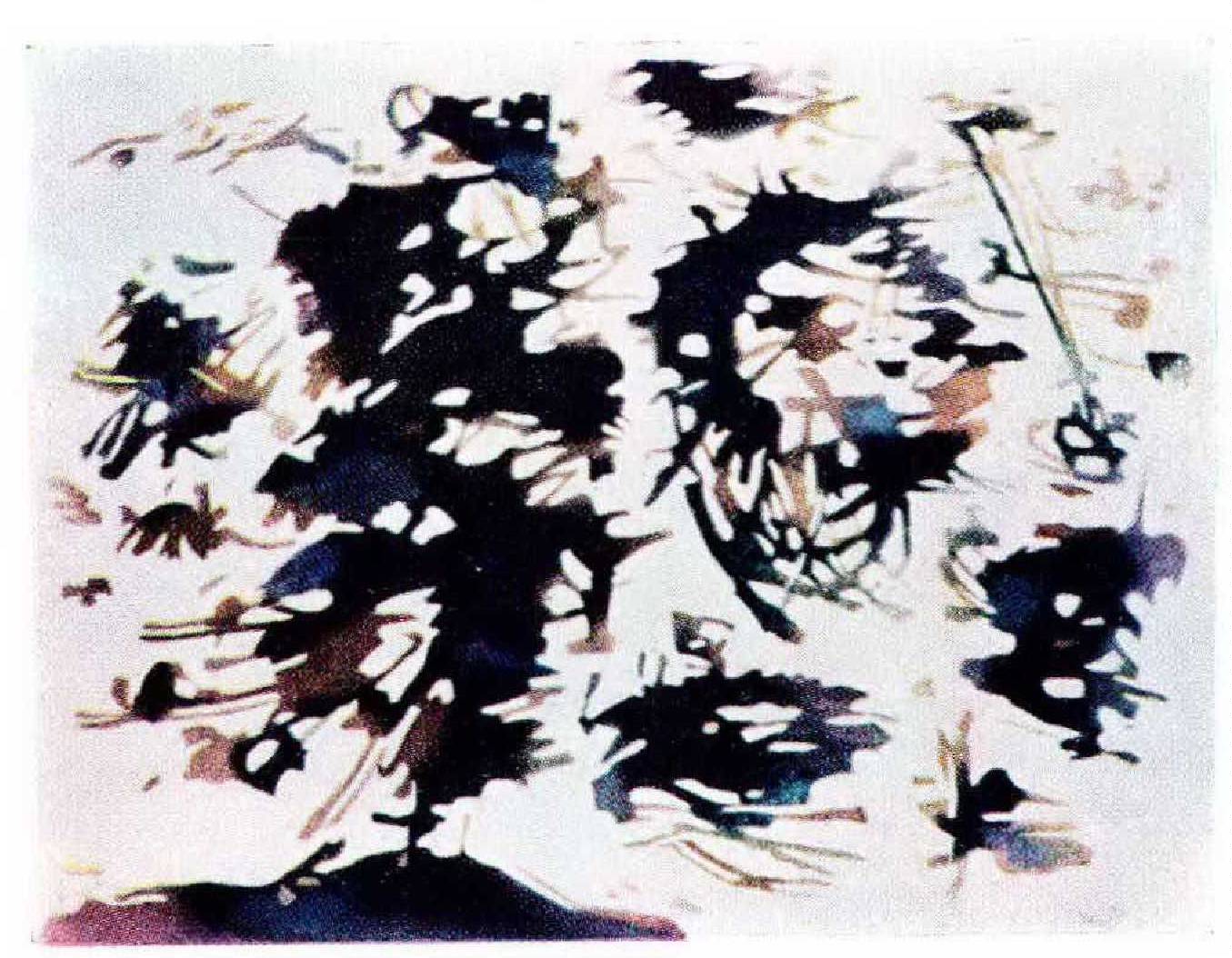
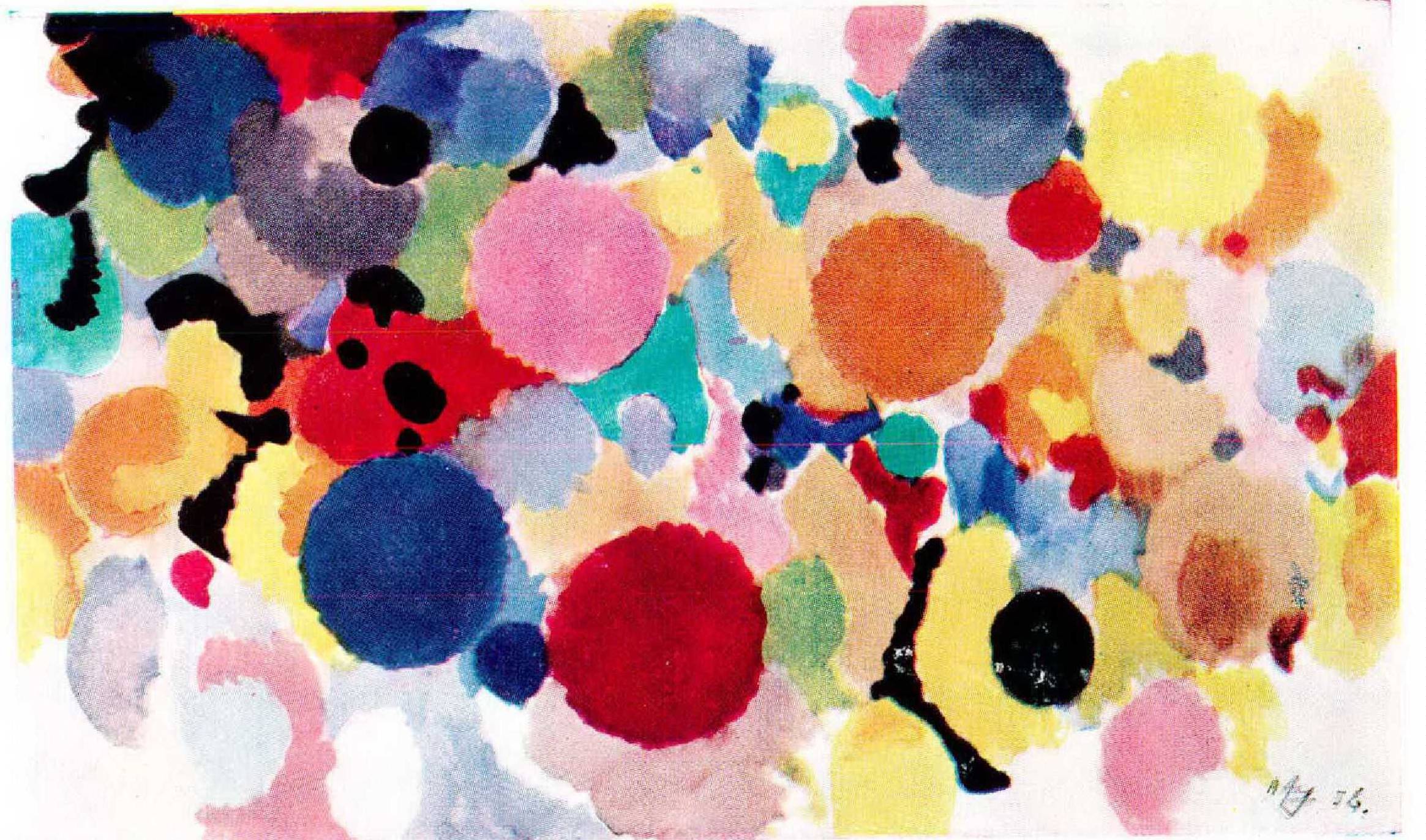
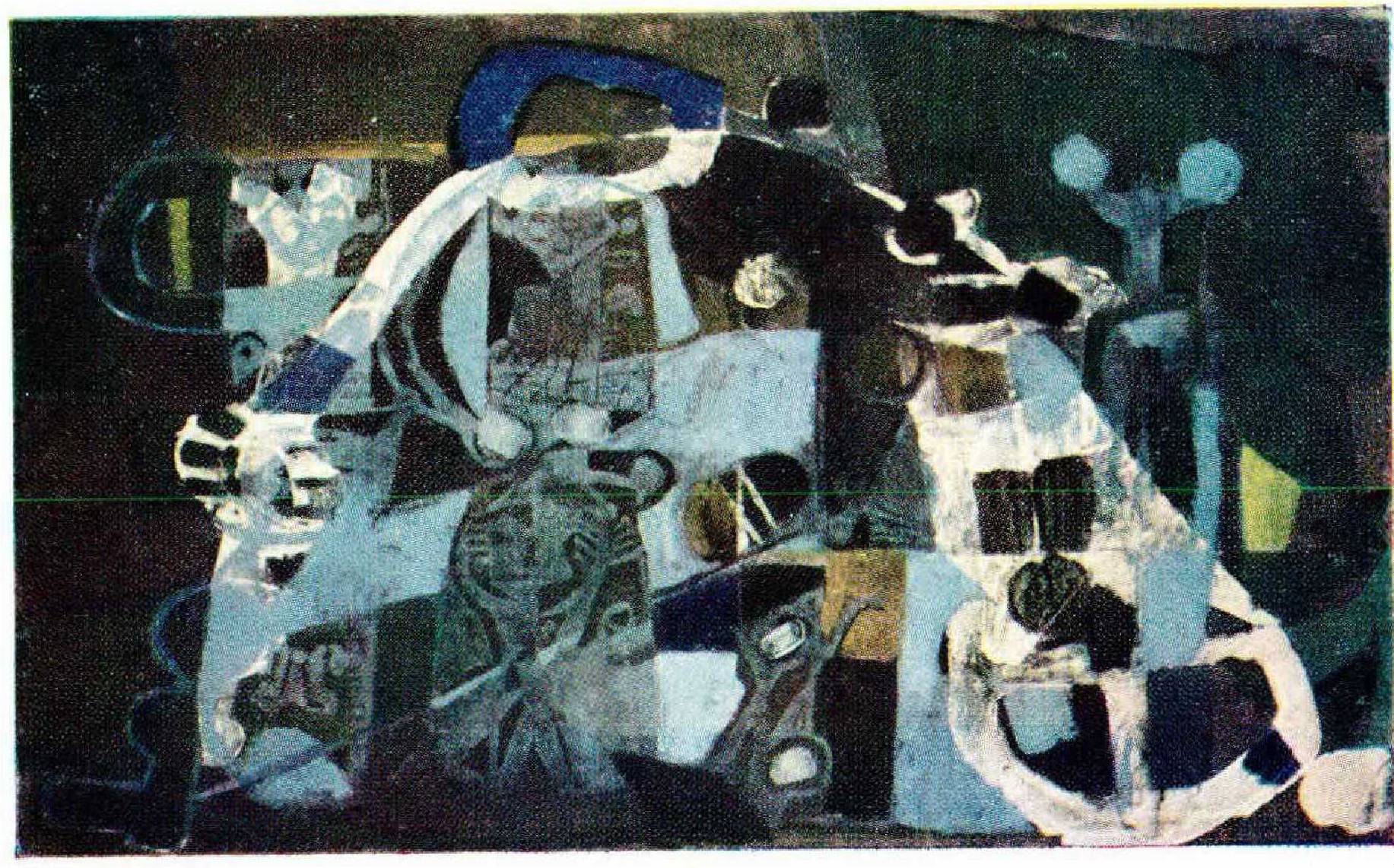
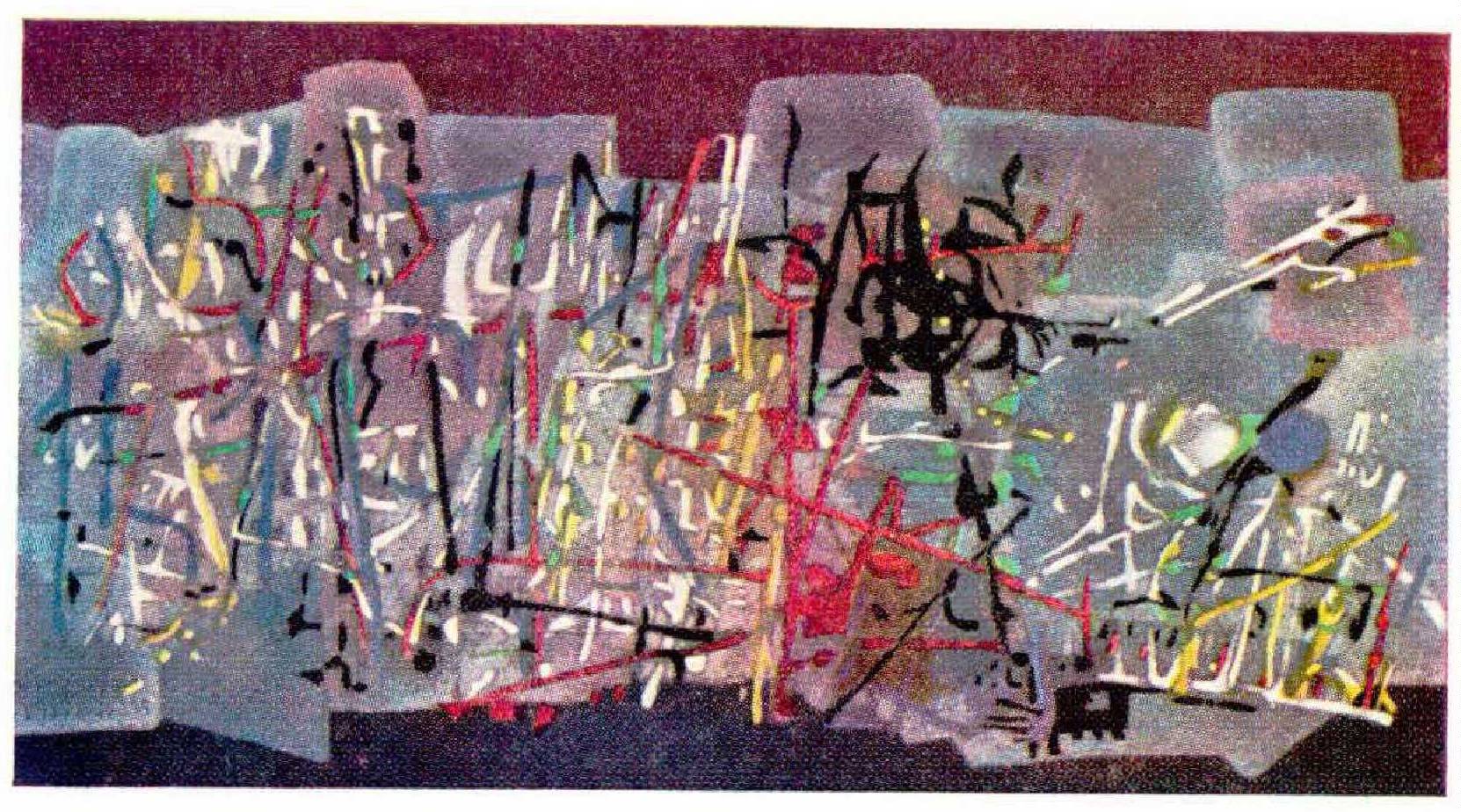
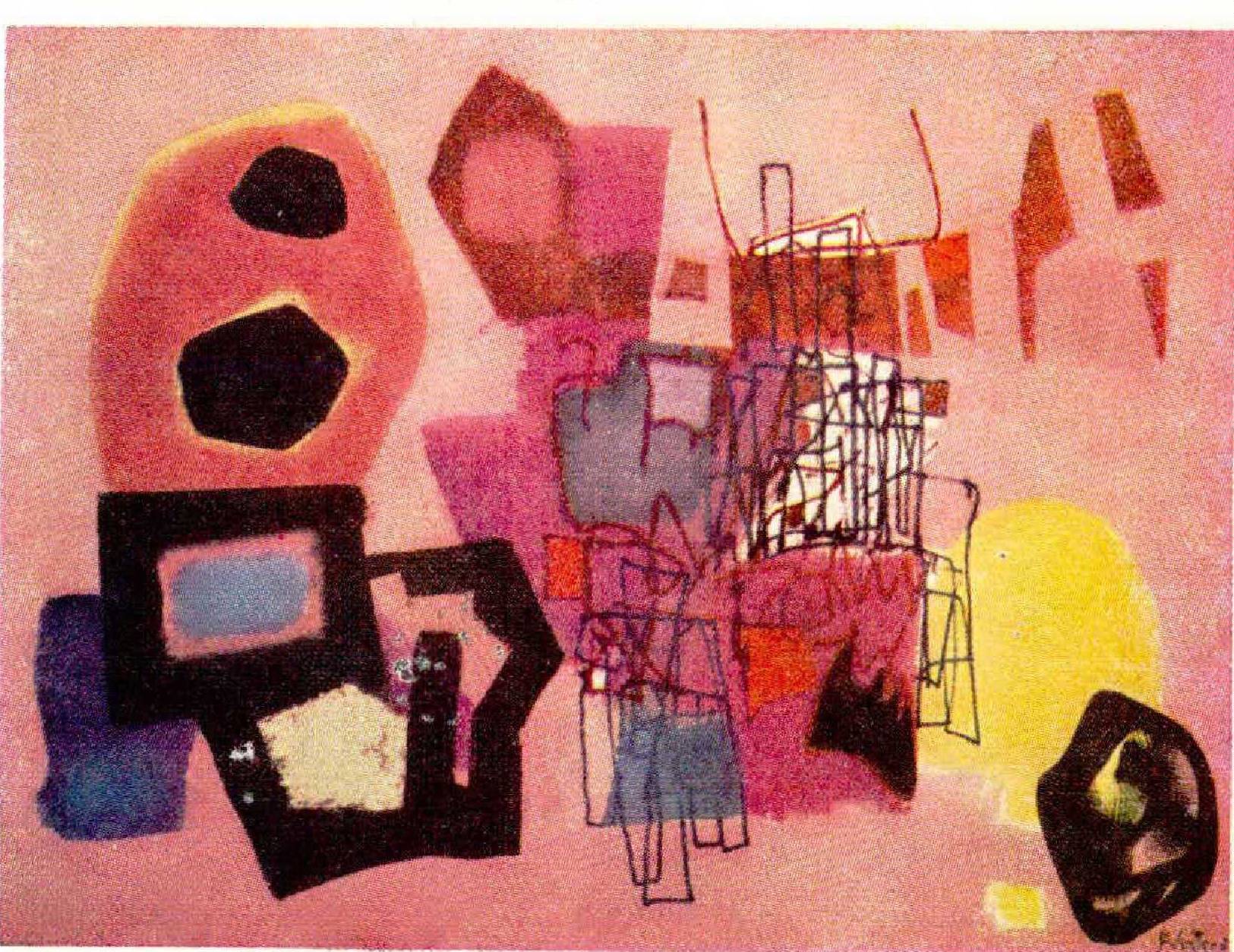
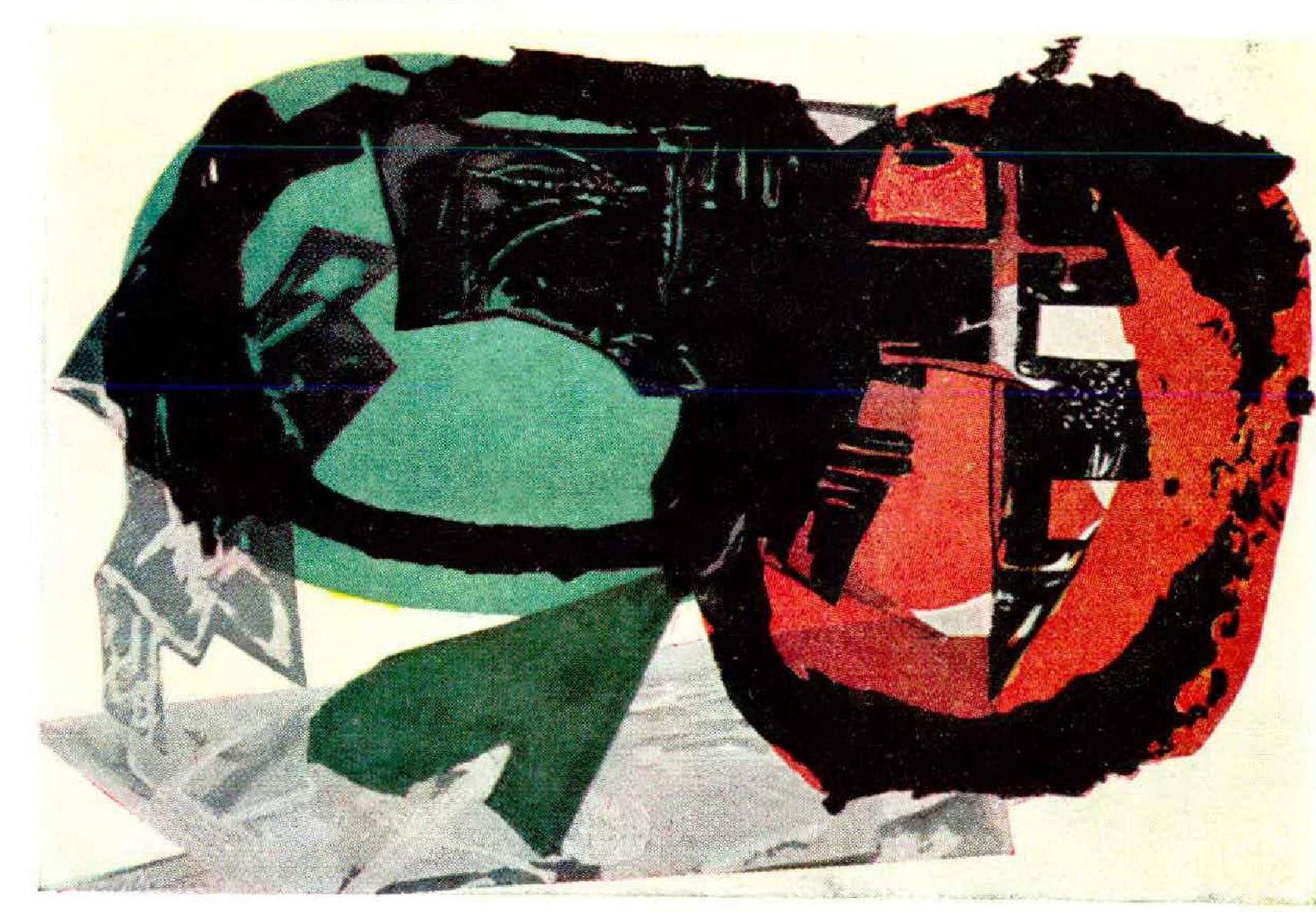
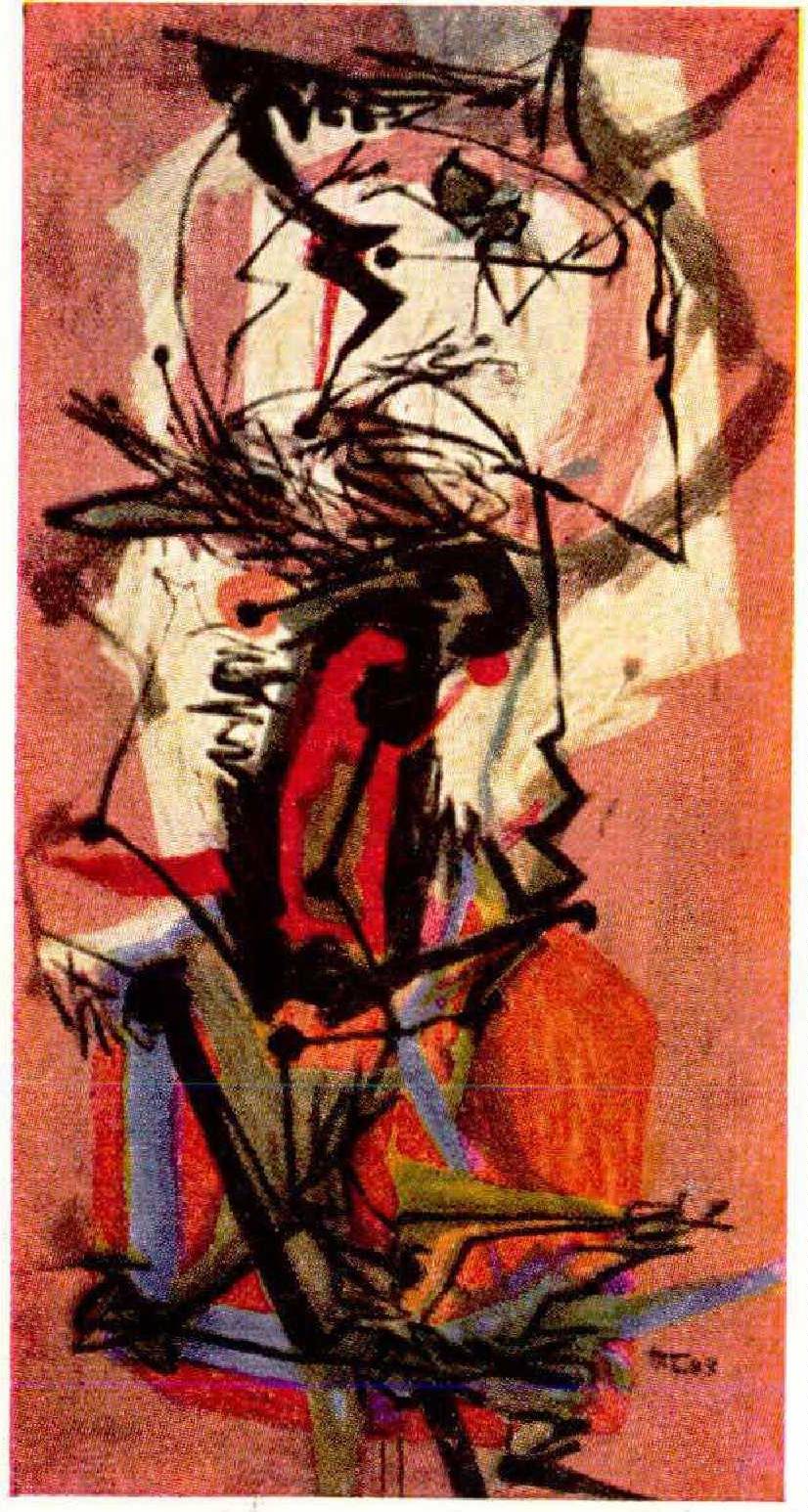
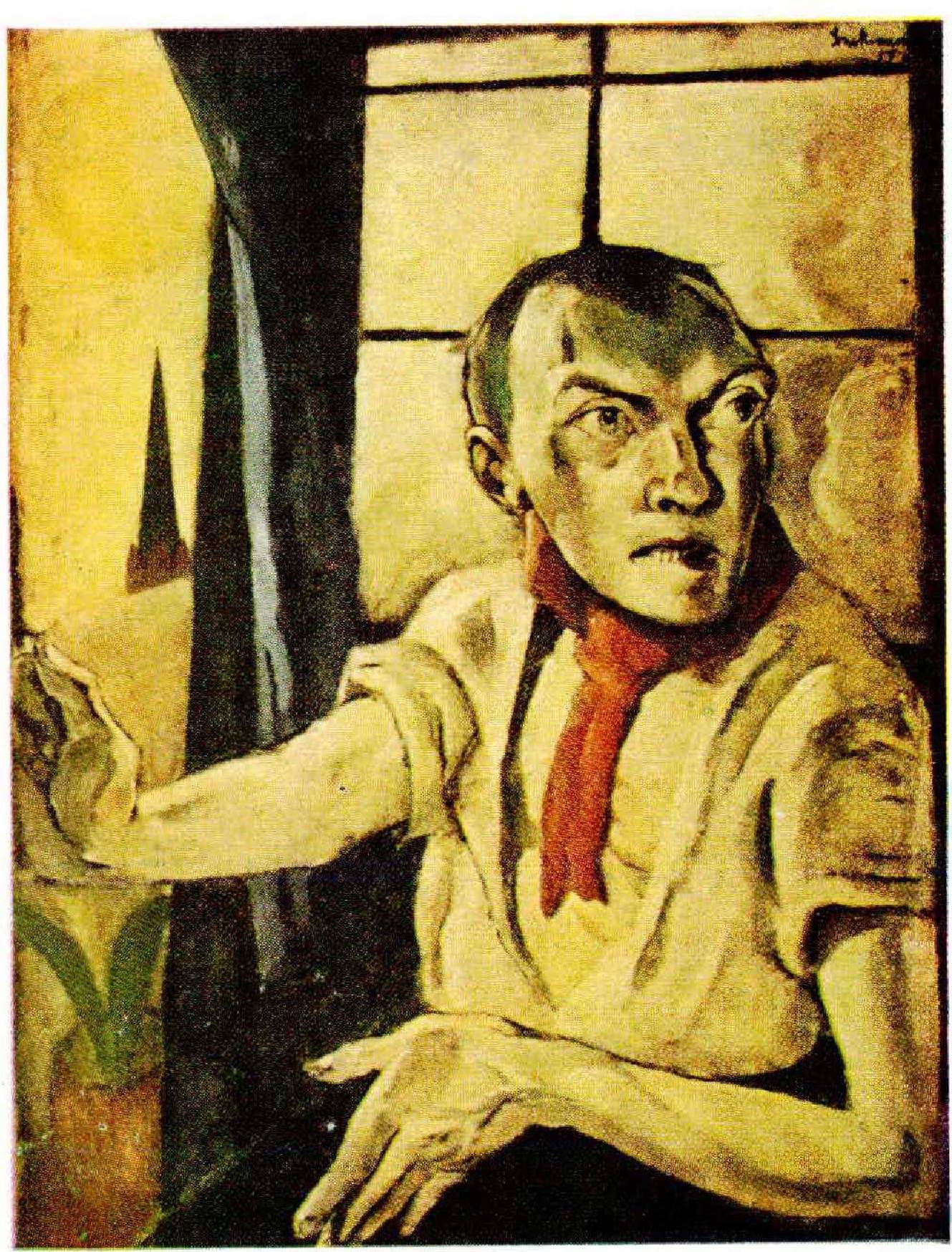
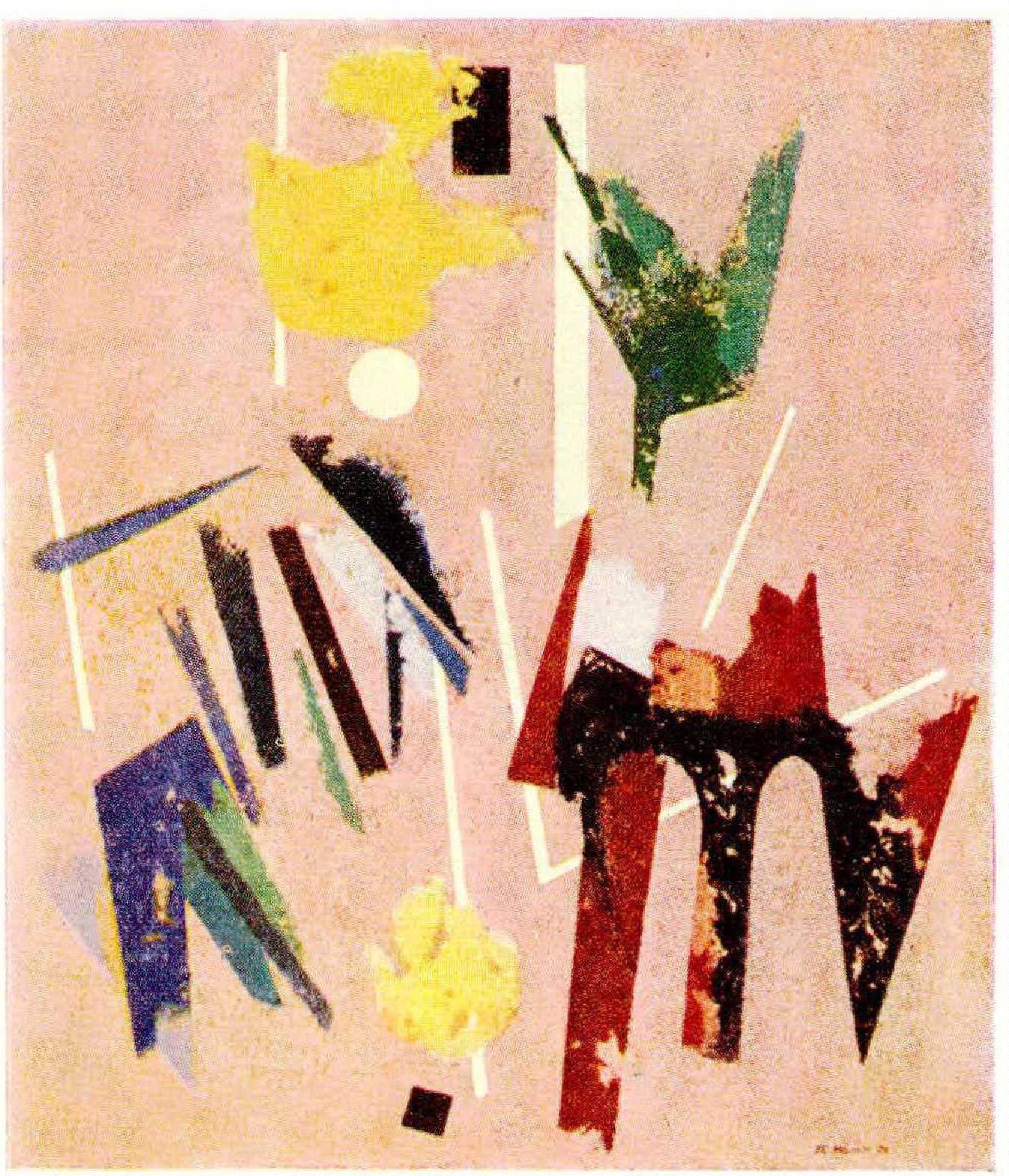
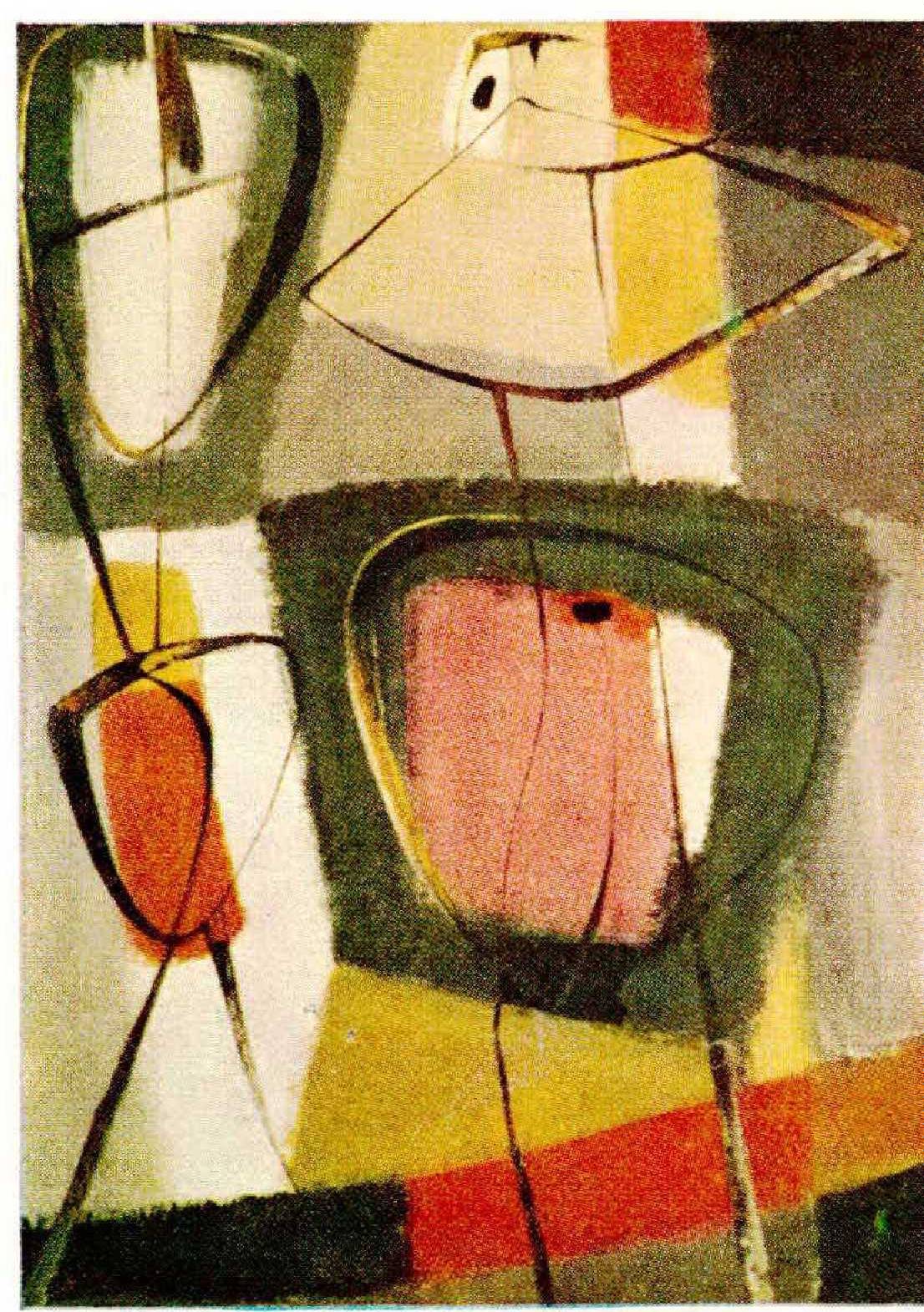
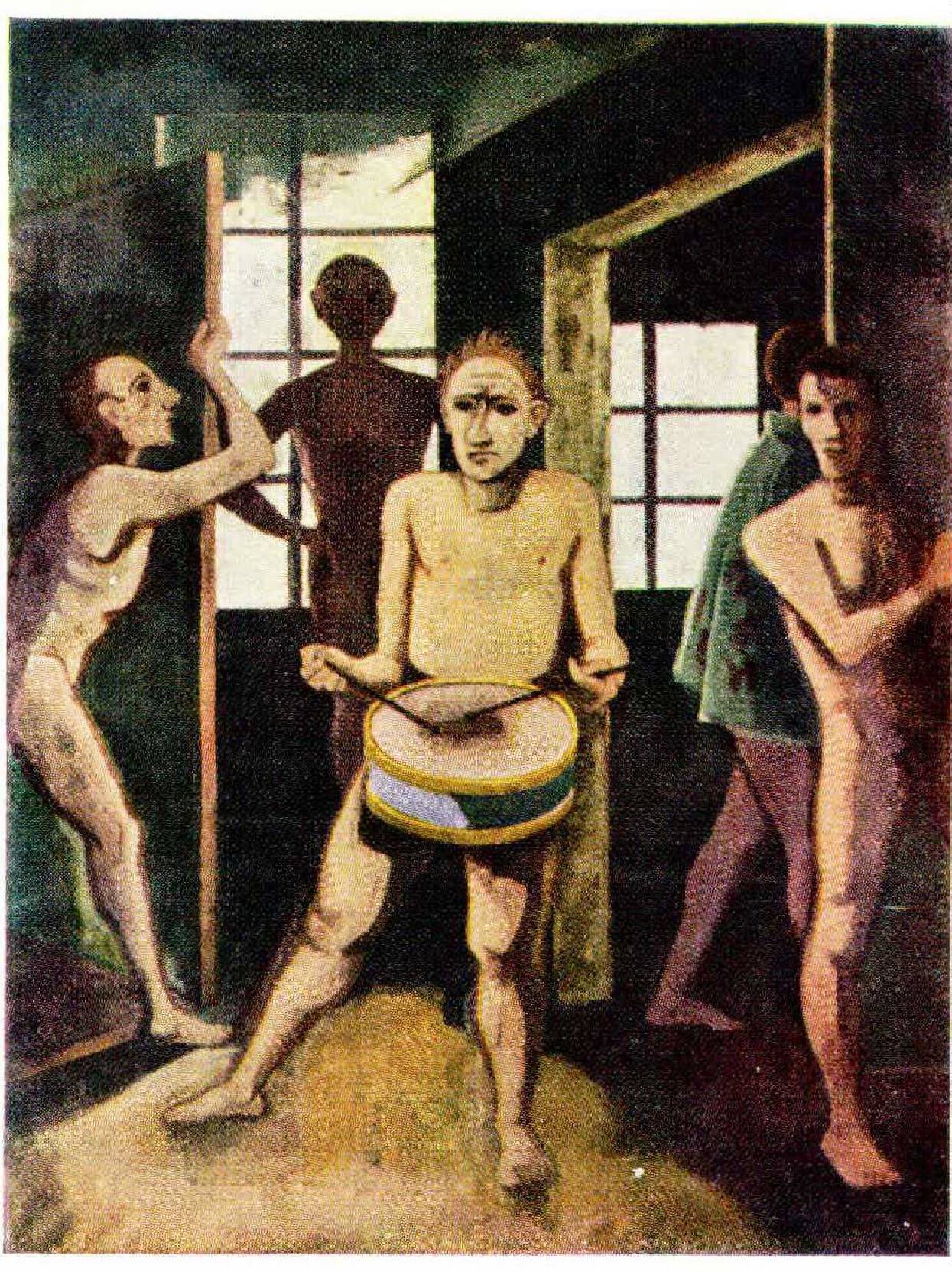
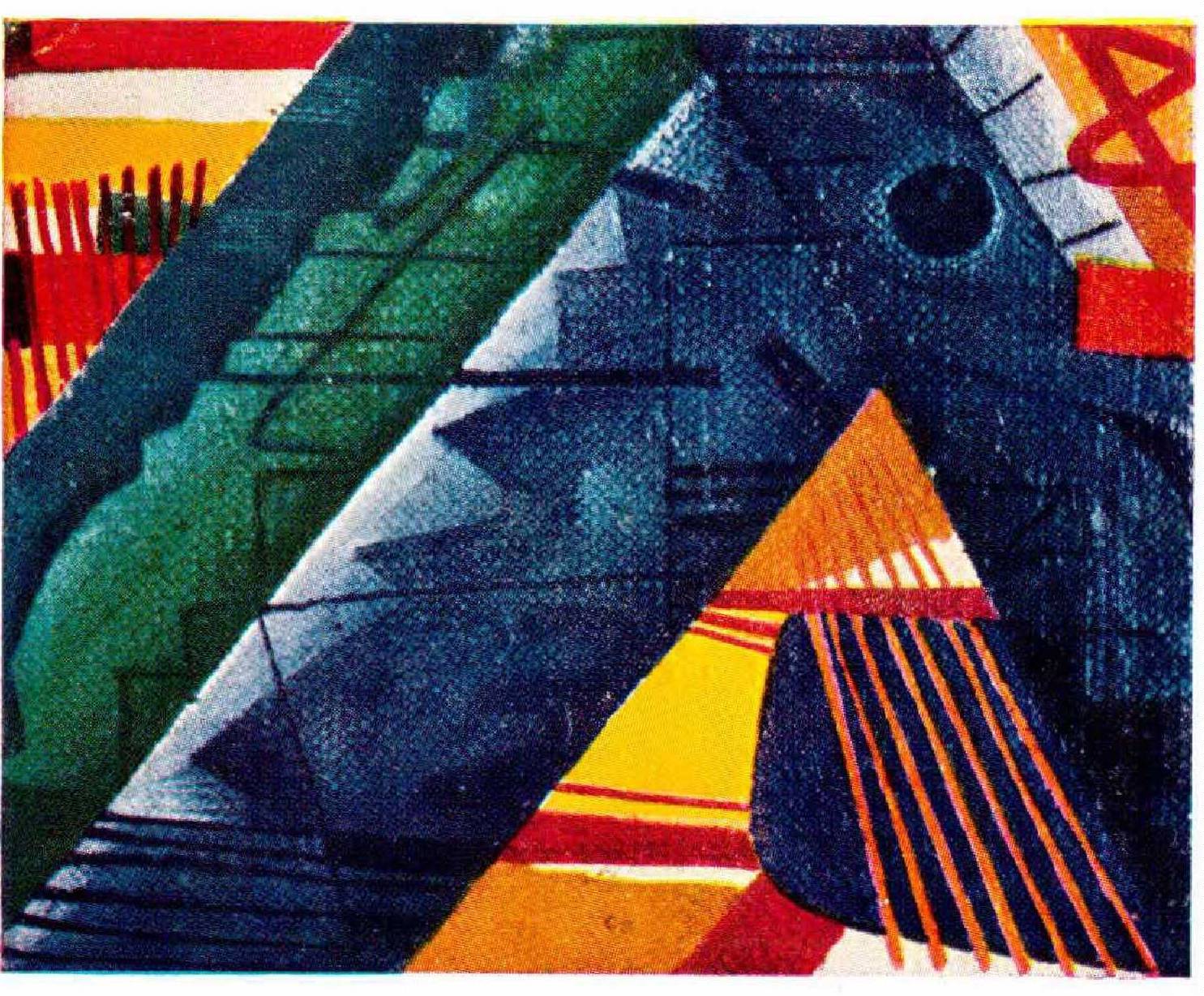
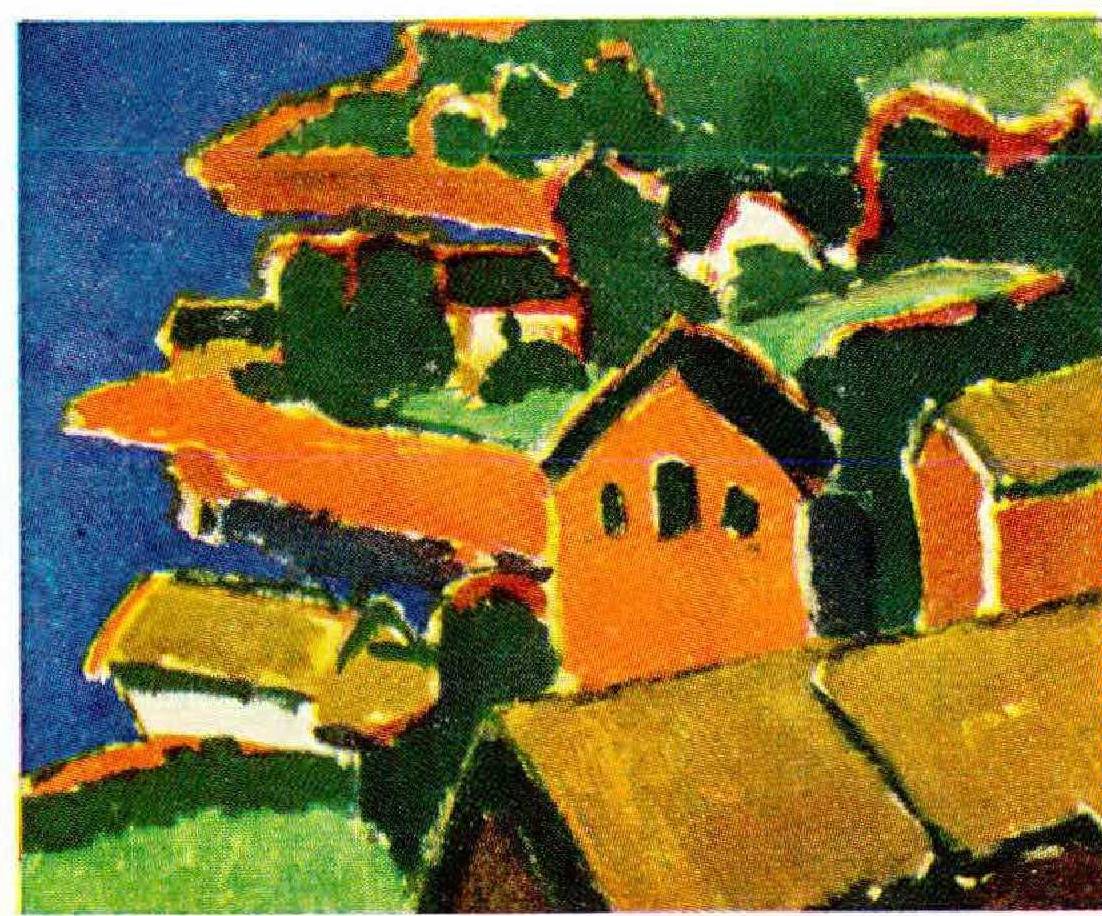
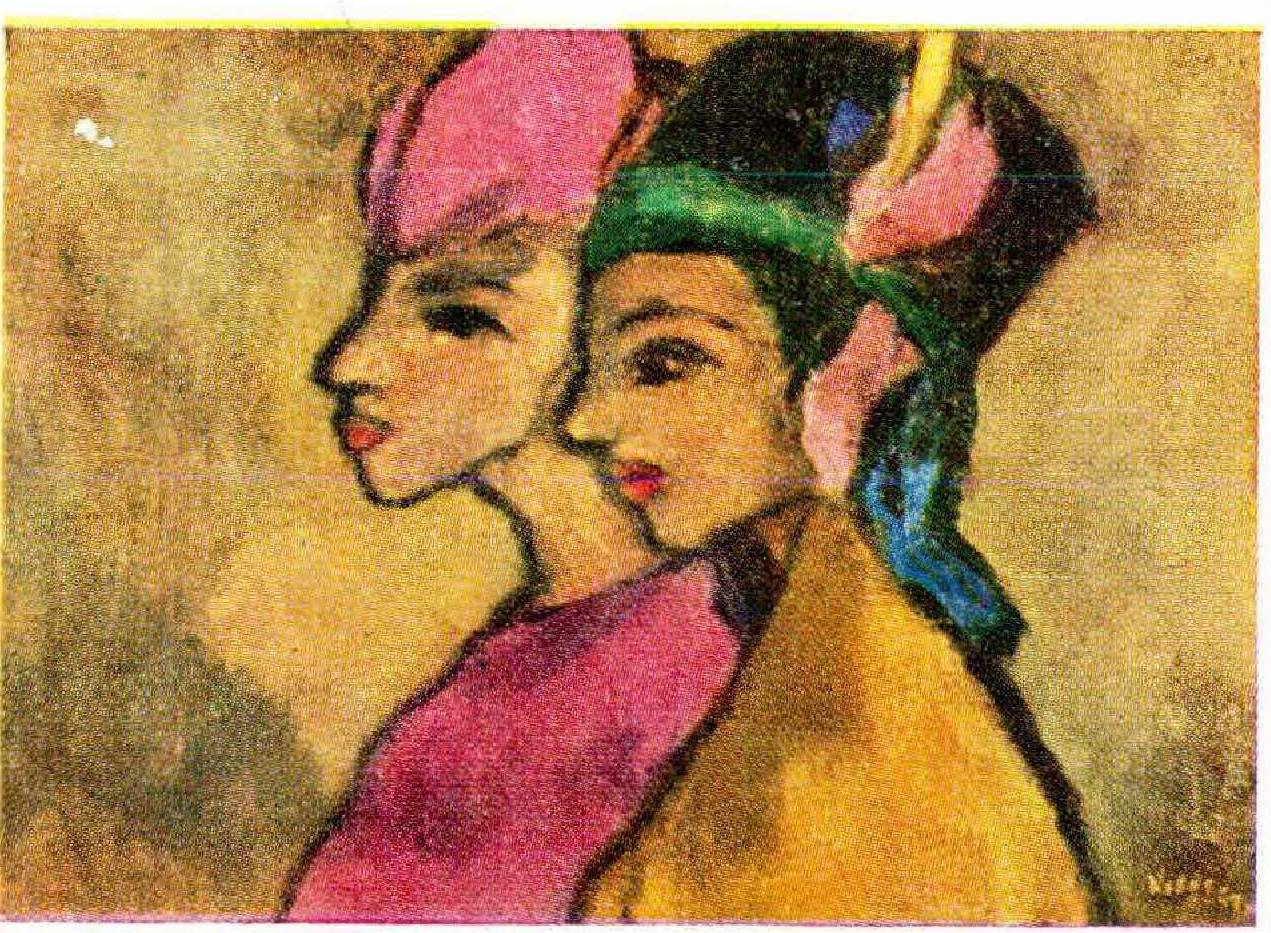
The young German painters seem to tend more and more to consolidate visionary “views” of the earth into a new landscape. In the case of Harry Kögler of Berlin (born in 1921) this tendency goes back to the montage techniques of the early Baumeister and the gifted Kurt Schwitters, who died in 1948 as an emigré in Britain; in the ease of K. R. H. Sonderborg of Hamburg (born in 1923) it aims at an intimate, all but graphic union of closest proximity and sudden distance; in the case of Hans Werdehausen of Essen (born in 1910) it tries out the dramatic way of merging different views in pathos (Plate 6). But everywhere it shows a purpose, now that the abstract manual of arms has been run through, to use abstraction so as to grasp, unveil, and visualize a new world reality. (This, by the way, is quite in line with the trend in American painting, from Mark Tobey and De Kooning to Sam Francis and Chelimsky.)
The fact that the names mentioned here can do no more than indicate a cross section of the manifold, abundant, dialectically interesting, and frequently contradictory flora of German art will kindly have to be pardoned by the reader, as well as by the unmentioned artists. Full, comprehensive justice cannot be done within the framework of a magazine; that would take a whole book. In closing, we give only one palpable instance of contradictoriness: the two pictures, Lofthus (Plate 13) by the mature Schmidt-Rottluff (born in 1884), and Abstraction XLVI (Plate 9) by a man only two years younger, Theodor Werner (born in 1886). Here we have two members of the same generation, one realizing a visionary expressionism in nonobjectivity, the other a supercharged dynamism.
5
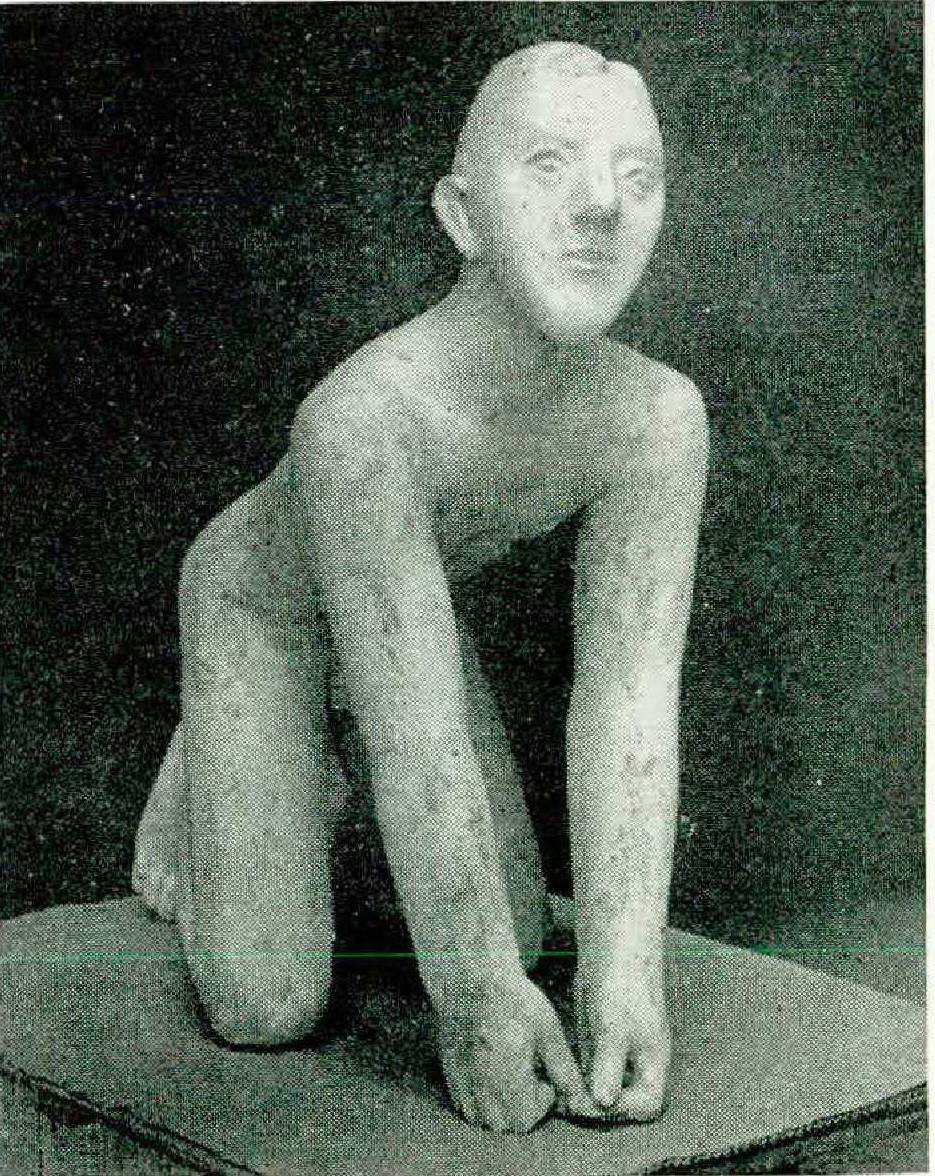
WHAT is the state of German sculpture today? In so far as it tried to present the human body more or less in its own image—i.e. not “too much” deformed — sculpture was the art most exposed to Nazi blandishments. A few great talents were actually seduced; on the other hand, Hermann Blumenthal (Plate 18), the greatest hope, a master of the abstract “construction" of bodies, was killed in the war. When a kind of balance sheet could finally be drawn after the end of the terror, few of the older sculptors proved capable of giving new impulses to a new age.
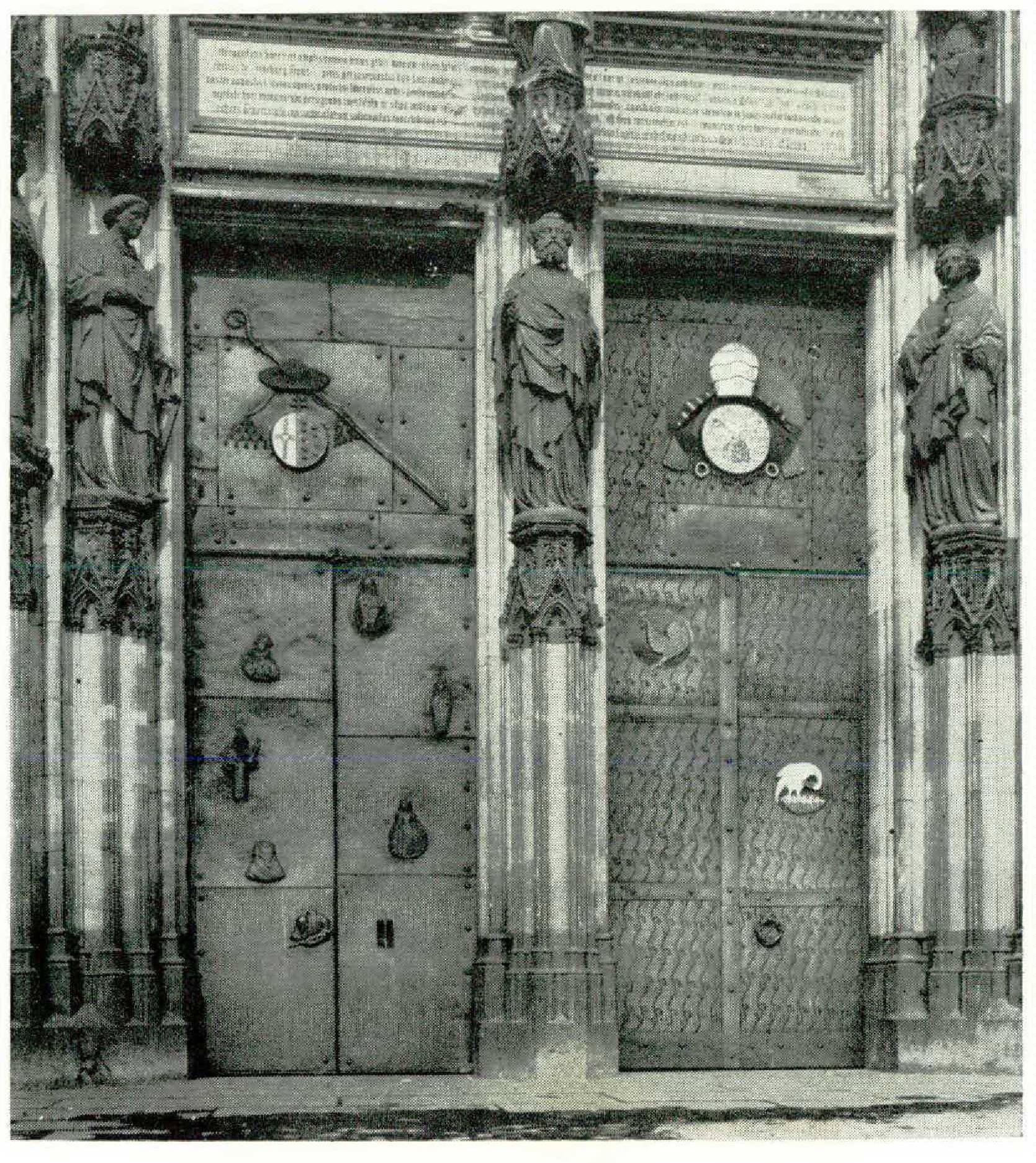
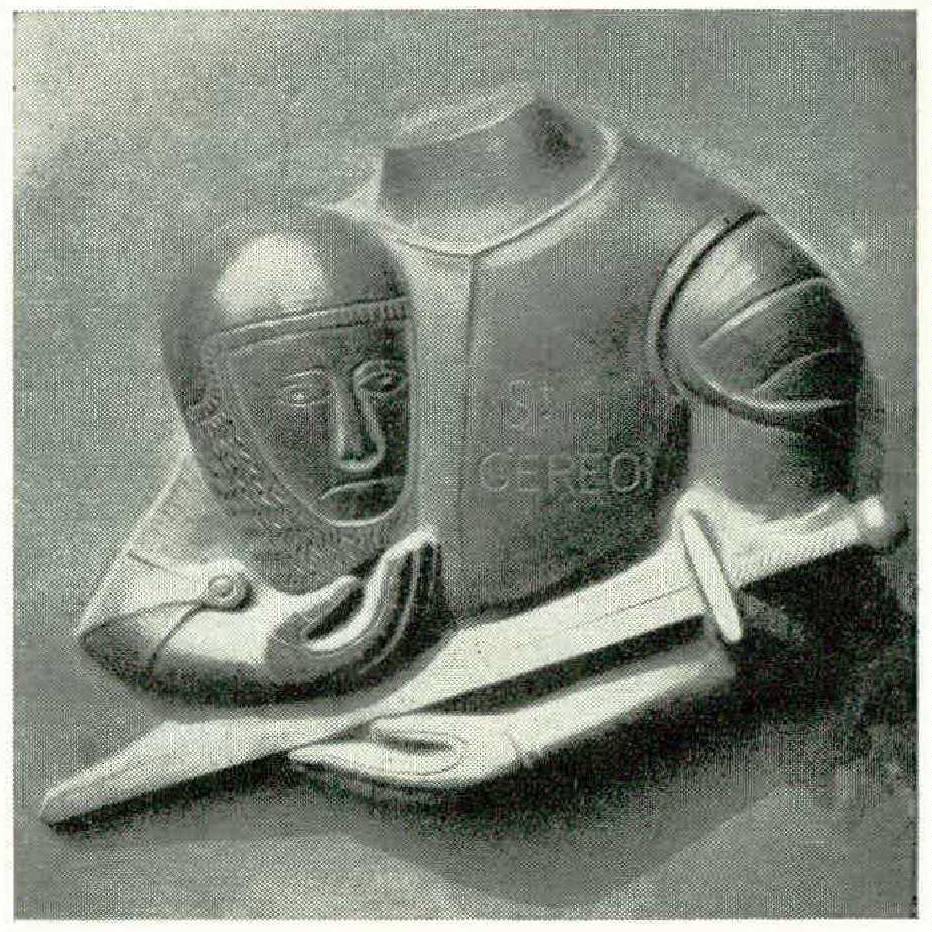
We have already mentioned Ewald Maturé (born in 1887). Having managed to survive, at least, in the shadow of the Church — not without gratefully deferring to its sacerdotal wishes – he promptly pulled himself together and returned to work, casting sparks in many directions. The greater the challenge, the more original the reply of his imagination. No wonder it was kindled by a task such as the new portals for the southern transept of Cologne Cathedral (Plates 22, 23). Over the four gate niches of the unfortunately Neo-Gothic front he cast a daring net of wholly asymmetrical forms, an expression of strong, purely spiritual autonomy.
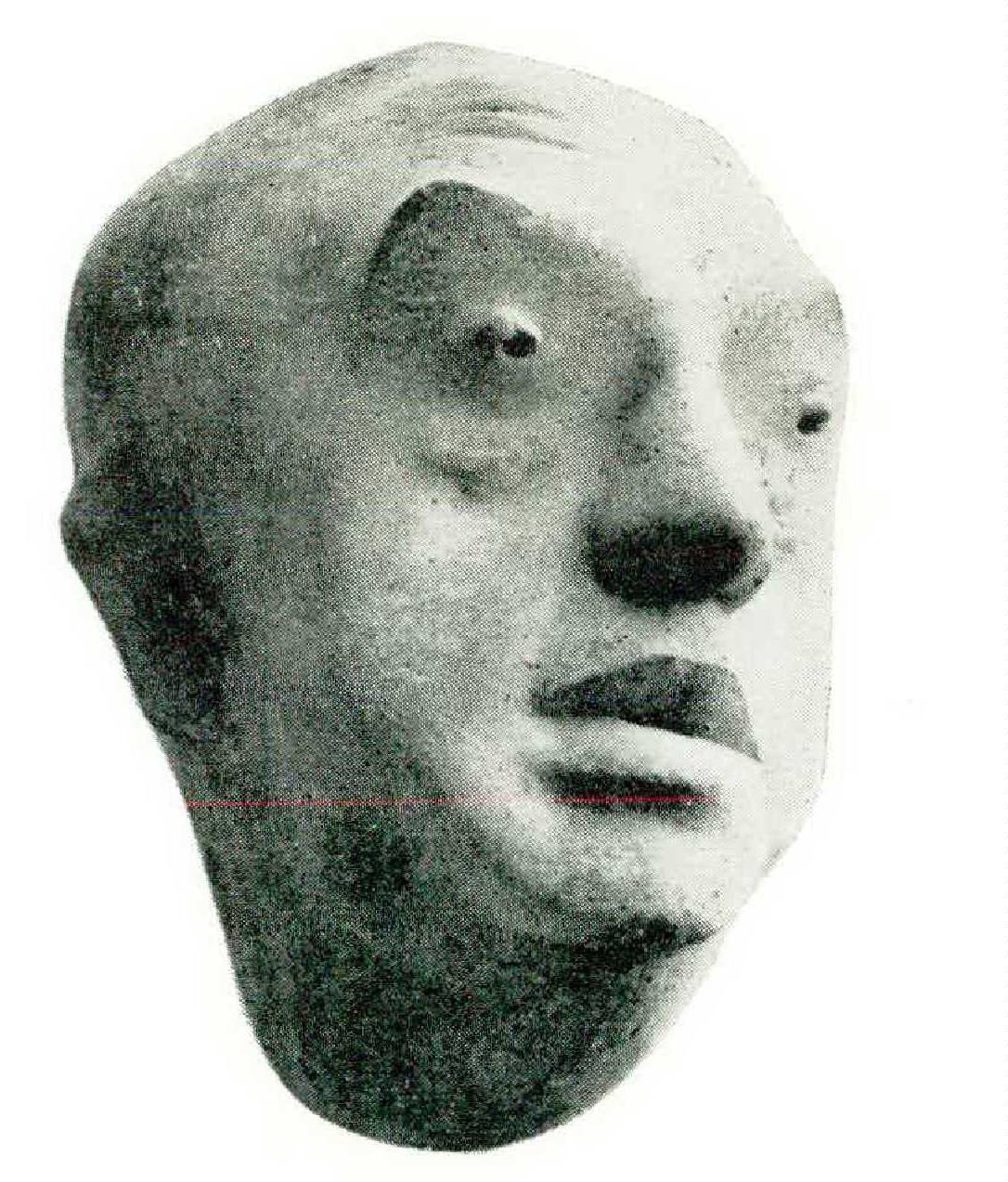
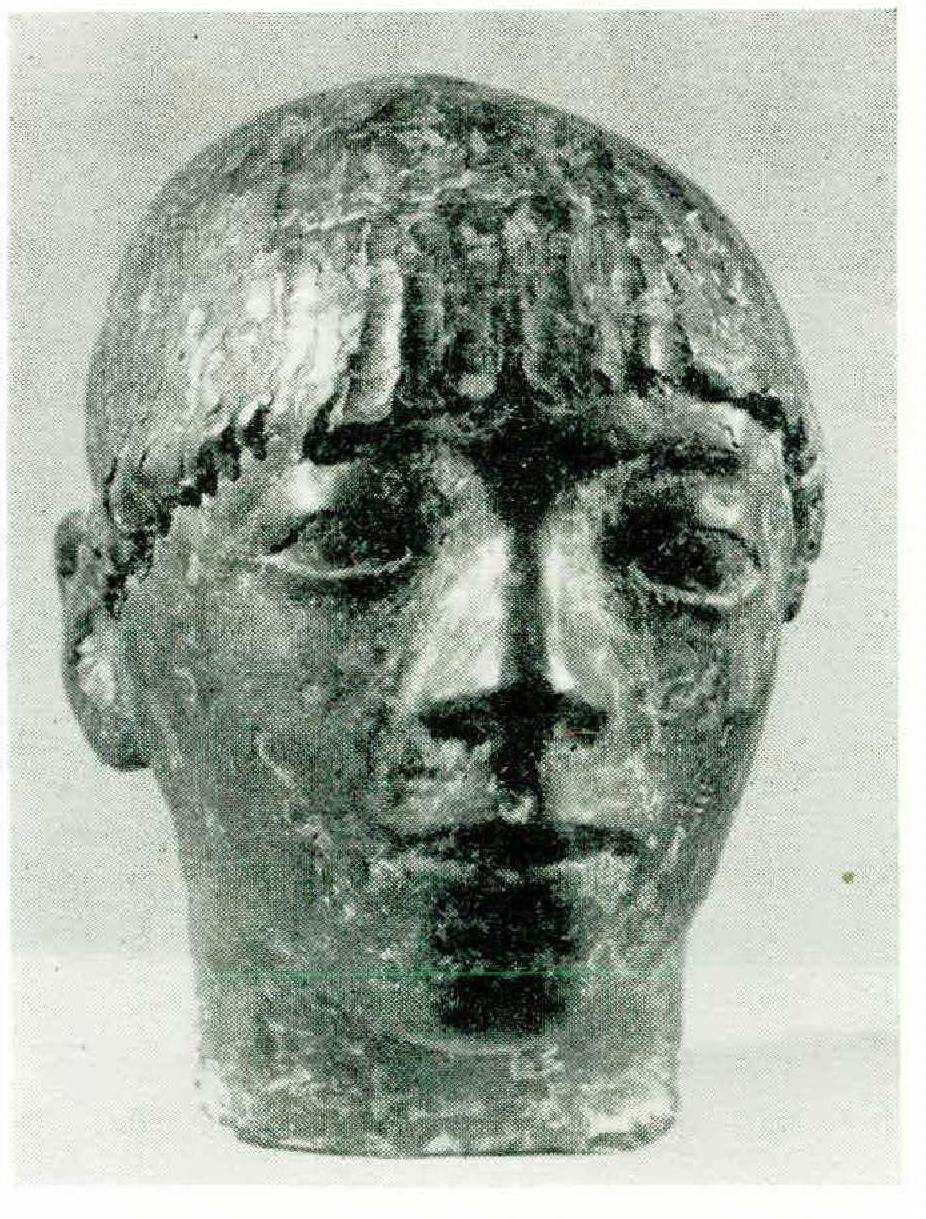
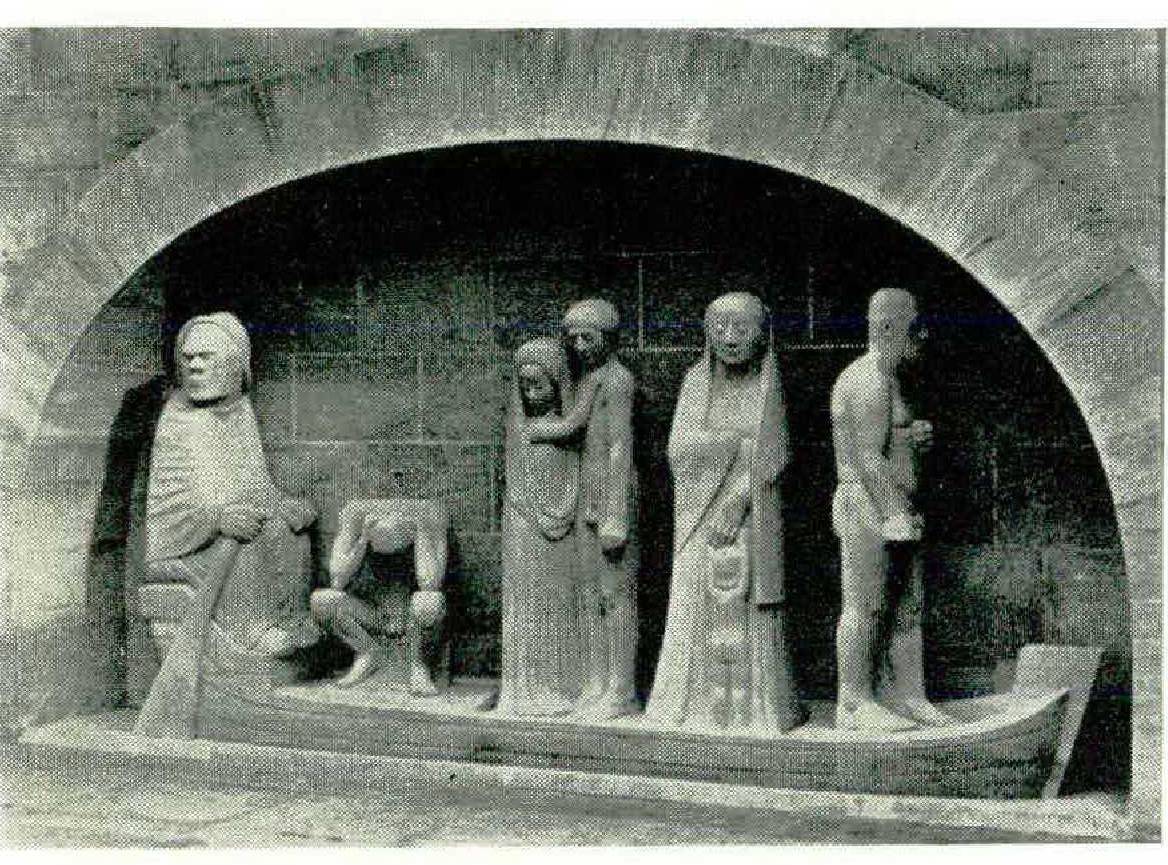
Gerhard Marcks (born in 1889) shows extreme sensitivity, especially in painstakingly formed portraits. Now and then — as in his monument for the victims of the bombing of Hamburg (Plate 24) — he achieves a peculiar, oddly magical form by combining classicism with expressionism. Toni Stadler (born in 1888 in Munich and working there now) responds to the Latin South and draws on paraphrases of Mediterranean, mostly Etruscan sculpture for the vigor of his unmistakably personal poetry. From his sculptures such as Head of a Boy (Plate 17) a lyrical breath issues without straying into pseudo-idyllies.
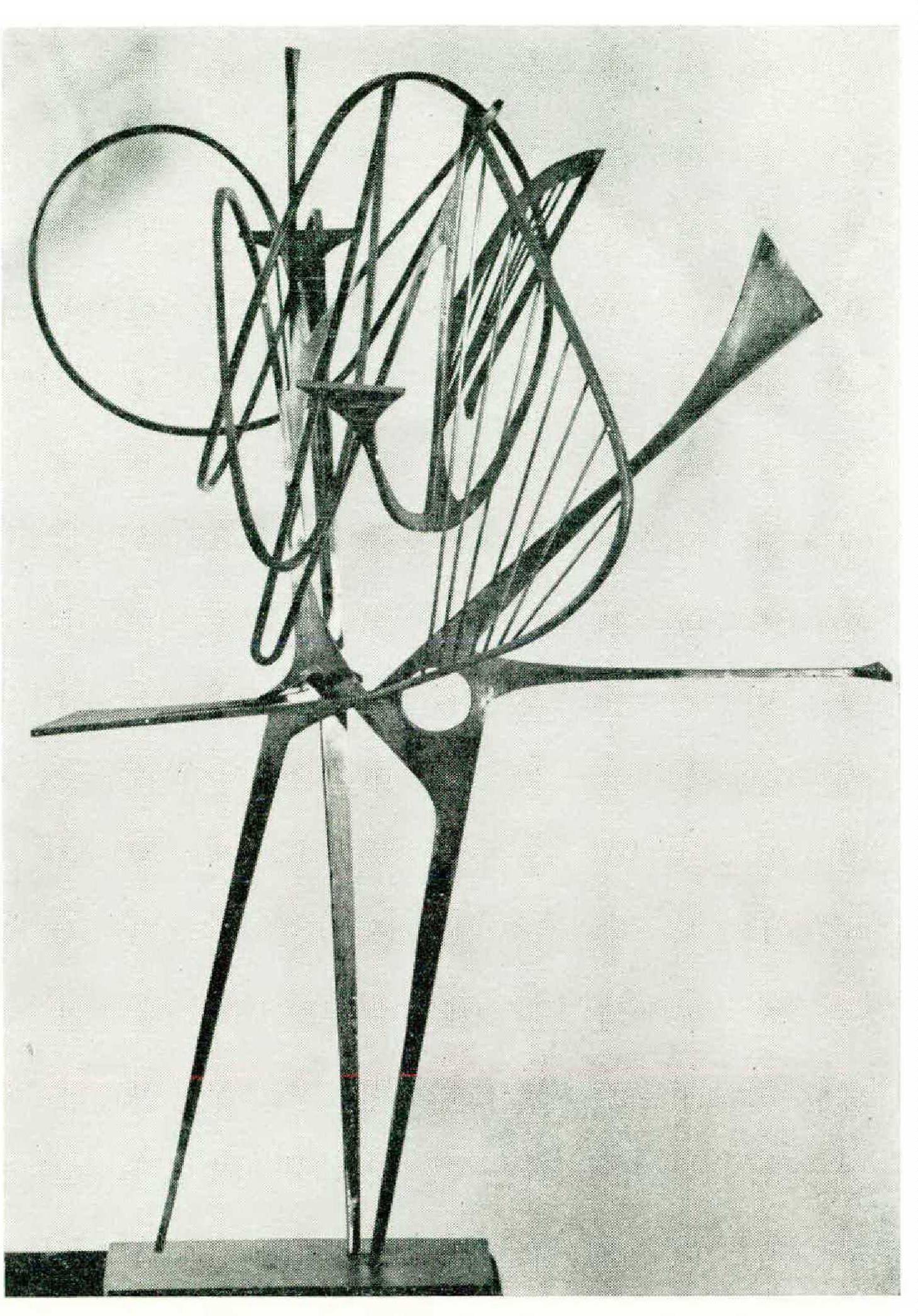
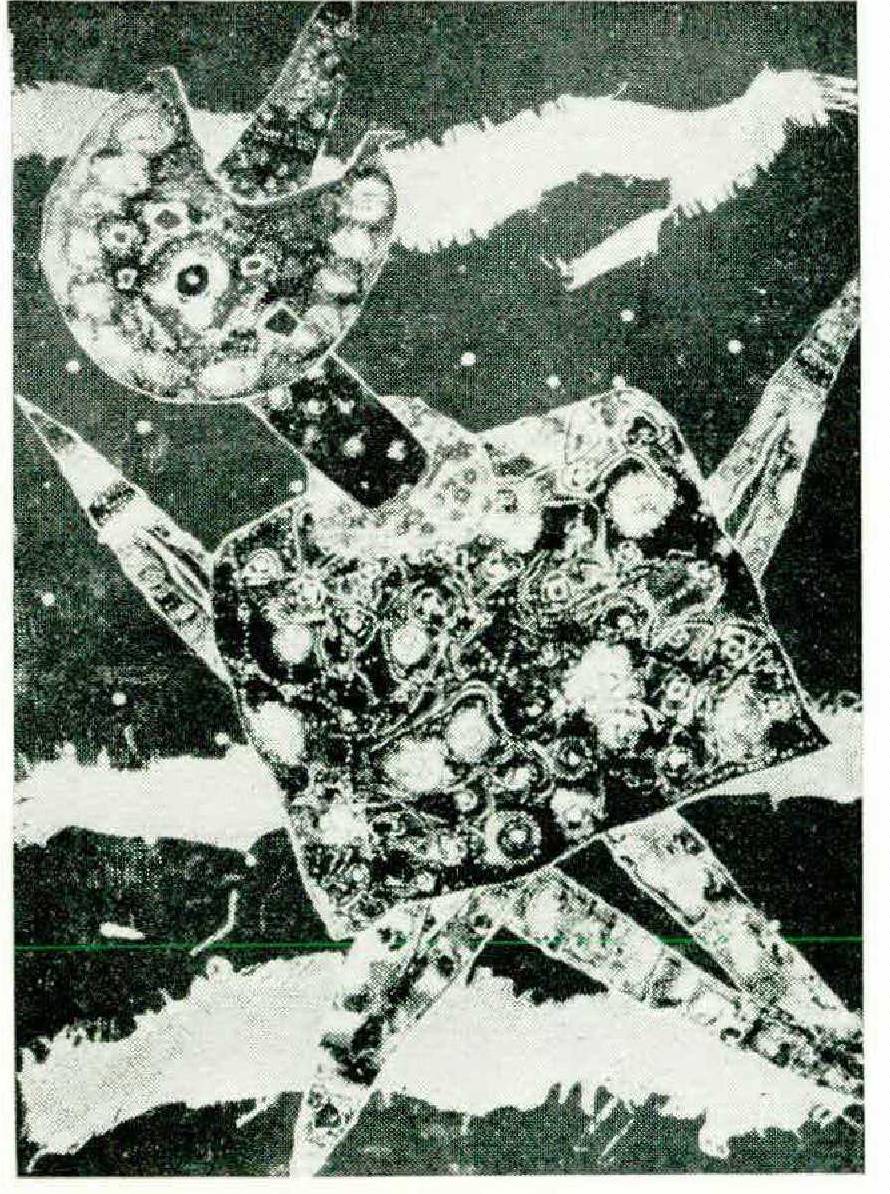
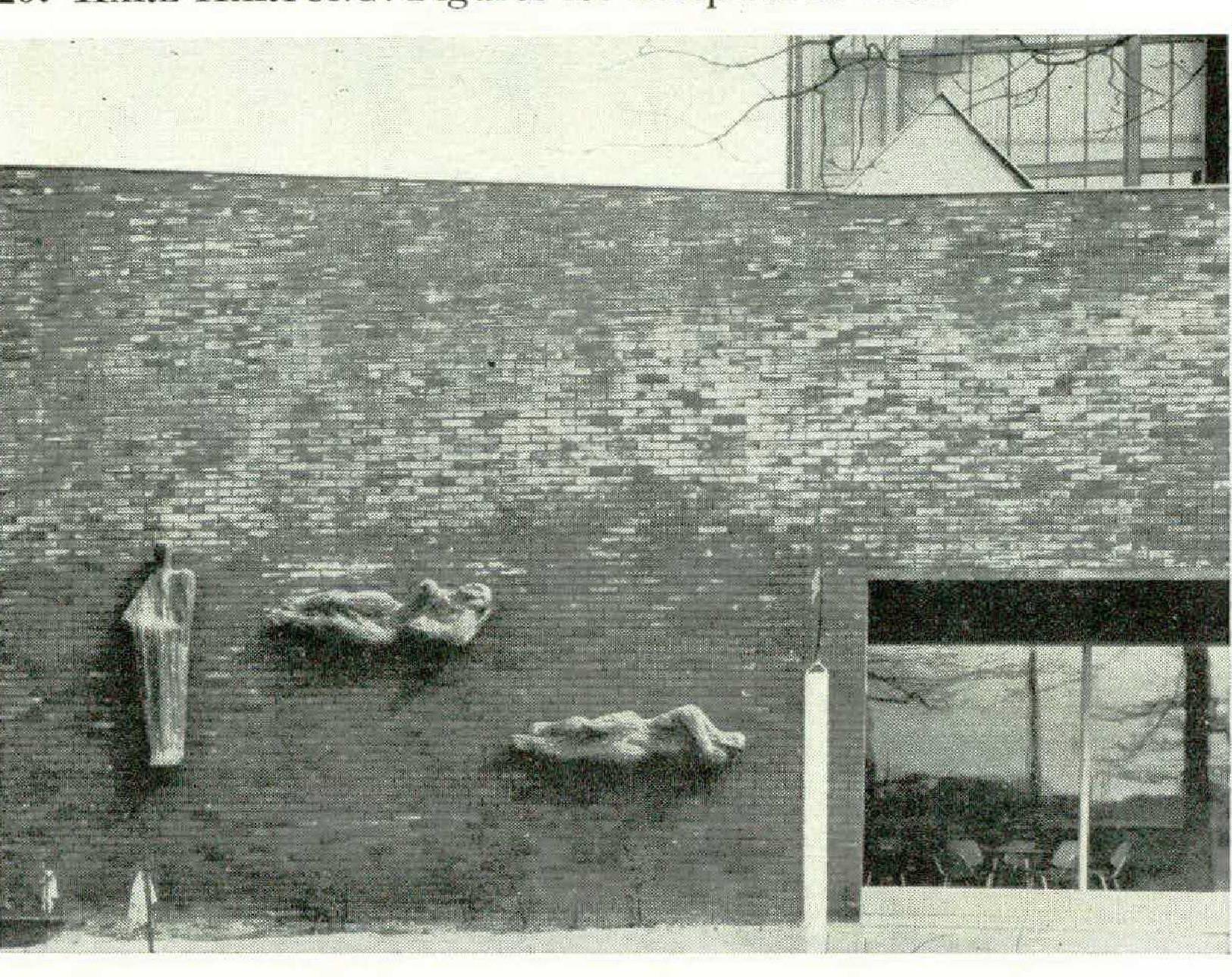
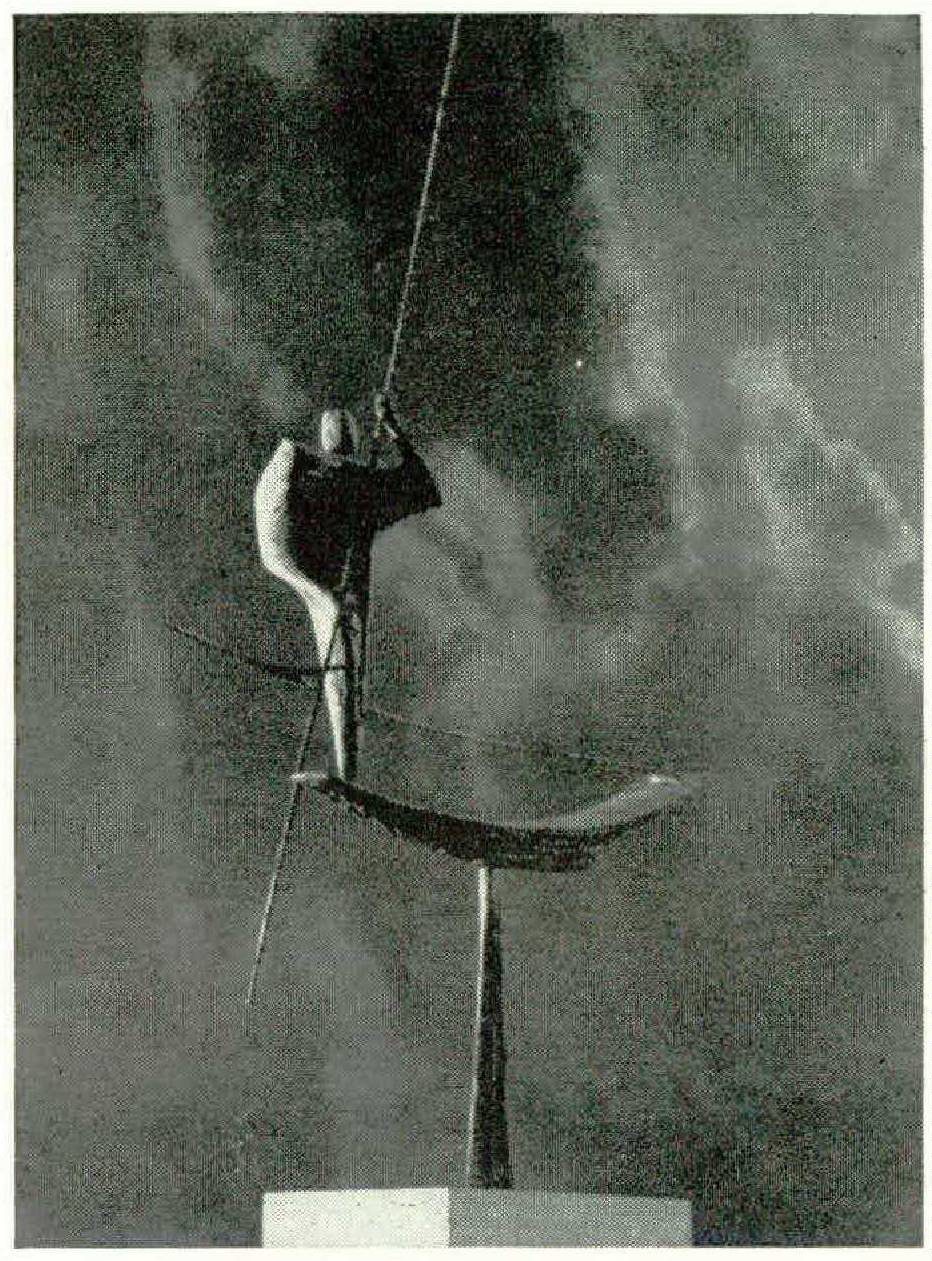
The growing formal power which Bernhard Heiliger (born in 1915, and now professor at the Academy in Berlin) acquired over the years in rubbedstone portraits (Plate 15) has encouraged him to try such great designs as the Symbol of River Navigation (Plate 21) for a new bridge over the Neckar. Karl Hartung (born in 1908, and also a professor at the Berlin Academy) has lately reapproached the problem of the whole figure from the opposite direction: unquestionably the greatest finder of non-objective forms in German sculpture, he wants to use his experience with “free images for the construction of bodies. The group at the gate wall of the hospital in Marl (Plate 20) circumscribes an “absolute” ensemble by means of seemingly natural bodies. As in recent painting, this road also leads to a new kind of reality. Hans Uhlmann (born in 1900, another professor at the Berlin Academy) realizes brittle and sometimes vibrant metal constructions (Plate 16). Rolf Nesch (born in 1893), an emigré in Norway, has gone from metal printing refinements to a highly original mixture of graphic art and relief sculpture (enamel-inlaid copper; Plate 19).
We come now to German architecture. Under the dictatorship it had the worst time, being most thoroughly harnessed. Every despotism seeks its immediate “expression" in huge, representative and representatively intimidating edifices. Architecture becomes directly enslaved. Thus the elite of German architects were virtually compelled to flee into exile after 1933, among them Walter Gropius, once head of the Bauhaus, and Mies van der Rohe, who have remained in America ever since. Every deviation from the prescribed “line” — a sodden, desolate, fourth-rate classicism — was regarded as a provocation hostile to the state. Not the studios alone, but even the chairs of architecture at the German academies were emptied. There remained technicians and engineers — competent men without imagination.
Accordingly, when reconstruction of the destroyed German cities and towns began about 1948, there was no dearth of technical specialists, but rather of the designing artists who had once given German architecture its truly world-wide importance. Considering this emigration of productive minds, and considering further how largely reconstruction depended on the existing underground utility and sewage systems, how greatly it was hampered by the chaos in real estate, how much could and had to be improvised for the time being — considering all this, we can grant all justified complaints of missed opportunities and yet marvel slightly that despite these paralyzing difficulties a good measure of architectural inventiveness could prevail in the welter of postwar building.
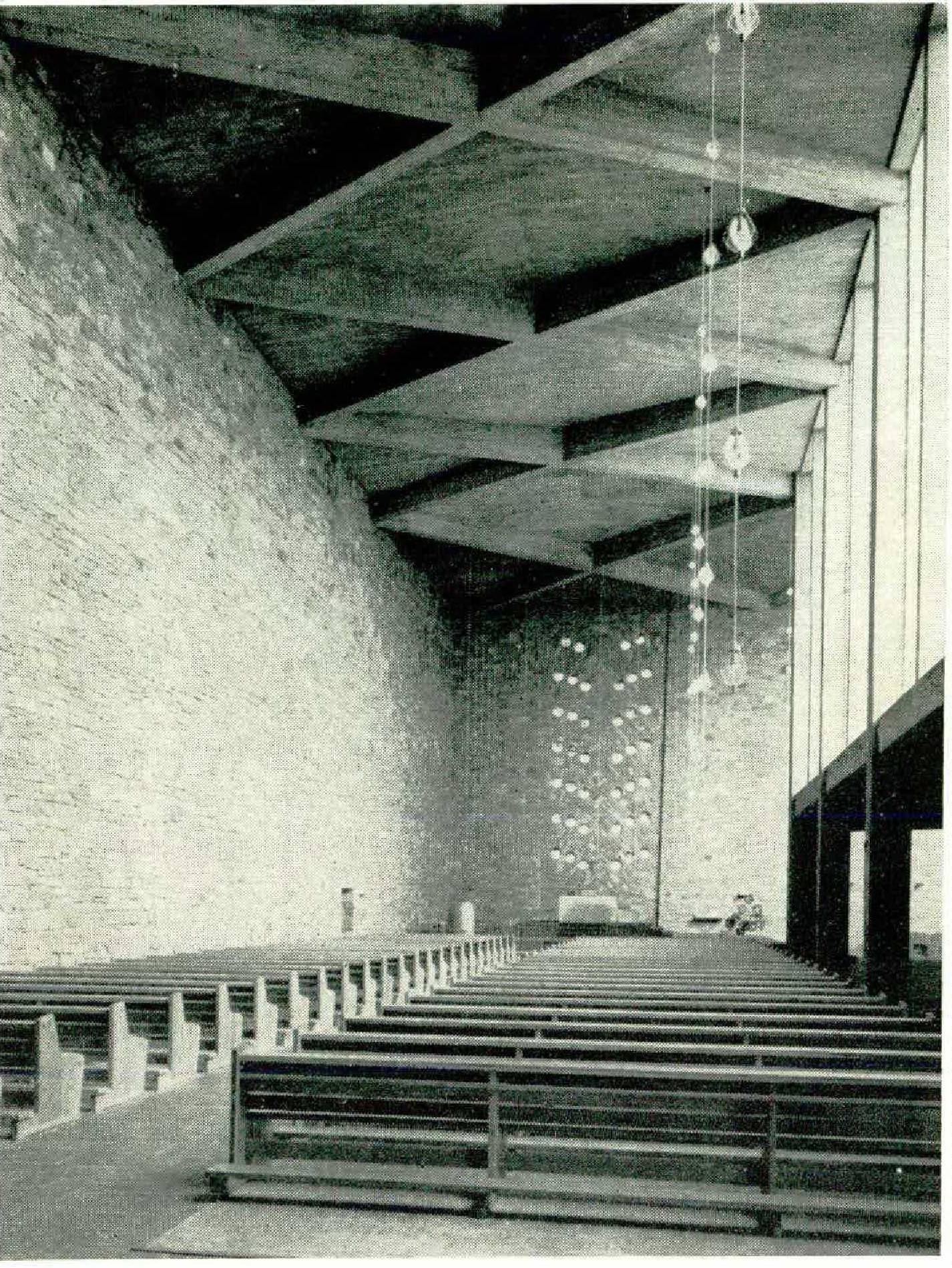
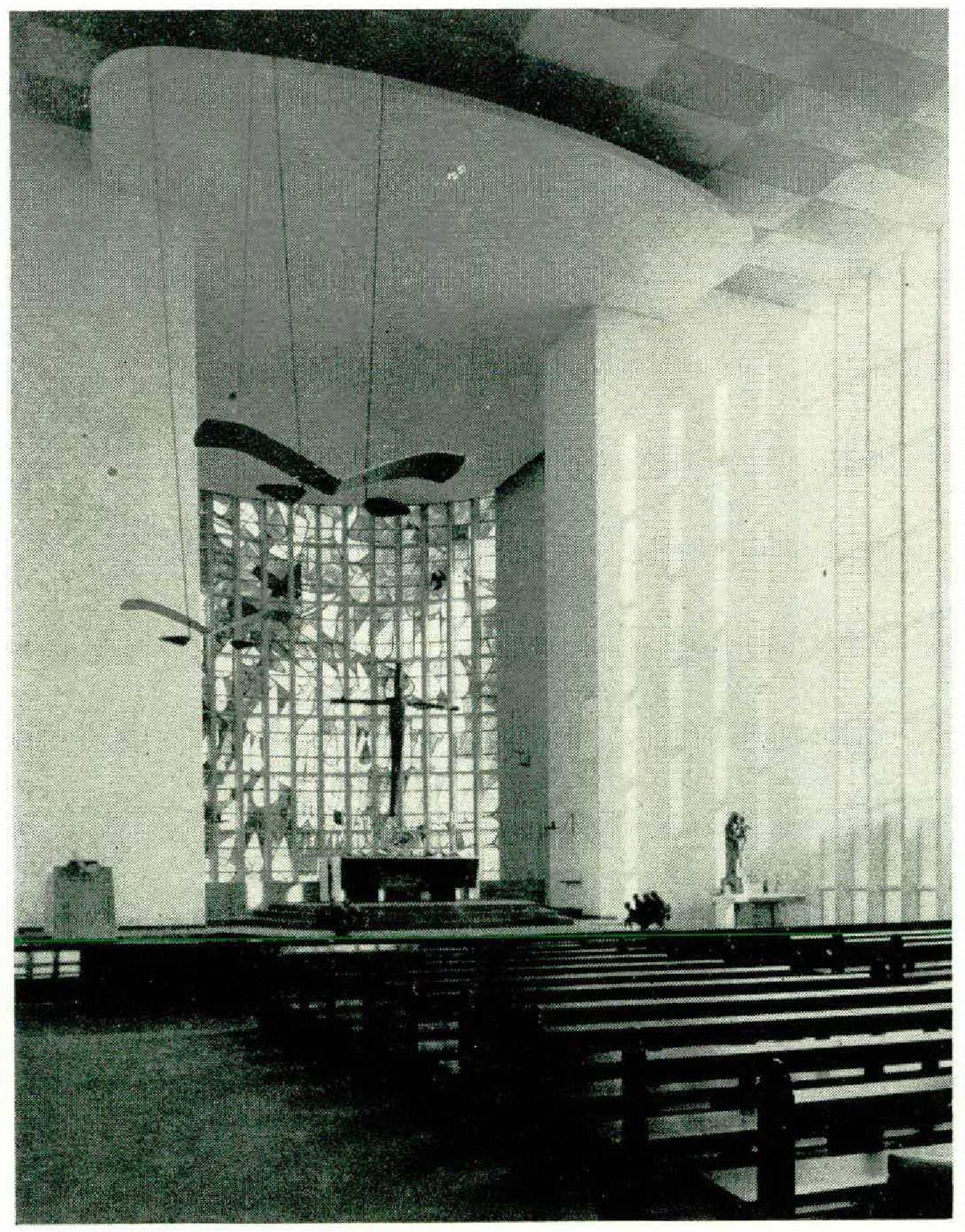
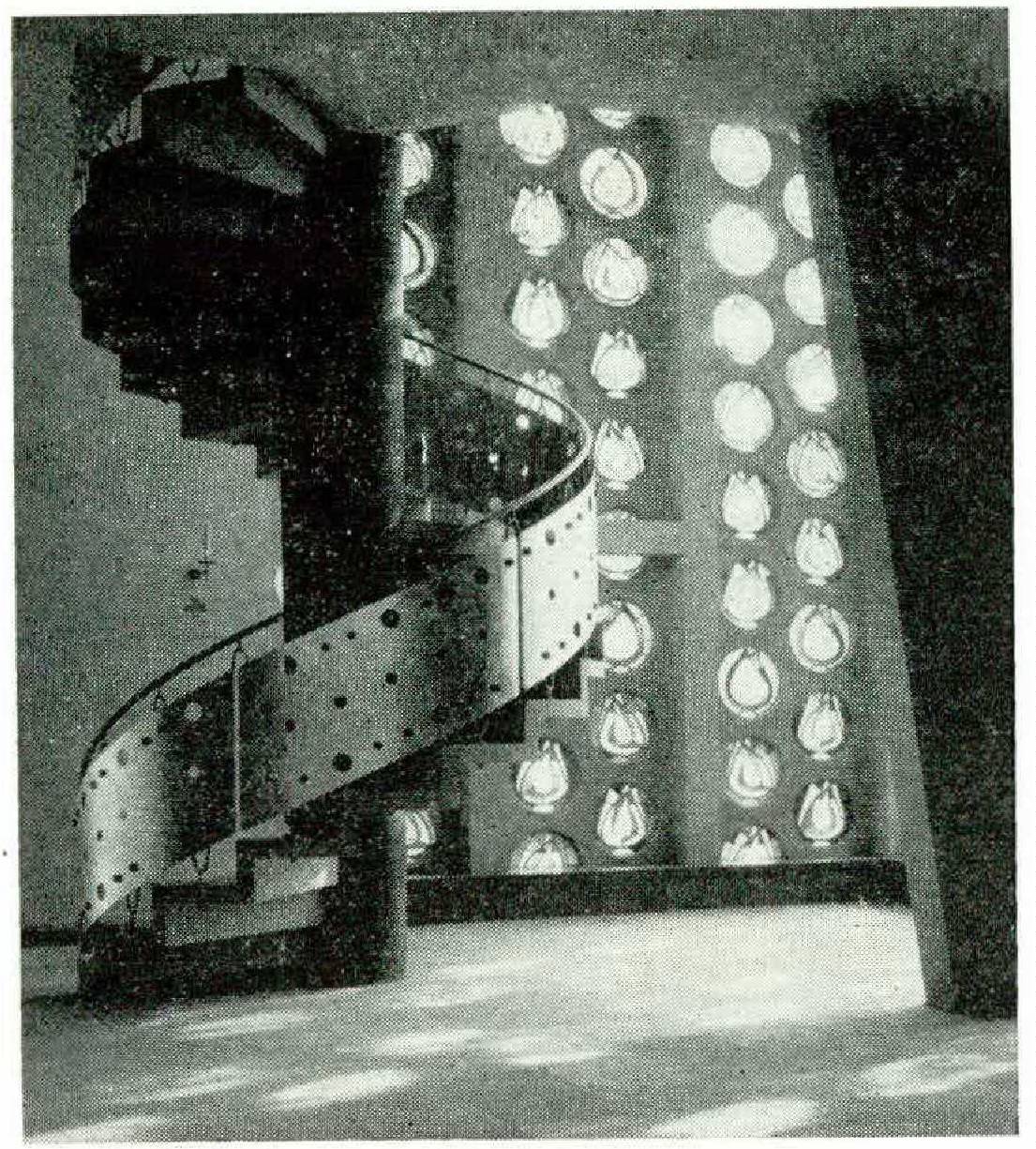
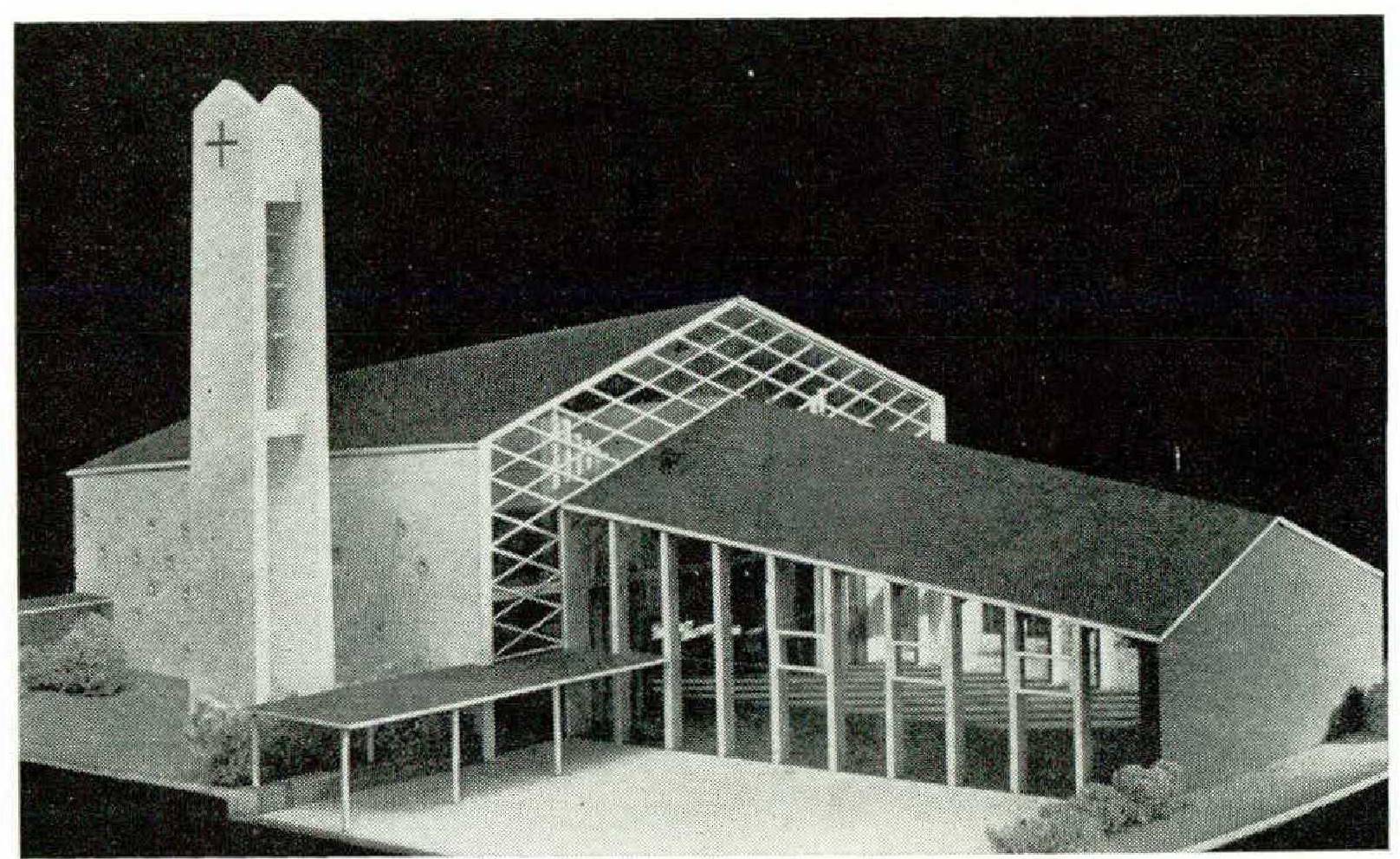
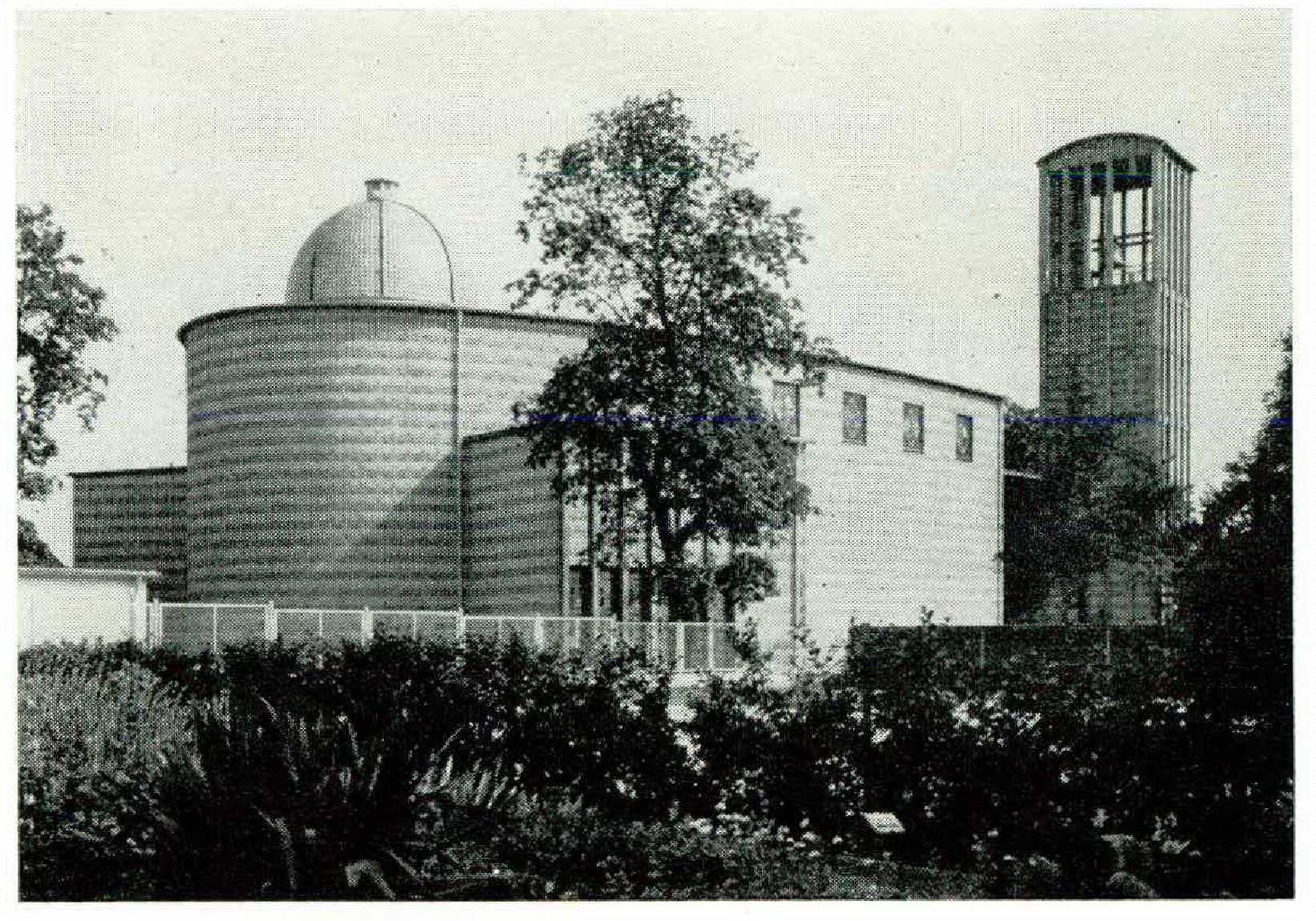
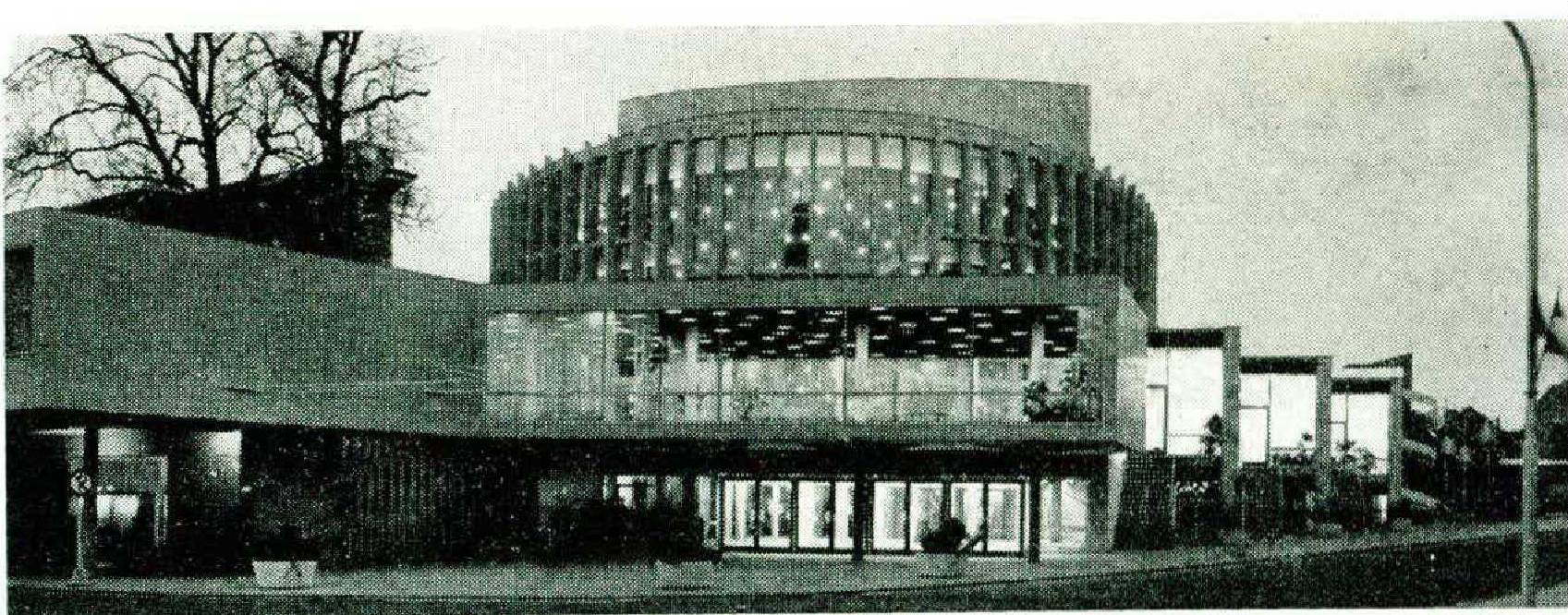
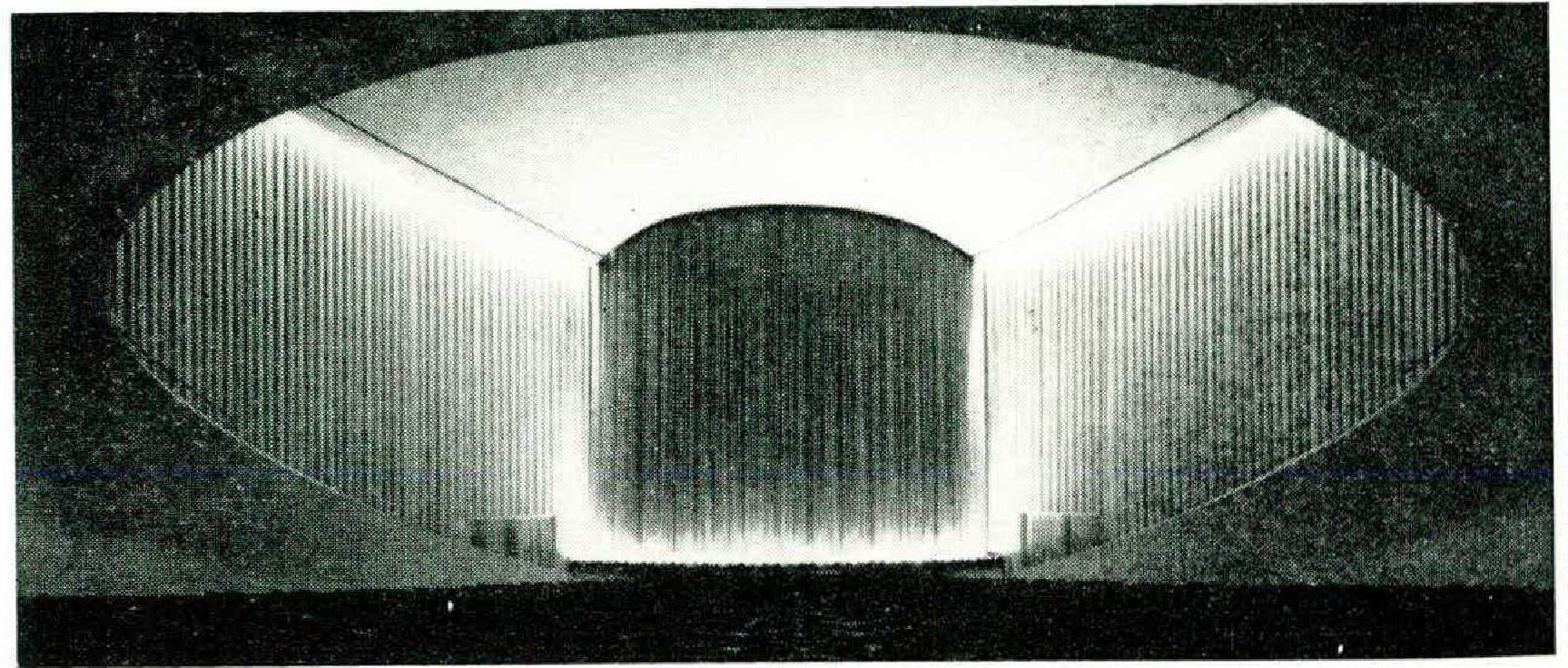
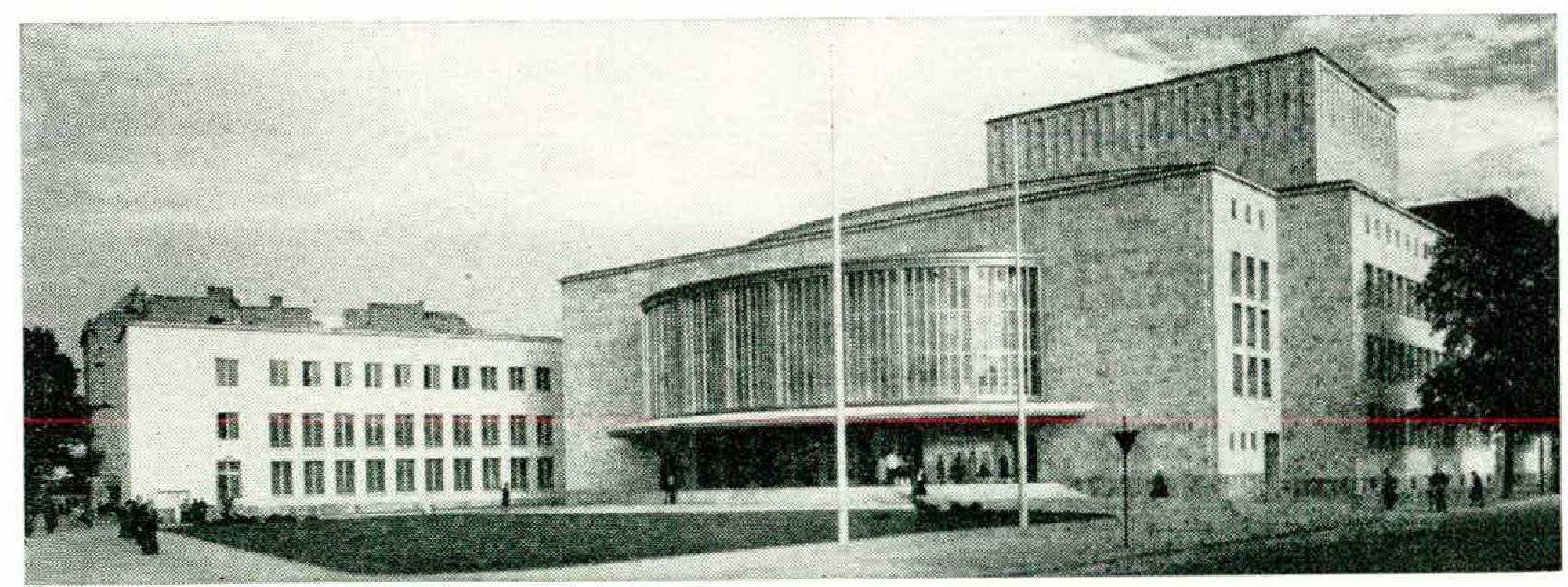
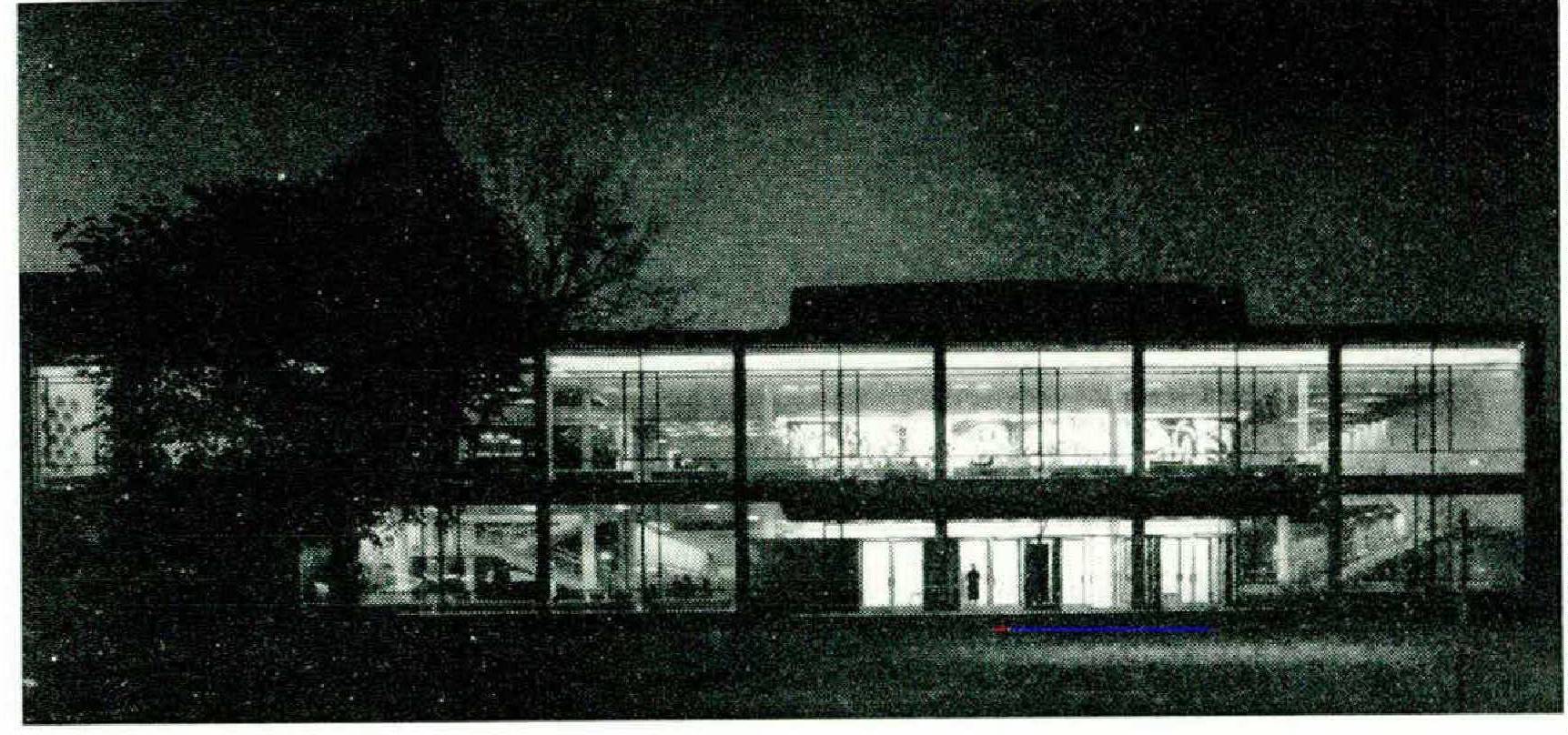
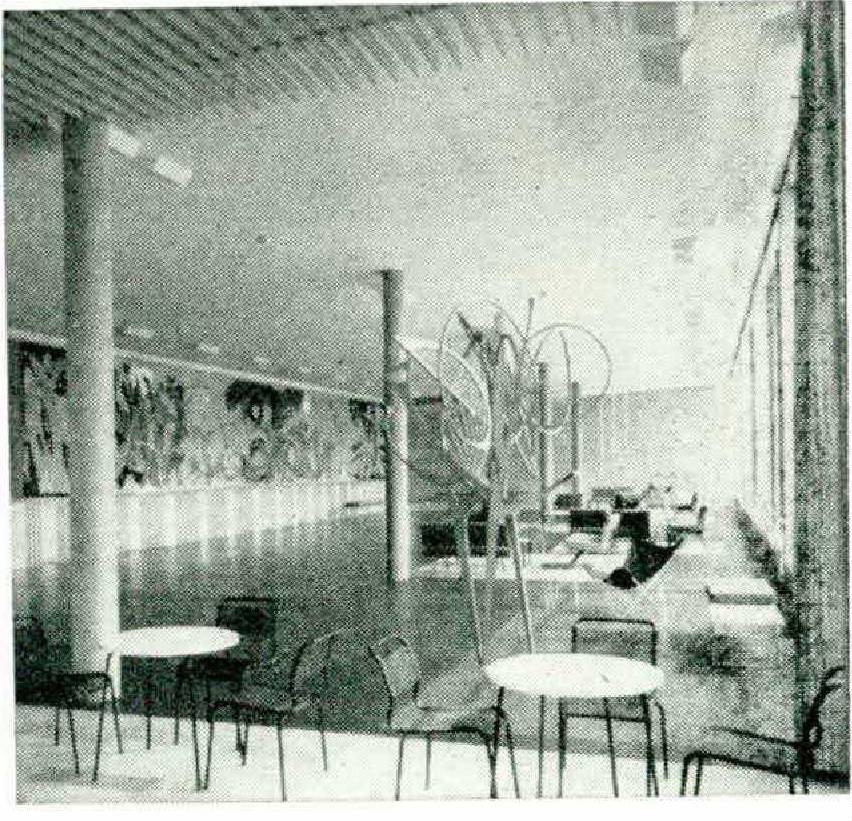
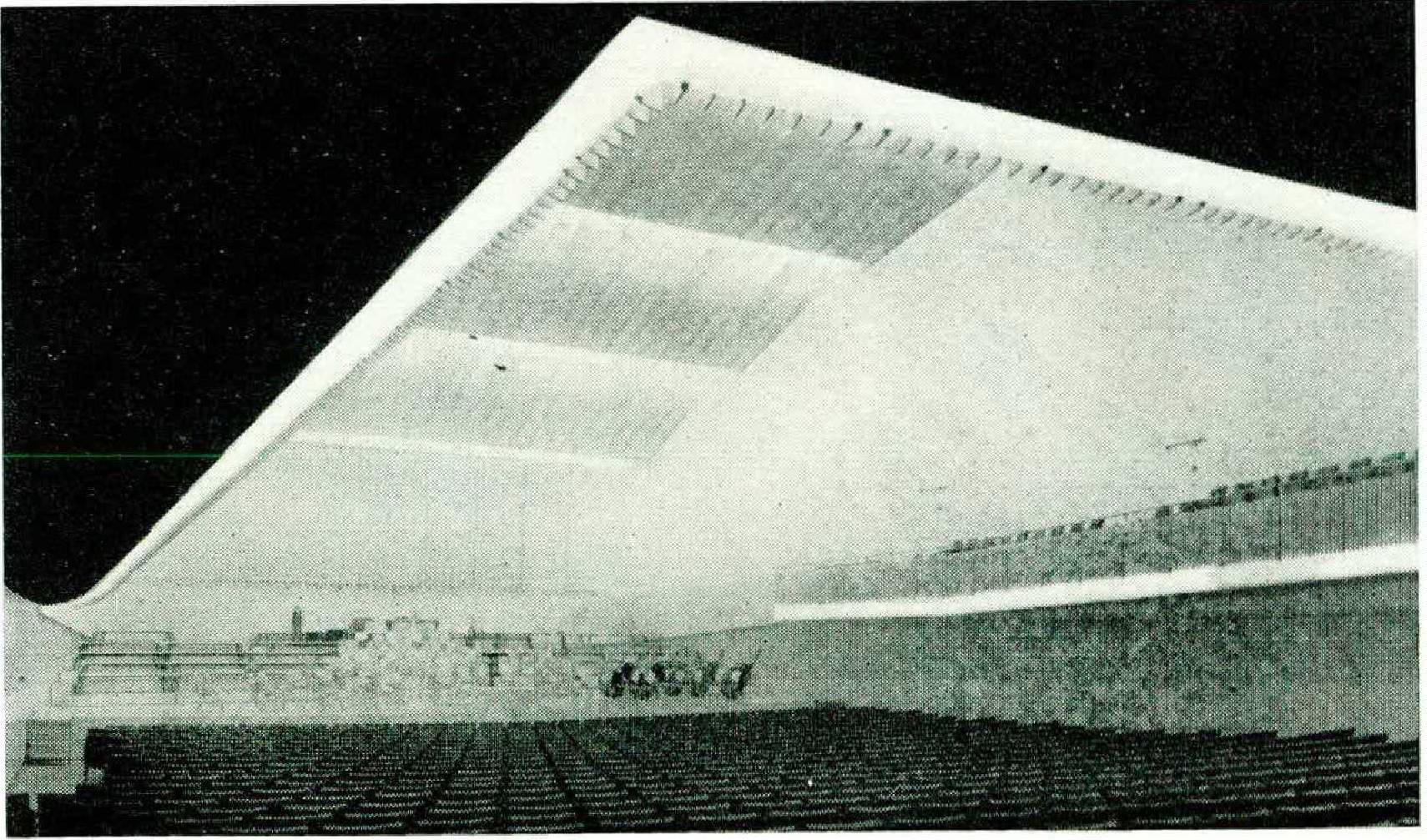
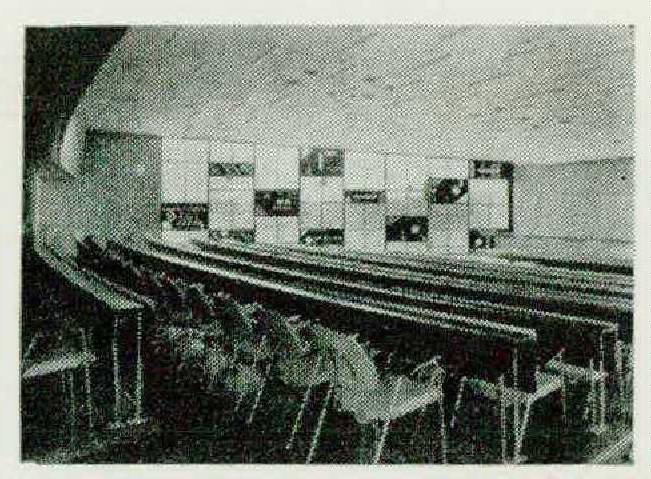
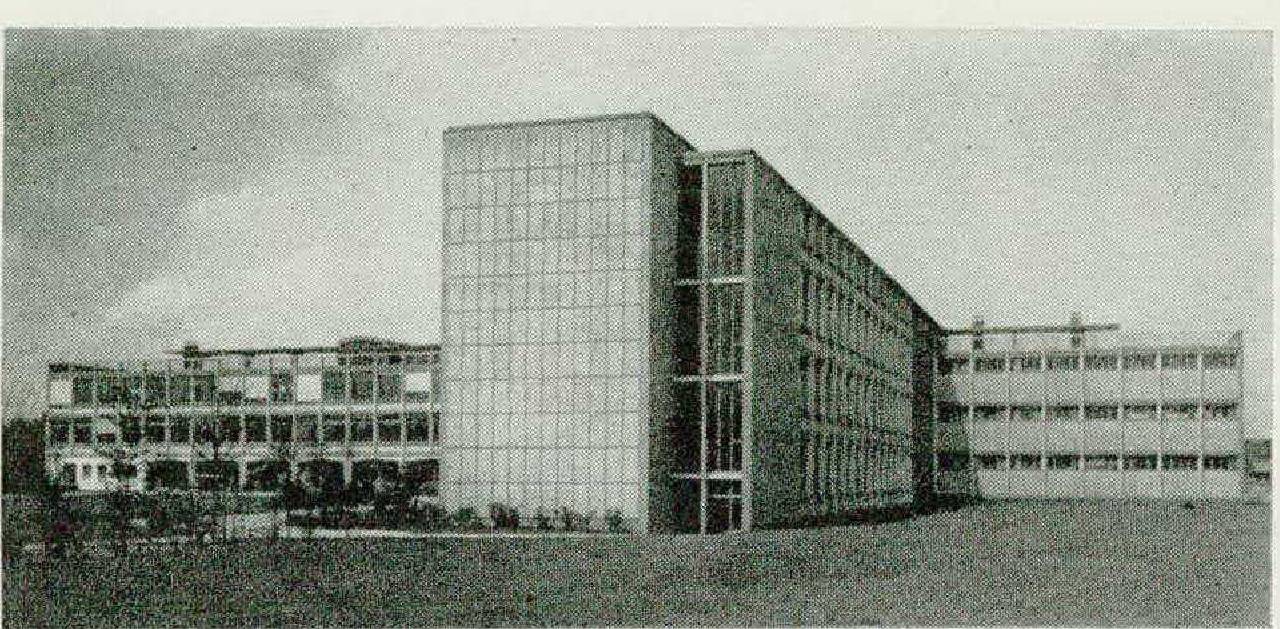
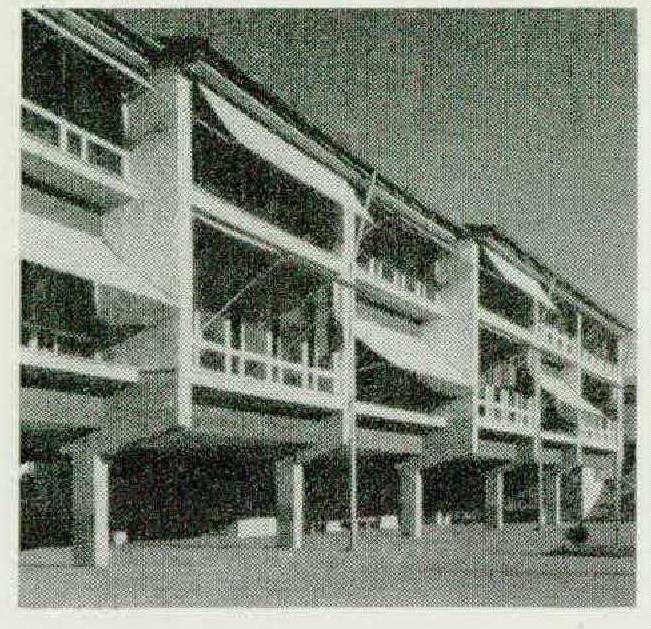
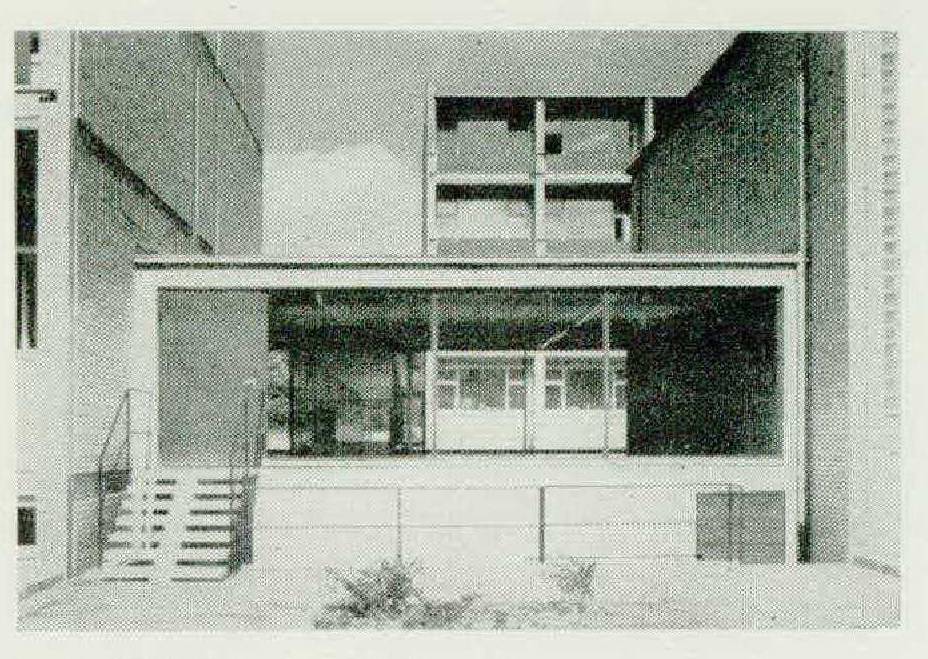
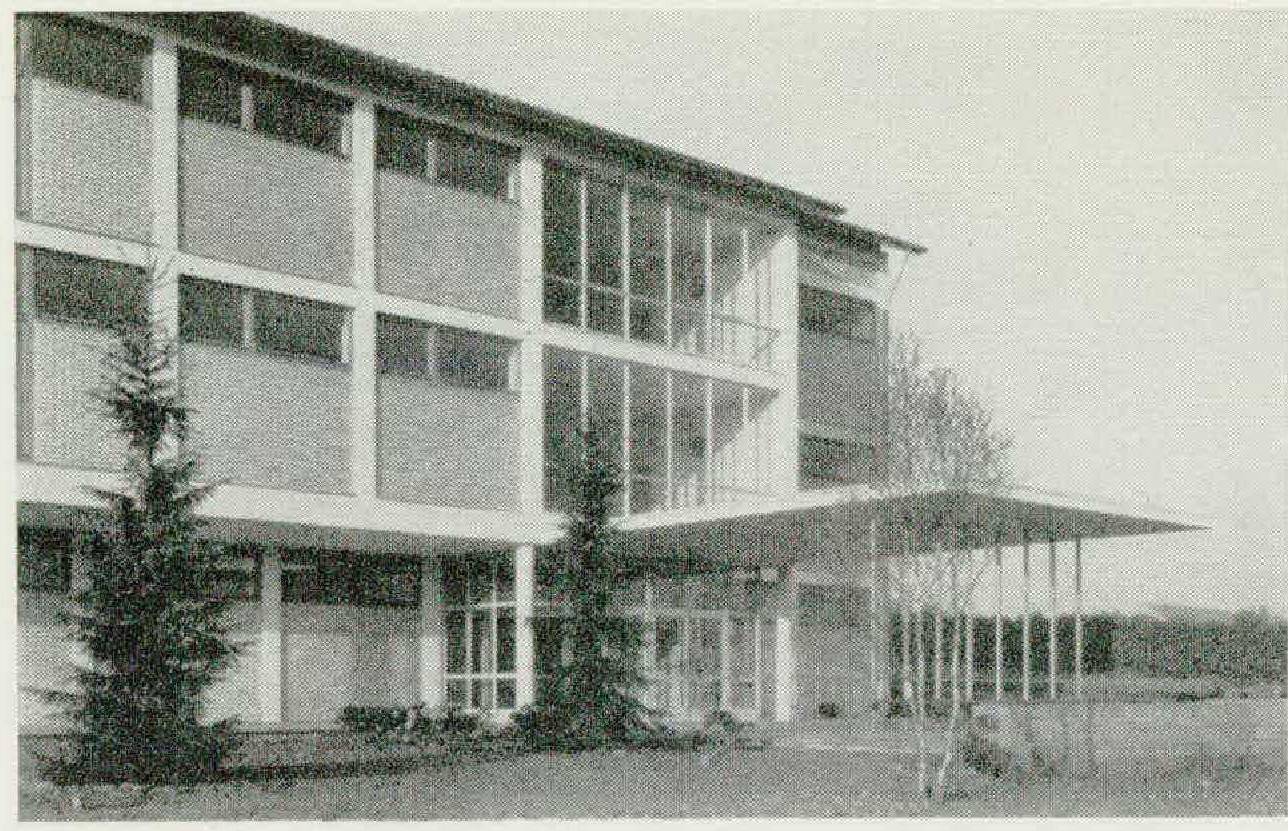
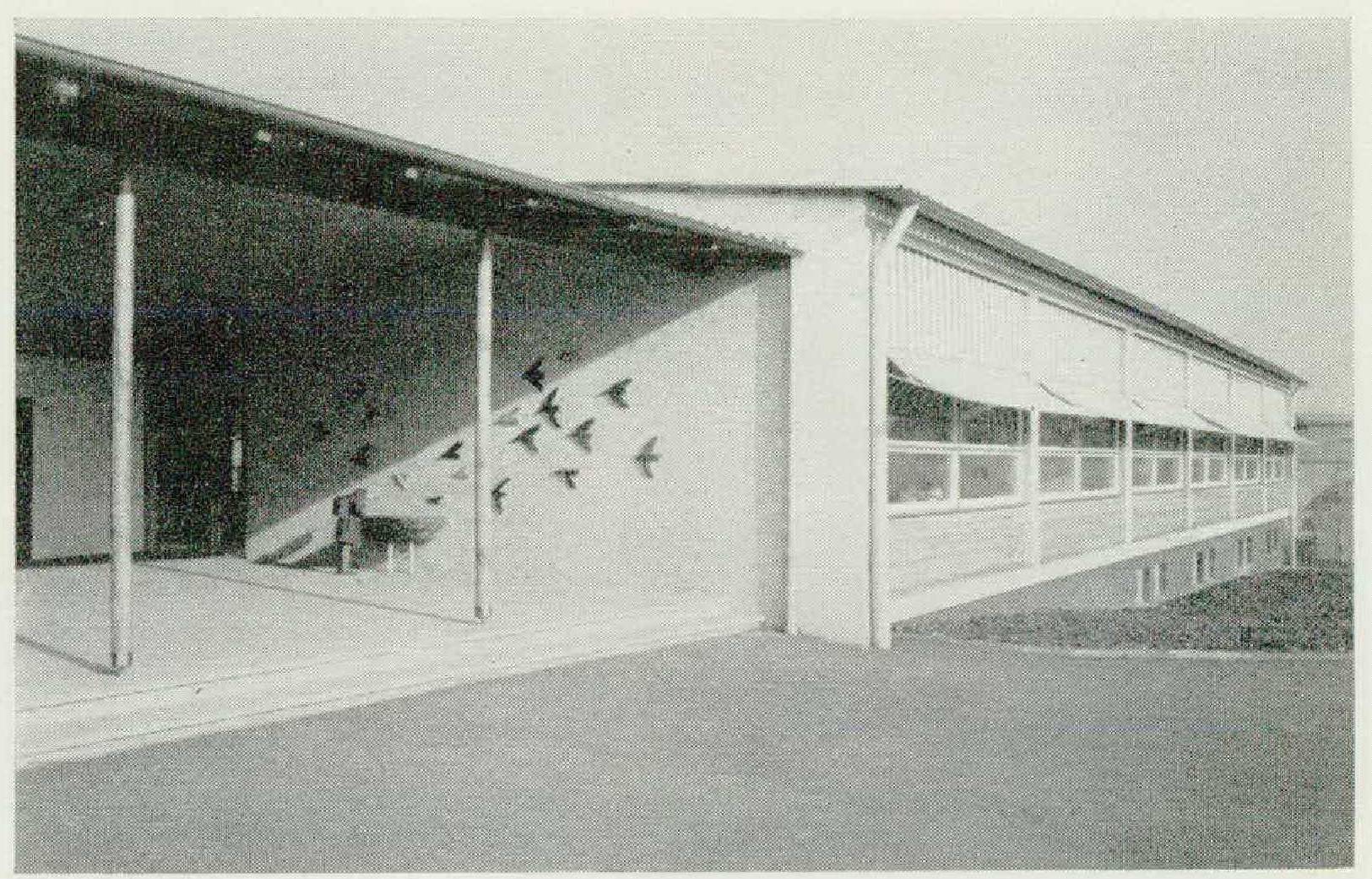
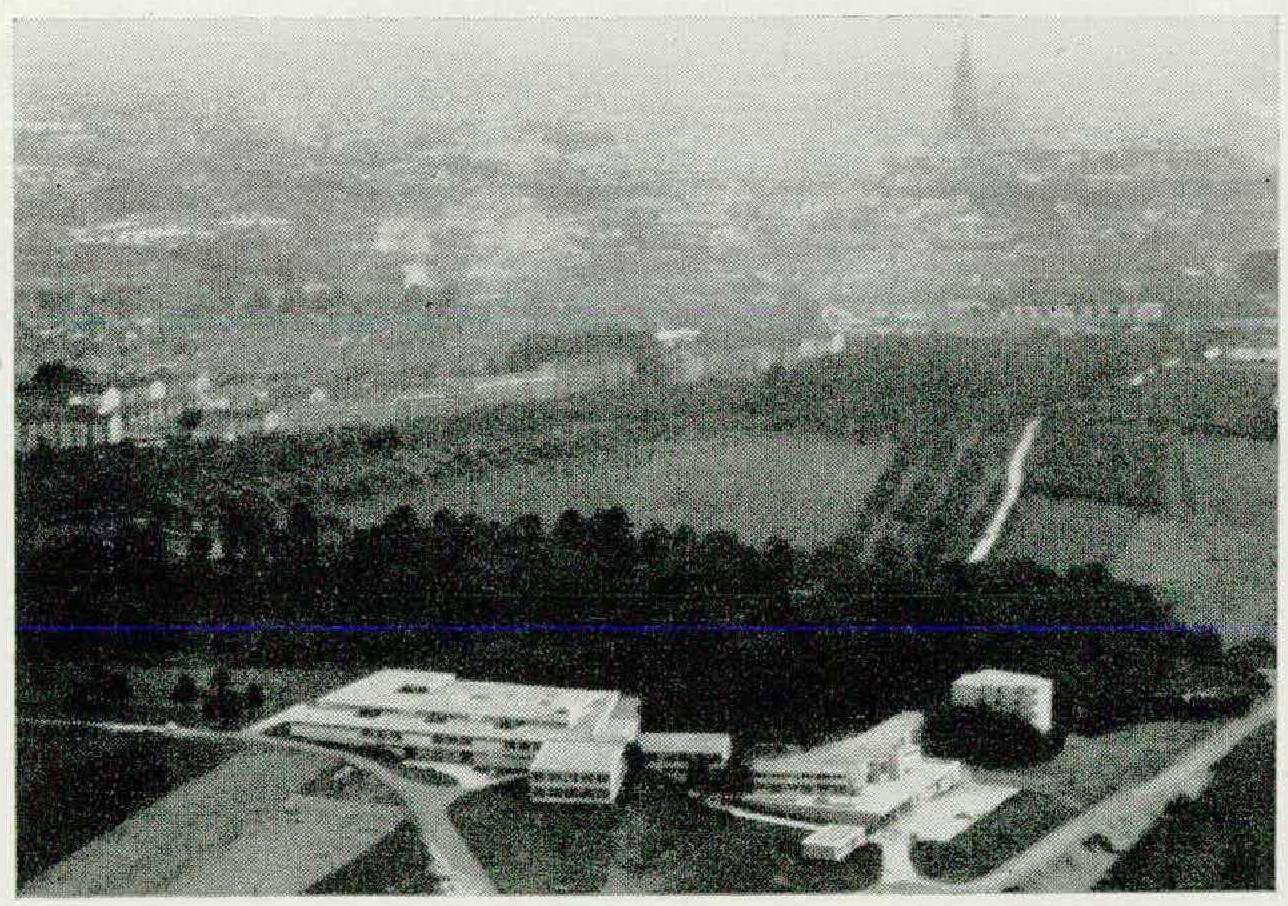
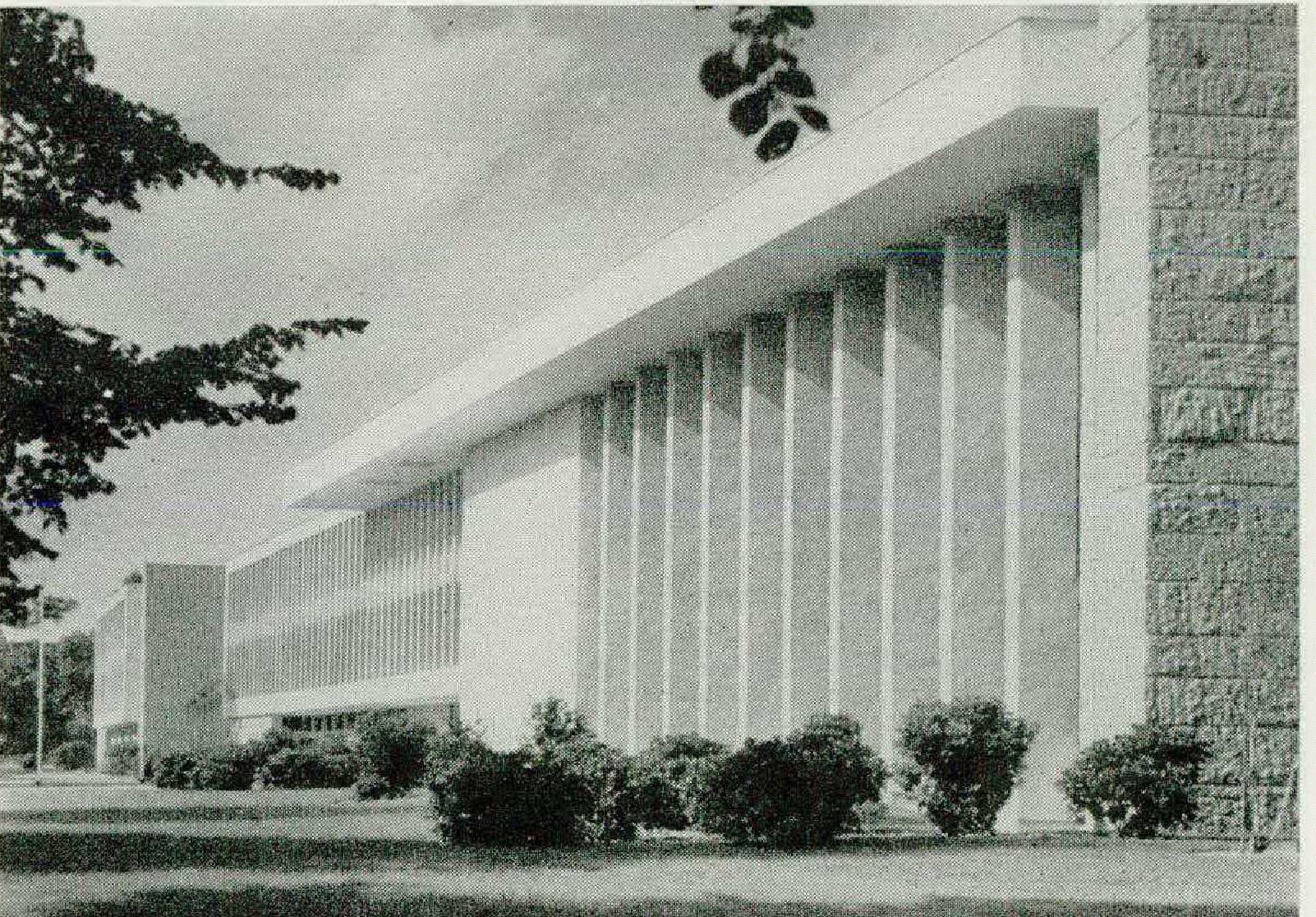
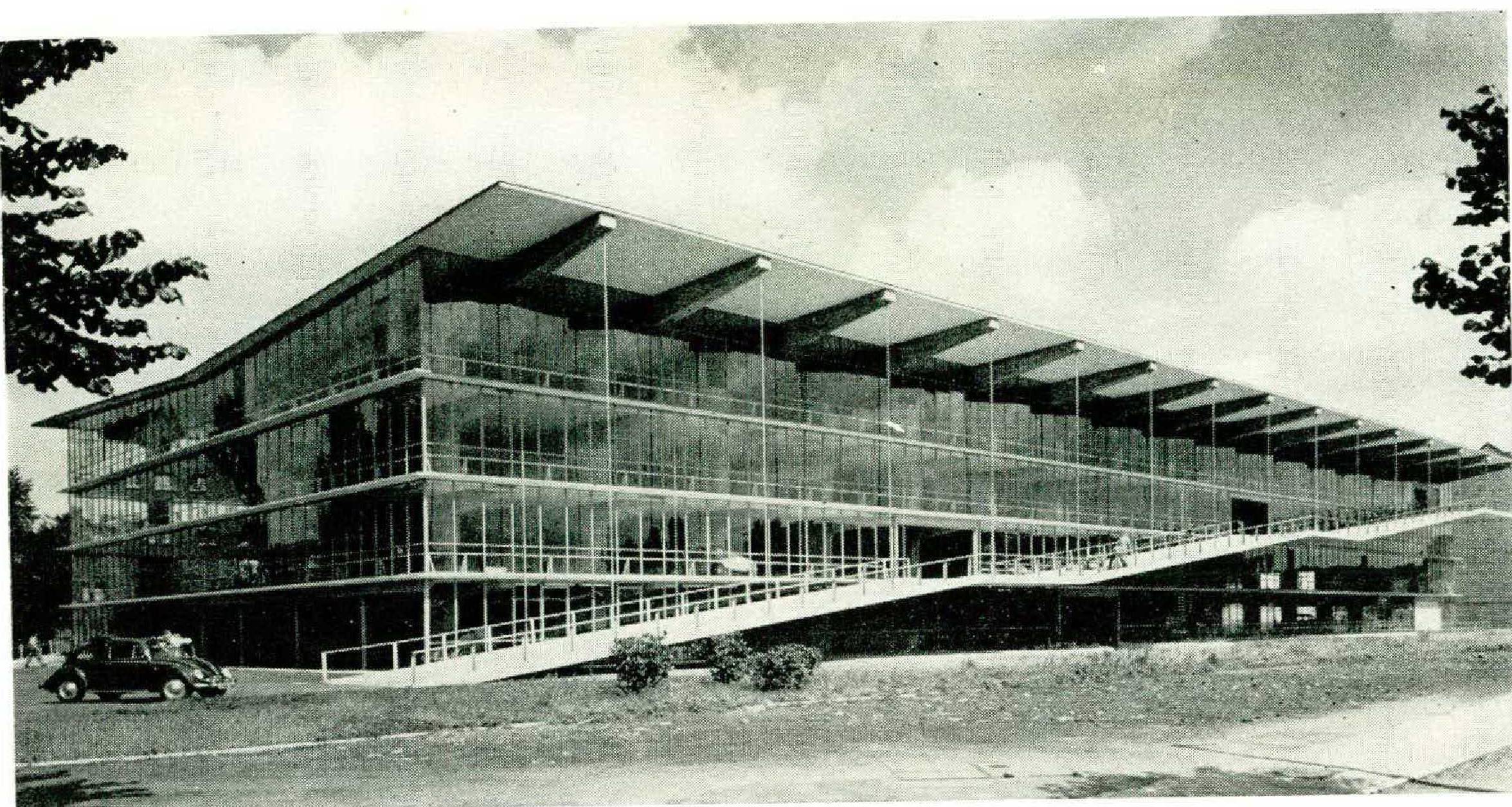
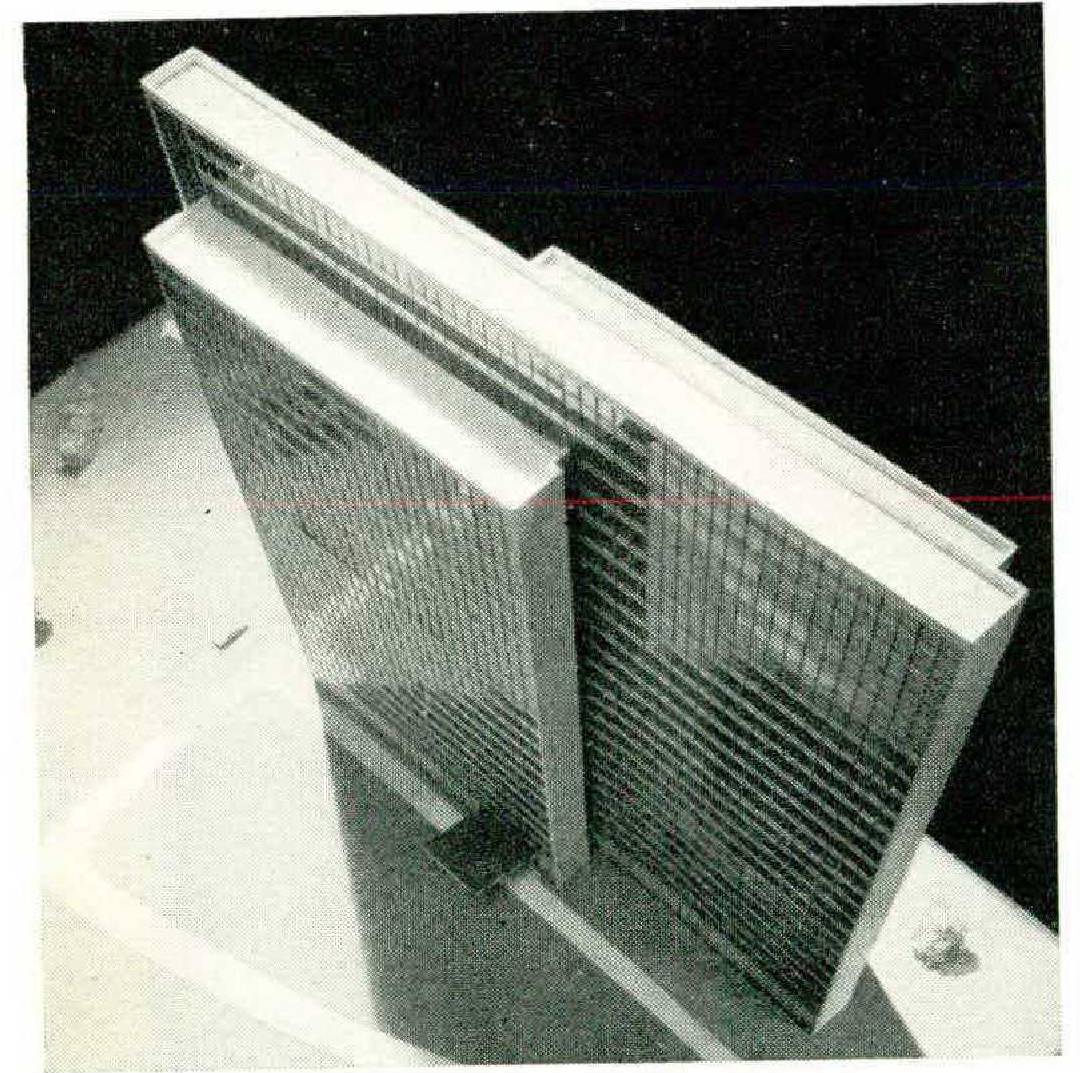
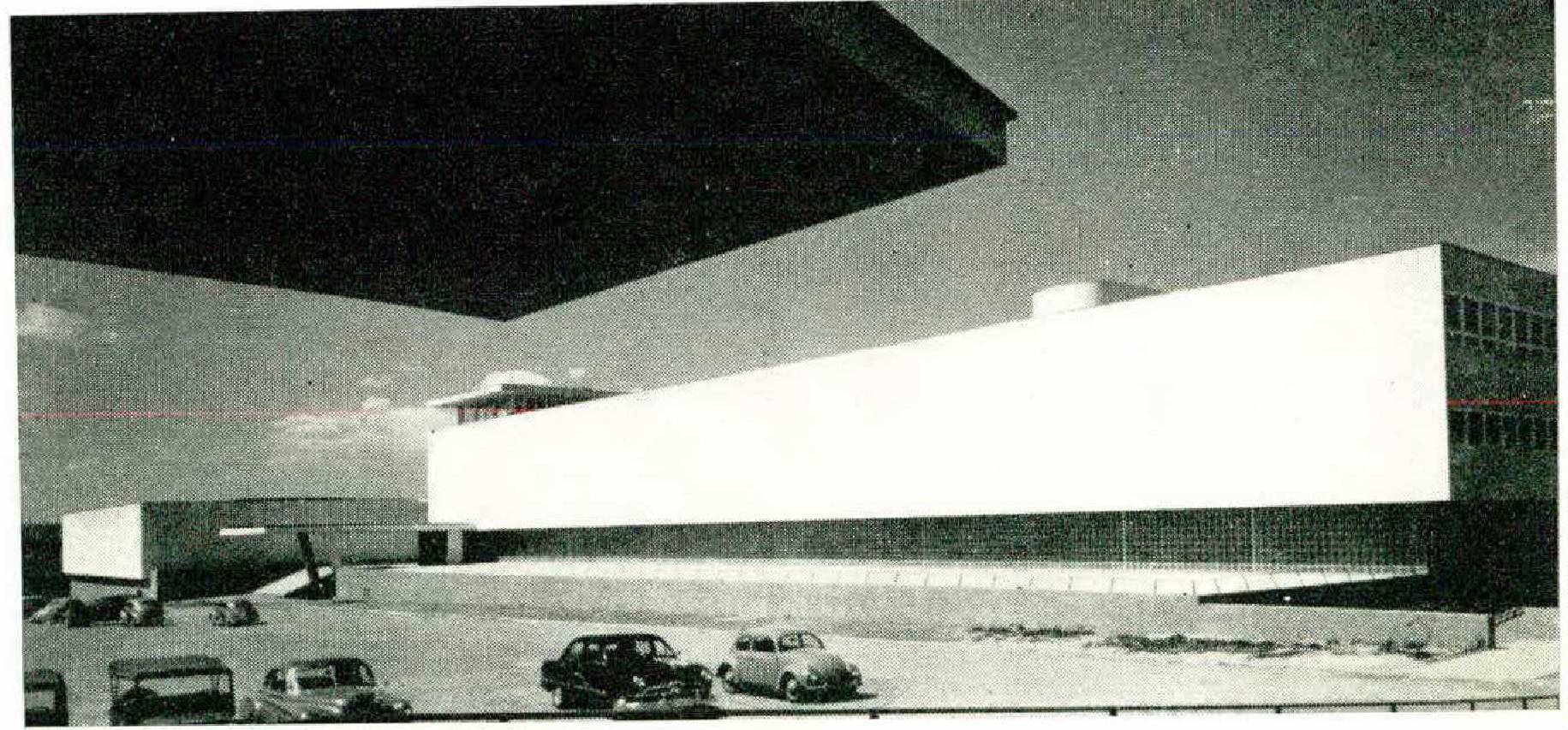
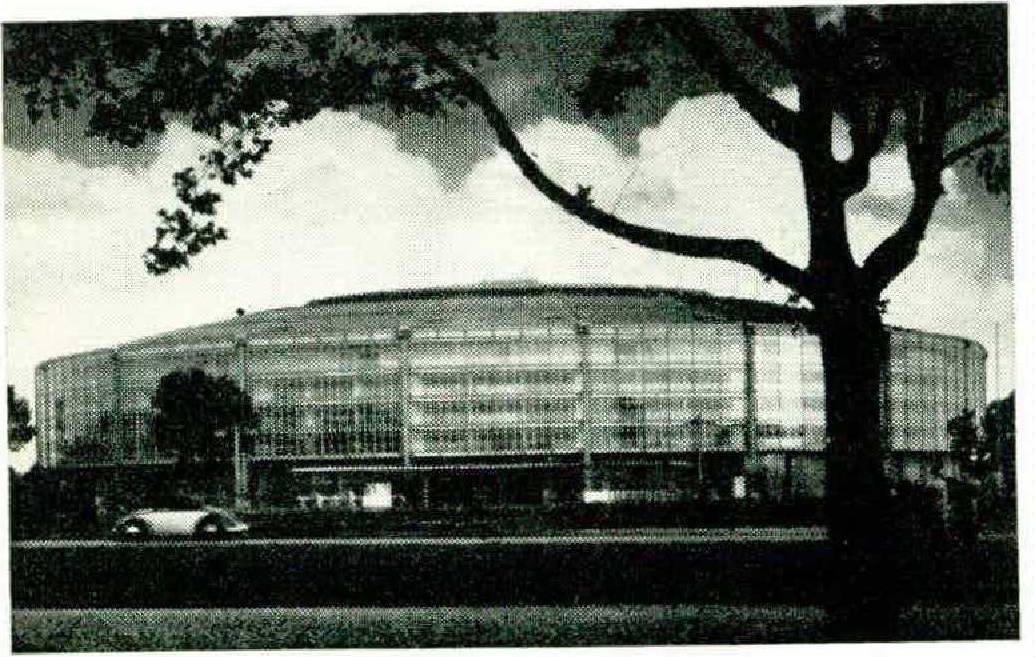
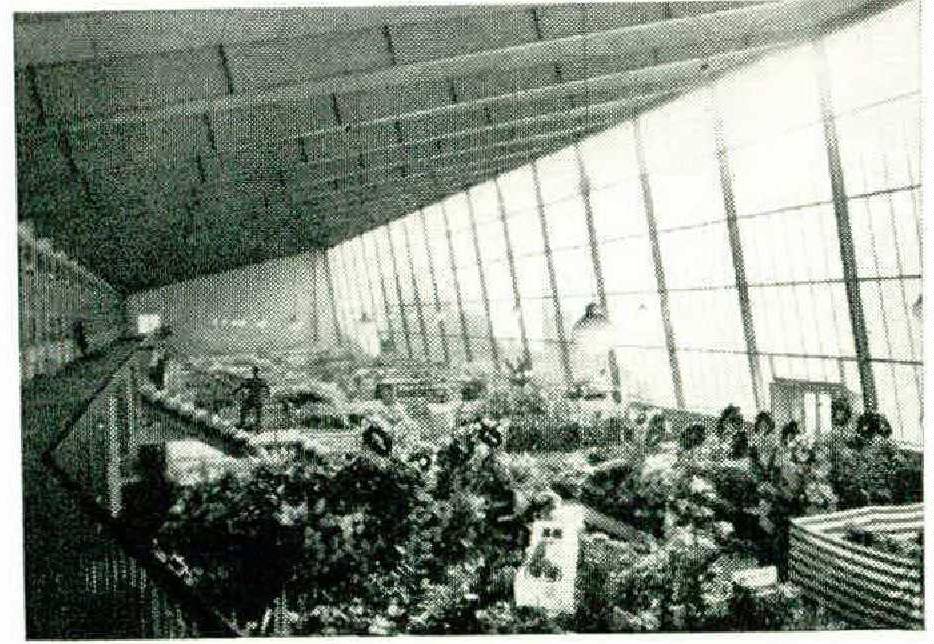
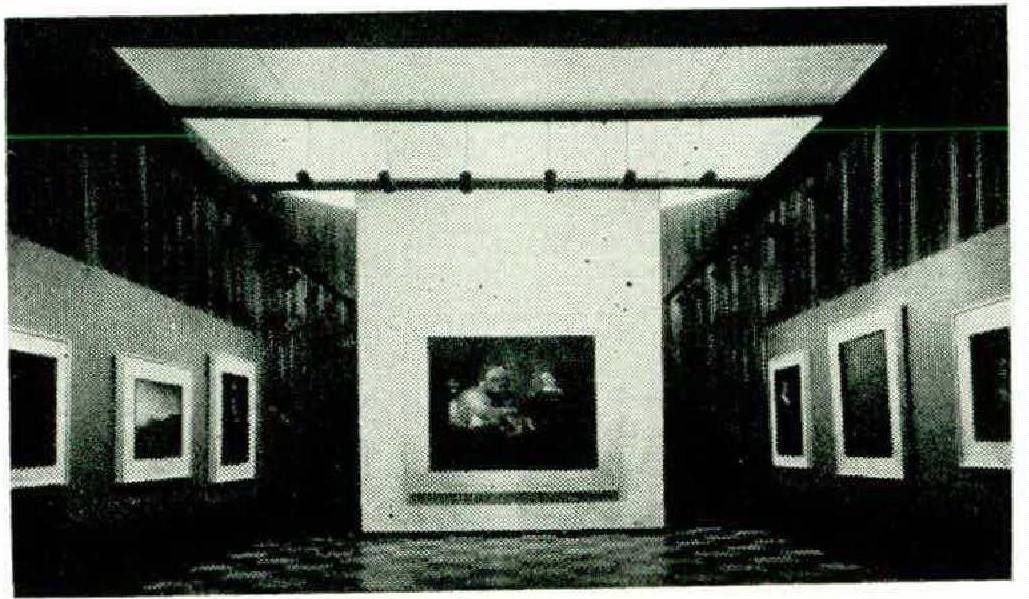
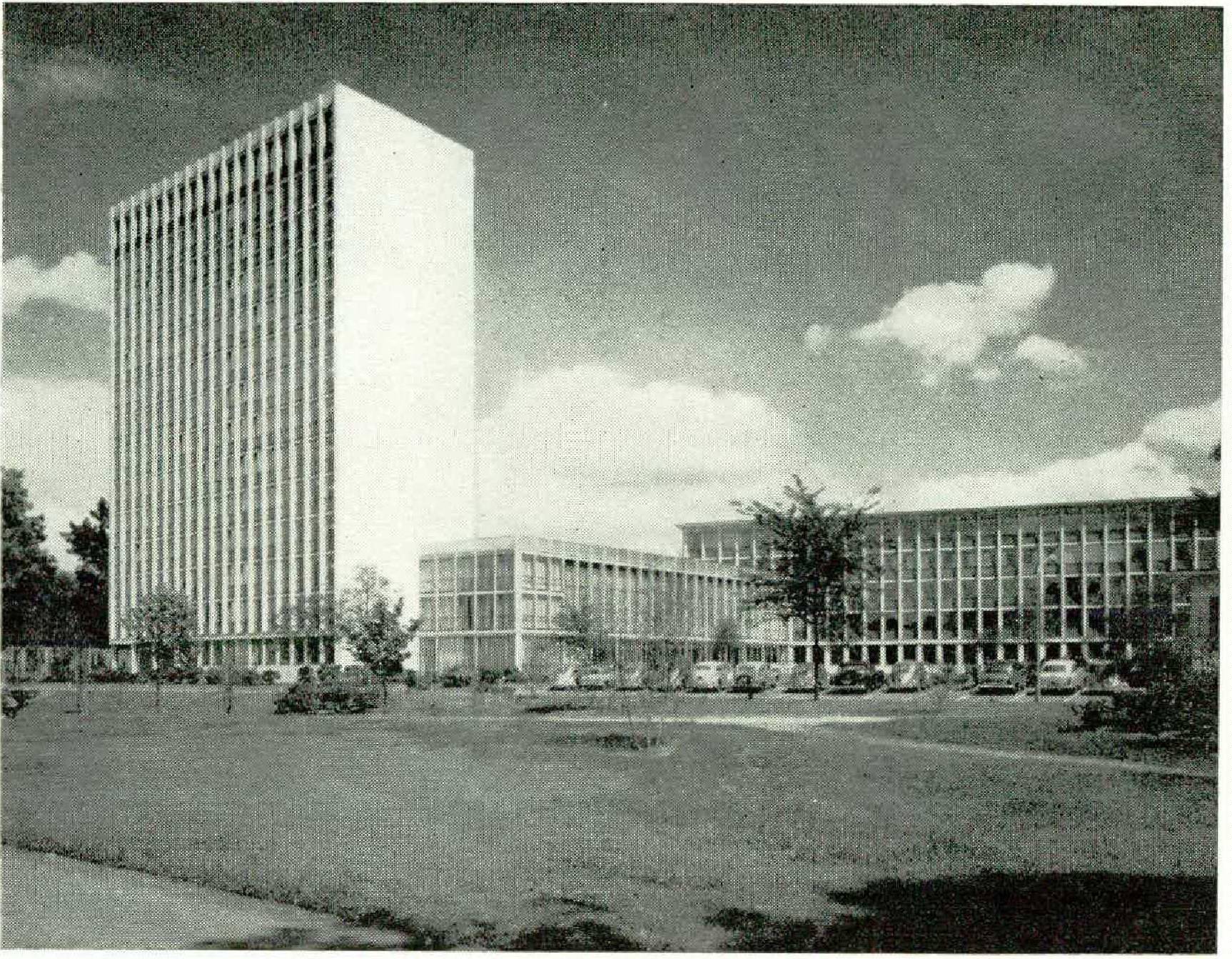
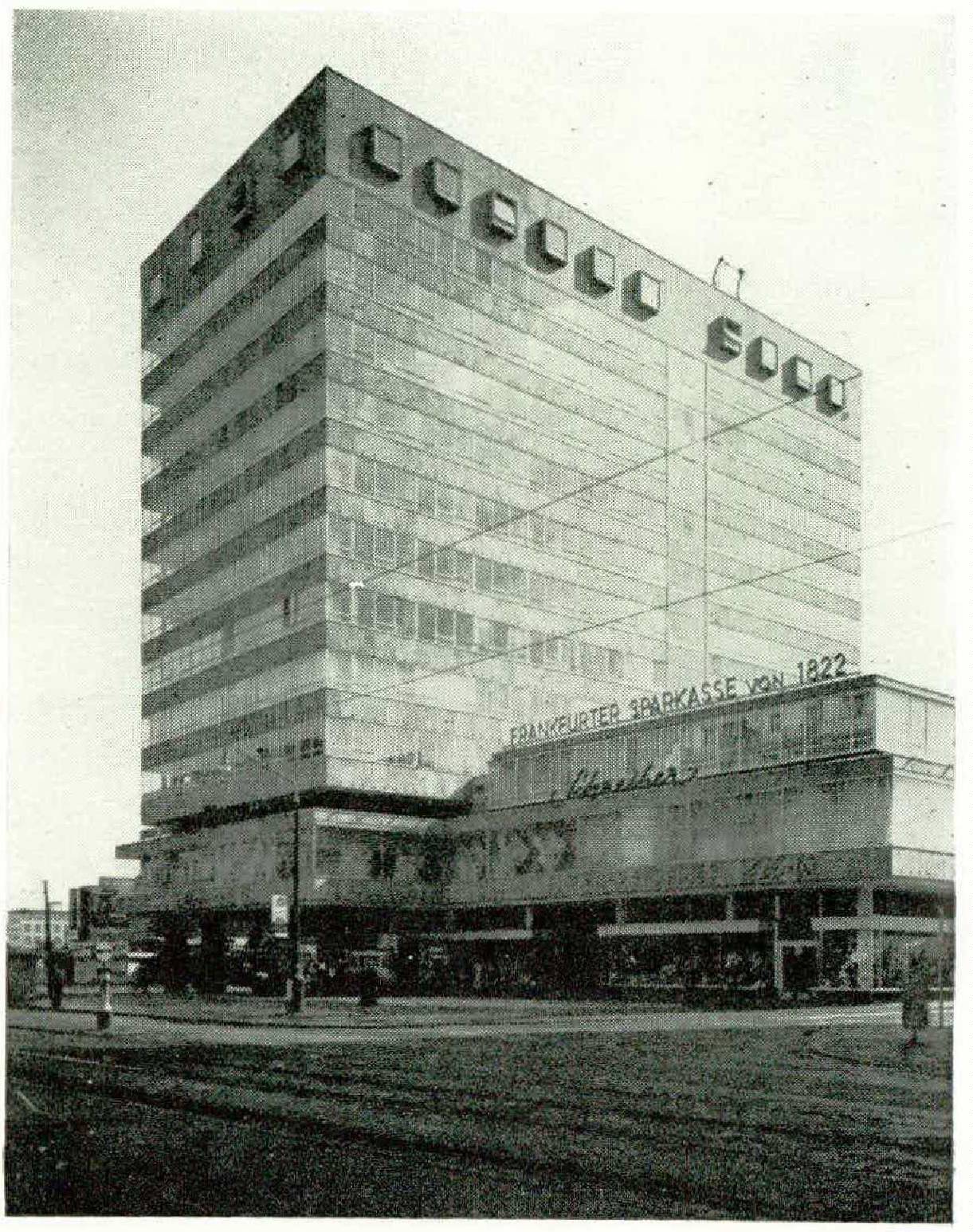
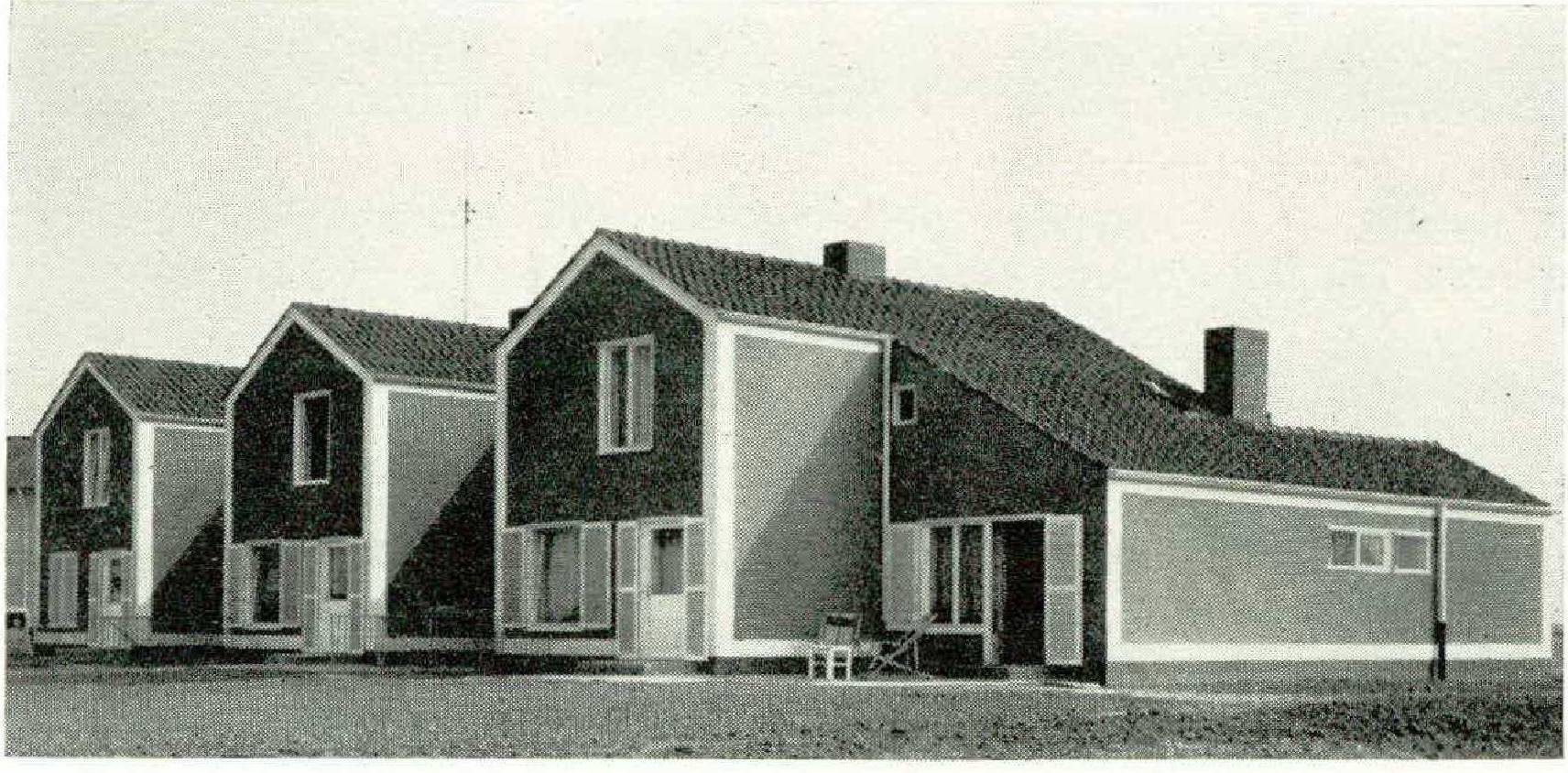
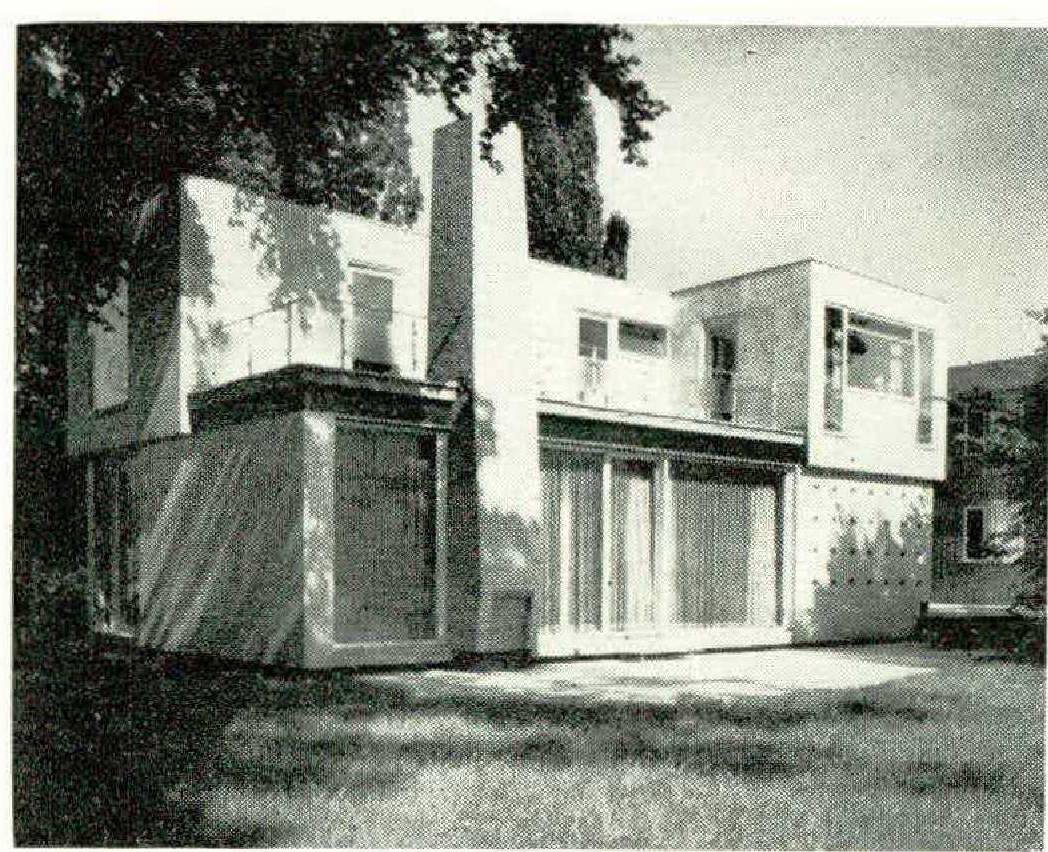
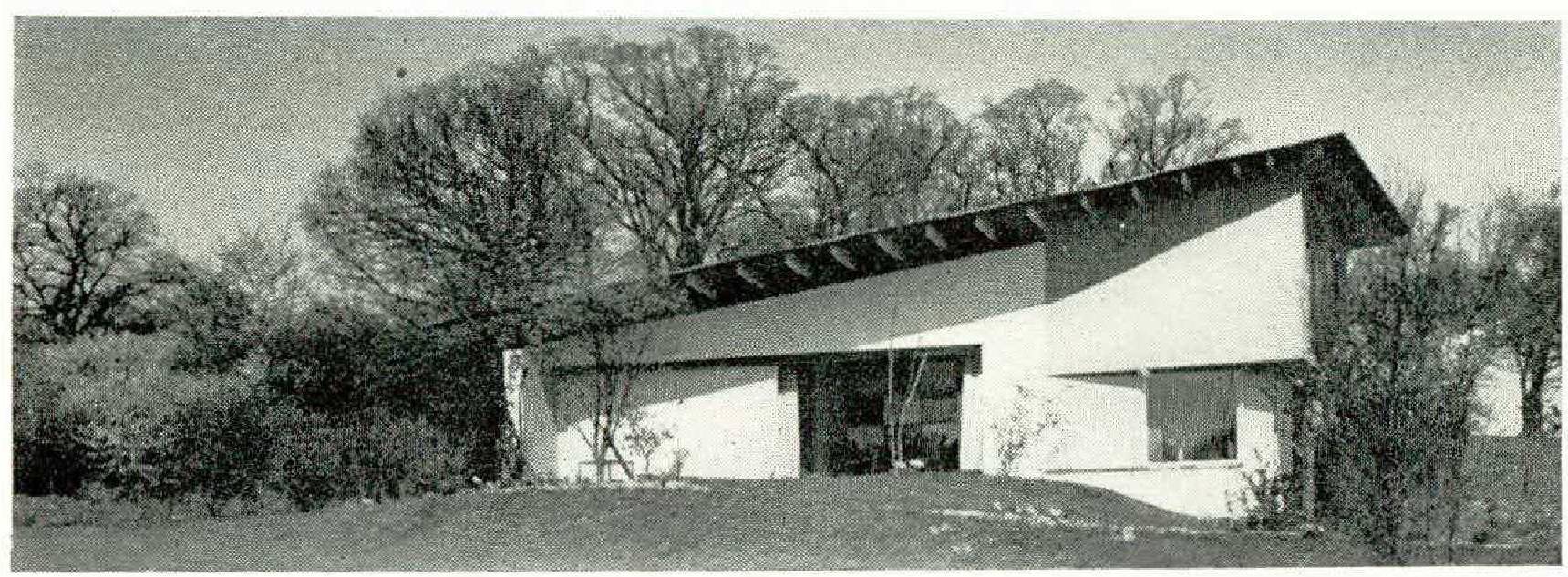
The Devil of forced classicism may have been driven out of German reconstruction only to be replaced with the Beelzebub of a no less barren mass-production style of building—but here and there, on the edges of the official and private building zeal, we note signs of formal imagination. And happily, as the illustrations prove, the signs are increasing. On the one hand, some outstanding men — Ernst May, for instance — have returned from exile; on the other, the younger generation is more and more dissatisfied with the old, obsolete formal canon. Comparisons with neighbor countries, with Rotterdam, Milan, and Genoa, the suburbs of London, the fascinating buildings by Le Corbusier, arouse feelings of inadequacy and occasionally serve to spur competitive boldness. We admit that the illustrations do not show the average; they have been consciously selected from the best. And yet, new impulses are felt even in smaller towns, chiefly in school and hospital buildings: children and sick people are to be given the most modern and the healthiest possible surroundings. Department stores and shops, too, have found that the new architecture is good publicity. Trade-fair pavilions, especially, outdo each other in novelty and daring.
As counterpoise there are the “representative” buildings — of banks, industrial concerns, government offices — and the one-family homes. Eor his home the typical German wants an expensively “cozy” little villa, a descendant of the pleasure castles of eighteenth-century potentates, bedecked with architectural fretwork, a seashell of a house. Of course, this desire may also be due to the German climate, which does not invite too radical a baring of the core of a house.
We may look forward eagerly to this year’s Berlin Building Exhibition and its possible consequences. It will be tied to the reconstruction of the wholly destroyed Hansa section of West Berlin, and the city, with the support of the federal government, has commissioned some leading architects of almost all nations to design buildings for it.
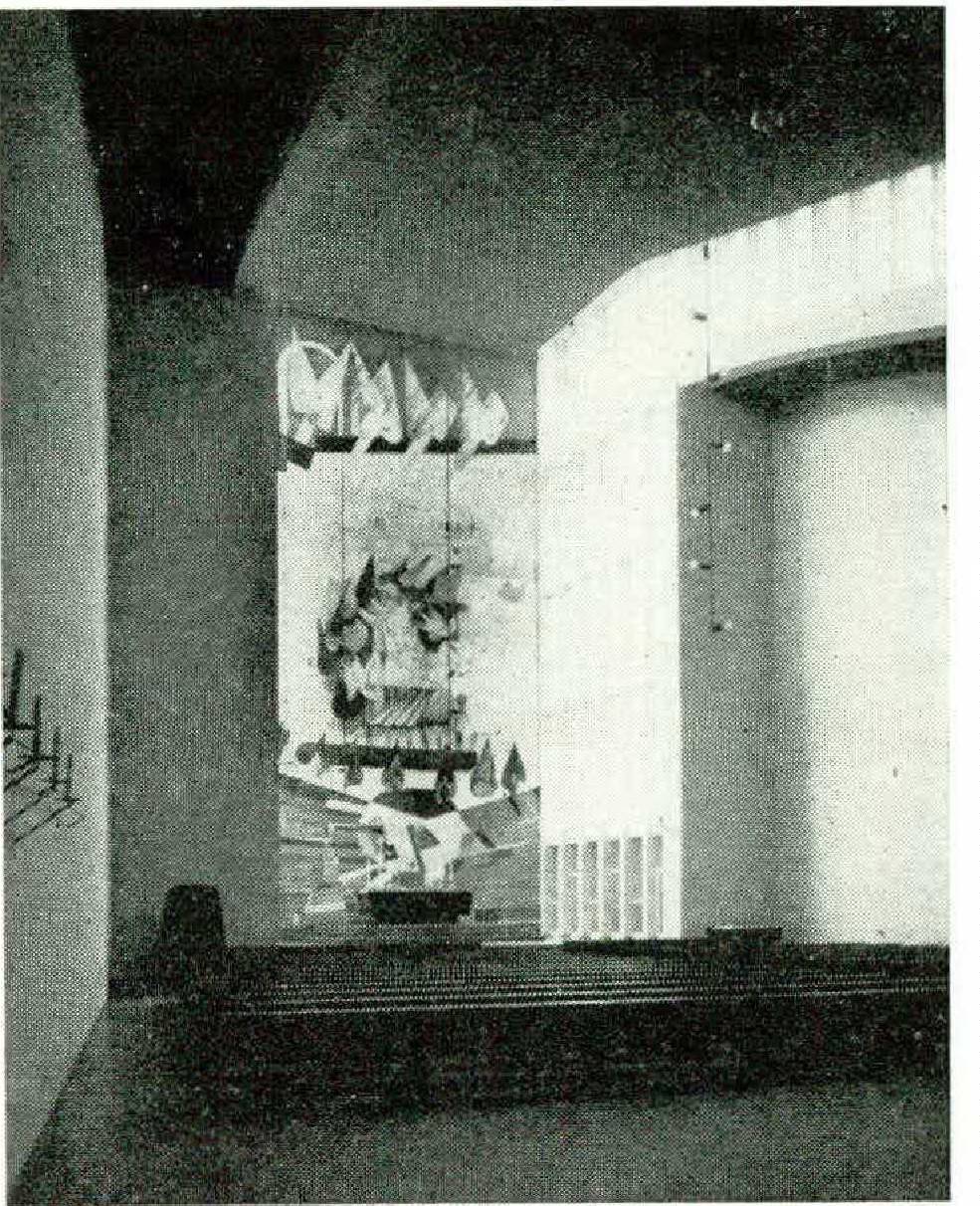
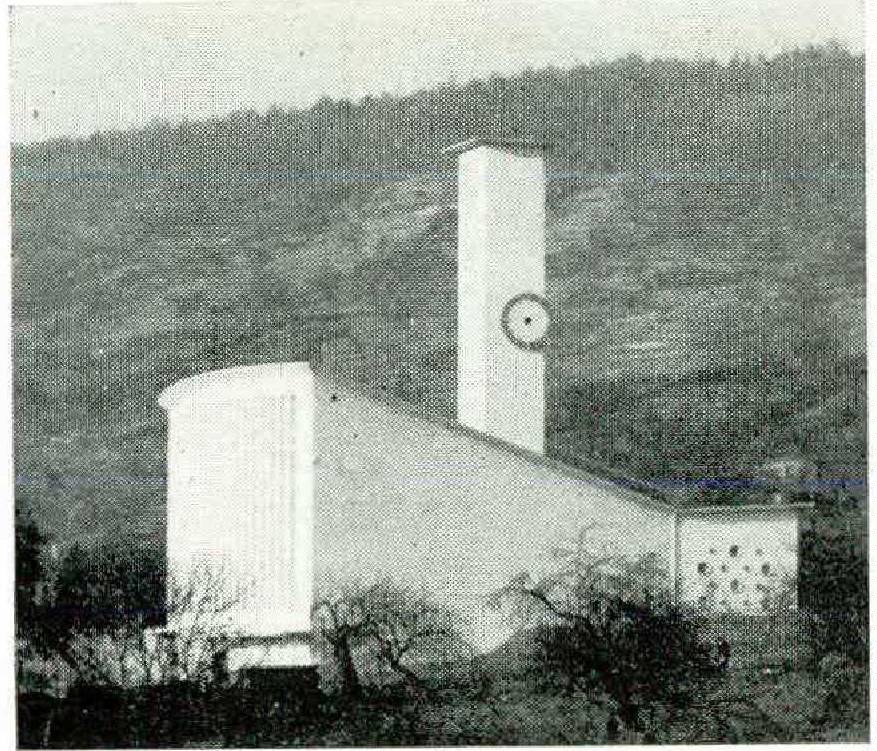
Church-building also looks and gropes for new ways. Le Corbusier’s miracle at Ronchamps — the pilgrims’ church on the southwestern slope of the Vosges Mountains — fascinates proponents and opponents far into the North German hinterland. Space limitations unfortunately prevent us from listing details.
Tracking down truly portentous formal forces is a depressing business that can suddenly become exciting and exhilarating. The West German case in particular is extraordinarily instructive. The country has had to endure and get over a kind of clean sweep — first spiritually, then materially. Many things that elsewhere remained undercover became plain as day. Thus it became plain that even so enlightening a “Point Zero" will not keep some basic follies from thriving again. But it became plain, too, that with human dignity regained, the free forces of free invention will instantly stir as well. Art is always evidence of freedom. Those who underwent complete enslavement personally, or experienced it in their environment, will — if they are able to think at all — be obliged to recognize and honor even seeming excrescences as signs of human liberty. We should not allow our most precious possession, this freedom to create and to find forms, to be denied or delimited by anyone, whoever it may be. At the start we hear of healthy regulation of the arts; the end is liquidation in extermination camps. The Germans were taught this lesson. May they never forget it.
Translated by E. B. Ashton