How to Read
H. F. ELLISis a Londoner whose light prose has frequently appeared in the ATLANTIC. He is the author, also, of an extraordinarily funny book, THE VEXATIONS OF A. J. WENTWORTH.
The way to get through this piece with the minimum waste of time is to avoid unnecessary eye movements. The average reader spends about 90 per cent of his total reading time in shifting his eye along the lines, not realizing that while the eye is moving, it cannot assimilate words. So what you have to do is to train yourself to take in the maximum inchage of print at each shift. A line at a glance is not too much to ask — certainly in this part of the magazine. The earlier pages, where the writers need three-inchwide columns to make themselves intelligible, should be left to more experienced readers.
I got this tip about eye movements from an article called “You Could Read Faster” in a scientific journal, which I was toiling through in the old time-wasting way, and I hasten to pass it on. From an author’s point of view, the quicker the reader can finish his stint and get back to his housework or money-making, the less likely he is to bear a grudge.
Some people have the pernicious habit of going back two or three lines — perhaps to the beginning of a sentence, or even a paragraph — to find out how the devil all this confusion of thought (or, it may be, of syntax, if the writer keeps injecting parentheses and subordinate clauses and suchlike bric-a-brac into his work) they’ve got into started. “A device which is useful in overcoming this,”the article states, “is a shutter which can be made to cover the page at a predetermined rate, so that there can be no going back.”
What this shutter costs, and whether it is portable for use in trains or has to be plugged in like a washing machine, I don’t know; either my informant failed to mention these points, or I was going so fast at the time (being a little on my mettle) that they escaped me. But this I do know. If I had had some such device during the time I was reading Kant and Spinoza and that lot, I should have got through twice as many philosophers in the time and might be a Hegelian to this day. All we had in the way of reading-aids in the primitive nineteen-twenties was a plain wooden ruler, and even that I used to use with its top edge under the line I was reading (to stop myself skipping ahead to see how it was all going to turn out); not one of my professors and tutors had the wit to tell me to use it to block out the bit I’d finished with.
However, that is all spilled milk. Let’s get back to the present and consider one more rule for speedy reading. It’s a fatal mistake to “subvocalize.” This is a handy term for what you have been doing all this time — not exactly mumbling each word to yourself as you come to it but speaking it inside your head, so that you can, in a sort of way, sub-hear it. Sub-vocalizers (and I admit I was one myself, until this lifesaving article came my way) will never get on, because they are ipso facto condemned to read at no more than a jog-trot talking pace. What a way to tackle War and Peace! “Subvocalization,” whatever you may think, “is unnecessary,” as can be proved, the writer points out, “by making the reader repeat a nonsense phrase all the time he is reading.”
We are now ready for a trial run. Kindly read this paragraph a line at a time, letting the eyes move steadily down with none of that swiveling from side to side that is better suited to tennis-watching than to intellectual pursuits; keep your shutter device going if you have one; on no account go back to the beginning, however much you are enjoying yourself; and don’t forget to repeat “So she went into the garden to cut a cabbage leaf to make an apple pic" until you’ve reached the end.
Good. Complete mastery of the new technique may not come at the first attempt — and of course that was a tricky little test in a way, because when you were reading “So she went into the garden . . .” you were actually repeating those very words — were you not? — thus introducing that element of sub-vocalization we were at pains to avoid. For your next test it will be better to choose a nonsense phrase that does not actually occur in the piece you are going to read. This is not always an easy thing to do; but I have found (and the reader may care to make a note of this) that “So he died, and she very imprudently married the barber” will take one right through Hamlet without serious overlapping.
One curious little difficulty about streamlined reading, not referred to by the writer of the article, is the sluggishness of one’s emotional reactions. Reading, for a man of sensitivity, is not just a matter of immobile assimilation. The brows are drawn down in sympathy or disapproval, the fingers drum nervously at moments of excitement, tears prick the eyelids. And these responses take time. Not much time, but longer than you might think. Meanwhile the lines flash by; and more and more, as my speed increases, I find myself physically outstripped by events. Amused by some comicality in Dickens, I am shaken by laughter at a time when my eyes, far ahead in their supersonic career, are scanning the death of Little Nell. I pale with rage over some item in my newspaper that happened a column or two further back. This gives a touch of incongruity to one’s reading, and may make it necessary for me to pause for a few minutes between books and let my responses catch up.
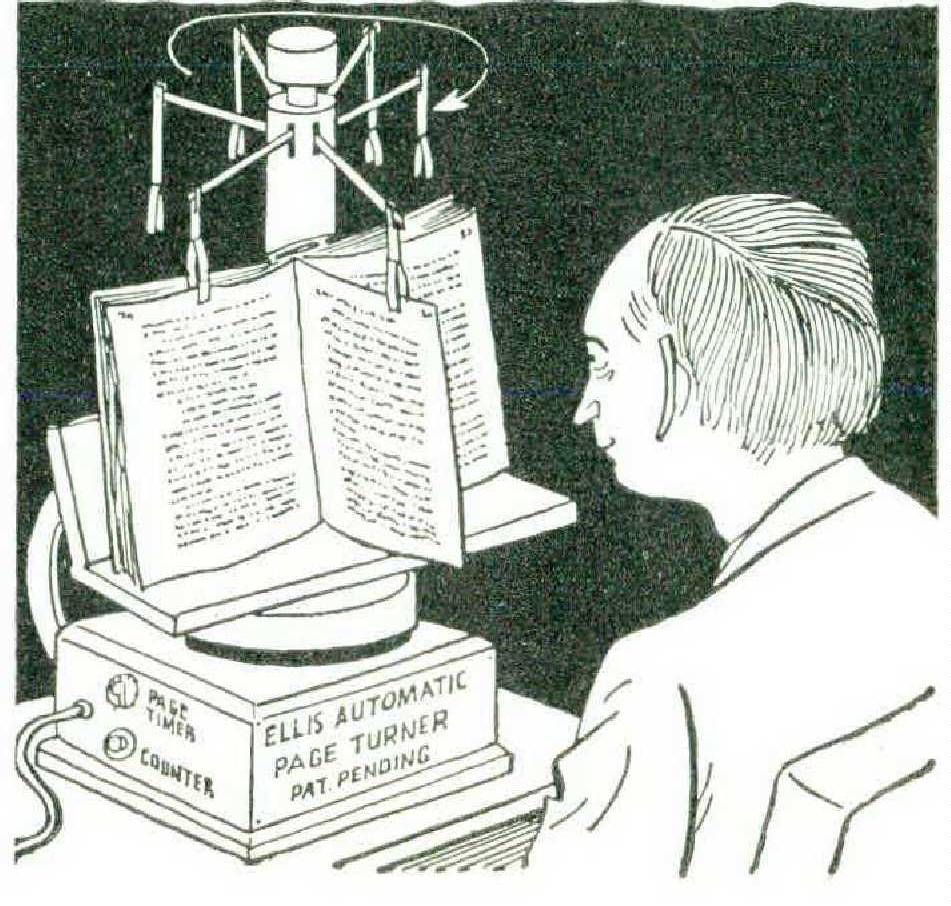
A secondary problem, not much likely to bother the reader of this article but capable of seriously holding up a man trying to get through a rice-paper edition of the Bible before bedtime, is the purely mechanical difficulty of turning the pages last enough. Time wasted in leaf manipulation can undo much of the advantage gained by the avoidance of unnecessary eye movements, and there does seem to be a need for some kind of device (perhaps an attachment to the shutter?) that would perform this tedious office — at a predetermined rate, of course. If it could be made to do the actual reading as well, so much the better. The reader would then be free simply to repeat nonsense phrases to himself, undistracted by the written word.