New York Hurly-Burly
One of France’s foremost humorists, PIERRE DANINOS is the author of a new book, THE SECRET OF MAJOR THOMPSON,which Knopf is publishing this month.
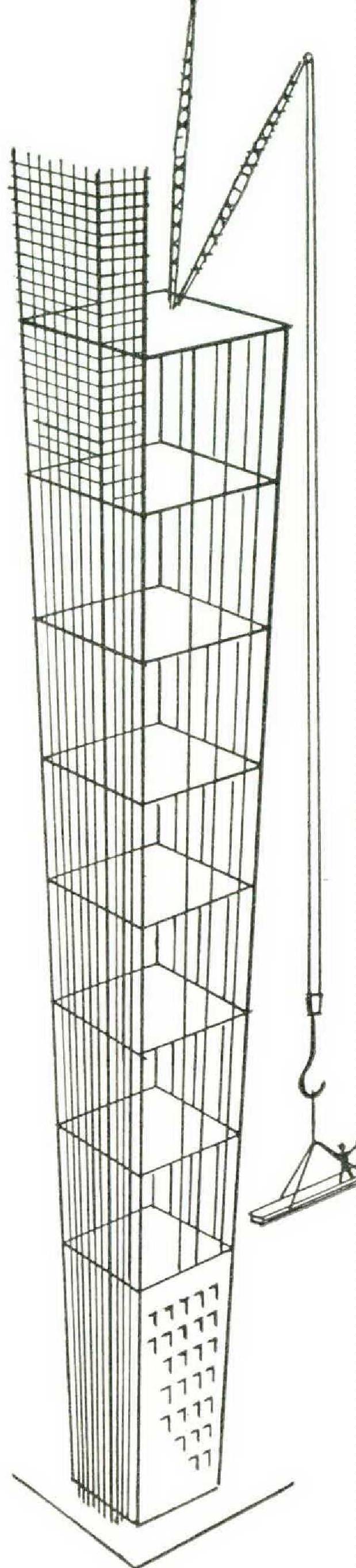
THE day after my arrival in New York, I woke up to find a man in red looking at me jeeringly. It’s quite unnerving to come to New York expecting to wake up to a view of Rockefeller Center and to find planted in front of you, instead, a man in red wearing a baseball cap and motorist’s gloves!
I sat up with a jerk, and opening my eyes wider I realized that the man was not exactly at the foot of my bed, but a few yards away; he was looking at me through the window from the top of a skyscraper that was going up next door. I knew that there would be no hope of peace and quiet in this room, so I decided to ask the management for another.
On the north side the situation was much calmer — the first day, at any rate. But at the crack of dawn on the second I was awakened by a mighty roar of trucks and cranes. They were starting to tear down the obsolete building opposite. It’s the law of existence in New York: everything is either going up or coming down — houses, jobs, gadgets, celebrities, topics of conversation.
I still cannot decide which is the more ghastly of the two noises, but I think the roar of demolition is even worse than the racket of construction. The former begins with the hammering of pneumatic drills digging into the ground and piercing the walls. Then immense cranes carry off whole floors. In the space of a few seconds I saw a living room, a dining room, and two bathrooms borne away. It is all so well done that you are surprised not to see anyone being carried off at the same time. You even wonder how the building ever held together.
Preferring to hear and see people build rather than destroy, I went back to the wing I had previously occupied. This time I got a room on the twenty-fourth floor, and I figured I had a six-day head start on the enemy (who was rising at the rate of one story every two days). A friendly enemy, to be sure, for over the intervening abyss I had established contact with the little man in red; he is called Benedict Camacho, is thirty-seven years old, has two children, a 1955 Chevrolet, a $10,000 life insurance policy, and makes $110 a week.
Contrary to my stupid calculations, which had failed to take into account the all-American passion for breaking records, Benedict Camacho was yesterday once more on the same level as my table. At three in the afternoon he had overtaken me. Tomorrow I shall see only his feet. I would gladly go up another floor, but mine is the top one. Above me there is only the “roof,”reserved for parties, receptions, and evening dancing. Which means that when the workers knock off at five in the afternoon (I don’t know how those people get down from such heights, but they vanish in the twinkling of an eye), I have a bare half hour of respite. At five thirty the party begins — with jazz, and then with the cha-cha-cha.
At any rate, according to my calculations (good or bad) in eight days it will all be over.
Major Thompson, however, proved less patient than I. He claims that it’s always risky associating with people before they’ve properly settled in. Besides, he says he can’t sleep comfortably unless he’s sure of waking up in the same place the next morning. He, therefore, left the hotel and New York, declaring to the desk as he went. “I shall return, gentlemen, when you are built.”
And he moved on to the only city in the United States which is more or less bearable to a subject of Her Majesty — Boston. This impregnable citadel of American Anglomania has managed to beat the British at their own game of numbering houses. Imagine die Major’s surprise when he discovered between No. 8 and No. 14 on Beacon Street a dwelling numbered 10 1/2. And as though this weren’t enough, he then espied through its large-paned windows solemn, whiskered gentlemen snoozing in deep black-leather armchairs under copies of The Times — exactly as though they were in the Cavalry Club on Piccadilly.
ONE can get used to anything in life — even to the hurly-burly of New York. None of this would have mattered much if it hadn’t been for the electricity. Paris is regarded, often mistakenly, as the Ville Lumière, but New York is really and truly the Ville Électricité. It is, at any rate, the first I have ever really made sparks in. In New York there is electricity everywhere — in the door handles of taxis, in hotel doorknobs, between two sheets of paper, in your hair — in everything.
When my wife Sonia, who arrived several days after me, came up to my room, she found me dressed in my underpants and wearing gloves, to say nothing of a little chain around my neck which linked me to the floor. She immediately realized that something was up. I explained to her that the air of New York was so dry and so saturated with electricity that one had to be properly grounded at all times.
“You are joking?” she said.
To prove to her that I wasn’t, I took off my gloves and embraced her. She immediately felt the shock and bade me keep my distance.
I then amused myself — if I can so call it — by making a few sparks, just to convince her. I opened a closet here and closed a door there. I have done many things in my life. Making electricity is, after all, an occupation like any other, if only it weren’t so painful. I was continuing my demonstration when the telephone rang. As I had forgotten to put my gloves back on I received the communication in the fingers.
“You get on my nerves!” said Sonia. And she left to go shopping.
Apart from the electricity you find in your hotel room — which varies with the amount of steel used in the framework — I always have the impression in New York of being plugged into a high-tension current. The sensation is aggravated if, as was my case, you have just come from Geneva. All of which makes me wonder if the best way to appreciate the United States is not to begin the trip in Switzerland.
Let me explain. When I arrive in Geneva, I feel an invisible hand slowing down my motor. I could almost swear that the stationmaster of Cornavin had given me a dose of quinine. In New York the dose becomes an injection of electricity. Something here speeds you up. No matter where you go, you go quickly. There is a certain New York rhythm you fall in with immediately, whether you are going to buy pajamas at Saks or to blow up the sale-deposit vaults of the First National City Bank.
Strolling is something that has no meaning in New York. In Paris you stroll down the Rue du Chat-qui-Pêche wondering whether you are going to end up in the Rue de la Huchette or come out on the Quai Saint-Michel. But you don’t stroll in a city where you are certain of finding 57th Street between 56th and 58th. Who is tempted to write a poem on graph paper?
Americans in general and New Yorkers in particular are veritable human locomotives that go nonstop from seven in the morning till midnight. As for the American wife, she is a super-locomotive that drags her husband after her at such a great pace that he must be sure to be well hitched if he wants to avoid an accident.
A few hours in New York and you, too, will be incorporated in the railroad schedule and become a part of the network. Consciously or unconsciously you become an express train.
It’s the same story with those numerous specialists you have to deal with in the hotels. You just can’t stop the first flunky going by and give him your dirty laundry, your shoes, a pair of trousers to be pressed, and a button to be sewed on. I have seldom seen a face as put out as the Irish chambermaid’s when Pochet handed her a pair of shoes his first day in New York. You could have sworn she had never touched that kind of merchandise in her life. The valet, a distinguishedlooking gentleman, considered the shoes in his turn without touching them, and then said to Pochet in a rather scornful tone, “Call the barbershop.”
For a moment Pochet was left wondering if in the United States shoes are given shampoos. Calling up the barber about a pair of shoes may seem strange to a foreigner. But it seemed stranger still to the valet that this ignorant foreigner, from God knows where, should not know that the express shoeshine boy is stationed at the barber’s.