A Hearsay History of Curzon's Mill
New England s most eminent novelist, JOHN P. MARQUAND was brought up at Curzon’s Mill on the Artichoke River, a homesite north of Boston. In this familiar essay, which holds the salt and savor of old New England in its every line, he draws a picture of the tidal mill.
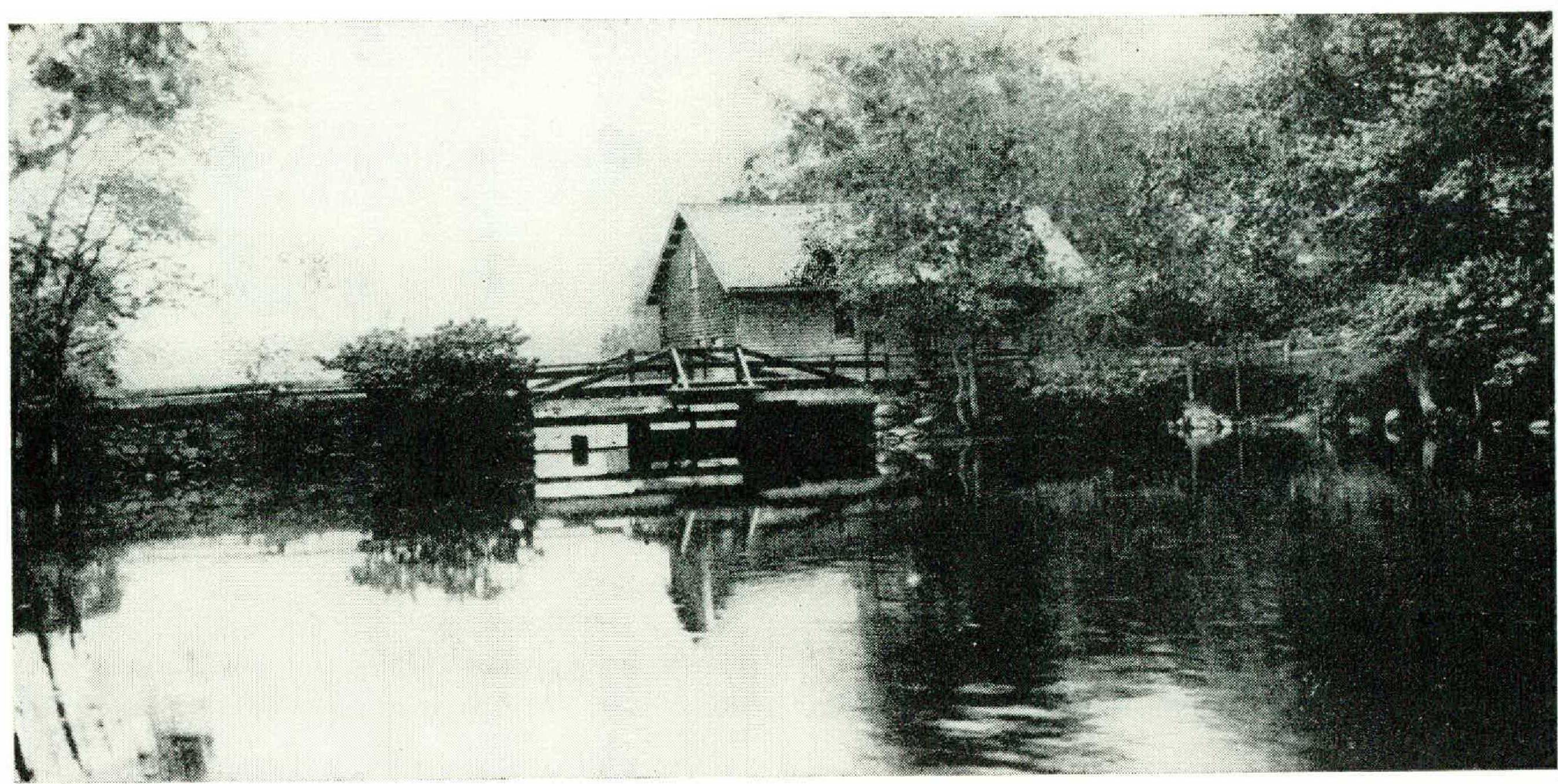
CURZON’S MILL, which has been in the possession of my family since 1820, is on the Artichoke River in Newburyport, Massachusetts. I am so ignorant as not even to know the origin of the name of the Artichoke River, whose brownish waters turned the wheel of our tide mill for over two hundred years, and would in all probability be turning it still if plumbing had not been invented and if the city of Newburyport had not been taught the necessity for an adequate water upply. The concrete dam which was built, I hink, in 1906, and which raised the level of the Artichoke, thus killing nearly all the great trees hat once grew along its banks and stopping also the wheels of the mill forever, has been a sore point in our family for the last fifty years. I can remember in my extreme youth before the dam was built that my great-aunt Mary Russell Curzon walked almost daily to the bridge with a basket of old bones from the kitchen and tossed them into the millpond because she heard that the city contemplated taking over our water rights. She was also known to encourage in those twilight days the drowning of sundry litters of small kittens in the millpond. Thus when Cashman Brothers, Contractors, drained the Artichoke preparatory to putting in their cofferdam, the workmen excavated several bushels of assorted bones and skeletons from the river bed. They expressed amazement as to how these gruesome relics came there, and no one ever told them.
But I was speaking about the origin of the name “Artichoke,” the tidal stream upon which Curzon’s Mill stands near its juncture with the Merrimack. Certainly no artichokes have ever grown upon its shores in either a wild or a cultivated state, and I doubt if any of our forefathers ever attempted to derive nourishment from this peculiar vegetable. In one of the old maps the river is called “Hertichoke,” and this leads me to believe that we can safely thank the Indians for naming it and that we are now by its peculiar name trying to simulate some tongue-twisting word of the ancient Penacook language.
This theory seems to me as good as any other, since the Artichoke valley was a favorite dwelling place of the unhappy and diseased Indians who staggered from their beds of sickness to greet the first settlers of Newbury. My great-aunt Mary once told me — and I may say that she and her namesake, my aunt Mary Marquand, are the most important original sources which I have for this paper — that a number of Indians were in permanent quarters upon a tract known as the “sandbank” just a little way up the Artichoke, when the first of our neighbors, the Emerys, came to occupy the land granted to them along the river. The legend is that nearly two thirds of these unhappy people were dying of smallpox at the time, and thus they made no trouble.
My great-aunt Mary told me that when she was a very little girl, in the early 1830s, she was startled while playing alone near the riverbank by the sudden appearance of a flotilla of birchbark canoes filled with Indians. She ran to the house to tell her father, my great-grandfather Samuel Curzon; he said for her not to be afraid and went with her to the shore to converse with these unusual visitors. He gave them a measure of corn meal from the mill and they told him that they were on their way to the ocean in search of salt water, which their medicine men would use for ceremonial purposes. Aunt Mary always concluded her story by saying that three of the canoes capsized the next day on the bar of the Merrimack.
My own family have owned Curzon’s Mill since the place was purchased by my great-grandfather in 1820. Until a few years ago one of my people has occupied the old dwelling house summer and winter for well over a hundred years. This is in no sense a record, particularly in a region like Newburyport, but it gives to the place an enviable and vital continuity in this changing time. The mill has been burned down and rebuilt. The old house has been on fire at least twice, and once in 1900 two thirds of it was consumed. The physical aspects of the place have undergone great changes. The trees which made the Artichoke a mysterious, shady stream and caused Whittier to speak of Curzon’s “bowery mill” have been drowned in part by the rising water; others have succumbed to age, such as the huge elm which used to stand between the old house and the road, and the great oak on the lawn by our riverbank‚ which must have been a good tree when Mr. Emery built the first mill. Other trees, such as the locusts in the flower garden between the old house and the newer brick house, were uprooted in hurricanes. The apple orchard across the road is nearly gone, and the road itself, once a sandy way, has been surfaced with tar.
No MATTER from what direction you approach Curzon’s Mill, there is a green and somnolent tranquillity in the Artichoke valley which affords a momentary sense of escape from the present. Driving from Newburyport, as the Curzon’s Mill Road curves down the hill from the Moseley estate, the thoroughfare rapidly goes from bad to worse, as though the civic authorities had felt, and I believe they do, that beyond our neighbor’s avenue their responsibilities were over. Once downhill, you first see a brick house, built by my great-aunt Elizabeth Curzon Hoxie in 1859. It is interesting largely because the wall which faces the north contains only a single, attic window. I have been told that my aunt Lizzie, who had previously made beds and washed and sewed in the Brook Farm experiment, had left the north wall of her dwelling blank in the hope of building a later addition for another communal colony. Beyond the brick house comes a flower garden, and then appears the main house with a ninetyyear-old horse-chestnut tree near the driveway. The large yellow house with its heavy central chimney was built in the 1780s, as is confirmed by many of its details. Beyond it is the lawn, which stretches to the mouth of the Artichoke, known in the family as “the bank.” On the edge of the road, jutting into the Artichoke River, is the weather-beaten frame building of the mill itself, and close beside it is the bridge, from which there is a view of the lake-like Artichoke on one side and of the Merrimack on the other. Finally the road curves uphill toward the Emery house.
The present mill building is not the one that John Emery, Jr., built in 1678. The present structure was erected in the 1840s after my great-uncle George Curzon, who one evening had imbibed too freely, accidentally burned the older building down. I do not believe that the building which was burned was John Emery’s old mill either. Originally, in 1678, the town granted John Emery, Jr., twelve acres on the west side of the Artichoke, provided that he build and maintain a corn mill, and during the ensuing summer work was undertaken on the dam. The mill remained in the hands of the Emery family until it was sold in 1761 to Jonathan Bagley of Amesbury, who gave a bond “to faithfully perform the conditions in respect to grinding corn.” We gather that Mr. Bagley was enterprising and enlarged the mill, for at the time of his death, when the property was sold by his executors, it consisted of two grist mills, with lands adjoining same. The executors sold this property to Stephen Hooper of Newburyport.
The story in our family has always been that Mr. Hooper was connected with the rich “King” Hooper family of Marblehead, and that he bought the place for the purpose of erecting a hunting lodge and used it for recreation rather than profit. It was he who built the large house, presumably shortly after his purchase, and — for a rich man’s plaything — it was a comfortable and a commodious dwelling with two spacious chambers downstairs and two above, all with open fireplaces, and with an ell in back for the kitchen.
According to the elder members of the family, it also contained a secret room. There is still around the old chimney a difference of some three and a half feet between the upper and lower floors, and I have been told that there was once an entrance by the old back stairs and that there were airholes cleverly concealed beneath the clapboards. As no one, to my recollection, has ever seen the interior of this secret room and as no one has ever done more than talk about it, it is hard to be certain that it exists. It is harder still to imagine why Mr. Hooper should have wanted it. My own opinion is that if such a room ever existed, Mr. Hooper used it exclusively for concealing wines and liquors from his dependents.
It seems that Mr. Hooper, during his short ownership of this retreat, lived in a careless and lavish way quite different from that of his hardworking neighbors, and indeed he seems to have been one of the pioneers of a new social class, the summer vacationist. His own coach or chaise would take him through the lane across the Emery farm, then a private road, until he came to the swinging gate near the bridge above the mill dam. Young Eliphalet Emery, the grandfather of the present generation at the Emery house, told my great-aunt Mary, when he was a very old man, of how the Hooper equipage would move across the fields. As soon as he saw it he would rush to swing the gate open for the city gentleman, who would reward him for his trouble by tossing out a coin. In later years Mr. Emery was a most substantial man, honored by his neighbors with a seat on the General Court, but even when he was very old there was one thing about the gay Mr. Hooper which he still remembered. The coin that was tossed to him was not a copper piece: it was invariably silver, a rare metal in West Newbury then and, I regret to say, still rare in the vicinity of Curzon’s Mill.
Mr. Hooper appears to have enjoyed himself decorously, but with his coming there was a new atmosphere at the mouth of the Artichoke. A man who did not derive his living from the soil had settled in the midst of a Calvinist countryside, and in so doing Mr. Hooper set a fashion which has been unchanged up to the present. Since his day, over a hundred and sixty-five years ago, the residents of Curzon’s Mill have belonged either to the small rentier or to the white-collar professional class, whose income, if any, has been derived from out-of-town scholarly or mercantile pursuits. Since Jonathan Bagley ground his last bushel of corn, there is only one person who has wrested a living out of Curzon’s Mill. That was my greatuncle John Hoxie, whom I believe my aunt Elizabeth Curzon first met during her sojourn at Brook Farm. He was an industrious, practical man, who ground corn on the morning and the night tides and even conveyed it upriver in a sailboat. It seems to me, on looking back, that he is the only practical man who ever dwelt in the hollow since Mr. Bagley, and I have heard that he was worried often by the carefree ways of the family into which he had married.
Thus since the federalist days of Mr. Hooper, the inhabitants of the Mill have been a continuing source of curiosity to West Newbury. They have brought with them smatterings of culture from the far places; their lives and their hours of living have been conducted according to a different plan. Instead of breakfasting at six, dining at noon, and supping at six again, according to country custom, they have breakfasted when they chose and have consumed their main meals close to a farmer’s bedtime. They have collected insects and botanical specimens, they have played word games and charades, they have painted pictures and have read poetry. The first game of tennis ever to have been seen in that section was played at Curzon’s Mill in the middle eighties. There was a rough grass court in the field behind the garden, and my father has told me of a farmer on his way to the mill with a load of corn stopping, bemused, to watch this novel sport. After studying it for some time, he inquired whether the object of the game might be to get the ball over or under the net.
I have digressed at this length because it seems interesting that Curzon’s Mill was largely a vacation retreat even before the adoption of the Constitution. Nevertheless it offered a healthy background of industrial compulsion. According to the original grant the owner guaranteed to grind corn for Newbury, and until the city put a stop to it every owner has fulfilled this agreement to the letter, taking as his fee a percentage of the corn, which usually went to feed a sty full of pigs in pens upon the hill.
On April 16, 1800, Stephen Hooper sold his holdings for the then substantial sum of twentyseven hundred dollars to a scientific gentleman named William Dandridge Peck of Kittery, Maine. Besides some twenty acres of land the deed included “A grist mill, saw mill, hulling mill, mill dam with privilege of the whole stream, a dwelling house, barn etc.”
The records at Salem show that my greatgrandfather, Samuel Curzon, purchased this property from Mr. Peck on August 7, 1820. The family legend has it that he took it over as a debt, although this seems to be belied by facts. It was probably offered by someone as a convenient explanation for why a man like Samuel Gurzon should have been so eccentric as to purchase a gristmill and a sawmill and a hulling mill when his business was almost entirely conducted with the Cabots and the Perkinses in Boston.
From his early teens Samuel Curzon was an agent and supercargo. In 1798 at the age of seventeen he was sent in this capacity around Cape Horn, stopping en route to acquire furs from the warlike and treacherous savages of the northwest coast, thus becoming a pioneer of the northwest trade. The vessel on which he sailed was the Eliza, the first of the Perkins ships to make this voyage. She was commanded by a cantankerous and untrustworthy captain. She touched at the island of Hawaii, where my great-grandfather had a pleasant interview with King Kameha Kameha, and then her course was set to the factories of Canton. From this time until close upon his death in 1847, Samuel Curzon was nearly always on the sea, keeping meticulous journals and writing letters home. He may have thought that the Artichoke was a safe and salubrious place for his family and a restful haven to return to, as many of us have thought since. At any rate, he established my great-grandmother there — a most kind and witty and delightful lady, who lived to be very old — and also his four children, my great-uncle George Curzon, my great-aunt Mary, my grandmother Margaret, and my great-aunt Elizabeth. They came there when they were young children, and with the exception of my uncle George, a spoiled boy who picked up with fast company in Newburyport and who ended his days on a sheep ranch in the West, the Gurzon children spent a large part of their lives on the Artichoke.
In many ways our family has not been thrifty, but it has practiced until quite recently that doubtful New England virtue of never throwing anything away. Two fires have done something to thin out accumulated souvenirs and possessions, but there still remains a formidable collection of journals and letters written mostly by Samuel Curzon, his wife, and his daughters, not to mention others from remoter ancestors and connections which go back to near the middle of the eighteenth century. This mass of correspondence is still in a state of great disorder, but even the small amount which I have so far been able to examine gives an interesting picture of Curzon’s Mill in the eighteen-forties and the fifties and the sixties, and even to the turn of the last century. The life of Mrs. Curzon and her children, in spite of many sad and difficult times, must have been exceptionally delightful and amusing. Their letters are enough to make me wish I might have been there with them in those remote days.
THOSE who knew her always spoke of my greatgrandmother with great affection and respect, and Whittier has spoken of her smile. “One whose matron lips unclose in smiles of saintly calm” is the line in his “Flowers in Winter” written in 1855 after a call on Mrs. Curzon and her daughter Margaret. Once of a morning long ago, when her son George was upstairs in bed recovering from the excesses of a too convivial evening, she prepared a breakfast tray for him in the kitchen. The hired man who sat watching her said later that he would get drunk every night of his life if Mrs. Curzon would only carry him up his breakfast.
“Mama’s picture is finished,” my grandmother has written, referring to a portrait done by Mr. Cheney, “and it looks quite lovely to me. ... It has all Mania’s sweet, lovely look, but not quite enough expression to suit me; and a fly-away look about the hair and cap, just as she looks after coming in from a high wind.”
I do not know where this picture may be, for the portrait of her that hangs in the little parlor at Curzon’s Mill was done when she was older, but it too makes one feel that she was always kind.
“My dear daughters,” she wrote to my grandmother and my two great-aunts when they were little girls. “I hope you will try to be very good girls while I am away from home. You must get up in proper season, help each other dress, make yourselves neat and tidy. Margie will mind what her older sisters say to her, and they must be very kind to her as the youngest. You will do all Aunt Fanny wishes you to when you come below and eat your breakfast with moderation. After breakfast always remember to make your bed and put everything in order. Then after a little run in the garden, waiting upon your grandmother etc. you will keep school for Margie and try to improve each other. Be more diligent at your sewing than you are wont to be. Aunt Fanny can supply you. Draw a little every day — and when Miss Cushing is at home remember your Latin lesson punctually. Remember to write a journal for me. You and Mary may take turns. . . . I hope Aunt Fanny will be able to give me a good account of you when I return. If you can get a book of the tales of Madame de Guise, read some French together. Do not waste your time. Be as good as you know how to be, remembering always that if your mother’s eye is not upon you, you are always in the presence of your Heavenly Father. Thank him daily for his many mercies and live in the sense of his goodness and all will be well with you.”
Her three daughters turned into very admirable people under her benign sway. Each of them was beautiful, talented, and witty. My grandmother in her youth must have been the gayest, judging from her letters describing the young men and the parties both in Newburyport and Boston. Her sister Elizabeth, who joined the other idealists of her time in the community experiment at Brook Farm, referred to somewhat acidly by her family as “saints’ rest,” was of a more serious turn, but she was a good companion to her children and her nephews and nieces, which is a high enough recommendation. She was fond of nature and of silence, and I have been told that she finally moved away from Curzon’s Mill to western Massachusetts because the whistles of the railroad trains disturbed her. I have often listened for the whistles, but my ears are not as keen as hers. My great-aunt Mary Curzon was beautiful and vivacious, industrious and methodical, with a sarcastic but kindly wit. My memories of her are most agreeable. In fact I have been impressed by her more than by almost anyone whom I have ever met. I can remember her walking on the bank, carrying a basket to pick up chips and pine cones to kindle the long-room fire, the laying of which she superintended with the minute care of her friend Mr. Whittier in his “Snow-Bound.” She generally wore a bonnet and had a shawl wrapped about her shoulders and hummed softly to herself. My earliest memory of her is when she endeavored to beat me after I had inadvertently picked the single cardinal flower which grew beneath the great elm tree.
Whittier has written of her also, on an occasion when she brought him a bunch of catkins in early spring. His poem ends in what time has turned into a somewhat melancholy strain:
Singing my words to breeze and stream,
Shall wonder if the old-time Mary
Were real, or the rhymer’s dream!
During the Civil War she had great difficulty in knitting socks for the soldiers, and the pairs very seldom matched, which caused her to say somewhat grimly that she knitted for “one-legged men.”
If Aunt Mary never married it was not because of absence of opportunity. Among her admirers were the artist, Morris Hunt, and the poet, William Ellery Channing. She was delighted to tell of her last interview with Mr. Channing, and once she even told it to me, perhaps under the impression that I was older than I was. At some time in the midst of those golden days when New England was in its intellectual bloom and when Mr. Channing’s first wife, Ellen Fuller, had died, largely due, I have heard, to his selfishness and neglect, he appeared at Curzon’s Mill in a horse and buggy and offered himself for a last time to my aunt Mary. He told her that he had driven over from the hotel in Salem and would return there and wait until he received a favorable answer.
“Ellery,” Aunt Mary told him, “you have killed off one wife, but you certainly won’t kill me.” And then she added in recounting the passage: “Well, well, that was fifty years ago, and I dare say that Ellery is waiting at the hotel in Salem still, because I have never sent for him.”
She was more charitable in speaking of another admirer, for she ended her account by saying: “That man has something to be thankful for.”
My great-grandmother was successful with her daughters, but her son was another matter. It might have been better for George Curzon if his father had not almost always been away at sea. For all I can gather he was a spoiled child, deferred to and pampered by a family of women. His grandmother saw the defects in the little boy’s character only too clearly, and she delivered a painstaking lecture to her daughter.
“My dear Peggy,” she wrote. “If what I write shall seem harsh or unkind you must forgive me and believe my intentions to be right. Scarcely a night while you were here I did not reproach myself for withholding my advice respecting your treatment of George. You have a precious trust reposed to you. On you it depends under Heaven whether this child so dear to you shall prove a blessing or a—. He is deteriorated in his character very much the last year, and forgive me saying I think it owing to your mismanagement. In the first place you should require implicit obedience to all your requirements, be they never so small. You must not indulge even his innocent desires always. (That induces effeminacy.) He must be taught that others are to be pleased as well as himself. Some task he should be made to perform every day with his book or some other way. No deviation from integrity must be winked at or passed over slightly. I know this must cost you great effort, but if you will make it, verily you shall have your reward, and when you take into consideration how much Mr. Curzon will be pleased at a change in your measures I think you will make an attempt, which will also afford the highest pleasure to Your affectionate mother, Mary Russell Searle.”
I am afraid that my great-great-grandmother knew better how to handle boys than her daughter. George grew up to be a source of tribulation, particularly after his father’s death, and perhaps it is well to treat him like other black sheep in other New England families and refer to him no further.
UNTIL the last years of his life my great-grandfather spent very little time at the Mill, but even his brief visits have made a deep impression on the place. He was the one who changed the open fireplaces in the front rooms of the house to the small coal grates which he had seen in England. He was quoted as saying that there was a fortune in the rock ledge beneath the barn, but he left it to his descendants to try to find it. He also filled the house with many interesting objects which he had picked up in his travels, particularly fascinating for a small boy to see. He brought back an enormous mahogany bowl nearly four feet in diameter, hewn out of a single tree. He also carried back a high tortoise-shell and ivory inlaid cabinet from Spain and several pictures painted on copper, which he was said to have found nailed to the bottom of one of his vessels, although I do not believe it. Then there was a rock on the mantelpiece which he had chipped from the top of the Andes, and the pearls given him by a chief of the Hawaiian Islands, and his library of eighteenthcentury classics, and his diaries and letters.
“Your father sits here talking of you,” his wife wrote to her daughter Elizabeth, while she was residing at Brook Farm, “telling me what to write to you until I told him I would take my pen and write his varying messages. In the first place, he says, this is no time to be away from home when there is so much to do in the garden and the house. Then he says give her a flaming account of the Mill, how nicely it has been repaired, how good the bridge is, larger and stronger than it was before. Then he says when he thinks criticizing may not prove effectual, tell her I have not hall the strength I had before. Tell her that Mrs. Emery is very anxious to see her, and now we have the bridge to go over, we can go up there very easily. Tell her we see the cows come down to water. George will be ready to fix up the bathing house for her when she comes home. This is not half the messages he has given, but enough I think. . . . The girls are talking gaily in the other room, which does not seem to disturb him, but he says tell Lizzie we want her at home as the head of the family, more grave than the rest of them. I wish you had been here at this moment. Margie brought us in a most lovely drink of lemonade. It is very warm, the weather not the lemonade, and we are sitting at the open door in our room, looking out upon the beautiful green bank and the lovely little river. The colors of the woods are now beautiful. The yellow blossoms of the willow and birch, the red maple and the beautiful white medlars, more full of blossom than I ever saw them. Tuesday afternoon when your father and I walked through the wood — George has cut out the path again — I thought I never saw anything so glorious as the scene was. The rain had given such an intense verdure to the grass. There was a glancing light upon the young buds as I looked up through the branches of the trees to the blue sky. At this season when no winds disturb the surface of the little river you know how lake-like it looks. . .”
IN THE ensuing years a great many different people came to see Madame Curzon and her daughters. The family had an entree into society of Boston through their connection with the Eliots and the Nortons, and many Bostonians and intellectuals from Concord visited the Mill. They always found hospitality and amusing conversation. Hunt came to paint pictures, and Channing came, and Thomas Wentworth Higginson and Elizabeth Peabody and Curtin, to mention only a few of them. Celia Thaxter was a dear friend, and so were the Whittiers across the river.
It has been said by commentators that the Mill has been embalmed in poetry, an expression that I do not like. This may refer to the lines I have quoted, but probably more particularly to some verses written by Whittier in 1857 when he called upon my grandmother and my aunt Mary on a washing day, to find them hanging out the clothes. Mr. Whittier, it seemed, had driven across the Merrimack toll bridge, when, to his embarrassment, he discovered he had not enough money for the return fee. In his predicament he stopped at Curzon’s Mill to borrow the necessary change. A poem narrating part of his adventure appears in his collected works, but never the opening verse, presumably considered too personal, which is still in his own handwriting among the family papers:
The needed coin you dared to lend
A luckless rhyming soul
Whose muses lend, alas, no spell
Like that of Orpheus to quell
The Cerberus of toll.
My great-aunt always expressed particular pleasure with two of the primed verses:
Good humor which on Washing Day
Our ill-timed visit bore;
Thanks for your graceful oars which broke
The morning dreams of Artichoke
Along the wooded shore.
Sprites of the river, woodland fays
Or mountain nymphs ye seem‚
Free-limbed Dianas on the green,
Loch Katrine’s Ellen or Undine
Upon your favorite stream.
I have heard Aunt Mary read these lines with a sardonic amusement, because she said that really she and Margie looked particularly unattractive that morning.
There were other visitors, less distinguished but equally interesting.
“Mama increases her family,” Aunt Mary wrote in 1854, “so constantly that she will be eaten out of house and home. Margaret’s two sisters have just come from Ireland, and Mama has just invited the younger, 13 years old, to stay here indefinitely. Perhaps you’ve heard of Patrick, a stout growing lad of 17, who is a boarder at $1 .50 a week and is not to pay anything till the spring, when of course it is to be paid to George.”
Among other pensioners was numbered for many years Aunt Liddy, who had spent most of her life in the family kitchen. In her declining years she loved to sit and peruse the almanac. Dr. Morse, the rector of St. Paul’s in Newburyport, called on her during her last illness and said that he hoped she would not count solely upon her good works for salvation.
Aunt Liddy laughed and answered, “I couldn’t be such a fool as that.”
There is also a record of a Miss Fortin. In 1867 Celia Thaxter wrote while visiting Mr. Whittier: “I went over the river to Curzon’s Mills. Mary, Charlotte Fortin and myself went up the Artichoke, floating lazily along its dreamy shores.”
Mr. Whittier had previously asked Elizabeth Curzon Hoxie if she would take Miss Fortin to board. She was partly colored and later married a Mr. Grimkey, the minister of a colored church in Washington.
From this you may understand that we were all Abolitionists in those days, and during the Fugitive Slave Act Aunt Mary did her part in the underground by entertaining a lady of even a deeper hue, who was making her escape to Canada. She stayed in the old house for several days and has been spoken of as a most agreeable guest. During this time, when she asked for something to occupy her, she was given materials out of which she cut and sewed a dress, and a very good dress it was. Higginson and his wife also found shelter in the Mill during the days of “Bleeding Kansas.”
Now that I have gone on so far I am tempted to explore further into the old days at Curzon’s Mill, and I might if there were time and if I did not feel that they were more amusing to me than to others.
My grandmother loved to draw and paint, particularly landscape and flowers. She was on the banks of the Merrimack, somewhere near what is now the Moseley place, doing one of her water colors, when one of her little boys ran to the house calling her. When asked what he wanted he said that no one else would do; he must find his mother because his sister, Molly Marquand, then about five years old, had fallen off the bridge into the millpond and the mill was running. This accident brings me to the real subject of the paper, and we may turn from little Molly, who was fortunately not sucked beneath the mill but was found floating when they reached her, buoyed up by the air which had caught beneath the voluminous skirts of the period. We may leave her to be safely rescued and turn to the intricacies of the mill itself.
A GOOD many people seem puzzled as to what made the mill go, but this is very simple. There was a fine heavy wooden dam across the Artichoke with great gates in it which swung upstream. When the tide rose in the Merrimack River the water would push these gates open and would flow up into the little Artichoke. When the tide began to turn, the outflow of the water would close the swinging gates, permitting none of the tide to escape. Thus when the tide of the Merrimack was low there was a fine head of water left in the Artichoke, and this of course is the simple principle of the tide mill. The disadvantage is that such a mill can only be operated for a few hours around low water. At this propitious time a sluice gate was opened allowing the water from the millpond to rush full force against the wheel which turned the grinding stones. The present mill was built in the late 1840s. It probably embodied most of the final mill improvements. Its wheel, for instance, is a turbine water wheel that was manufactured by the Rodney Hunt Company of Orange, Massachusetts, a venerable firm which still makes water wheels.
A system of gears connected the turbine with the millstone. There are two sets of these stones at the mill, but only one set was ever used in its last period of activity. You may still see the stones under a wooden housing, over which is a wooden hopper for the corn or grist. In line with the lower stone is a small wooden chute and a large trough for the meal. The upper stone is the one which turned, and the lower one was stationary. On the landing beside the upper stone there is still a curious derrick-like device, which was used at intervals to lift out the upper stone, so that the surfaces of both the stones might be roughened by the use of small hand picks. There is also near the trough a weight and lever for moving the upper stone up or down a fraction of an inch, thus regulating the fineness of the meal.
It was an easy matter to start the mill once the tide was low. I know, because I started it myself when I was ten years old and was reproved for my officiousness. All one had to do was to turn a wheel which opened the sluice gate, and once you heard the water swirling beneath the lower floor you pulled a great wooden lever that served to mesh the gears; then there was a humming, rumbling sound above the gay noise of the water. The old millstones were turning, waiting for their broken corn and cobs, for both of these used to be ground together and they made an excellent fodder.
Sometimes when I regret that I was not born ten years later, so that my mind might now be more agile in coping with the startling changes witnessed by my generation, the mill is a consoling thought. I was on this earth early enough at least to see it running, fulfilling the tail end of a contract that stretched back over two-hundred-odd years. I can still remember a late spring morning when it was grinding day. The teams from West Newbury with their barrels of corn clattered down across the bridge, pausing beneath the secondstory window where the barrels would be hoisted ready for the grinding. There was a strange, low rumbling in the air, audible a good distance away, not unlike the purring of a gigantic cat, and once you were inside the mill the whole building would vibrate with this calm, contented sound.
My cousin, Elizabeth Hoxie, tells me that it did not make a purring sound. But I am sure that she will agree with me that the sight inside was worth remembering — the rafters and the cobwebs all lighted by the dusty windows were whitened by the almost impalpable powder; the floor was full of empty barrels waiting for the meal; the hopper was full of the broken corncobs that were being fed slowly down to the mysterious depths where the stones were moving, and by the trough was Jim Knight, the miller, whitened like the mill by its dust. The meal, still warm from the friction of the stones, was pouring in a rich and steady stream into the trough, ready for you to catch it in your hands, and Jim Knight was scooping it out with an oakum implement not unlike an artist’s palette, and if you looked out the windows you could see the water rushing out beneath the underpinning, white and boiling. From one side of the mill you could view the wild rice on the Merrimack mud flats and the houses of Pleasant Valley across the river. On the other side was the old red wooden bridge, and the millpond, and the upper waters of the Artichoke glinting in the sun, with the shadows of the trees making waving patterns above the water. Where the Artichoke began to turn, you could see the pads of the white water lilies that my grandmother had planted, and if you traveled to them by boat you could always find small turtles sitting in the sun. Over all that memory is always the indescribable smell of warm fresh meal. I repeat that I do not entirely regret that I was born in the early 1890s, because I have an adequate recollection of the days when the mill was running.
Only last spring it was necessary for me to find a memorandum which my great-aunt Mary had written in connection with her will, and finally after considerable difficulty a Boston trustee discovered it. Her memorandum did not have the usual precise formality of a competent legal document, and its last sentence had no legal significance whatsoever.
“This is written,” the last sentence read, “while they are picking at the stone.”
The trustee, who was in a position to be familiar with the papers of many eccentric old ladies, could not understand it. “Now what the devil does she mean,” he said, “picking at a stone?”
It surprised me that I had to explain it to him. It was a day worth remembering when the millstone was lifted off so that it could be sharpened. There was no reason why he should have known about it, but I was surprised at how difficult it was to explain something that was to me so utterly familiar. The truth, I suppose, is that not many people now living either know or care about the running of a mill.
I have been told by competent authority that this last anecdote with its thought, though it appears significant to me, is not a suitable conclusion for a paper. So I shall turn to something more succinct and bring in a line from Ecclesiastes, although I doubt if there were any tide mills in the semi-arid country of the Biblical poet.
“In the day when the keepers of the house shall tremble, and the strong men shall bow themselves,” I shall conclude, “the grinders cease because they are few.”