Writer Versus Reader
PEG BRACKEN is the pseudonym of Mrs. Roderick Lull of Portland, Oregon. Her verse, articles, and stories have appeared in many magazines.
I think writers are admirable, on the whole, and I often wonder where they get all their ideas; but I do wish some of them wouldn’t try so hard to make their readers feel backward.
There is really no need to. You don’t shoot a sitting duck, and that is what the reader is, once he picks up the book — innocent, passive, vulnerable. Yet these writers continue to take their unsportsmanlike pot shots.
For years, one of the more popular ways of cutting the reader down to size was the Obscure Title bit. For instance, a writer would name his book This Rondure, This Haven. Sometimes he would tell where it came from, but more often he wouldn’t — because it was part of a line from one of his own numerous unpublished works, and this fact wouldn’t have looked too good on that random page you sometimes find between the title and the copyright.
But wherever it came from, it worked. It had the reader musing, uneasily, “This rondure . . . this haven . . . Shakespeare? No, it doesn’t sound quite . . . Spenser? Perhaps a lesser-known line of Spenser’s? So many of Spenser’s lines are lesser-known that it just might be. But no, there’s a modern something about it. Benét? Ciardi?” In any case, by the time the reader had finished mulling it over and had come up with nothing, he was properly chastened before he turned to page 1.
Another stout weapon in the writer’s armory — one which is frequently used in Letters and Biography — is what we might call the Boomerang Footnote (footnote which makes you wish you had never turned to the Appendix). For instance, the reader is reading along and comes to a line like this:
Said M. Bergeret, with his characteristic small smile, “It is merely a matter of‘the turn of the sheet.'"2
Of course the reader hustles to the Appendix in the legitimate hope of finding something gamy. What he finds is: “Ch. 39-2: Bowdlerization of Crotius’ famous Palatinate rebuttal” — which is enough to put any reader in his place for keeps.
The Underplayed Mot is another one which you bump into now and again; and for sheer subtlety it makes Machiavelli look like Laurel and Hardy. You can recognize it easily because it begins with a disclaimer: “It is a commonplace that . . .” or “It is a truism to say . . .”or any of a dozen others.
But to give a concrete example. The writer is doing a thoughtful piece on the effects of television on the American family. He rolls up his sleeves and begins:
It is, of course, a truism to say that the typical American, known to all the world as an irresistible force, is becoming an immovable object. Yet, one must not overlook . . .
See, only see, how much the writer has accomplished here with one neat sentence! In the first place, he has out-and-out lifted an excellent phrase belonging to somebody else (in this case, to Mr. Louis Kronenberger, Company Manners, BobbsMerrill, Library of Congress catalog card number 53—9861). Here is a stolen gem to lend glory and glitter to the writer’s own stodgy prose. Here, also, is a fast right-left to the reader; for the writer’s airy implication that the whole thing is old stuff leaves the reader unhappily and apologetically aware that he is terribly, terribly behind the times.
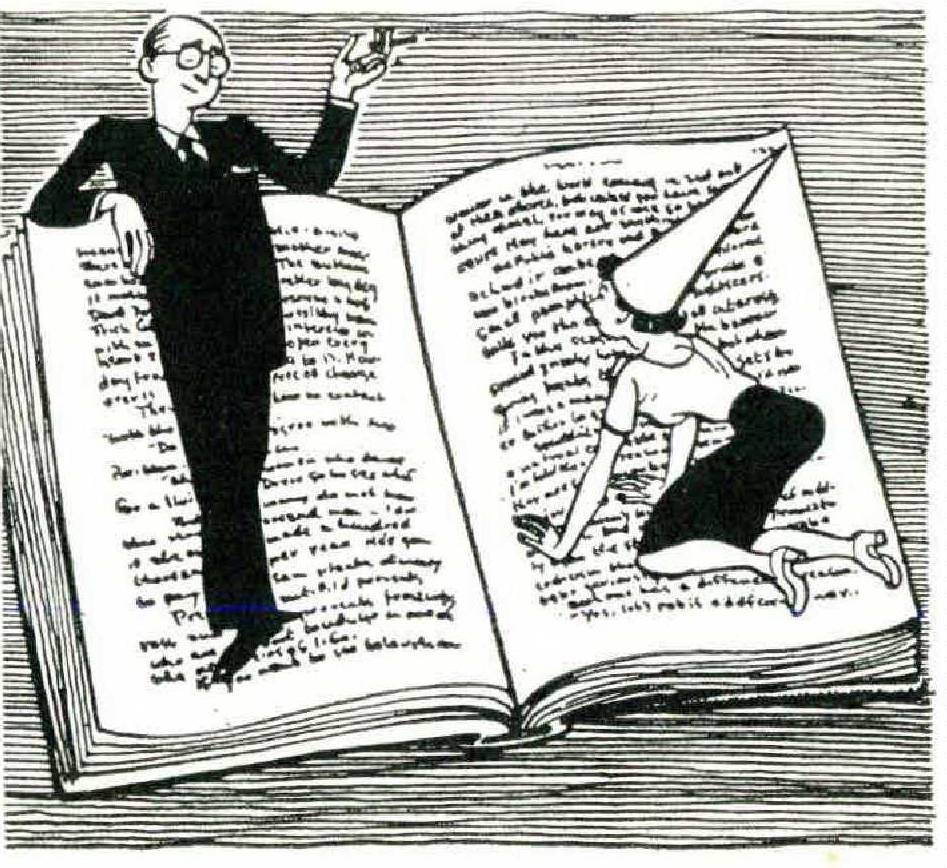
One other technique that deserves mention here is the Foreign Word or Look-at-All-the-Stickerson-My-Suitcase approach. Here, the writer writes, for instance:
The summer had a dreamlike quality. Sam loafed through Southern France, savoring the girls, the humble vins du pays (regional wines), the strong hot sun . . .
Well, sir, this makes a reader pretty mad. He didn’t have to have a simple thing like that translated for him, for goodness’ sake! His high school French stretches that far.
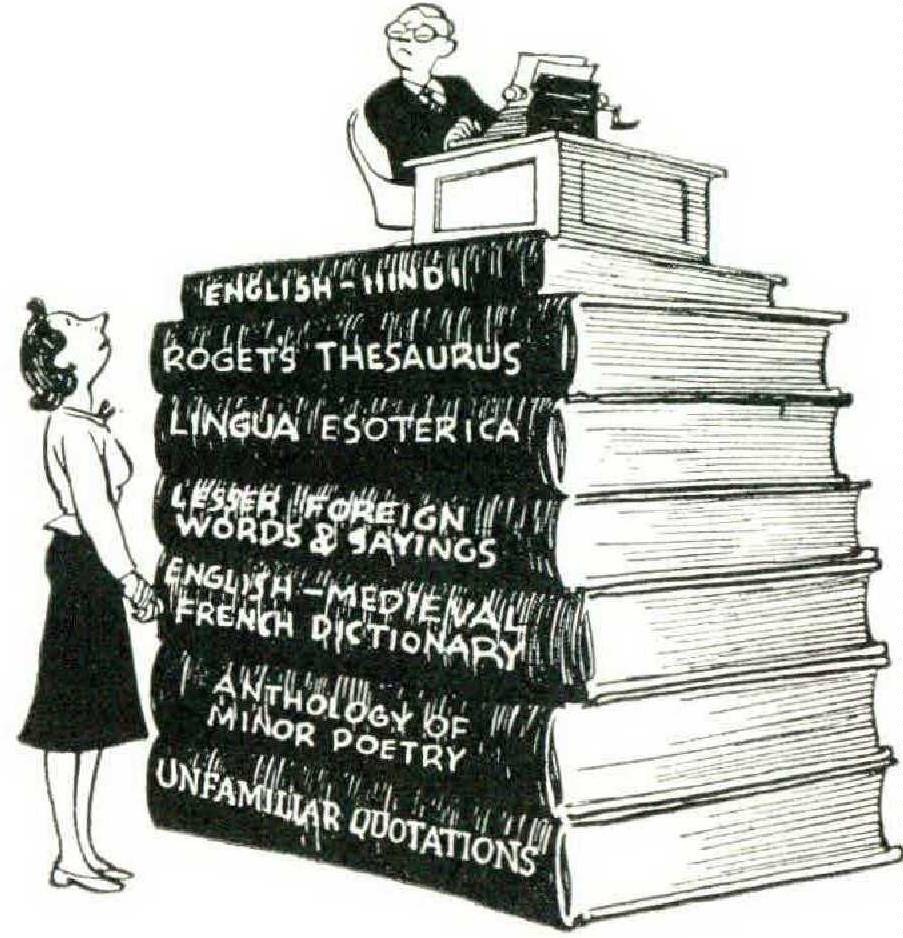
Yet, on the other hand, he feels uneasy because he knows, deep within himself, that that’s about as far as it does stretch. And after all, this writer seems to be pretty handy with the language. Like the way he handled that dialogue in the café and everything. Maybe the reader had better quit being such a slob and brush up a little. It’s a shame to let things like that go. . . . Right here you’ve got a worried reader. Worried bad.
However, the writer can also err in the other direction:
The moment had a dreamlike quality. Sam heard, as though from far away, Ragusi’s soft slow voice. “B’wami, umbili o poona mambozo.” Then Sam knew, saw, understood.
Which is a lot more than the reader does, of course; so this makes him pretty mad too. As you can see, in this foreign word business, the reader ends up over a barrel either way.
Perhaps there is only one solution. Perhaps the only way to even the score is for all readers to change their spots and start writing. And — judging by the publishers’ current listings, and to paraphrase a remark alleged to have been made to Oscar Wilde under circumstances much too well known to be related again here (see Appendix 379-4) — they are, friend. They are.