At Home in Scandinavia
A few years ago, I was at London’s Waterloo Station to see some friends off to New York. A middle-aged American asked me to direct him to the boat-train platform, which I did. On my way out I saw him again, looking very lost (I thought), and I assumed he got my directions confused and missed the train.
“Oh, no,” he assured me. He wasn’t due to leave for several days yet, but after a couple of weeks in London on his own he’d decided to take a look at the train on which he would, eventually be leaving. He’d wanted, I gathered, to reassure himself that there was such a train; and it had also given him vicarious pleasure to see others started on their journey back to the United States. By way of demonstrating how eagerly he was looking forward to his own return, he showed me snapshots of his home and family in Ohio.
As a Briton, I remember feeling embarrassed that a visitor, especially one who had spent all the money necessary to cross the Atlantic, could be so wretchedly lonely in London. Though his was possibly an exceptional or exaggerated case, a sense of social isolation is, of course, a hazard of foreign travel even when the language is no barrier. I can imagine that many visitors who arrive in Britain knowing nobody leave days or weeks later without having met anybody outside of hotel porters and the like. For the problem of how to provide foreign visitors with suitable social contacts, of how to enable them to meet the people as well as see the sights, of how to give them some psychological understanding of the country as well as some physical knowledge of it, has not, so far as I’m aware, been a matter of official consideration in Britain.
It is a problem, I should think, that any country engaged in the tourist business would be both charitable and wise to consider. And in Scandinavia, where one is likely to come across more evidence of a progressive spirit than anywhere else in Europe, its handling has become a responsibility of national and private tourist agencies.
I say this after a recent journey on my own through the Scandinavian countries. Denmark was the initiator of current plans to safeguard the foreign visitor against loneliness, and appropriately I went there first.
I took the ship that sails daily during the summer months from Harwich to Esbjerg. That, incidentally, if the tourist can afford the time for it and England happens to be his starting point, makes a very pleasant overnight voyage. Though the ship is apt to be booked up, especially in August, it has sufficiently spacious accommodation to give the impression of not being at all crowded — a rare thing in these days of mass travel. The traveler gets an excellent four-course dinner aboard for just over a dollar, a foretaste both of the delectability of the Scandinavian cuisine and of the reasonableness of prices in Scandinavia— particularly in Denmark — by comparison with those in most other parts of Europe.
The Danes are a patriotic, homeloving people, full of bonhomie but curiously modest. Talk to a Dane and the chances are he will soon be telling you that though there is no poverty in Denmark and life there is happy and abundant, his is a poor country without iron or other rich industrial resources. This same modesty is characteristic of official Danish travel literature, which sometimes seems to have an oddly self-denigrating tone. The fact is that though Denmark needs a thriving tourist trade for its economic welfare, it frankly does not believe it can have one merely because its countryside is pretty and dotted about with ancient castles or because Copenhagen, toward which the great majority of Denmark’s foreign visitors gravitate, is a gay and handsome city, “the Paris of the North.” In other words, so far as conventional tourist attractions go, Denmark does not feel well enough endowed to compete with Norway and Sweden, let alone with such veterans in the tourist business as France, Italy, and Switzerland.
Hence it has invented and developed an original selling policy of its own, a policy expressed in the slogan: “Life-seeing rather than sight-seeing.” To judge from the facts that Denmark’s tourist trade has quadrupled in the past ten years, that it is now at least abreast of Norway’s and Sweden’s, and that the country welcomed 100,000 American guests in 1956, this policy is proving highly successful. But obviously its practical effectiveness is dependent on the attitude of the Danish people. Conducted tours that take in visits to schools, factories, and farms can be and are made available. But they would hardly be attractive without the coöperation of individual Danes and Danish families.
There was never any attempt to enlist this coöperation officially or to propagandize it into existence with appeals to patriotism or selfinterest. As a member of the National Tourist Association ol Denmark put it to me, “We couldn’t very well say to the people, ‘smile, damn you, smile when you see a foreign visitor.’ And anyhow, we didn’t need to.” For the Danes, evidently, are remarkably free of xenophobia or racial prejudice, and they are traditionally hospitable. It is a natural thing for them to smile at strangers and to talk to strangers uninhibitedly. Because they are proud of their way of living, they want others to know about it and share in it. Moreover, the majority of them speak at least one language besides their own. This is likely to be English, since English is a compulsory part of their school education.
The traveler in Denmark may be sure that if he looks lost, say, and a passer-by volunteers assistance, or if, as happened to me, a chance acquaintance on a train offers him hospitality, these displays of friendliness are characteristic and quite spontaneous. Nevertheless, there are two programs run under the auspices of the National Tourist Association that in a sense make the coöperation of the Danish people in the lifeseeing policy a more organized thing than it would otherwise be, though both of them were actually in operation before the policy was formulated.
One is known as “Room Service.” If the traveler arrives in Copenhagen or any of the larger towns in Denmark without a hotel reservation, he needn’t be afraid of finding nowhere to stay. He can go to the tourist information booth, in or near the main railroad station, and there within a half hour he will be fixed up with accommodation in a private house or apartment; with accommodation, what’s more, that pretty well meets his own specifications, unless these are exceptionally demanding. He would certainly cause no dismay if he insisted, say, on being directed to a home where English was spoken or where his hostess would be willing to serve him breakfast.
In Copenhagen and its environs alone, 3500 homes arc open to tourists. Among the families on the Room Service books all social classes are represented, with the exception of the few rich landowners left in Denmark, who still manage to live with a staff of servants in mansions or castles. The accommodation offered ranges from small, uncarpeted rooms, clean but primitive, at about sixty cents a night per person, to rooms with private bath, up to the standard of comfort in a luxury hotel, at just over two dollars.
Room Service was started before the war to supplement the inadequate hotel space in Copenhagen and elsewhere. That, basically, is the reason for its continuance, for though new hotels have been built and are being built, the supply has still not caught up with the demand. At the same time, such a large-scale and informal method of introducing tourists to private homes is, however fortuitously, a useful contribution to the life-seeing policy. Moreover, not all the householders with accommodation to offer join Room Service simply because they want to add to their incomes, even though the service is meant to be a strictly business proposition. They may join it as much for enjoyment as profit — for the fun of meeting people from other lands.
When the National Tourist Association makes an appeal for new subscribers, it invariably receives a few offers to provide lodging entirely free; and there have been instances of the foreign paying guests being invited to prolong their visits without charge. Danish hospitality to the stranger, in short, is apt to be irrepressible. So if a tourist applies to Room Service with the desire and expectation of being treated as impersonally in a private home as he would be in a hotel, he had better make that one of his specifications. The application must be made in person, by the way. The Room Service officers won’t handle advance reservations.
The second organized contribution to the life-seeing policy that individual Danish families are making is entirely a labor of love. It is called “Meet the Danes,” and under different names it has lately spread through all Scandinavia. Essentially it is an arrangement whereby every tourist can be certain of an appropriate social contact if he wants it — and that one may well lead to others. The idea really started during the war when Danish families, at considerable peril to themselves, made a practice of giving harbor to parachutists who arrived surreptitiously to help rid the country of the Germans. After the liberation, a national committee was formed to organize private hospitality for Allied soldiers; later still, the work of this committee was taken over, and greatly developed, by the Tourist Association.
More than four hundred families are now registered with the association under the Meet the Danes program in Copenhagen, and during the high season (July and August) some of them are prepared to entertain tourists as often as once a week. If the tourist calls at the association’s head office (it is next door to the railroad station) and applies for an invitation to a Danish home, the arrangement usually can be made for him within twenty-four hours, though, as in the case of Room Service, he can’t make a reservation by writing ahead of time. He will be required to show his passport and also to fill in a form, stating his age, nationality, marital status, profession, and special interests. He will probably be warned against expecting a free meal, and he will certainly be discouraged from seeking an invitation primarily for that purpose. But otherwise he will not be given any advice unless he asks for it. If he inquires, for example, whether he should return the hospitality he receives, he will be told that there is no social obligation to do so; that it is a matter for him to decide, depending on the time he has available and the inclination he feels to develop the contact once made.
It is doubtlessly indicative of a difference between national temperaments that at the moment the Meet the Danes service is patronized more by Americans than British. For my part, I must confess that having applied for an invitation and received it, I was seized with considerable misgiving. A typed notice from the Tourist Association informed me that I was expected at 7:30 for afterdinner coffee at a private house in Klampenborg. Klampenborg, as I was to discover, is about twenty minutes by electric train from the center of Copenhagen; it is an attractive seaside suburb with a good beach and an amusement park second only to the famous Tivoli.
On my way, I reflected that to spend an evening with complete strangers was the last thing I’d willingly do in my own country, and I wondered why on earth I’d wanted to do it in a foreign one. The prospect of trying to make polite conversation with people whose command of the English language would probably be halting, who knew nothing about me, and about whom I knew nothing seemed highly embarrassing. As I approached the house, which happened to be guarded by a ferocious-sounding dog, I was wondering how soon, if the dog let me live, I could decently take my leave.
But my hostess was evidently practiced at dealing with strangers, timid or otherwise. She gave me a shouted greeting from her doorstep in impeccable English — it turned out that she had been to school in England — and immediately put me at my ease. I was introduced to her grown-up children, a son and two daughters. The dog was called into the living room, and was immediately conciliated.
We sat down to coffee and one of those delicious home-made Danish cakes that seem to be chiefly composed of strawberries and thick cream. I was soon asking my hostess whether she didn’t sometimes feel a bit apprehensive of admitting an unknown visitor to her home, for I had been toying with the perhaps melodramatic idea that the Meet the Danes program might provide criminals with a most convenient means of invading private houses. She assured me that though she had been participating in the program since 1952, and had lost count of all the guests she had received in that time, she had been burdened with only one tiresome character. But with nearly all her other guests, she said, she had got along splendidly, and with a few of them she kept up a correspondence.
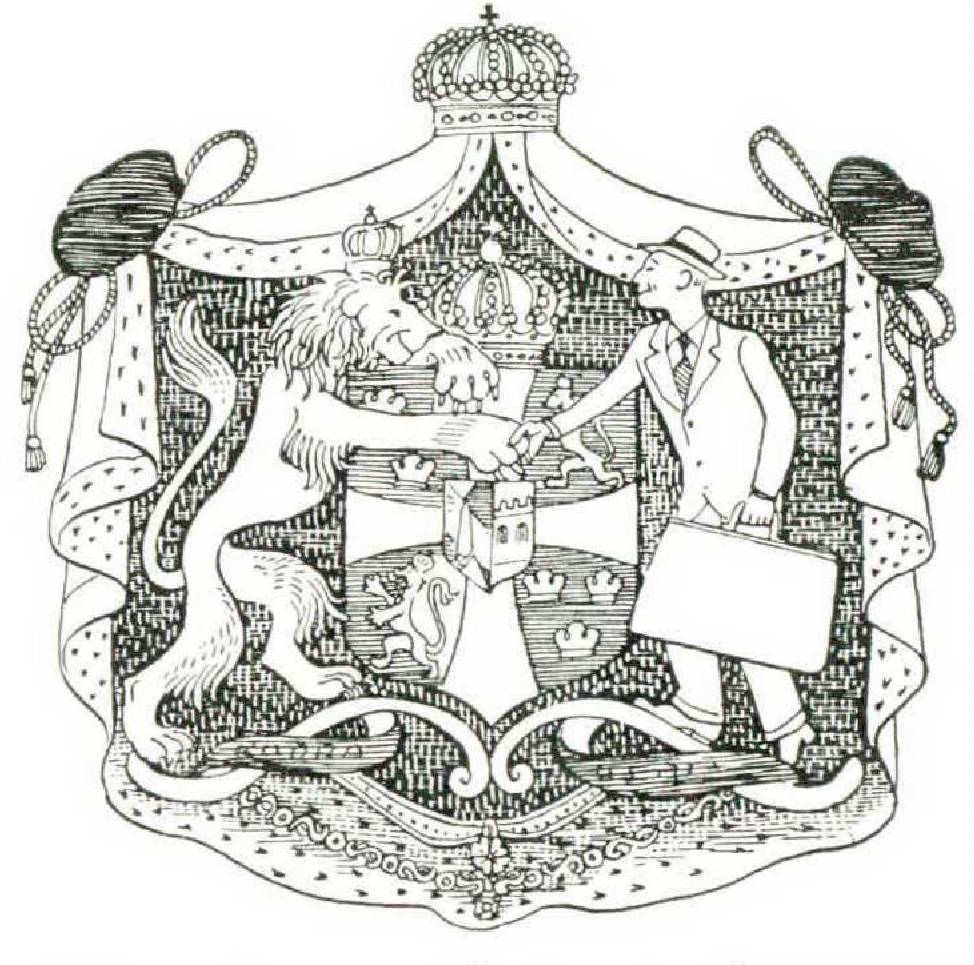
My hostess and her family went on to talk of other things: the new Danish Coalition Government (which they didn’t like at all), taxation in Denmark (which they didn’t like much, either), the training of children for the Royal Danish Ballet (which includes a general education), the subsidization of art and science in Denmark by the great Garlsberg brewery, the Americanization of the Danish kitchen since the war, the virtual classlessness of Danish society, and so on. I spoke of comparable things in England. It wasn’t long before I lost any sense that we had met as casual strangers. I felt rather that we met as appointed representatives of friendly states. And I realized afterwards that at a meeting of this sort conversation is bound to flow easily, granted the least curiosity on either side about the other’s problems and customs. Moreover, it is most likely to end, as it did in this instance, in mutual assurances of good will.
Paradoxically, though the Meet the Danes program may have considerable potential value as a tourist attraction, its charm lies in the fact that it wasn’t designed and still isn’t run as a commercial undertaking. Travel officials told me, and I’m sure sincerely, that it isn’t in any way a “selling” device. They consider it a public service; a planned contribution to a better understanding between peoples.

The same may be said of the imitative programs that have been started in Sweden and — thus far in a smaller and more embryonic way — in Norway and Finland. The Swedes are on their mettle to make their program a success, for the Danes are privately skeptical of their ability to do so and the Swedes are perfectly well aware of this. The Danes consider that the Swedes are too introverted as a people, too stiff and formal ever to take kindly to the idea of throwing their homes open to foreign visitors.
Perhaps the Swedish version of the Meet the Danes program, which was begun two years ago under the auspices of the National Traffic Association, does seem a rather formal affair compared with the original. To begin with, there is the more ceremonious title — “The Swedes At Home.” And this title is lived up to with a printed invitation card for the tourist when a contact has been arranged for him, instead of just a typed notice. The official brochure containing advice as to how a visitor should comport himself in a Swedish home has a grimly serious tone by comparison with that of a corresponding Danish publication, which is openly facetious. The tourist is instructed, for example, to arrive punctually, to thank his host and hostess immediately after a meal, and, preferably, to shake hands with them as well. He is given an especially detailed piece of advice about toasting: “The lady on your right will appreciate your toasting her. The glass is raised slightly from the table and on catching your partner’s eye, smile, bow slightly to your lady, and then say ‘skal.’ ”
But if this sort of thing appears to support the theory that the Swedes have a too forbidding national temperament to conduct a successful private hospitality-for-tourists scheme, the theory is fast being disproved in practice. A young and pretty Baroness is at present running the program on behalf of the Traffic Association, and running it very actively and lovingly. She has come up from the ranks, so to speak, for when the program was launched with a press and radio appeal for participants, she and her husband — a well-known musician — were among the first to volunteer.
Now there are as many Swedish homes in the Stockholm area for the entertainment of tourists as there are Danish homes in the Copenhagen area. The Baroness uses the hut-like little tourist information office in the central Kungsträdgården as her headquarters, and there she interviews personally every applicant for an invitation. Though he is required to fill in a form, just as he is in Copenhagen, the Baroness believes she can tell better from talking to him what sort of contact will prove the most socially rewarding both for him and his hosts.
She is extremely anxious that the evenings she arranges should go well; indeed, vicariously and sometimes very nervously, she is present at all of them, for she never fails to ring up next morning for a report. A successful evening she counts as one that leads to further meetings between the parties introduced, and by this standard she has known some failures, including a few really dire ones. The chief hazard she faces — and this is true with her colleagues in the other Scandinavian countries — is an overdeveloped sense of class consciousness on the part of a particular applicant. For class distinctions, whether based on birth or money, are not taken into consideration in running the hospitalityfor-tourists programs. If the visitor is a millionaire, he is as likely to be sent to a humble home as a rich one.
The Baroness has had mostly successes. When I called on her she was feeling particularly pleased, because a contact she’d had some difficulty in arranging — it was for a young medical student from Ghana who wished to meet a doctor near his own age and interested in stamp collecting — had turned out very well. By contrast, apparently, I presented no problem at all. She said she knew exactly the people I should meet. It was only a question of finding out whether they were free to entertain me on the evening I’d specified.
Fortunately, they were; and promptly at eight o’clock I presented myself at their apartment in the center of Stockholm. At the Baroness’ suggestion, I was armed with a box of candy as a small offering. My host showed me into a handsomely furnished living room lined with books, as many of them, I noticed, English as Swedish. He was a dentist, his wife a journalist. They were comparatively new recruits to The Swedes At Home, they told me. In fact, I was only their third visitor. Before me, they had entertained a dentist from New Jersey and a professor from California who had brought his mother with him. They were now looking forward to being called upon to receive some French or German visitors, for, as they said candidly, part of their purpose in joining the program had been for the agreeable opportunities it might give them to practice their foreign languages.
They apologized for having asked me to “light supper” rather than dinner. They had had to go out to a lunch party, they explained, and while servants had become a thing of the past in Sweden, except in the houses of the very rich, dinner was necessarily still such an elaborate affair whenever a guest was invited that they wouldn’t have had time to prepare it. I could well believe this after I had partaken of the light supper, which wasn’t exactly light from my point of view. It was preceded by martinis and accompanied by wine and consisted of generous servings of ham, salad, cheese, and raspberries and ice cream.
I should find it difficult to make comparisons between this experience of The Swedes At Home and my previous encounter with the Meet the Danes program without seeming invidious. But the evening passed no less easily and enjoyably for me than the other had, and if I was remiss in the observance of formalities supposedly expected of a guest in a Swedish house, I was certainly not made to feel so.
We were talking at one point about the liberalization of the monarchic institutions in Scandinavia. An example of this which had struck me is the fact that the Royal Palace in Stockholm is now open to the public except when the King is in residence, and that is rarely during the tourist season.
I remarked that it seemed to me quite impossible at the moment to conceive of anything of the sort happening in England; even the gardens of Buckingham Palace are still surrounded by a high wall with barbed wire and spikes on top. This reminded my hostess that there was to be an event at the Stockholm Palace in a short time — the swearing-in of a new minister of state by the King — which she had been assigned to cover for her newspaper. She suggested that I might like to go with her, so that I could see for myself how little pomp and ceremony royal occasions in Sweden have nowadays.
Unfortunately, I was due to leave Stockholm before that day, so I had to refuse. But it was an opportunity I much regretted missing, and one which obviously wouldn’t have come my way at all if I hadn’t applied to the Baroness for an invitation to a private home. Moreover, it was just the sort of opportunity that The Swedes At Home and kindred programs do produce when they work as they are intended to.
To my mind, the whole idea of private hospitality for tourists is such a manifestly good one that it seems bound to become increasingly popular, and I cannot help wondering how much traffic it will eventually be able to bear. Danish officials are a little apprehensive that the demand may become too heavy. The Baroness, on the other hand, believes that there is still plenty of room for expansion, and she is planning to widen her field of operations beyond the Stockholm area. (Hälsingborg already has a small Swedes At Home service, but this is independently run.)
I hope that the idea will never become too self-consciously a part or a prop of the life-seeing policy, and I am sure that if it did it would lose its present quality. Stopover visits to “typical Swedish homes” are now part of the luxury ten-day trip to Lapland and the midnight sun organized by the Swedish National Railways; a hotel in Geiranger, a beautiful Norwegian mountain resort, offers its clientele surprise visits to neighboring farms, where the occupants may be viewed in the midst of their daily chores.
These are just two indications that the commercial possibilities of the Danish life-seeing policy have not gone unheeded elsewhere in Scandinavia. But though it may be true that the friendly and publicspirited people who comprise the Meet the Danes and Know the Norwegians and Swedes At Home services are to some small extent helping to bring dollars and other desirable currencies into their countries, that was the last thing that prompted them to agree to entertain tourists and would be the least encouragement they could have to continue to do so.