Gilbert Murray
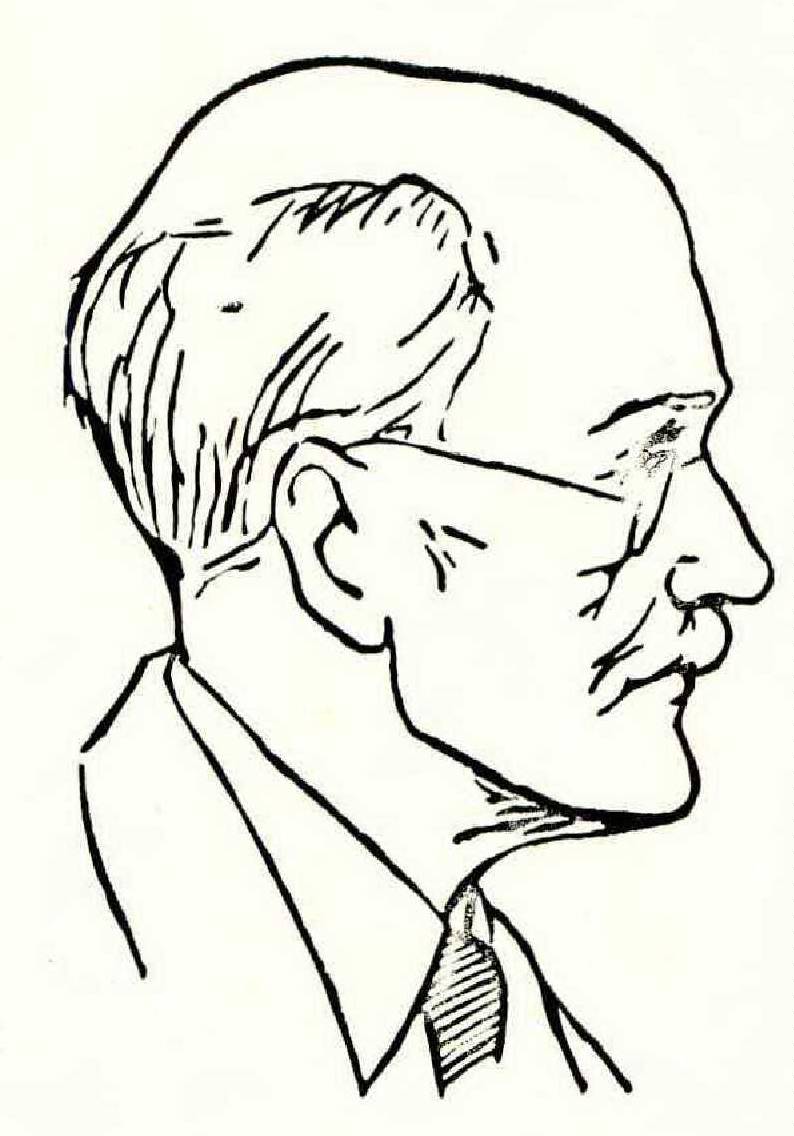
When Gilbert Murray received the Order of Merit, the London TIMESsaid, “He might equally have earned it by his success in transmitting the light of Hellas to a generation that is forgetting the Greek tongue —or by the noble failure of his long works for peace.” Some of the interesting facets of this great classicist’s career are shown in the portrait by his former student and friend, C. MAURICE BOWRA.Sir Maurice is himself a British classical scholar and literary historian, and since 1951 has been vice chancellor of Oxford University.
BY C. MAURICE BOWRA
WHEN Gilbert Murray died on May 30, 1957, it was hard to believe that he was ninety-one years old and had spent the first thirty-five years of his life during the reign of Queen Victoria. Not only did he keep his full physical and intellectual faculties to the end, but to people at least half a century younger than himself he seemed to be somehow a contemporary, so well abreast was he with a changing world and so able to notice and enjoy new impressions and points of view. Yet Murray owed much of his peculiar eminence to being an authentic Victorian, who, like other Victorians, was compounded of contradictory elements. He combined assurance and doubt, classical precision and romantic vagueness, intellectual independence and intransigent prejudice.
For this his origins were partly responsible. He was born into the old “governing” class, which found an outlet for both its ambitions and its sense of responsibility in administering territories which were still colonies. His father, Sir Terence Murray, was president of the legislative council of New South Wales, and his elder brother became an enlightened and highly capable governor of British New Guinea. But this orthodox lineage was tempered by a strain of Irish blood and membership in the Roman Catholic Church, which Murray forsook at the age of eleven. Though there was an aristocratic distinction in his unfailing, irresistible courtesy and in a certain quiet dandyism in his dress, he saw himself as a rebel, while his adversaries saw him as a crank.
In his Australian childhood he was horrified by the brutal treatment of aborigines and formed his first sympathies for the oppressed. His speech, which was admired in the United States as a model of the English accent, owed not a little to a slight Australian twang, which mitigated what might otherwise have been too mellifluous an utterance. He went to England in 1877, and, except for short visits abroad, remained there for the next eighty years, exerting a. powerful influence over many generations at Oxford, where he lived. But he could never be fitted into any accepted category. In the academic world he was suspected as a man of letters and a man of affairs; in the world of politics he was always unmistakably a professor. Yet in both he moved on equal terms with his more strictly professional colleagues. He was sustained by a Victorian confidence and pursued his own ends with an assurance characteristic of his generation and his class.
Murray had a very distinguished appearance. The high, domed skull of the scholar was matched by a fine mouth and a remarkably resolute chin. He had no airs or affectations and was charmingly courteous to everyone with the true courtesy which comes from being really interested in others. He never lost his lithe and easy movements or his upright stance. Even in old age he could walk up a ladder without using his hands and was a master of adroit and hilarious gamesmanship at tennis. He was a fast and determined walker, who would go straight through a wood regardless of boughs or brambles, or step lightly along ice edges or the brinks of crevasses in Switzerland.
As a boy at Merchant Taylors’ School, London, and as a young man at St. John’s College, Oxford, Murray laid the firm foundation of an intellectual equipment which was to be his stand-by throughout life. He was brought up on the old classical curriculum and made to study Latin and Greek, and very little else, from quite early boyhood. A wonderful memory, a naturally studious temperament, a brilliant, eager mind, and a real passion for ancient literature, not merely for its contents but for its use of words, marked Murray from the start. When he went to St. John’s College in 1884, he won all the university scholarships and prizes for classics. Murray liked Greek more than Latin, and though his knowledge of Latin poetry was always remarkable and he would take Ovid’s Metamorphoses on his holidays, it was to Greek that he decided to devote his life.
The way lay open. In 1888 he was elected to a fellowship at New College, Oxford, and in the next year, when he was only twenty-three, he was appointed professor of Greek at Glasgow. Even in those adventurous days this was regarded as risky by some cautious Scots, and his more traditional colleagues were disturbed by his red tic, which in fact he wore for purely aesthetic reasons, and by rumors that he was not only a teetotaler but unsound on theological matters. At Glasgow, lectures, which began at 7 A.M., were preceded by prayers, and Murray confounded his critics and appeased his own conscience by reciting the Lord’s Prayer in Greek. He stayed at Glasgow for ten years, and then, on the advice of his doctors, who thought that he had not long to live, retired to Surrey.
His health soon mended, and retirement meant no more than a change of scene and a slight change of work. He took advantage of his leisure to study for a short time in Germany under the magnificent Hellenist, Ulrich von WilamowitzMoellendorff. Wilamowitz records that he received a letter from Murray “in elegant Attic,” and Murray used to recall that, when he himself got right what the German students had got wrong, the great man would bang the table and snort indignantly: “Only the Englishmen!”
At home Murray moved in literary and dramatic circles, and some of his translations of Euripides were admirably produced at the Court Theatre in London. In 1906 he came to Oxford, where New College created for him a special post which still allowed him plenty of time for himself, while he was able to resume his old taste and capacity for teaching. When in 1910 Prime Minister Asquith, who knew and admired him, appointed him to be Regius Professor of Greek, he could well argue that no one could rival Murray’s claims for the post. In Oxford Murray stayed till his retirement in 1936, and for another twenty-one years afterwards as professor emeritus.
MURRAY’S life was shaped by his love of Greek. He liked almost everything about it. In the language he admired the effortless ease with which even the most complex thoughts can be expressed, the ability to say much in a short space, the uncorrupted and untarnished purity of the individual words, the absence of pomposity, evasion, and ambiguity, the generous gamut of possible effects from closely argued prose to majestic poetry. He felt that though modern languages might have increased the range of expression in technical fields, in all things that really mattered Greek usually “had a word for it,” and a better word at that. He carried large parts of Greek literature in his memory and was never at a loss to illustrate a theme or an idea or a linguistic usage.
He was an incomparable teacher of Greek. I was fortunate enough in 1920 to be a member of a class of four whom Murray took in Greek composition. He would set adroitly chosen pieces of English to be translated into Greek prose or verse. They were often far from Greek in their substance and manner, and many times what we produced must have seemed to him deplorably barbarian, but he never said so. He corrected the mistakes without making too much ado about them, praised what he thought good, and then he would produce his own version, which was the real, right thing and made the whole affair look wonderfully straightforward if only we set about it in the proper way. Though we could never hope to approach his consummate mastery, we did at least develop a feeling for the essential qualities of Greek and begin to see how they could be used.
As a teacher, Murray enjoyed all the delights of a lively curiosity and found endless scope for its exercise, but though he agreed with Aristotle that the pursuit of truth is a first duty of man, he did not agree that it is sufficient as an end in itself. He felt rather that the duty of a teacher is indeed to discover the truth but also to expound it, and that in the end it leads to results outside itself. Though he delighted in scholarship, he never persuaded himself that it was enough; he must get others to share his enjoyment, and if he could do this, they would lead richer and more rewarding lives.
Though Greek was the soul of Murray’s outlook, he related it to other material which was not easily combined with it, and this accounts for some of the more surprising paradoxes in his personality and his achievement. As a boy he felt the overpowering impact of Victorian Romanticism. When in the eighteen-seventies he first began to read poetry, his heroes were not only the Greeks, but Swinburne, Morris, and Rossetti, who appealed to him all the more because they were, in their different ways, rebels.
His love for poetry, which he regarded as a religion uncontaminated by superstition, made him wish to write it. The only original poem which he published was a versified Egyptian tale, Nefrekepta, and he soon realized that he was not a creative poet. He turned instead to translation, and from various pieces in his Ancient Greek Literature (1897) to the Knights of Aristophanes (1956), he produced a long series of translations into English verse from Aeschylus, Sophocles, Euripides, Aristophanes, and Menander. Through his translations, especially from Euripides, he appealed to a public far wider than any he could reach through his more scholarly works and won an extraordinary fame. They were acted with considerable success on the commercial stage, and the sumptuous production by Max Reinhardt of his Oedipus Tyrannus caused a sensation in 1914.
His translations earned Murray the friendship of Bernard Shaw, who put him as Adolphus Cusins into Major Barbara and got Granville Barker to play the part with an uncanny verisimilitude. Euripides, who had never been a first favorite with English readers, won a much belated renown and was credited with having played in Athens of the fifth century B.C. the kind of part that Shaw now played in London. In the first decade of this century, Murray’s translations were almost the only new verse in England to command a large sale.
Murray’s success came the more easily because he presented Greek poetry to the English-speaking public in an idiom with which it felt at home. The high Victorian manner, mellifluously romantic and even archaic, was still regarded as the only way to write poetry. There were indeed subterranean rumblings of revolt, but most educated readers took no notice of them and welcomed from Murray something they liked and understood. Murray turned Euripides into the style of Swinburne and Morris; Swinburne provided a model for the choruses, Morris for the rest. In recent years sophisticated taste has on the whole turned against these translations, and critics tend to repeat, in rather less cogent words, T. S. Eliot’s sharp little criticism that “as a poet Mr. Murray is merely a very insignificant follower of the pre-Raphaelite movement.” It is understandable that the young Eliot, in his ardent search for a cosmopolitan, colloquial diction, found nothing to help him in Murray’s translations, which were regrettably reminiscent of his own first poetical contributions to Harvard periodicals. Yet Murray could hardly have done otherwise than he did. A man who was born in 1866 and began to write verse in the eighteeneighties could scarcely anticipate even the dehydrated manner of H.D., which Mr. Eliot, oblivious alike of Milton and Arnold, recommends as suitable for Greek choruses.
If Murray had been a fully creative poet, he would no doubt have created a different style, but in that case he would not have been content with mere translation. It was because his poetical talent was essentially derivative that he never altered his style or brought it up to date with new fashions. Swinburne and Morris, having done sturdy service for Euripides, were called in to help with Aeschylus and Sophocles, while parts of Aristophanes, who needed different handling, profited by the example of W. S. Gilbert, famous for his part in the Savoy Operas but also responsible for Murray’s Christian name.
Though Murray’s later versions of Greek tragedies have a sharper edge than the earlier, they are all composed in what is essentially a single idiom. The trouble is that translations are usually the preserve of those who respond with a special power to the work of others and feel the need to reproduce this response for themselves, but just because they are made in this way they pick up a style which lies ready to hand, and their work bears the unmistakable marks of its origin and its time. As soon as a new style emerges, they become out of date, and this has been Murray’s fate as it is the fate of many gifted translators. In time, perhaps, his translations will be revived not merely for the dissecting laboratories of students writing theses for the Ph.D. but because of their real merits: their unfailing resourcefulness, their undoubted melody, their ingenuity in turning Greek into the vastly different idiom of Victorian English.
A MORE serious criticism of Murray’s methods is also urged by Mr. Eliot: “Professor Murray has simply interposed between Euripides and ourselves a barrier more impenetrable than the Greek language,” and he refers explicitly to one or two places where Murray uses images which are not visible to the naked eye in Greek nor easily inferred from it. The accusation is fair enough and was indeed current in Oxford before Mr. Eliot gave his imprimatur to it.
Murray certainly adorned his originals, but he did so consciously and with a set purpose and was ready with his defense. In his view, English, after centuries of hard use, had lost the first freshness which survived in Greek, and he had to compensate for this by giving an emphasis which the Greek itself does not possess and does not need. It might be doubted whether this was the best way to do it, but we can hardly dispute that there is something to be said for it. If we stick too closely to the Greek and translate literally word for word, we are liable to get only the bare, dry bones and to extinguish the living breath. The problem may, of course, be insoluble, but in fairness we must admit that it is at least real and that Murray tried to solve it. He found in Euripides something which not all scholars have found, and did his best to convey it to others in a language which they could understand and appreciate.
It was characteristic of Murray that when he practiced the parallel art of translating from English into Greek he allowed himself no liberties and produced Greek verse which is not only very close in sense to the original English but delightfully lucid and firm and, above all, Greek. The two arts illustrate the two sides of his character, the romantic and the classical. It was this unusual combination which was responsible for much of his power both in teaching and writing. He was without question one of the greatest teachers of his age in England. His lectures at Oxford were both a revelation and an inspiration to young men and women who had indeed been taught Greek at school but seldom been allowed, still less encouraged, to treat it as a living thing. Murray, who believed passionately in Greek as an intellectual discipline and thought the study of it more useful than that of English or modern languages, believed no less passionately that it was also a great deal more, that it was an exalting experience to be shared and assimilated and enjoyed.
In his exposition of Attic tragedies he began with the establishment of the text and the precise meaning of the words, and to both he gave his trained and careful attention, but this was only the start from which he moved to his dramatic and imaginative interpretation of the poetry and the drama. His own experience of the stage stood him in good stead, and he had clear and cogent ideas as to how a play should be acted. But more than this was his feeling for the movement of the whole; for the significance of the choral songs, which he read as if they were music and not prose cut into arbitrary sections; for the mounting tension which leads to a climax; and for the actual climax when it comes. The whole performance was done quietly, but every word was chosen with consummate skill, and strong reserves of emotion would come to the fore as Murray unfolded the doom of Agamemnon or Oedipus. His explanations were swiftly and surely delivered, as when he explained Clytemnestra’s summons of Cassandra — “She wants another victim” — or marked the stages by which Jocasta comes to see the hideous truth about Oedipus. Everything fell into its place, and the whole masterpiece emerged in its strength and wealth from Murray’s concentrated, eager exposition.
In the years immediately after World War I, when Oxford was full of young men battered and stunned by bloodshed, Murray brought them back to civilization and through his evocation of the Greek past made them feel that they had after all fought for something which was worth defending. In the national scene his work was even more significant. For at a time when reform was in the air and a classical education seemed to many an outdated and useless luxury, Murray demonstrated that it could do more than almost anything else to restore sanity and balance and perspective after the indescribable devastation of war.
By uniting scholarship and imagination in his lectures and his books, Murray satisfied both sides of his conflicting nature and indulged alike his classical sense of order and his romantic yearnings, his pleasure in words for their own sake and his desire that they should make an impression on the world, his respect for the past and his rebellion against it.
Among professional scholars he had some unrelenting opponents, notably at Cambridge. When Henry Jackson, Regius Professor of Greek, saw in the preface of Murray’s Ancient Greek Literature the opening words: “To read and re-read the scanty remains now left to us of the Literature of Ancient Greece, is a pleasant and not a laborious task,” he scrawled in the margin “Insolent puppy!” Murray’s old forerunner at St. John’s, A. E. Housman, who after strange vicissitudes had come to be feared as the most savage scholar of his day and who was appointed in 1911 to the chair of Latin at Cambridge, devoted much of his inaugural lecture to a denunciation of Murray and his methods. The editor of Manilius had long prevailed over the author of A Shropshire Lad and did not approve of scholarship being mixed with poetry or of scholars displaying a love for literature. Even in Oxford there were those who regarded Murray as “brilliant,” but the word was not meant to praise him.
Yet Murray was attacked for his outstanding virtues. It was idle, and worse, to wish him to conform to ordinary methods of scholarship; for that would have ruined his unique gift for teaching and interpreting Greek. But while those who did not know him might maintain a contemptuous superiority toward him, those who knew him succumbed to his indisputable mastery of his subject. At meetings oflearned societies he was always able to take a leading part just because he knew Greek poetry by heart and knew what it meant. He would remind his fellows of this or that passage or supply what was obviously the right interpretation, and no one could gainsay him. Even before 1914 his chief battles were won. The younger generation looked on him as their master, and though he was sensitive to criticism and saw no excuse for odium philologicum, he was sure enough of himself to go his own way.
EVEN so, scholarship was not enough. Murray had always been actively interested in politics as a radical who disapproved of the South African War and advocated votes for women. He was vigorously abetted by his wife, whom he married in 1889. Lady Mary Howard was a daughter of the ninth Earl of Carlisle and came of a family noted for its aristocratic distinction and its political independence. She combined a warm heart, a noble courage, and brisk intelligence with a strong element of Puritanism and a delightful way of saying just what she felt. She converted her husband to abstention from both meat and alcohol but failed to persuade him to follow her example in becoming either a Quaker or a member of the Labour Party.
In other political activities she gave him energetic encouragement, but his personal admiration for Asquith and Grey modified his earlier radicalism, and it was partly from trust in them that he supported the entry of Great Britain into war in 1914. He saw it as a crusade for what he most valued in European civilization, but once it was finished, he was determined that it should not happen again.
With men like Smuts and Robert Cecil, Murray worked hard for the League of Nations and for a machinery to make it effective. In England he was a pillar of the League of Nations Union and its president from 1928 to 1938. He would spare himself no trouble to make its objects known and would think nothing of spending hours in explaining them to small groups of people in remote places. He did the work because he believed in it, but he was rewarded by the pleasure which he found in its personal and dramatic aspects. Though he cut an unusual figure at official dinners as he sipped his barley water or ate nut cutlets, in council he carried considerable weight and on the platform he was an eloquent speaker.
But he always seemed rather too fine a creature for the rough-and-tumble of politics, no matter how high-minded, and his ability to see more than one side of a question was sometimes construed as an inability to make up his mind. Indeed, so far from being an implacable doctrinaire, as academic persons are supposed to be when they take to public affairs, Murray was unusually supple and resourceful. He enjoyed the intricacies of maneuver and felt that compromises and concessions were inevitable if any progress was to be made. He was probably at his best at meetings of the International Committee of Intellectual Co-operation, which was a faint anticipation of UNESCO and dealt with cultural and educational matters on which he could speak with authority.
If at times he wondered whether he was really doing any good, he would derive confidence from some of the men with whom he worked. In the early days of the League he formed a deep affection and admiration for Nansen, who fulfilled his ideal of what a hero in the modern world ought to be. Once, when Nansen went to stay with the Murrays, he announced to their horror that he was going out fox hunting. They tried to dissuade him on the ground that he had no suitable clothes for it, but Nansen was not in the least perturbed and toured a series of undergraduates’ rooms until he got all that he wanted.
Murray admired too the intellectual agility of Benes and the stirring eloquence of Briand. The League of Nations provided him with the kind of drama that was near to his heart and brought him into touch with men who shared some of his ideals but who were in other ways unlike him.
MURRAY embodied much that was traditional in English culture. Despite his affection for eccentrics and rebels and misfits and his own advanced views on certain subjects, he was, in the best sense, conservative in many important respects. He was extremely fond of literature, but his tastes were formed in boyhood and altered very little afterwards. Apart from Greek, he liked the great masters of the classical manner, such as Milton, Racine, and Goethe, and he remained to the last a devotee of the Victorian poets. He was not very interested in modern poetry and failed to see even the splendor of Yeats’s later work.
His most curious blind spot concerned Shakespeare, about whose work he went as far as George III in thinking much of it “sad stuff,” while he positively disliked Shakespeare’s frankness on physical matters. An ardent young undergraduate, who was much distressed by Murray’s low view of Shakespeare, once played his last card and said, “But surely you like Twelfth Night?” Murray answered, “I think it’s a disgusting play.” On the other hand he greatly enjoyed the irresponsible frivolity of P. G. Wodehouse, and once, in a Swiss hotel, when Murray was reading aloud from a Wodehouse book, he caused such hilarity that he was told by the proprietor that if he did not stop he would have to leave.
On morals and politics Murray had unexpected limitations. Though he was a man of unusual understanding and charity, he was strait-laced on personal morals and even felt that J. M. Keynes was a doubtful accession to the Liberal Party because of his tolerant views on morals. In politics, though Murray believed in peace, he was not a champion of it at all costs, and he had no hesitation about approving the declarations of war by Great Britain in 1914 and 1939.
More surprisingly, he had in him a strain of the Victorian imperialist who thought that it was sometimes permissible for a “higher” civilization to impose its will by force on a “lower,” and he went so far as to give modified support to Sir Anthony Eden in his Suez adventure. Yet Murray would do everything he could to help the oppressed and the persecuted. Refugees from Hitler were given a warm welcome at his house, and he was indefatigable in his efforts to make the odious reality of the Nazi system known to his countrymen.
MURRAY had an enchanting sense of humor. Those who knew him only from his books might never have surmised his whimsical and original fantasy. His academic stories were quite unlike the usual legends and had a charming absurdity, like “I knew a learned Turk. He knew all about Cicero, and had read everything about Cicero. No one has ever known so much about Cicero. ... He hated Cicero.”
He was equally unexpected about the figures whom he had heard and seen, from Gladstone to Baldwin, and liked to tell how Asquith, on being asked by a distinguished American lawyer if he knew anything about the American constitution, nodded and said, “The worst in the world!” His wife did not always approve of Murray’s stories and once said sternly to him, “That’s not true, Gilbert, and you know it.” With a gentle smile he answered, “I may have dramatized it in my mind” and proceeded to tell another. His resourcefulness was no less ready when he was faced by situations not quite to his taste. Robinson Ellis, who had an old-fashioned scholar’s taste for impropriety, suddenly said to Murray, “Tell me, Mr. Murray, are you interested in incest?” and Murray replied politely, “Yes, in a general way.”
His letters and post cards usually contained some touch of gaiety or fancy. When the Oxford Book of Greek Verse was in process of compilation, he was asked whether it should include something by the stridently un-Hellenic poet Timotheus, and he answered, “We had better put him in. Otherwise T. S. Eliot might complain.” When he was eighty-seven, he sent me a post card on a point of scholarship and added a postscript: “I’m getting terribly old, but don’t tell anyone.”
Murray bore his advancing years with apparent ease. Late in his eighties he would catch an early train to London to attend some committee meeting or address a learned society. In Oxford he would appear unobtrusively at classical discussions, where he always showed that old age had in no way diminished his mastery. His patience and his tolerance gained a new serenity. Seeing him called to one’s mind the lines of Sophocles:
By living with the bold light of day.
Even after his wife’s death he still had his inner resources and his old loves to sustain him. About his last weeks there is some mystery. His daughter, who was a convert to Roman Catholicism, introduced a priest to her father. Murray took a liking to him and in his illness allowed himself to be blessed by him and made some sort of statement to him. This was taken to mean that after eighty years of apostasy he had returned to the faith of his childhood. It is possible that he did, but he was gravely ill, and what was thought to be an act of submission may have been made without any real understanding of what it implied. It is at least significant that about a week before he died, Murray was walking in his garden with Mr. Hugh Lloyd-Jones, who was working with him on Aeschylus, and, pointing out two houses on the left, said: “That one is a mental home, and the other is a Catholic community. So if anyone in this house develops either trouble, he has only to cross the hedge.” If Murray had known that his ashes were to be placed in Westminster Abbey, he would have been pleased and touched, but he would also have been amused.
To those who had known Murray, his death was indeed the end of an epoch. He belonged to an age more spacious than our own in its intellectual curiosity, in the wide scope of its interests and tastes and aims, in its firm roots in a civilized past and its courageous approach to the future, in its charm and its courtliness and its wisdom. It was impossible to know him without loving him, or to love him without being revived and encouraged and inspirited whenever one saw him.