Onward the Lemmings
R. P. LISTER is an English free lance whose poetry and light articles appear frequently in the ATLANTIC.
I only once met a lemming socially, and that was on the lower slopes of a mountain called Akka, not far from the shores of the great lake Luoktanjarkajaure, which few but Lapps can navigate and none but Lapps can pronounce.
This lake is one of a string of lakes joined together by rapids. We had been navigated up it the day before by a Lapp called Lars Pitto. Pitto was small and square and wore a peaked hat with a huge bobble of Scarlet wool on it, falling forward over his forehead. His boat was an open boat with an outboard engine, effective enough for the purpose except that it broke down every hour or so. The journey consequently took nine hours. Sometimes repairs could be executed on the spot, while a heavy sea threw the boat about, the thunder bellowed, Pitto peered at his plug by lightning flash, the rain trickled steadily into the open cylinder, and all idle hands baled out with billycans. On other occasions it was necessary to row ashore on various uninhabited islands, so that Pitto could blow through the petrol line, freeing it of its present obstruction but providing plenty of material for future ones in the shape of fragments of scarlet wool from his plume, which commonly got into his mouth while he blew down the pipe.
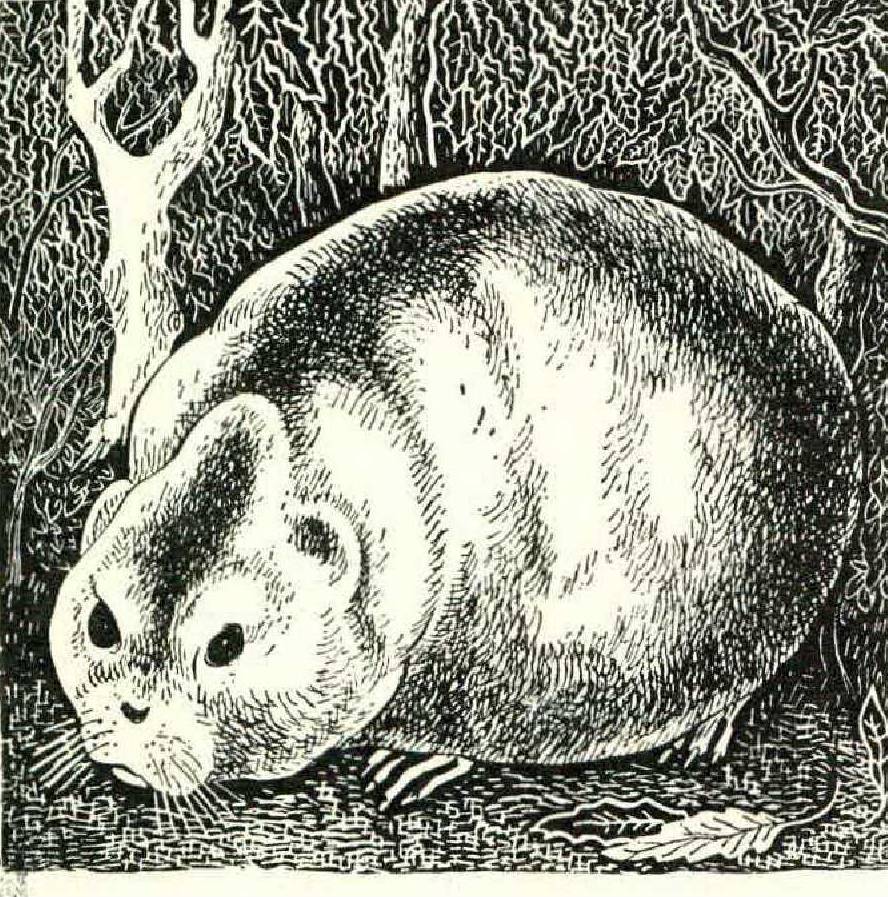
The next morning, however, when I met the lemming, was one of those warm, sunny mornings of the brief arctic summer when the mountains and the lakes doze in the heat, the birch and willow scrub buzz with a million man-eating mosquitoes, and the previous day’s storm seems an improbable memory. In the company of a scientific Swede called Gustafson, I was strolling down toward the lake from the solitary hut on the slopes of Akka, enjoying the sunshine and the quaintly mingled smells of the steam rising from my sodden anorak and the anti-mosquito jungle-oil with which we were both liberally smeared, when we spotted the lemming sitting in the scrub a yard or two away from the trail.
I was not formally introduced to the lemming, but I have since learned that his name was Lemmus Lemmus, of the family Microtinae. He was five inches long and covered with tawny yellow fur. He did not run away when he saw us, but backed up against a birch root and looked as fierce as he could, which was not very fierce. Lemmus Lemmus is rather like a vole, and is about as successful at looking fierce as a vole would be, except that a vole does not try.
We squatted down to look at Lemmus, slapping away the mosquitoes which were eating our knees through our trousers, while Lemmus looked fiercely back at us. He seemed a rational enough creature; and yet the lemming legend, Gustafson told me, is quite true. Lemmings breed very fast, and when there are too many of them for the amount of food they can find in the district, they all set off in their thousands to go somewhere eise. They make for the lower-lying land and the distant sea, and on the way they eat anything that is handy to be eaten, which is mostly stuff that the people of those parts would prefer to eat themselves. Lemmings are vegetarians so do not actually eat the cows; but the cows have to get along on what the lemmings leave.
The lemming horde is understandably unpopular. On its journey, which may take many months, it is attacked and set upon from all sides. Eagles and hawks and crows swoop down and treat the horde as a perambulating larder; reindeer, in the upper reaches, and cattle and goats lower down stamp around among it, obliterating whole companies and battalions of the army with their hoofs. Like all armies, it suffers from epidemic diseases, so that division after division is reduced to platoon strength by lemming fever.
Nevertheless, the lemmings move slowly but implacably on, undeterred by these disasters. When they encounter rivers or lakes they plunge unhesitatingly in and swim across. If a river is too swift, or a lake is too wide, the lemmings that choose to cross there are drowned by the thousands; but there are still plenty more. All the time they are having lemming babies, and by the time they reach the sea, despite the numbers lost, there are quite commonly more of them than when they set out.
There is something very human about lemmings. Once they get the idea that there is always a better place further down the road, it possesses them completely. Somewhere ahead there is the lemming paradise, a place where the grass is greener and the birch shoots are sweeter; where it is never necessary to munch the lichen off the rocks till the grass comes up again and the dwarf birches sprout new leaves in the spring. Inspired by this belief, they make their way onward and ever onward, with a devotion and selfsacrifice which would be called inhuman if it were not, only too recognizably, very human indeed.
My own lemming, Lemmus Lemmus, showed no signs of this idealistic madness. He seemed a quiet, amiable creature, contented with his lemming wife and his arctic-summer birch shoots. When we stopped staring at him so closely and retreated to a few yards’ distance, he ceased to back up against his birch root and went off into the scrub, where, stalking him cautiously, we watched him enter his cozy little nest in a tussock at the base of a desirable rock. Clearly it would only be when the idea, the cause, the great adventure, got hold of him, together with a certain hunger in his stomach, that he would set off with his fellow millions for the glorious if imaginary lemming paradise far away.
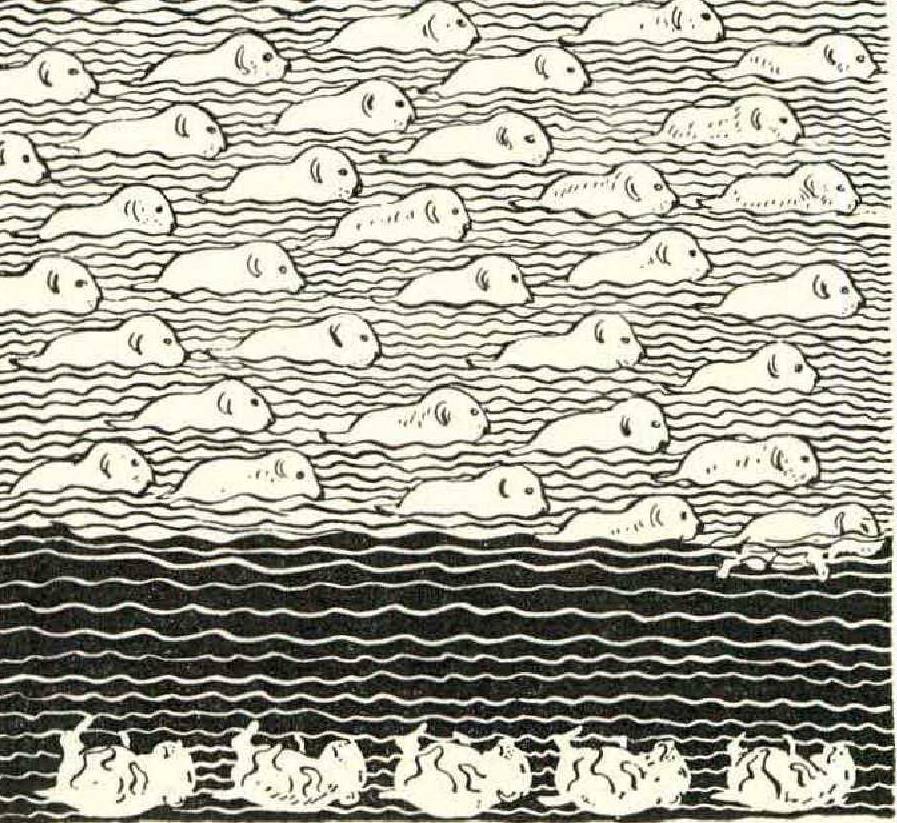
For the lemming’s idea never leaves him, once he has it. He does not, as the popular belief sometimes maintains, have any notion of mass suicide. He merely comes to another piece of water which is in his way.
Since he has not yet met perfection on this side of it, it must clearly lie on the other. He has crossed pieces of water before. So he plunges in, and swims. This piece of water, though, happens to be the Atlantic Ocean, or the Gulf of Bothnia, as the case may be; and when he gets tired of swimming, that is the end of Lemmus Lemmus.
Man, however, as the scientific Gustafson assured me, always makes sure before he sets out exactly where he is going and whether there is a reasonable chance of his getting there. I have sometimes wondered since whether Gustafson was not something of an optimist.