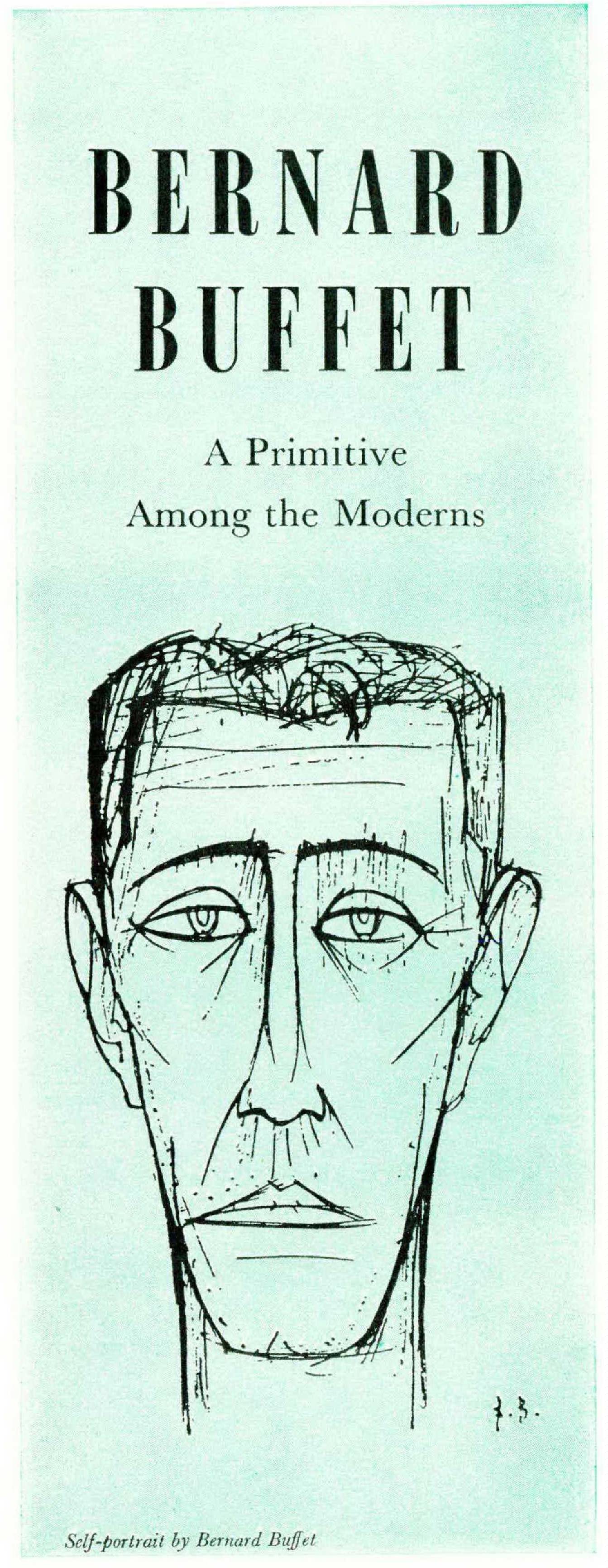
Bernard Buffet: A Primitive Among the Moderns
A firm believer in the traditional values that have been the glory of France, JEAN DUTOURD is the author of THE TAXIS OF THE MARNE, which was a recent best seller in the United States.
JEAN DUTOURD
I FIRST saw one of Buffet’s canvases some years ago at Manosque at the house of the writer Jean Giono. Buffet was a young man at the time (he is thirty today), and no one had heard of him. Though his pictures already displayed the characteristic traits which subsequently ensured his success, no one bought them. I do not remember exactly how Buffet and Giono got to know each other. All I know is that Buffet was as poor as a church mouse and that Giono, who is kindness and helpfulness personified, lent him for a few months a small house he owned in the neighborhood of Manosque. There Buffet painted dozens and dozens of canvases: landscapes, portraits, coffeepots, bottles, thistles, red herrings, and so on. In other words, he threw himself into that prodigious labor of production which every artist undertakes in his years of apprenticeship.
Giono, a great mind and a great writer, is also a man of simplicity and good humor, so that one respects him as a father and likes him as a pal. These are, at any rate, the feelings he inspires in me, his junior by thirty years, and I am certain that he inspires the same in Buffet, whom he understood, encouraged, and lodged at a time when this boy needed a powerful voice and a warm heart to convince him that he had talent and that he was on the right road.
Out of gratitude, and even more out of friendship, Buffet gave Giono several of the canvases he painted during his stay in Provence. I have seen these paintings many times. They are the work of a young man who was barely twenty years old, and they reveal a singularly precocious talent. What is striking in them, above all, is that — young as he was — Buffet had already found his style. He was no longer looking for it. I remember clearly my surprise and my joy when Giono, with a kind of paternal pride, showed me a large, rectangular still life containing three or four stiff objects, smoke-colored and arthritic. It was not pretty, but it was beautiful. It was the work of a sad, austere, I would almost say Jansenist, painter a painter gifted with a temperament exceptionally suited for a tragic period. Beyond this work of youth one could foresee a long procession of paintings, marking advances in inspiration and color; but the essential was already there, that is to say, a new sensibility in painting, an original representation of the world. I remember saying to Giono: “Your boy’s a bit scared of color, eh?” To which Giono replied: “Wait a bit. He’s starting to get bolder. Look — here’s a nice yellow. Right now he’s experimenting with red. A couple of years and you’ll see.”
These years have passed, and Buffet’s painting has grown considerably richer. He is famous. It is a tribute to French taste that it recognized a great painter in Buffet relatively quickly and that it rewarded him with an opulence which allows him to paint without cares or hindrances. He has now discovered color, which seemed to frighten him at the start of his career. He handles it better than any of his contemporaries do, but his strong and impeccable drawing does not suffer because of it.
BUFFET was born in 1928 into a modest Parisian family. His father seems to have taken no interest in him. The boy’s health was delicate and, as so often happens with young artists preoccupied with finding themselves, he was lonely and withdrawn. He had no friends, undoubtedly because youngboys do not provide much intellectual stimulus to a child who somehow feels that he has in himself a creative gift. On the other hand, he liked his mother, whom he resembled; a fragile woman much given to melancholy. Today, as wealthy as a prosperous industrialist, Buffet says things like this: “Outside of me the universe is painful, hostile, dangerous. I think that everyone must have this feeling.” A remark which would be meat for psychiatrists.
At the age of fifteen he was only in the ninth grade. This shows how much he liked schoolwork, which he evidently found useless for both his vocation and his future. The director of his lycée wrote his parents that it was pointless for him Lo continue his studies, for “young Bernard has no gifts, except perhaps for drawing.”
Madame Buffet, desiring above all her son’s happiness, let him enroll in the École des BeauxArts, despite the open horror which this establishment (even though it is conformist) inspires in the French petite bourgeoisie. Buffet’s talent for drawing immediately blossomed, but the school’s academicism brought him none of the great examples that his genius required. Just as young writers learn to write by tirelessly reading good authors, so young painters learn far more about their trade in museums than they do by listening to the advice of art teachers.
All disorder and anarchy in the realm of art, as in that of politics, end up by arousing a revolt, or let us say, a reaction. Buffet was violently thrust toward classicism — a natural reaction provoked in a strong, self-willed spirit by a spectacle of general incoherence. He has himself indicated the allies he chose in this battle against modern painting: Courbet, Carpaccio, and the Romanesque sculptors. This choice is judicious, as can be seen at once. Courbet and Carpaccio were great painters but not complete, unmatchable geniuses like Rembrandt or Raphael; they still leave something to discover for anyone wishing to study them. So too with the Romanesque sculptors, who mark a beginning rather than an accomplishment.
As a reflective and conscientious artist, Buffet rounded out his studies in museums with studies in the library of the Bcaux-Arts, which delighted him as much as his teachers disappointed him. “This library is a treasure,”he has said, “the most astonishing in the world for art and painting.” Library work, solitary and silent, was ready-made to please Buffet, lie was never more at ease than when “away from adults.”
If Buffet’s teachers at the Beaux-Arts were powerless to teach him what he expected of them (“often they don’t know how to draw,” he says), they were able at any rate to recognize his genius. The fact is surprising, but it is undeniable. Buffet exhibited at the Salon for Under-Thirty-YearOlds, then at the Salon of the Independents. He sold several canvases at prices ranging from ten to twenty thousand francs. The art dealer David offered him a contract. As a starter he bought ten of his paintings, for which he paid a total of fifteen thousand francs. After that, David advanced Buffet a monthly allowance of forty thousand francs (about $115). Today these sums seem ludicrous. But Buffet was unknown and penniless. This pittance represented a fortune.
In ten years Buffet has painted fifteen hunched canvases. Each of his paintings is now worth between one and two million francs, which makes a total of about two billion. This spring the Galerie Charpentier put on a retrospective show of one hundred Buffet paintings — an unheard-of event for a painter of his age. The day of the opening, eight thousand people, each of whom had paid one thousand francs to get in (or the equivalent of three movie tickets), trod all over one another in the elegant salons of the great Faubourg SaintHonoré gallery. Squads of policemen had to be mobilized to unravel the worst traffic jam seen in this quarter for years, even though the Elysee Palace, the residence of the President of the French Republic, is just across the street. A month later the entrance fee was down to three hundred francs, and the crowds were still queuing up on the Faubourg Saint-Honoré. An American friend I took there one Wednesday was dumfounded by the sight and remarked: “It’s only in Paris one sees things like this.”
Buffet has become one of the glories of France. Hardly a day passes without the papers speaking of him. His opinion is sought on every subject, from the collection unveiled by Dior’s successor to the war in Algeria. This year he has been asked to participate in the Cannes film festival. He owns a ducal château in which, clothed in torn overalls, he paints twelve hours a day. He has a Rolls-Royce for short outings, a chauffeur to drive it, and a couple of butlers to people his castle. All this, of course, enrages the bourgeois who refuse to admit that an artist can have talent unless he is starving in a garret.
IT IS admirable that, in the midst of the tired and vapid painting of his time in which, almost always, theories have replaced practice and doctrines inspiration, Buffet has appeared as a primitive, at once knowing and naive, nourished on old traditions and totally impervious to any kind of intellectualism. He holds an average of one exhibition a year and — this is something that has not been seen since the great painters of the past — he devotes it entirely to one subject: the horrors of war, Paris, the circus, or the life of Joan of Arc.
He is afraid of nothing. In our century of tiny apartments where, it was said, only easel paintings stood a chance of selling, he covers canvases as vast as Veronese’s. These canvases are full of human beings, trees, houses, objects, grouped according to the most tried and tested rules of composition. They contain no secret symbolism. They are content to describe the world as an intellect can reveal it and a hand can express it. Like the great painters of old, Buffet naïvely inscribes a title at the bottom of his paintings: The Coronation of Charles VII at Rheims or Descent from the Cross. This is a change, it must be said, from those thousands of smeared messes which we have been offered in contemplation for the last thirty years and for which the authors would be hard put to it to find any title other than Painting.
It is refreshing to hear Buffet talk about his art: it is a member of the French Institute of 1750 or 1820 who speaks and who expresses himself in the most reasonable, sensible, and least romantic language. This intrepid painter, who dishes out the fiercest reds and blues of modern painting in trowelfuls and who edges in his faces with lines as black as Hell, is a timid boy who defends himself with bashful smiles. But sometimes he manages to emerge from his reserve.
“By what standards do you judge painters and their works?” a journalist once asked him.
“By the drawing and composition,” Buffet replied. “Does a painter know how to draw a hand or a foot? No? Then let him start learning.
I refuse to confuse decorators and makers of bathroom mosaics with painters. The quality of a work lies first of all in its power of recognition. Real courage for a painter is not to surprise, but to communicate. Reference to the subject is the only way of judging talent, skill, and art. A painter who does not know how to draw a foot, a hand, a face has nothing to do with painting. If I paint boats on the sea, I want them to Boat.”
Buffet’s ideas on abstract art reflect the same triumphant common sense. “This kind of painting,” he says, “is based solely on relationships of colors. It turns its back on form. Something in it is missing. I feel that abstract art is a dead end. An effort was made to pass it off as the highest form of intellectual evolution. This is paradoxical, for tired intellectuals actually invented this haughty form. Abstraction is above all a return to infancy, a game played among initiates incapable of carrying the weight of real discipline.
“True abstraction,” says Buffet, “is in Rembrandt and Courbet. It is the power to signify more strongly than by exact representation; it is a certain quality which, from the picture of a beaten ox or a nude woman, conjures up a feeling surpassing not only the picture, the idea, but also the emotion that would be aroused by a real bull or a real woman.”
Among Buffet’s declarations I shall quote just one more, which is moving because of its evident sincerity: “I have known success. It has sometimes been thought exaggerated. The mistake made is in imagining that I have, even once, in order to obtain it, consented to betray the truth such as I feel and conceive it.”
It seems to me that this is the tone of a dedicated painter of inflexible honesty. The sole misfortune of Buffet, otherwise so fortunate, was to be born in a period of artistic decline. When he began painting, Bonnard was dead, Vuillard was dead, and his own genius was far too strong to be influenced by the delicate hands which remained.
In saying this, I make no exception for Picasso, that Gargantua of modern art. Picasso essentially is Voltaire turned painter; that is to say, a prolific, clever artist, knowing every trick of his trade. Voltaire wrote more than any other Frenchman: Picasso has painted more than any man in the world. Like Voltaire, Picasso is of staggering intelligence, he has ranged over every field of creation, his taste is exquisite and his art accomplished. But, like Voltaire, he has no heart and he is no poet, though he sincerely believes (and makes people believe) that he is. Picasso, in fact, will go down in history not as a finished painter like Rembrandt, Rubens, or even Cézanne, but as a journalist of painting. His work in sixty years constitutes a curious art sale catalogue. Goya, Gainsborough, Ingrès, Manet, Toulouse-Lautrec, Cézanne, Renoir, and so on parade before us. Now and then we come on an unusual canvas which resembles nothing: here Picasso is at last himself. But this painter is inferior to the others. Picasso has been imitated by no one because he has imitated everybody.
Buffet, furthermore, was initiated into painting at a time when Picasso, tired of imitating others, had taken to imitating and repeating himself. In the last few years several films of Picasso have been made. Those I have seen are devastating. They show us the great man reduced to facile puttering. The pyrotechnical creator of the first Cubist paintings, the charming artist of the blue period, the painter of cow-eyed Junos is here seen amusing himself making pottery for luxury shops, covering blank walls with childish drawings, and fashioning extravagant objects. Has Picasso perhaps reached the same point as Matisse, who painted such bad pictures in the last fifteen years of his life? The second-rate stuff which is exhibited at the Museum of Antibes and which represents, it seems, The Creation of the World, would lead one to fear it.
For a painter of Buffet’s intensely serious and tragic cast of mind, Picasso could offer little even if he had maintained a workshop for apprentices. Buffet thus lacked a master. He knows it better than anyone. One thinks; of what he might have become had he been privileged, like EI Greco, to be the pupil of Tintoretto. Instead of being a great classic painter, he will doubtless be no more than a great primitive. Like Cimabue, he must rediscover everything. But perhaps it has fallen to his lot to inaugurate a new phase in the history of painting. At the level of growth and achievement he has now reached, one can only hope that when he too becomes an old master, he may find a disciple as richly endowed as himself.