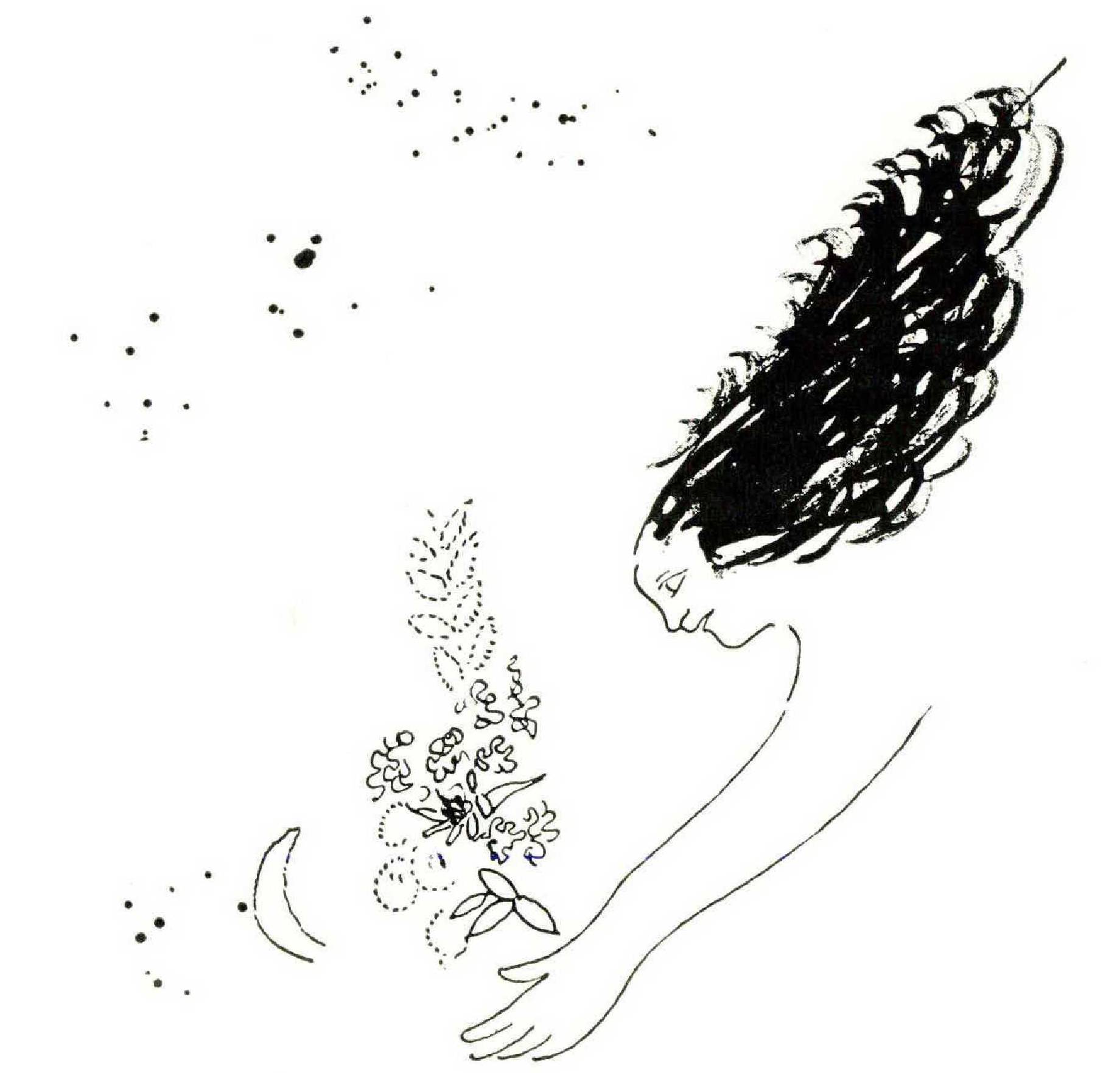
Color as Love: A Portrait of Chagall
CARLTON LAKE is the Paris art critic for the CHRISTIAN SCIENCE MONITOR, and since 1952 he has made his headquarters in a venerable Louis XIII house on the Ile St. Louis. When Marc Chagall returned this spring from his visit to the United States, Mr. Lake called on him at his home in Paris. The following article is the result.
BY CARLTON LAKE

CHAGALL is back in Paris — late, but back, finally — after his trip to America, and I am eager for a look at him. Not that he will have changed, but I want to chide him for missing his boat and our rendezvous with spring and the chestnut buds on our island. Too, I want to find out how America looked to him after an absence of ten years. Mostly, though, I just want to see Chagall. Ca fait da bien.
I walk out of my house, through the portecochere, onto the quai, turn left, pass the old cabaret where Charlotte Corday (according to a badly garbled island legend) picked up the knife with which she punctured Marat’s left lung, and stop in front of the massive studded door that leads to the courtyard of Chagall’s house.
Chagall’s concierge, more or less sober, sprawls in a chair just outside the entrance, the point from which he surveys daily the traffic along the Seine and soothes himself with dreams of his years in the merchant marine. He is chewing at his straggly mustache and scratching rhythmically at something underneath his shirt — a sure sign of spring. I step into the courtyard.
“He’s not there,” he calls out over his shoulder as I pass. Standard procedure.
“Bien sûr,” I tell him, “but I’ll wait.” I hear him mutter something involving the word foutre as I cross the cobblestones. I climb the grand stairway and ring Chagall’s bell. Madame Chagall opens the door. She has a softly dark, glowing Oriental beauty in her face and manner. Inside the apartment, a few suitcases stand open, halt unpacked. She apologizes for a disorder which is hardly apparent, and we pass through the hallway into the high, white, sparsely furnished salon. Chagall is writing at a long refectory table that stretches between the room’s two full-length windows. Flowers are everywhere, but the walls are bare except for two posters announcing exhibitions of his work in Paris and in Nice.
As we enter, Chagall jumps up and comes over to greet me. I think of Joseph Delteil’s observation: “Chagall appears and day breaks.” Chagall is thirty years older than he was when Delteil made the comparison, but it still holds. He has the lithe, springy step of radiant good health, and if his curls are a bit thinner and grayer now than they were when Delteil knew him, I’m sure his eye was not bluer nor his smile warmer then. Still, he doesn’t have quite the same bounce he had the day I bade him good-by in February.
“I’m tired,” he says. “Come sit down.” He cases back into a corner of a dark blue divan which is opposite his worktable, stretches his legs out onto the Persian runner in front of him, and yawns, “It’s terrible,” he says. “Americans are wonderful people — so goodhearted — but, my God, the parties, the receptions, the questions, the handshakes! I guess I met all my old friends — and at least five hundred new ones — but I’d be hard put to tell you all their names.
“In Chicago, at the University, the Committee on Social Thought had me take part in three round-table discussions on ‘Art and Life.’ I talk, then everybody asks questions, and I answer them. Or try to. They’d like to épingler you, just like a butterfly” — Chagall’s right arm lunges over at me as though I were his butterfly— “but I didn’t let them. I wanted them to think about what I said, worry about it a little afterwards, maybe, but not to spell it out for them, I hope they got something from it all.”
I told him I felt sure they got a good deal, in one way or another, from him; did he feel he got something from them, from America as a whole?
He sat up straight. “What do you think I am, a stick of wood? Of course I got much from America. I always did. It’s not up to me to say what or how. You know my work; you can tell me about that better than I can tell you. To me, America has always seemed a country of great lyricism, surging with a kind of spontaneous poetry. You feel it everywhere, welling up from under the surface. Does it show up in the work I did in America in the forties? You know better than I. All I know is that when I was there — when I went to Mexico to work on the ballet Aleko, for example —I sensed it very strongly, and I think the work I did then reflected it. Also, maybe, what I did for The Firebird, in New York. That lyricism, I mean.”
I said I agreed, but that I didn’t feel that lyricism anywhere else in his work more strongly than in the etchings he made, at Ambroise Vollard’s request, for the Bible, which Tériade has recently published here nearly twenty years after Chagall completed them. But that question of place interested me very much and I wanted to explore it a bit further with him.
His first great: illustrated book — Gogol’s Dead Souls — is twice a masterpiece: Chagall’s plates are as great as Gogol’s story. But they are specifically Russian, just as his autobiographical album Mein Leben, which Cassirer published in Berlin in 1923, is specifically the reflection of his Byelorussian birthplace, Vitebsk. The advance toward universality is enormous in the plates he made, between 1927 and 1930, for the Fables of La Fontaine, I told him.
“That’s what France did for me,” he interrupted me to say.
“When you got to the Bible, then, what was it that made that so much greater, even, than your interpretation of the Fables? Was it still France? Was it the two trips you made to Palestine?”
“Ah. Ah.” Chagall threw his head back and opened his eyes and his mouth wide — a characteristic geste with him when ideas begin to bubble, “Not really, no. It’s more a matter of time and growth; metaphysical distance, you might say. That’s more important than place. But most of all, it’s the book. It’s the book. The Bible has always gone very deep with me. My work is full ot it; you know that. Not symbolically, the waymany people seem to think. I don’t believe in symbolism. But it’s the most moving poetry in all recorded literature. For me it’s not a religious book, in the sense that most people conceive of religion. I’m not orthodox. I don’t believe in any organized religious form or activity, in a synagogue or anywhere else. I don’t say prayers or what pass for prayers with most people. But the poetry ol the Bible is deeply moving, and I’ve always been greatly affected by it. I call it divine poetry and let it go at that. It’s inside me, and when I paint, it comes out. You remember that poem Cendrars wrote about me? What’s the name of that book — something élastique?”
“Dix-neuf poemes elastiquesT I prompted him.
“That’s right. That’s right.” Chagall ran over to the bookshelves behind us, came back with a book, and opened up to Cendrars’ poem “Portrait” — his portrait:
Suddenly, he paints He takes a church and paints with a church He takes a cow and paints with a cow With a sardine With heads, hands, knives
And all at once it’s your portrait It’s you reader It’s me It’s him It’s his fiancée It’s the corner grocer it’s the cowherd The midwife
Christ He’s Christ He spent his childhood on the Cross He kills himself every day
Chagall closed the book and tossed it onto the low table in front of the divan. “There,” he said. “There you have it. It’s just that way. I can’t get away from it. It’s as close to me as the sky, I feel I’m in the midst of it all the time. You see?”
I asked him if he had any plans for illustrating the New Testament. (The plates he has made for the Bible are all drawn from the Old Testament.)
“Oh, I’ve got a long way to go before I get there. I’m still working on the Old Testament. There’s that ten-foot ceramic, The Crossing of the Red Sea, and the sculptured bas-reliefs I made for the baptistery of the church at Assy. And you’ve seen my Moses; that s just part of a sequence I’m planning. Then there’s the Song of Songs. I want to do something more with that. And the French government has asked me to do a twenty-loot stained-glass window for the Cathedral of Metz. I’m working on the maquette for it now. They’re all parts of a whole. For me, you understand, the New Testament is simply an extension of the Old; it’s not something different.”
Chagall sighed. “I work those things over and over,”he said. “It’s the mystical element that preoccupies me constantly. The aesthetic solution isn’t enough. I think the work Leger has done for the Church proves that. And Le Corbusier too. You can’t be too stark or cold. You can’t be brutal. You can’t go against the thought of the people who come there to pray or worship. On the other hand, you have to keep it pure and keep away from orthodoxy. I had them put a little plaque on what I did for them at Assy. It reads: ‘In the name of the freedom of all religions.’ ”
I asked Chagall if, when he works on a painting, he makes as many preparatory sketches — pen and ink, wash drawings, gouaches, and so on — as I know he did in preparing his etchings for the Bible and La Fontaine’s Fables.
“Yes, indeed,” he said. “That’s why I spend so many years on these things. 1 ake the Fall oj the Angel, in Basel, for example. 1 began work on it in 1922 and only finished it in 1947. I could do ten paintings a day, like some of the others, if I wanted to. It’s not that hard to paint and sign a picture. But there’s more to it than that. A true work ol art is a self-contained world, and the world wasn t made in a day. A woman doesn’t have a baby in a day. She prepares for it slowly and waits patiently and then, when nature says it s time, she finishes her work. I’m not much of a one for ‘finish’ in the slick sense. I don’t believe in the joli mot in art. I never drew a line in my life to please or amuse anybody. But I do believe things must arrive at their finish naturally and normally. Does that sound complex to you?”
Not at all, I told him. Very logical, in fact.
“Of course it’s logical,” he said. “1 don’t understand why writers have always talked about me as though I were an illogical artist creating an antilogical universe. I’m profoundly logical. And normal.”
I looked into Chagall’s eyes, and I understood that what he had just said was gospel. Logic may be personal, but it must be rigorous.
“No, I’ve always been for logic, but against realism,” he said.
“Against realism and for abstraction?” I countered.
Chagall sighed deeply and scratched his head. “Ecoutez, mon cher. That’s very complicated. People just don’t understand about abstraction. They think painters like Mondriaan are abstract. Not at all. Mondriaan just used a different brand of metaphor, that’s all. I’ve been against realism since I began painting: first in Russia, where the ‘best’ painters were a kind of hybrid formed of Impressionism and Bouguereau. Then, when I came to Paris, in 1910, the struggle was still goingon between the partisans of Courbet and the inheritors of the Impressionist tradition. But Impressionism itself, however much of a new departure it may have been in some respects, was, alter all, just a relaxed realism with blue shadows. And what is Cubism but the architecture of realism? I fought shy of it all. I was always looking for another reality — the real one — but it wasn’t until my return from America, in 1948, when I began to study Monet and the transparency of his pigment, that I was able to understand.”
Chagall got up and began to pace back and forth along the rug. “You have to realize this,” he said, stopping in front ol me. “As you grow older, you become more and more preoccupied with the matiere: pigment, color, whatever you want to call it. That’s the way it was with Rembrandt. That’s the way it was with Renoir. That’s what happened with me. I had gradually come to realize that color is all. And it was Monet who made me see it. But who understands color today? Practically nobody. Five people, maybe, living today, in the whole world.” He sat down again, on the edge of the divan. “Color, he said, “is two things. It is chemistry and it is love. Color as love is what so few understand. Rembrandt understood, which is why he was a great abstract painter. Mondriaan didn’t; he’s cold, dead. Gimabuc understood, Giotto, Titian, Goya even Courbet. But Monet best of all. In our time, at least.”
“What about the rest of the Impressionists?”
“But that’s the point: Monet was not an Impressionist. He’s not an ism, he s an event, a phenomenon. Beside him, Pissarro is dusty, Sisley is meager, Renoir — well, Renoir sings, but after Monet, his voice is a little fragile. No, Monet had the most brilliant gift of the. century, there’s no doubt of it. But, as I say, few people understand the real reason why, in spite of the lact that there seems to have developed a wholesale vogue for Monet, to the point where his son has hardly a scrap of canvas, however fragmentary or tentative, left to sell.”
I asked him if he saw color as love elsewhere in recent painting. ‘"Yes, in Gauguin,” he said, thoughtfully. “And then, of course, Bonnard. And there are others, too.”
“And right now?”
Who can tell? You may think your young son is very bright, but you can’t say that he’s a genius. It takes time and distance to know that.”
I asked him how he would define color as love.
“I don t know if you’ll understand it,” he said, “but I’ll tell you what it is. It’s Mozart, it’s Watleau, it’s children everywhere. It’s when you get down on your knees to make a declaration of love or to cry over someone very near to you who has died. Or when you pray, maybe, although I don’t pray like that. It’s what we need so badly in the world today, in every sphere beginning with the political. That’s color as love. But so few understand it. I’ve talked with many people I thought might see it, but they hardly ever do.
I’ve talked with Matisse about it, and Braque, but they didn’t sec it.”
“Picasso?” I asked.
“Oh.” Chagall shook his head. “You can’t talk with Picasso about things like that. He’s not serious. He just wants to make jokes.”
I ASKED him it he could tell me who are the live living today who understand color as love. He shrugged his shoulders and looked away. “Just a few poor malheureux. Suppose we call them ‘the possessed’ and let it go at that. But that’s what makes great abstract painting—great like Rembrandt.”
He turned back to me once again. “I have nothing against the current crop of abstractionists,’ he said. “I believe in full freedom for everybody, not just for myself. My only complaint is that they’re wrongly labeled. They’re not abstract painters; they couldn’t be more figurative. Cezanne started the great revolution in art. The new abstractionists claim they’re the new revolution. But what is it, really? Isn’t it just another kind of realism, in a new dress? Naturalism, even? They’re copying things we’re not used to seeing copied, that’s the main difference. They take a leaf and blow it up beyond all recognition, or a piece of wood” — he pointed to the graining of a new palette that lay on his table — “or the pattern of a rug, or a woman’s sexe. They copy the cracks in walls, the graffiti in public toilets, all kinds of accidental effects, like rain water in the gutter.” Chagall spat on his hand and held it out toward me. “They spit and then they study their spit under the microscope and copy carefully what they see. They copy it precisely but they magnify it, so that you don’t know what it is or where it came from. Some ol them go so far as to imitate caca and pipi. That’s all right with me; after all, in painting it’s results that count. But it should5 be understood that they’re imitating their subjects as slavishly as the old pompiers copied their nudes, with every fold of the skin and every mole in full relief. I hat s their business; not mine. But why not call it something like impressionnisme real isle? fn the end, what’s the difference between the old realism and the new? It’s a difference of scale, principally often with the use of a richer, more decorative palette.”
U as he thinking of anyone in particular?
“Oh, you know their names as well as I do. Besides, I have a great gift for forgetting things that don’t interest me. Took at tfiat plant over there. Chagall pointed to a rubber plant standing in front of one of the windows, “It’s perfect. You can’t reproduce that, because it’s authentic, and whatever you might reproduce of it couldn’t be.” He pointed to the flowers — red roses and carnations, yellow tulips and daisies — that filled one corner of the room. “Why should anybody wish to violate those by reproducing them?” he asked.
He went over to a console in the opposite corner and came back with a white marble abstract sculpture mounted on a burnished black plinth. It was the work of a very recognizable contemporary hand, currently showing in New York and Paris. He held the sculpture out to me. “He gave it to me,” he said, “but it’s moche — sculpture, base, and all. It’s no better than that” — he pointed to the fabric covering the divan — “or that" —a magazine cover in colors — “or that”
— a candy box on the low table in front of the divan. “It’s not authentic. Almost nothing is. We live in an age that promotes degradation.”
He returned the sculpture to its table. “Here’s beauty,” he said and held out to me a piece of wax-pale chalcedony, about the size of a hen’s egg.
It had been broken away from a larger piece, and the exposed inner surface, smooth but irregular, gave off a soft, warm glow in the afternoon sun.
“Do you think any sculptor could do anything with that that wouldn’t degrade it?” he asked. “And do you think you could reproduce it? You can’t reproduce nature. You can only expose your own nature, beside Cod, as authentically as you know how. You listen silently and that sacred power that is within you dictates and you obey, and that is what is called creation. The point is, art doesn’t set out to reproduce anything — whether a Roman gladiator or caca under the microscope. Two artists copy the same statues from the antique. One becomes Bouguereau; the other, Seurat.”
“Should we burn down the schools, then?”
“I wouldn’t go that far,” he said. “I was always a bad student, myself. Wherever I went to study formally, I soon realized they were doing me more harm than good, and I had to leave. If you have a gift, you have to uncover it with care and love, the way you polish the facets of a diamond. Of course, if what you have isn’t a diamond, it’s hardly worth the trouble of devoting a lifetime to uncovering it. So schools do serve a purpose, perhaps.
“Here — this will interest you.” He walked over to his worktable and came back with an envelope and handed it to me. It had been slit open, and it bore the superscription of the University of Glasgow. I took out the letter:
Dear Monsieur Chagall:
I am desired by the Senate of the University to invite you to receive at its hands the Honorary Degree of Doctor of Laws. I have much pleasure in conveying this invitation and hope to hear that you will accept it.
The Honorary Graduation ceremonies will be held on Wednesday 18 June. ... It may be useful to say that for the occasion of the ceremony itself the University will provide each graduand with the academic dress appropriate to his degree . . .
It was signed by the Clerk of the Senate. I congratulated Chagall. He smiled slyly. “Not bad for somebody who could never get by in school, no?”
The phone rings, loud and wild, Madame Chagall answers it and calls to Chagall. He leaves me. I get up and take another look at the white sculpture. Chagall is right: it’s moche, there’s no doubt about it. They both rejoin me. Chagall looks disturbed. “It’s that sacré ballet,” he says.
“What about it?” Madame Chagall asks.
“They want to know how it’s coming on, naturally. And it’s not—pour le. moment.”
I start for the door. I know that Chagall should be working on Ravel’s Daphnis et Chloé, not talking about it. And then there is the edition of Daphnis et Chloe he is illustrating with color lithographs and for which he has made two trips to Greece. When are we to talk about that? Not today, certainly. I reach the door. We shake hands.
“Come back soon,” Chagall says. “We’ll be leaving for the Midi in a week or so.”
Downstairs, the concierge is still in his chair, but no longer surveying the river traffic. His little granddaughter is playing in his lap, and he smiles and waves to me as I pass. Color as love. I begin to understand what Chagall meant.