Curnonsky: Prince of Gastronomes
Etcher, writer, and photographer, SAMUEL CHAMBERLAIN has lived for many years in France. Interested in French gastronomy ever since he was an ambulance driver with the French Army in World War I, he is the author of CLEMENTINE IN THE KITCHEN and BOUQUET DE FRANCE.
Curnonsky
BY SAMUEL CHAMBERLAIN
OBSERVANT diners in many Parisian restaurants today will see a small, discreet brass plaque fastened to the wall above the banquette. In the exclusive Chez Taillevent, near the Étoile, it appears over a choice seat by the window. In one of the best bistros in Paris, La Chope Danton on the Left Bank, it occupies an inconspicuous spot under the spiral staircase. In a hundred or more other restaurants it discreetly announces that this seat was once occupied by “Curnpnsky, Prince Liu des Gastronomes.”
To many people this will prove an introduction to the foremost French epicure of his day, a rotund, genial man with a gates-ajar collar, a twinkle in his eyes, and a prodigious gastronomic reputation. Restaurants vied with one another to wine and dine him. Dining clubs found Curnonsky’s presence essential if their banquets were to be a success. Writers of cookbooks felt that a preface by him meant the difference between success and failure.
The pseudonym of Curnonsky which this famous gourmand adopted leads to the false assumption that he was of Slavic origin, whereas he couldn’t have been more French. He was born Maurice-Edmond Sailland on October 12, 1872, in the historic city of Angers on the River Maine. His parents belonged to an old Royalist family dating back fifteen generations to 1427. Young Maurice-Edmond studied at the College Stanislas and the Institut Catholique, and showed an early ambition to become a journalist.
To assure the boy of a tranquil old age, his parents invested his inheritance in Panama and Russian loans, with the result that he reached his majority without a sou, and with absolutely no sense of worry about the future. He plunged into the journalistic whirlpool of Paris with gusto, writing articles for La Vie Parisienne and collaborating with Paul-Jean Toulet in the authorship of early volumes bearing the rather startling titles of Le Bréviaire des Courtisanes and Le Métier Amant. One is impressed by the self-assurance of these dashing young men, who also felt qualified, a year or so later, to publish a book called Demi-Veuve. In spite of his sudden sophistication, youthful Monsieur Sailland also wrote articles for a children’s magazine called Qui Lit Rit. The budding boulevardier met many celebrities in those early years. He interviewed Emile Zola, who asked him about his Polish-sounding name. He met Colette in her youth, and they remained lifelong friends. Being a Royalist sympathizer, he came to know Leon Daudet, another friendship which endured for decades.
The pen name of “Curnonsky” is the result of an exuberant, youthful impulse which he later regretted. At the age of eighteen he decided upon this Latin-Slav pen name composed of two Latin syllables, cur non (why not), and one Slavic flourish, sky, supposedly inspired by his admiration for Dostoevski. It might be translated as “Whynotski,”a name which seems quite fitting for the line-up of a Middle-Western football team.
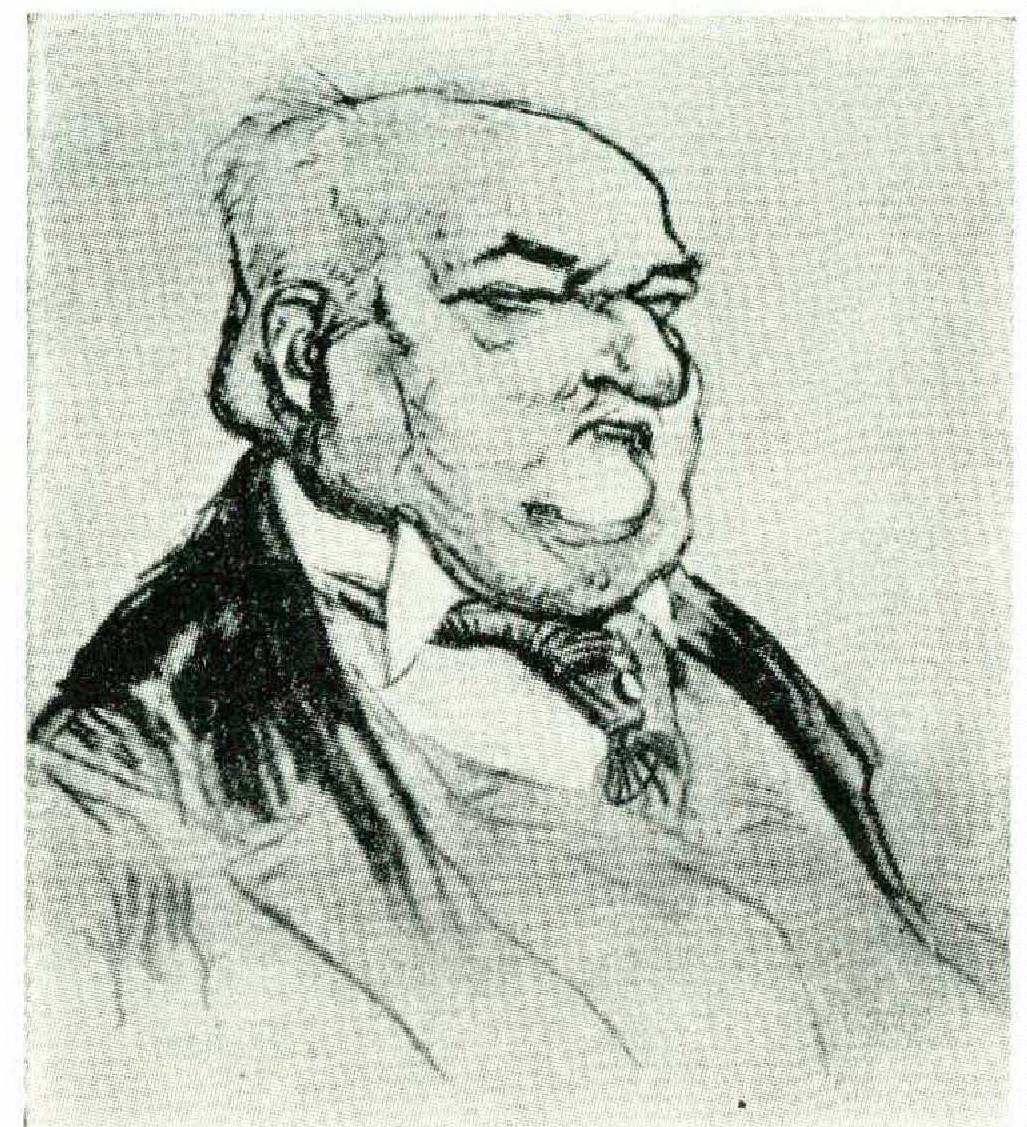
Drawing by Georges Villa, copyright Librairie Larousse
In later life the man from Angers found the name to be a confusing bore, a hybrid “as barbarous as ‘autocar’ or ‘aerobus,’ ” and worse, a name which led people to believe that he was either Russian or Polish when in reality he was a total, vociferous, almost xenophobic Frenchman. But by this time his literary career had been launched, and it was too late to change. Curnonsky he remained, though Sailland could have strangled him!
Curnonsky’s name caused him a good deal of trouble. At the outbreak of World War I he had a hard time escaping arrest as a “Russian spy in the pay of the Bulgarians.” Again, in Vienne, on the banks of the Rhone, he was mistaken for Léon Daudet, who had just escaped from the Sante prison by means of a famous telephone hoax, and Curnonsky was held for six hours in the police station. He made the mistake of producing two identity cards, one for each name, a phenomenon which the police found pas naturel. Luckily the victim had a friend in Vienne who cleared up the matter by telephone. Even luckier, this friend was dining at the time with the sous-préfet at the establishment of the most famous of all French restaurateurs, Fernand Point. The story ends as a Curnonsky story should — with the newly released suspect joining the superintendent of police to make a foursome at the table.
When Curnonsky’s name came up for the Legion of Honor, the Minister of Public Instruction, at the time Louis Barthou, looked up his dossier and found two police folders instead of one. The Sailland folder was in good shape, saying that he was a Royalist to be watched and that he dined nearly every week with the pretender to the title of Duc de Guise and other Royalist notables at a restaurant (presumably Voisin) on the Rue St. Roch.
But his Curnonsky folder was a sizzler: “Dangerous anarchist, without a fixed domicile since 1912. Took part in riots in the Latin Quarter in 1893; has frequented anarchist meetings and contributed to avant-garde pamphlets. . . . Relations tiès suspectes: has cohabited for two years, from 1904 to 1906, with la fille Sonuskaw, nihilist spy, disappeared since 1908. Has made many trips to Asia (China, Indochina, the Philippines) and to Spain, Switzerland, Belgium, and England. Too often absent.”
Louis Barthou, who knew Curnonsky’s true reputation well, remarked that the balance of these reports produced “an excellent liberal Republican" and promptly decorated him. Curnonsky admitted later that “my buttonhole still blushes from it!”
As HIS reputation as a boulevardier and humorist grew, Curnonsky wrote increasingly of gastronomy. He was one of the first writers to recognize and promote the liaison between good food and automobile travel. With this in mind he undertook a remarkable series of little books on La France Gastronomique in collaboration with a witty fellow with flowing hair, Marcel Rouff. There were twenty-eight of these small, paper-bound volumes, size 43/4 by 6 inches. The first one, which appeared in 1921 and cost three and a half francs, was devoted to that truffle-scented gamboling ground for the gastronome, Périgord. The whole series is now a rarity, and most of the booklets have become collectors’ items.
The two itinerant food tasters were carefree and debonair in those days. Curnonsky was in his plump middle age, untroubled by worrisome advice from his doctor. They covered the French countryside in a venerable automobile and were careful not to mention the mishaps which overtook them. In later years Curnonsky admitted to a total of twenty-three motor accidents! But they did give details about rural French restaurants and hotels, coupled with regional recipes and suggestions of specialties which would please the wandering “gastronomad,” a word of Curnonsky’s own coining. They also warned motorists of the coup de fusil, the unjustified overcharge that awaited unwary travelers in some “palaces.”
Curnonsky apparently agreed with Alexandre Dumas that “Ideas are like nails: the more you hammer, the deeper they go,” for he pounded away insistently on a few favorite themes throughout these little books and his later work as well. He pointed out repeatedly that there are four cuisines in France, not just one, each with rewards to the epicure: la haute cuisine, la cuisine regionale, la cuisine bourgeoise, la cuisine paysanne.
He wrote at length on the virtues of each, but never ceased to sound the trumpet for simple cooking, citing the great Escoffier, who, for all his complicated sauces and involved recipes, had this final word of advice to French cooks: “Faites simple!” Curnonsky, the veteran of more than four thousand banquets, was never happier than when seated before a dinner prepared by a French housewife, claiming that nothing equals the honest cooking in the home of a Breton fisherman, a Pyrenees farmer, or a vineyard tender in his native Anjou. “Her dinner is always delicious: a. good hot soup, two main dishes, a bit of cheese or fruit, a good wine of the country, and a hot cup of black coffee. Nothing can be better!” He championed the household classics: a simple gigot, a poule au riz, a pot-au-feu, or a cutlet cooked a point. “The best French cooking is here, where sauces prolong the taste of a dish without ever disguising it.”
PROFESSIONAL diner-out who rarely paid for a meal, Curnonsky sought the simplest Paris restaurants when he had a night off from banqueting. Very often he would go to an unostentatious place called the Restaurant Coutcau on the Avenue d’Orléans, now renamed the Avenue du Général Leclerc. It was here that I was introduced to the Prince of Gastronomes by Monsieur Couteau, the owner. This genial restaurateur, by the way, had quite a story behind him. His ancestors were butchers for Joan of Arc at Orléans, and took the name Coutcau centuries ago. But his restaurant has long since disappeared. Its heyday was in the twenties.
Monsieur Sailland (as he was called there) liked the Restaurant Coutcau for the perfection of its simple dishes. Here he could be certain of having his classic leg of lamb with Soissons beans, his blanquette de veau enriched with egg and cream, his thick tournedos with pommes pailles and grilled mushrooms. I have seen him there often, napkin tucked high in his waistcoat, waiting impatiently for his perfect dish. He had a particular affection for Monsieur Couteau’s Saint Jean-de-Braye, a red wine from the neighborhood of Orléans which, believe it or not, benefited from being iced. A wine bucket containing a cool carafe of this wine was the first thing to appear at his table. He had a horror of drinking water, and referred to himself as a “dedicated hydrophobe.” “I have an iron stomach, and water would surely rust it” was one of his often quoted sayings.
He was a portly man and wore amply tailored clothes which allowed a maximum of comfort. His wing collar had its gates far enough apart to allow plenty of space for his imposing double chin. His neck bulged pleasantly over the back of his collar as well. What hair he had bristled out behind like a thinning brush. The rosette of the Legion of Honor glistened in his lapel. His mustache was inconspicuous, and his eyes inclined to be half closed. But he had a look of beatitude, especially when dining upon one of his cherished plats simples.
The distinction which pleased him more than any other was bestowed upon him in 1927 when the newspaper Paris-Soir and a culinary magazine conducted a plebiscite among chefs, epicures, cordons bleus, hotel and restaurant men throughout France. As a result Curnonsky received more than three thousand votes and was awarded the title of “Prince Élu des Gastronomes.” He responded with enthusiasm and modesty, disclaiming any royal form of address except one: “Sa Rondeur — Your Plumpness!” But the title always appeared in his subsequent writings.
The next year Curnonsky founded l’Academie des Gastronomes, a group of forty of the most gifted connoisseurs of food and wine in France. He belonged to dozens of other dining clubs: Le Grand Perdreau (a publishers’ club), La Serviette au Cou, Les Amis de la Table, and was founder of the Diner du Quatorze and dean of the Anciens du Chez Maxim’s. His name was considered essential on the masthead of all gastronomic clubs but one. This was not open to him — the revered Club des Cent, which restricts its membership to amateur gourmands. Curnonsky definitely was an old pro.
During the late thirties the Prince Elect of Gastronomes made a second trip to the Orient. He spoke fondly of his travels “à tracers les deux mondes, sans compter le demi.” During his trip to China he met many epicures who readily agreed that there are but two cuisines in this world, French and Chinese. This was quite an admission from Curnonsky, who was almost violently patriotic on the question of national cookery. He never traveled to America but had such total contempt for American culinary achievements that his remarks are really embarrassing. His indignation flared especially high on the much debated subject of Homard a l’américaine. Is this the correct name for this famous lobster dish, or is it Homard a l’armoricaine, thus paying tribute to its Breton origin? (Actually, of course, the dish has much more the savor of Mediterranean Provence than of Brittany.)
THE Prince of Gastronomes, a dinner guest on countless occasions, had no facilities for repaying his hosts. He had neither a cook, a kitchen, a wine cellar, nor even a dining room. His apartment on the Square Henri-Bergson, near the Place Saint-Augustin, was modest. He was a lifelong bachelor, and gourmet clubs, restaurants, and literary societies considered it a rare privilege to have him as a guest. At banquets, seated at the head table, solemnly appraising the food and wine brought before him, he could always be counted upon for some Gallic witticisms, reminiscent reveries, and a few reverberating words on the glory of la cuisine française.
Though exact statistics are not available, close friends estimate that he sat through more than four thousand banquets in Paris and the provinces during his epicurean career. His engagement book was usually filled three months ahead, and every night he had a multicourse French dinner with a full complement of wines. All of these years of high dining were unable to ruin his digestive system. But they had an alarming effect on his waistline. At the age of sixty he achieved a fine rotundity of two hundred and seventy-seven pounds, and admitted that once he had almost touched three hundred. This was a bit uncomfortable, he admitted, but pointed out that nobody would take his gastronomic mission seriously if he looked like an emaciated fakir. Alexandre Dumas, after all, was dodu, and Rossini, the composer, didn’t see his feet for six years. Both were dedicated gourmands, as was Vidor Hugo, a “mighty and indiscriminate eater.”
The Prince was able to perform this prodigious feat of gastronomy by omitting luncheon completely and limiting himself to a small cup of black coffee for breakfast. Though his hours were irregular, he ordinarily had a late dinner, after which he wrote in the small hours of the morning and then slept between eight in the morning and three or four in the afternoon. He ascribed his robust good health to a reasonable indulgence in all excesses and a nonchalant scorn of all sports. He was boastful of the fact that he had never been seated on a horse or a bicycle. He had never played golf, tennis, or football, nor had he boxed, rowed, or learned to swim. “Doubtless my corpulence permits me to float, but not advance.” Strangely enough, he cared neither for hunting nor for fishing, but contented himself at being a passable champion at belote, the revered classic among café card games. But there is another side to the picture. He was a pioneer air passenger and a fanatic for automobile travel, the faster the better.
The restrictions that accompanied the outbreak of World War II put an immediate damper on Curnonsky’s professional career. By 1940 he confessed that “my plate threatens very soon to be as empty as my purse.” One of his most spirited forewords was prepared for a pathetic and courageous little paper-bound book published under German occupation in 1940 entitled La Cuisine d’Aujourd’hui. It was written by a fellow gastronome, Gaston Derys, and contained valuable ideas on how to make jams without sugar and mashed potato without milk or butter. There was no place for Curnonsky’s former dictum, “nothing replaces butter,” in this practical little volume for the wartime housewife in France. It was a period of discouragement for the thinning Angevin. He felt, as did Racine’s hero: “Grâce an del, mon malheur passe mon espérance.” Hs journalistic career suffered a total eclipse, and so, apparently, did his finances. Approaching seventy, he decided to leave Paris for the duration and to sit out the war in the solitude of a Breton village. But characteristically he chose his village carefully, settling upon the hamlet of Riec-sur-Belon in Finistère. The most famous citizen of Riec was Madame Mélanie Rouat, owner of a gracious little inn and known as the best cook in Brittany.
Here he stayed, quietly and anonymously, for the better part of six years. Reading matter was hard to come by in this remote village, but sets of the classics still remained on library shelves. Curnonsky reread his Racine and Moliere, wrote a few brief essays, and took ins one meal a day in company with his Breton hostess, a plump, benign woman crowned by a wonderful lace coif embellished with wide lavender ribbons. Fate decreed that Mélanie should abandon her casseroles, her inn, and her oyster beds only a few months before Curnonsky indulged in his last banquet. We know little of the women in Curnonsky’s life, although he once admitted to being married to “cent jolies filles” but the one who makes the best reading was the one most beyond reproach.
the war over, and his weight down to a trim one hundred and seventy-six pounds, le vieux Prince returned to Paris with much the same zest he had shown at the turn of the century. He founded two new magazines, La France à Table and Cuisine et Vins de France, both of which are Still prospering. He launched a new cookbook. Bans Plats, Bans Vins, filled with recipes from famous chefs from all over the country. He experienced not the slightest difficulty in collecting material for this fat volume. A request from Curnonsky was enough to start a flow of fabulous recipes from chefs everywhere. He emphasized the fact that he was an editor, not a cook. “I have too much respect for the culinary art to pose either as a chef or a cordon bleu. I have only been a fisher of pearls. Madame, but I think I can offer you a rather pretty necklace of them.”
By 1948 his pace seems to have slowed down, as he published a little book of literary sketches under the title of À Travers Mon Binocle. It was reminiscent and gay in spots, but the picture that passed before his binoculars was also a trifle melancholy. He called himself ”un Français moyen . . . et myope” and he worried about the world’s sadness.
But two years later, with a fine change of pace, he brought out La Table et L’Amour, a delicate treatise on the desirability of adding gastronomy to Cupid’s forces. There were tactful warnings about truffles, “great inspirers of tenderness,”and toward the end a wistful confession that “The joys of the table are those that remain to console us for the loss of other joys.”
For all his banqueting and his advancing years, le vieux Prince remained a tireless writer. For the Librairie Larousse he undertook the compilation of an ambitious cookbook bearing the same title as the magazine he founded — Cuisines et Vins de France. This richly illustrated volume of eight hundred and fifty-six pages, published in 1953 when Curnonsky was over eighty, ranks with the great works on gastronomy, a fitting climax to a prolific writing career.
During his nightly banquets the old gentleman put on as good a show as ever, but when he was off the scene he was often melancholy. One summer day in 1956, Maurice-Edmond Sailland, aged eighty-three years, enfeebled by dieting and uremia, accidentally toppled out of the window of his fourth-floor flat into the courtyard below. Thus in a few seconds the career of the genial Prince of Gastronomes and President of the Academy of French Humor came to a sudden end. Amid consternation and disbelief, countless friends came to the church of Saint-Augustin to bid farewell to a friend they considered imperishable.
Charles Monselet, the noted epicure of the early nineteenth century, wrote that “un gourmet est un être agréable au ciel,” an observation which leads one to hope that the gay and gallant Curnonsky has found his true reward, and a six-course dinner with appropriate wines, in heaven.