Fifty Years of French Fashions
An intimate friend of Gertrude Stein, ALICE B. TOKLAS still lives, surrounded by Picasso and Juan Gris paintings, in the old Left Hank apartment in Paris which they once inhabited together.
ALICE B. TOKLAS
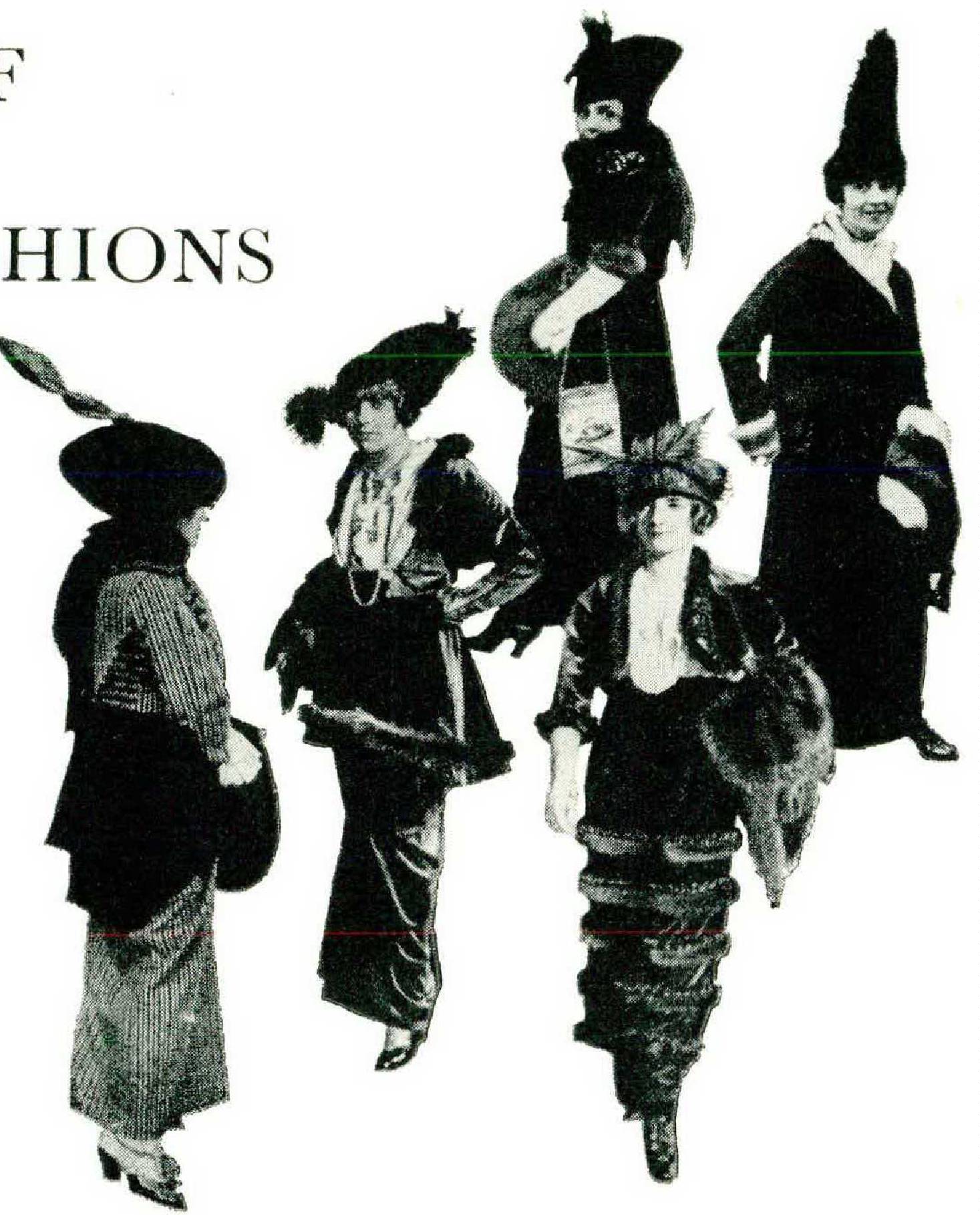
QUITE naturally haute couture commenced for me in Paris. I was nearly nine years old when my parents reached Paris on their way home from a European tour. My mother wasted no time, but went directly to Monsieur Worth to order the dresses, coats, and suits she was to take back to San Francisco with her. They opened my eyes, fired my imagination, and formed a standard for creative dressmaking. They did the same thing to my mother’s friends when she got home and wore the clothes. Spanish lace was draped by Monsieur Worth himself, held in place on the shoulder by paste buckles; the décolletage back and front was almost to the waist. My mother said that depended upon one’s anatomy.
In San Francisco there were several French dressmakers who went to Paris once or twice a year not only for the styles but for materials as well. One of them returned with sufficient white satin brocaded with large red roses for three dresses. One of these was made for a very handsome blonde debutante, another for the intellectual mistress of a magistrate and regent of the university, the third for a dashing young woman of dubious reputation. How could the dressmaker foresee that the dresses would all meet on the same night in the foyer of the Opera House?
When I came to Paris in 1907, Monsieur Worth and Les Soeurs Callot were the fashionable dressmakers and were guiding the haute couture in the direction in which they thought it should go. Monsieur Worth wished to keep the old fashion, with its elegant long trains and huge feather fans. The Soeurs Callot, on the other hand, believed in small embroideries and delicate colors. The results seemed less enticing to me than they had when I was a child. Modern paintings had entered my consciousness and couture, even haute, couture, was coming to have less and less meaning for me and less importance. Still, from time to time there would be a lovely creature whose intrinsic beauty was made more evident by the dress that she was wearing, especially designed for her.
During that period and until after World War I, it was the custom to design particularly for certain clients. Strictly speaking, there were no collections in those days. A few models were shown with the exclusive material made for that dressmaker. The designer was in the salon with his pencil and large pad to make drawings he considered suitable for his client.
This continued until the war of 1914 when Chanel, who never really became haute couture, emerged from her little shop of pull-overs and skirts to become a fashionable dressmaker. She launched a simple dress, belted, with short skirt, sleeves, and rounded collar. It required no subtleness to design and to wear. Poiret, who was an adventurous innovator and lover of novelty (he was one of the first to acclaim Josephine Baker when she appeared in Paris), took the diametrically opposite direction. He found his inspiration in the Levant, Persia, Asia, and China, in the divided skirt, in bright scarves with deep gold fringes and heavily brocaded silks. Just before the war he designed a very wide, very long mousseline scarf of a rich magenta hue, with a deep greengold fringe, for Picasso’s friend, Fernande Olivier, which he gave her as a gift. But Worth held last to his tradition, and ladies remained ladies.
NOT long after World War I the greatly gifted Madame Madeleine Vionnet came upon the scene. In her quiet, precise manner she sat on the floor of her workroom and cut, pinned, and sewed her tarlatan models, half the size of live models. These she would give to her seamstresses, who made the full-size models in the materials of her choice. No one was allowed to enter the workroom. Once when the American wife of a French prince appeared in the doorway, Madame V ionnet waved her away. Even for royalty she made no exceptions. Their measurements and coloring sufficed. She was enamored of texture as well as of color. One of her creations — a white sleeveless evening dress of mousseline with apple-green silk grapevines — was shown under glass at the Guimet Museum. The appliqué grapevines were so dispersed as to make a composition worthy of a great draftsman. Madame Vionnet has founded a museum of dresses, which is under the direction of the Beaux-Arts and to which other dressmakers have contributed.
At Pierre Balmain’s seasonal showing of models, it has been my privilege and pleasure to share with her the place of honor at the head of the room. She has by her perspicacious observations as the mannequins approach and turn taught me a great deal. All the points of elegance touch her —line, color, design, but above all the way material is used.
It was natural that when I first saw a collection of Balenciaga’s I should be seduced by its Spanish beauty, as I had been a generation earlier by things Spanish — Spain and Spaniards. Gertrude Stein used to say that I saw things clearly; that is, everything except Spain and Spaniards. Balenciaga’s collection was a reawakening of the ecstasy of that early love. The mannequins, as I was told later, were all French, but they wore their clothes and had the air of tragic gloom reminiscent of Juana la Loca.
Monsieur Balenciaga is a Basque from San Sebastián. Long ago we had spent a week in June at San Sebastian to cool off under the umbrella pines from the heat of Madrid. Balenciaga’s color, design, architecture come into being there on a very hot, early Sunday morning when a distant church bell is clanging. How otherwise explain the unexpected mysticism that suddenly makes a dress more real than reality? And this Balenciaga can do and does from time to time, as when he makes a Madrilena, who has held us enthralled, an even more beautiful grande dame. Indeed, his mannequins with their hair severely pulled back from the forehead and gathered together on the crown of the head with sprays of flowers or feathery material take on the bearing required to wear the dresses designed for them, and they approach the beauty, reserve, and dignity of the ladies of the Spanish capital. There are, of course, some French clients and even a few Americans who achieve this. Once, after the parade of the mannequins was over, I saw a plain and not too young compatriot completely transformed by stepping into one of Balenciaga’s dresses. I have had a delicately woven gray grass-cloth Balenciaga scarf with narrow gray lines since the early days of the Liberation, and it has become an object to treasure.
Some of the dressmakers have designed jewelry more suitable as objects to place on a table than to wear. There is in one of my closets a carved coral object, inspired by the dwarf gardens of Japan. It is neither jewelry nor garden. My three great dressmakers, Madame Vionnet, Balenciaga, and Balmain, have never indulged in such decorations, but not infrequently jewelers will lend them a few priceless gems to be worn with evening dresses.
Accessories are of importance — gloves, umbrellas, parasols, slippers, even fans. By their line and the manner in which they are carried, they emphasize the character of an original invention. Actually, taste and elegance are the basis of enduring fashion.
AT THE beginning of the German occupation in 1940, Gertrude Stein and I became acquainted with Pierre Balmain, and he quickly became one of our friends. He was then designing for Lucien Lelong.
Balmain’s first collection in September of 1945 was small but original. Two of the salient points of the time were noticeable: the tops of the sleeves were never trimmed, the free movement of the limbs was never impeded. Women consciously or unconsciously appreciated this. Not only were they comfortable in Balmain dresses, coats, and wraps, but they did not have to struggle to keep folds in place; sashes and trains stayed where they belonged. The entire garment had a life of its own. It asked nothing of you but to wear it graciously. More and more Pierre Balmain became interested in emphasizing the beauty of the female form as Manet and Renoir used it in their portraits of women — as a decoration and composition. As he became more impressed by their elegance and style, he designed dresses of striped silk and velvet of contrasting colors. With this new influence and the change of headdress, hats, and accessories, mannequins became living Manets and Renoirs. It is astonishing how women change physically to resemble the style of the moment.
When we went to that first collection, Gertrude Stein was wearing a tailored suit that Balmain had made for her, and I a garden dress he had made for me. (It is still obviously designed by a great couturier.) As we were going into the rooms where the collection was about to be shown, I said to Gertrude Stein: “Be sure you don’t tell anybody that we are wearing clothes made by Pierre Balmain. We look like gypsies.”
Later, during the winter, he made an imperial evening suit for Gertrude Stein of brown velvet heavily embroidered in jet, and a heavily embroidered jet cap from which a long tassel flowed.
The time had come, however, for Balmain to discard such excellent influences as those of Renoir and Manet and to turn to his own inspiration. He found himself through the use of embroidery and applique, first unostentatiously on the front of bodices, cuffs, and collars. Little by little, it became more elaborate. The embroidery was enhanced by sequins, by eighteenth-century ribbon embroidery, by ribbon, by small tassels, by beads, by tiny colored stones, spangles, and rhinestones. For these embroideries he drew his own designs, taken from historical models, at first from the Latin countries, then from Asian and even from Polynesian countries.
This decoration threw the emphasis on the line, which became simplified or complicated according to the inspiration of the moment, never interfering, however, with the free movement of the body, though the length of the steps might be reduced to a matter of inches. To emphasize the line he used stitched bands on wool, flowing scarves on silk, and finally artificial flowers and even ostrich feathers on evening dresses. None of these inventions was shocking, because, good Frenchman that he is, he remained ever in the tradition of the haute couture — even in this period of chaos. Sputniks are not his concern: the survival of the fittest in French haute couture is.
From what may be called the modern Balmain classics, he has permitted his imagination to stray in extravagantly designing costumes for fancydress balls, which were fashionable a few years ago in Paris, and for those in Venice, which were more international in character. But these are diversions; Pierre Balmain’s real concern is to continue to create haute couture. He told me that his greatest pleasure had been to find recently in Rome a client wearing a coat which he made for her two years previously and which had not become old-fashioned. It was beyond fashion.
Fashion is the best propaganda in which France indulges. For though France is accused of chauvinism, she is an indifferent propagandist. In wartime she is too occupied in defending her frontiers, or too overcome by the invasion of her country by the enemy. In peacetime she is too indifferent to what foreigners may be thinking of her. It is, however, a deep satisfaction to us Americans who know and love France to sec the way haute couture unconsciously has made friends for France in our country.
It is surprising how the fame of French haute couture has penetrated into the most unexpected crannies of America’s Middle West. A number of times in the last few years Americans employed in universities in the corn belt have written to ask me how they can sec French collections. Would this not help them to understand the artistic nature of one of France’s most creative activities? One wishes that the French Foreign Office or the couturiers would do something about this. Would this not be an aid to international peace, and who better than France could undertake this task? Has anyone ever heard of American or, for that matter, other women being interested in German or Russian haute couture?