The House of Gallimard
Born in 1922 GUY DUMUR is a young author and critic who has written, two novels and a book on the plays of Pirandello. A resident of Paris, he has had ample opportunity to observe the fortunes of the house of Gallimard from both the inside and the outside.
WHEN Hitler’s ambassador, Otto Abetz, arrived in Paris in the fateful summer of 1940, he made this celebrated remark: “To control France, one must control the Banque do France and the Nouvelle Revue Française.” It was a tribute to the fact that he was in a country where the power of the pen is no less awesome a social force than the power of the purse.
Controlling the purse, as it happened, proved to be an easier task for the German occupants than controlling the pen. For the Banque de France a few SS men were enough. But the Nouvelle Revue Française, or the N.R.F., as it is more familiarly known, was another matter. A French Fascist writer called Drieu La Rochelle, whose books Gallimard had published ever since the end of World War I, was eased into the editorial chair of the monthly review which for the preceding thirty years had effectively dominated the world of French letters. For two years Drieu La Rochelle sought to gather about him writers who had nothing in common with those who were in the “free zone” of Vichy or who had taken refuge in North Africa, England, and the Linked States. Then, when the Germans marched into Southern fFrance, the Nouvelle Revue ceased to appear, though the publishing company associated with it, which was still run by Gaston Gallimard and his staff, continued to function. Two years later Drieu La Rochelle, fearful of the fate awaiting him at the hands of France’s new masters, committed suicide.
The difficult war years proved, in effect, to be the crucible in which the post-war literature and thought of France were fired. While Abetz was talking of “possessing” the N.R.F., the Vichy government was accusing N.R.F. writers of being responsible for the debacle. To this accusation the aging Gide, who had left France for the North Africa of his youth, replied: “Were they held responsible for the victory of 1918?”
Behind this war of recriminations a new clandestine literature was silently growing up. From the sky the Royal Air Force kept raining down printed odes to liberty written by Louis Aragon (who was in the Vichy zone) and by Paul Éluard (who had remained in Paris). The former editor of the N.R.F., Jean Paulhan, whom Drieu La Rochelle had replaced, was arrested and imprisoned for editing a clandestine journal called Les Lettres Frarnçaises. But hardly a year later, in 1942, Gallimard published the first novel of Albert Camus, a young Resistance author destined to become famous. He had been recommended to Gallimard by a colonel of the Maquis, one Andre Malraux.
Thus, with the dawn of the Liberation in the summer of 1944, the N.R.F. publishing company, still directed by the brothers, sons, and nephews of the Gallimard family, emerged stronger than ever, even though its monthly review had been suppressed. It was, in fact, in the review’s old offices that Jean-Paul Sartre (himself a Gallimard author) edited the first number of his new magazine, Les Temps Modernes, with its famous Existentialist manifesto on la littérature engagèe -the literature of commitment. The star of Albert Camus, editor and chief editorialist of the newspaper Combat, was beginning to rise in the firmament. André Malraux, enthroned as Minister of National Education, was about to become the intellectual standard-bearer of the Gaullist party. Paul Valery, another Gallimard writer, was given a national funeral, and a little later André Gide received the Nobel Prize. The Paris theaters put on plays by Sartre, Camus, and Paul Claudel, the greatest French dramatist of this century. The Rue Hamelin, in the fashionable 16th arrondissernent, was given the new name of Marcel Proust, in honor of the famous writer who had lived there.
Thus, within a year or two of the end of hostilities, the Gallimards had reconstituted what can be called “the brain trust of French intelligence.”Living or dead, the authors and editors who had launched and sustained the N.R.F. appeared to have re-established their literary hegemony, and on an unprecedented scale, for. paradoxical as it may seem, it had taken the violent upheavals of the occupation —far more violent than the stresses of World War I — to bring to full light the almost secret forces representing all that was most intelligent in France. Thirty-five years had elapsed since the founding of the N.R.F., and yet the thousands of books which had been published in the famous white cover with its thin-lined borders and its black and red lettering had hitherto attained only a few thousand readers. For years, thanks to the N.R.F., Frenchmen had talked of the “divorce between literature and the public. The explanation of this phenomenon given by Jean Paulhan was simple: “There are bad books which everyone reads and good books that no one reads.” It went without saying that the N.R.F., under his direction, intended to continue publishing only the latter.
The literary historians of France perceived long ago that the history of French literature since 1910 has essentially been the history of the N.R.F., tor it has not only published the cream of modern French literature, but it has also presented the best of contemporary world literature to the French reading public. From the start, the writers who succeeded one another at the head of Gallimard strove ceaselessly to open its doors to important foreign authors. A good half ol the literary life of Valery Larbaud, today a model for many young authors, was devoted to foreign translations. Melville, Meredith, Dostoevski, Kafka, D. H. Lawrence, William Faulkner, Joseph Conrad, Thomas Mann, Dos Passos, Joyce, and Lorca are just a few of the influential foreign writers who were introduced to the French thanks to the efforts of men like Valery Larbaud, Gide, and Malraux — the Malraux of The Voices of Silence, who thirty years ago prefaced a work of Faulkner’s with the remark: “Sanctuary is the introduction of Greek tragedy into the detective novel.”
This world-wide aspect of their work deserves stressing all the more because the N.R.F. has sometimes been accused of constituting an esoteric “literary chapel.” In the nineteen-thirties a rightwing journalist named Henri Béraud unleashed a violent campaign against those he held up to public scorn as ”les longues figures” — those grim, long-faced authors whose names, he declared, connoted universal boredom. And who were they? They were Marcel Proust, Paul Valéry, André Gide, Jean Giraudoux, Valery Larbaud, Malraux, Claudel, and the surrealist poets Éluard, Aragon, and Andre Breton; all those who have made the French literature of the twentieth century as great as was its past.
THE prejudices against writers of lasting talent were, in their own way, an indirect tribute to the lofty standards maintained by those who had originally founded the N.R.F. in the years 19081910. For the N.R.F. had been founded in an almost deliberate effort to be, if not unpopular, at any rate unfashionable. Its authors had set out to break with the worldly literature of the period, with the amateurisme, academicism, and facile psychology of the successors of Emile Zola’s naturalism, typified by men like Paul Bourget, Octave Feuillet, and Anatole France. “The reign of art,” as one of the N.R.F.’s founders, the writer Jean Schlumberger, exclaimed in 1910, “demands the enslavement of the artist.”
In poetry the god of N.R.F.’s originators was Mallarmé, that anchorite of letters. In philosophy it was Nietzsche, rather than Bergson, while in literature it was the great French classic writers of the past. But above all, their aim was to afford a hearing to aspiring authors of their own generation. For the leading editors of the day were not interested in young writers. A young writer who was not content simply to satisfy the frivolous tastes of la belle époque, as France’s Edwardian age is called, could only get his works published by paying for them. Fortunately for the Nouvelle Revue Française there were writers at that time who were men of independent means and who could place their fortunes in the service of good literature. Such was the case with its two author - founders, Schlumberger and Gide, both of whom were the sons of rich Protestant families. And such was also the case with Gaston Gallimard, who at the age of seventy-seven still runs the publishing company he started fifty years ago.
Because he has never been an author, but only an editor, Gaston Gallimard’s story is less well known than that of the other literary luminaries who contributed to the early issues of the N.R.F. There is, indeed, little chance that he will ever write his memoirs. “Too much to say,”he explains with a smile whenever the subject is brought up.
Gaston’s father, Paul Gallimard, had inherited a sizable fortune. He was one of the very few Frenchmen who, at the end of the nineteenth century, had understood the real impact of the revolution then taking place in the world of art. He was a close friend of Manet, and he had bought some of the first Cezannes and Van Goghs, which no one else wanted. For one of the finest of these he had paid just three hundred francs (about sixty dollars at the time). He had also made a trip with Renoir to Spain, where they both discovered a painter then totally unknown: El Greco.

Renoir, in fact, was the family’s closest friend. With hardly a cent to his name, he used to take most of his meals with the Gallimards, and Gaston recalls once seeing him, in the heat of conversation— for Renoir was a brilliant talker — sculpt the pile of spinach in front of him as though it were a lump of clay. In the evening the Gallimard children, Gaston, Raymond, and Jacques, would be taken to the Théâtre des Variétés, which their father had bought, it was said, for a famous singer. Brought up in this Bohemian and luxurious milieu, Gaston seemed destined for a life of dilettantish ease, slowly squandering his father’s fortune by selling an occasional Renoir which, with the passage of time, would have allowed anyone to lead a more than comfortable life. At the age of twenty he idled away his time buying new ties or new books, riding in the Bois de Boulogne, and in the evening, going to the theater in order to write an occasional column of drama criticism for Robert de Flers, who was content to sign it.
Robert de Flers was the leader of a group of writers and men of the world who would dine at Larue or Maxim’s after the theater. Gaston would accompany them, and often, around two in the morning, he would see a strange person appear, clothed invariably in a fur coat. A man “with the chest of a mechanical toy” Jean Cocteau once described this asthmatic and snobbish chronicler of worldly happenings, whose name was Marcel Proust.
One day the young Gaston read a book which made a deep impression on him: The Immoralist of André Gide. He wrote the author, and they became friends. Like others of his age and generation, Gide had long felt the crying need for a review and a publishing house which would afford a hearing to young authors. The idea appealed to Gaston, and with Gide and Schlumbcrger, the three decided to launch a new monthly, the Nouvelle Revue Française, the first issue of which appeared in 1908. Two years later the three friends put up six thousand francs each out of their own pockets to start a publishing company, and the following year they managed to publish their first three books: Gide’s Isabelle, Paul Claudel’s L’Otage, and Charles-Louis Philippe’s La Mere et L’Enfant. The first of these was printed on a Belgian printing press, which now belongs to the Gallimards. It was such a sloppy job that Gide ordered all but a dozen copies destroyed, and these today are worth a fortune.
THUS the N.R.F. was born, around a team of ambitious writers which included, in addition to the founders, Giraudoux, Valery Larbaud, the poet Charles Péguy, and the producer Jacques Copeau. Copeau, who was to become the greatest French theater director of this century and the inspiration for Louis Jouvet, Jean-Louis Barrault, and Jean Vilar, was looking for a new theater, and it was Gaston who found one for him: the Athénée-Saint-Germain, on an old street bearing the picturesque name of Rue du Vieux Colombier — the street of the old dovecot. Gaston still likes to relate, with a twinkle in his eye, how when he took possession of the vacant hall, he was informed by the Paris Prefecture of Police that “for reasons of safety, the internal arrangements would not allow for stage-sets.” It was this restriction, according to Gaston, that gave rise to the new formula of dramatic austerity, which was destined to revolutionize the French theater, cluttered as it was with all the extravagances of lavish Edwardian spectacle.
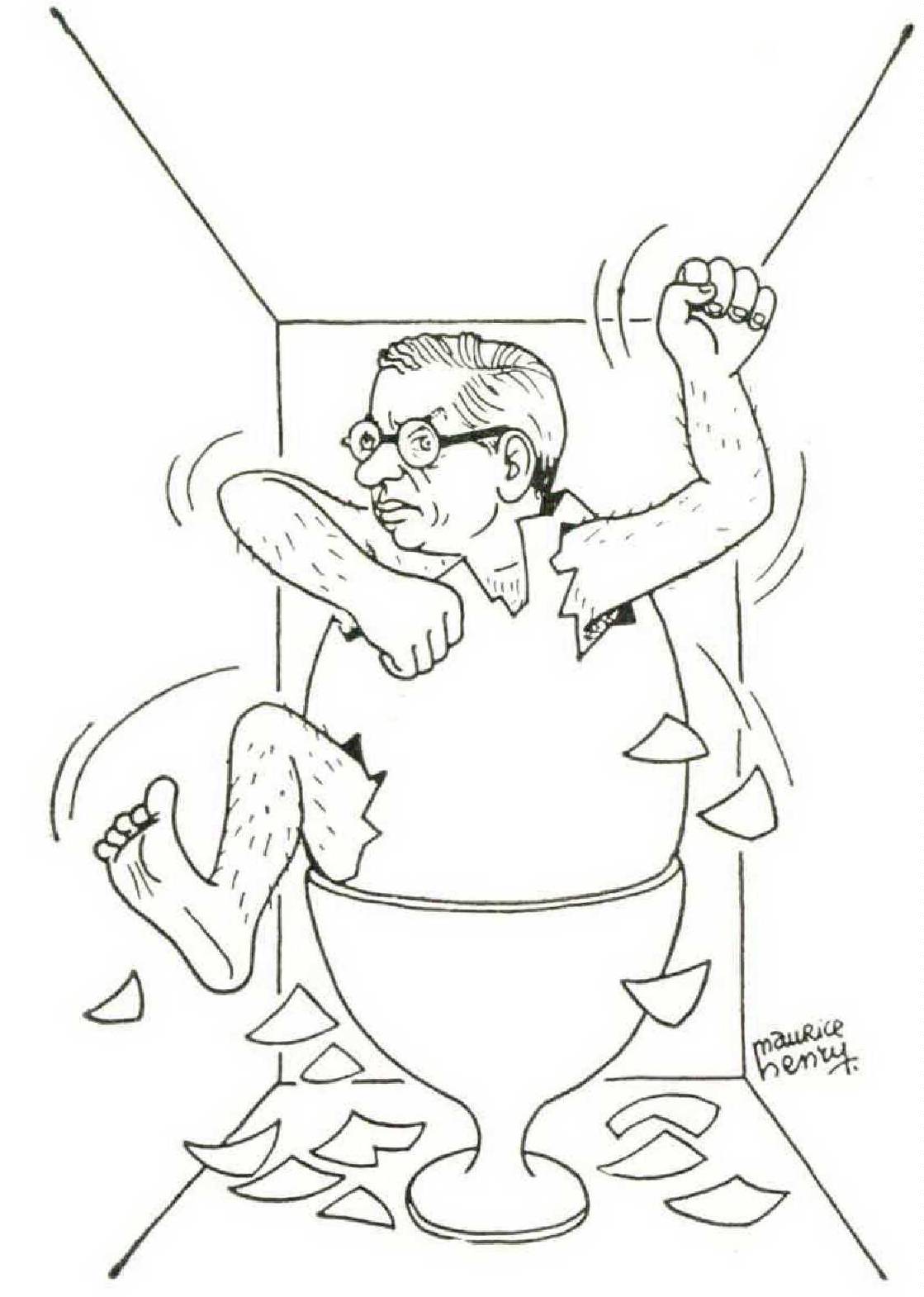
Be this as it may, Gaston lent his willing patronage to the struggle against the “baseness ol the contemporary theater.” As administrator of the Théâtre du Vieux Colombier, he set up his headquarters in a little corridor office, and through the glass window he kept one eye on the theater and the other on the publications of the N.R.F. The progress was slow but steady, thanks in large part to his own diligence in running after manuscripts and to his offer to publish “free of charge” the works of men like Valery Larbaud and Roger Martin Du Gard (a future Nobel Prize winner), who had spent small fortunes getting their first manuscripts into print. It was Gaston who thought of collecting the scattered poems of Paul Valéry into one volume — an idea which had never occurred to their author. It was also he who, for ten years, kept urging Paul Valery to write La Jeune Parque (published in 1917), one of the most epoch-making French poems to have been written in this century.
The almost puritanical zeal of his readers, the most important of whom was Gide, was, however, soon to get the N.R.F. into trouble in an incident which has remained famous. In 1913 a manuscript entitled Du Cote de Chez Swann was submitted to Gide for his critical appraisal. Gide, who knew of Proust only as a ubiquitous salon snob and as a writer of light prose in Figaro that is to say, as the incarnation of all the vacuous literature of the boulevards that Gide and his associates were bent on combating — leafed through Swann with a casual eye and sent it back to its author. Proust, who could get it published nowhere else, took it to Bernard Grasset and had to pay heavily to get him to print a first edition, limited to eleven hundred copies. Their appearance eventually sufficed to arouse Gide’s colleagues from their complacency and to make them realize that a frightful error had been made. Gaston went to call on the night owl of Maxim’s and talked Proust into letting him buy up all of Grasset’s published copies of the first two volumes of À la Recherche du Temps Perdu. Hiring a fiacre, he went down to the printer s and bought every copy he could lay his hands on (about eight hundred) for 2.70 francs apiece. Filling the cab with them, he returned in triumph to the small office he occupied not far from Saint Germain des Prés. Here he hastily had all the Grasset covers removed, replacing them with new ones of the N.R.F. The success of Swann was immense, and from all over Paris bibliophiles descended on Grasset, ready to pay for the old covers in their weight in gold. To satisfy the demand, Grasset s manager did not hesitate to have a whole set of new covers printed up, which he sold at fancy prices.
This incident proved a turning point in Gaston Gallimard’s career with the N.R.F. That year (1916) he was confronted with serious financial difficulties, and to keep the review and the book business going, he was forced to borrow from abroad and to set up a corporation. It was “a few Grasset covers” for the first edition of Du Côté de Chez Swann, he likes to say, which kept him from remaining sole master in his own house.
The war of 1914, in which Alain-Fournicr, Charles Péguy, and Guillaume Apollinaire were killed, had scattered many French authors. During that period, Gaston Gallimard had gone to the United States with Copeau’s Vieux Colombier theater group on a trip financed by the banker Otto Kahn. They landed the day the Bolshevik revolution broke out. On returning to France after the armistice, Gaston realized that the N.R.F. was not simply a small literary circle, but a publishing venture which needed to be sustained and expanded.
This created new financial problems. Paul Gallimard’s Renoirs and Cézannes had long ago been sold. But one day a private detective called on Gaston and offered to sell him a small crime weekly. With a true businessman’s flair, Gaston bought it. It was not long before Detective, as the weekly was called, was bringing in enough money to finance the publication of the works of the surrealist poets, whom Gaston had immediately adopted at the urging of his two principal advisers, Jacques Rivière and Jean Paulhan.
Along with the surrealists, a new generation of writers of action, led by Paul Morand, Drieu La Rochelle, Montherlant, and André Malraux, appeared on the scene. It was Gaston Gallimard who put up the money for Malraux’s expedition to the jungles of Cambodia, where he claimed there were abandoned Khmer temples to be rescued. He found them all right, and cut away whole sections of jungle-covered bas-reliefs with a metal hack saw, only to be arrested and sentenced to prison for trying to make off with state property. In die end he never served the sentence, but the black mark entered against his name in his judicial record almost kept him, twenty years later, from becoming a cabinet minister.
From then on almost every author of talent was sooner or later adopted by the enterprising Gaston. With a canny business sense he did not hesitate to print best sellers, but at the same time the N.R.F.’s review and literary departments clung tenaciously to their high standards and insisted on publishing works which might take ten, fifteen, or twenty years to reach a wide audience. It was, for example, the French translation of Gone with the Wind, which was still selling a hundred copies a day a couple of years ago. which financed the publication of the poems of Henri Michaux and Jules Supervielle and the strange confessions of Marcel Jouhandeau. Every year some new genius would be added. In 1929 it was a young aviator named Antoine de Saint-Exupery. In 1938 it was a young professor of philosophy named Sartre; in 1942 a young native of Algiers called Camus.
SHORTLY before the war Gide, who had a mania for stuffing his pockets with books when embarking on trips, came to Gaston with a suggestion made to him by Jacques Schiffrin. The idea was to put out a collection of the classics on thin, onion-skin paper, like the one which Collins had made famous in England. The result was the Collection de la Pléiade which —to cite just one example — was able to compress all of Shakespeare into just two volumes. This innovation has proved a boon in an age when living space has become increasingly cramped and scarce, and it explains the fact that though each Pléiade volume is relatively expensive (costing around three thousand francs each, or about seven dollars), Andre Gide’s Journal alone has sold 200,000 copies in this edition.
Incredible as it may sound, it is not the detective novels of the famous Série Noire which are now the financial mainstay of Gallimard, but the Pléiade editions, Malraux’s books on art (translated into a score of languages), and the General Encyclopedia, whose first six volumes have already appeared under the editorship of Raymond Queneau, the most caustic novelist in the Gallimard household.
Running this vast literary empire now requires the attention of no less than four Gallimards, while two adjacent town houses, one with an entrance on the Rue Sébastien-Bottin and the other on the Rue de l’Université, barely suffice to house its two hundred employees. At their head is a committee of readers who, with the exception of the Gallimards, are all authors in their own right. It is probably the most brilliant group of literary censors in the world. Here, in a labyrinth of converted salons, winding corridors, and sudden staircases, every degree of political and artistic tendency meets and clashes. In the entrance hall of the Rue Sebastien-Bottin, next to an austere waiting room with fluorescent lights, the Communist poet Aragon may bump into Jean Cocteau, clothed, with Bohemian dandyism, in a navy bluejacket lined with red satin. Jean-Paul Sartre will try to avoid Albert Camus, whose rise, Gaston Gallimard claims, is the fastest he has ever known. Anxious young authors await the decisive verdict of Jean Paulhan, the editor of the review, who receives them with Olympian maliciousness in an office walled with deforming mirrors and Dubuffet paintings.
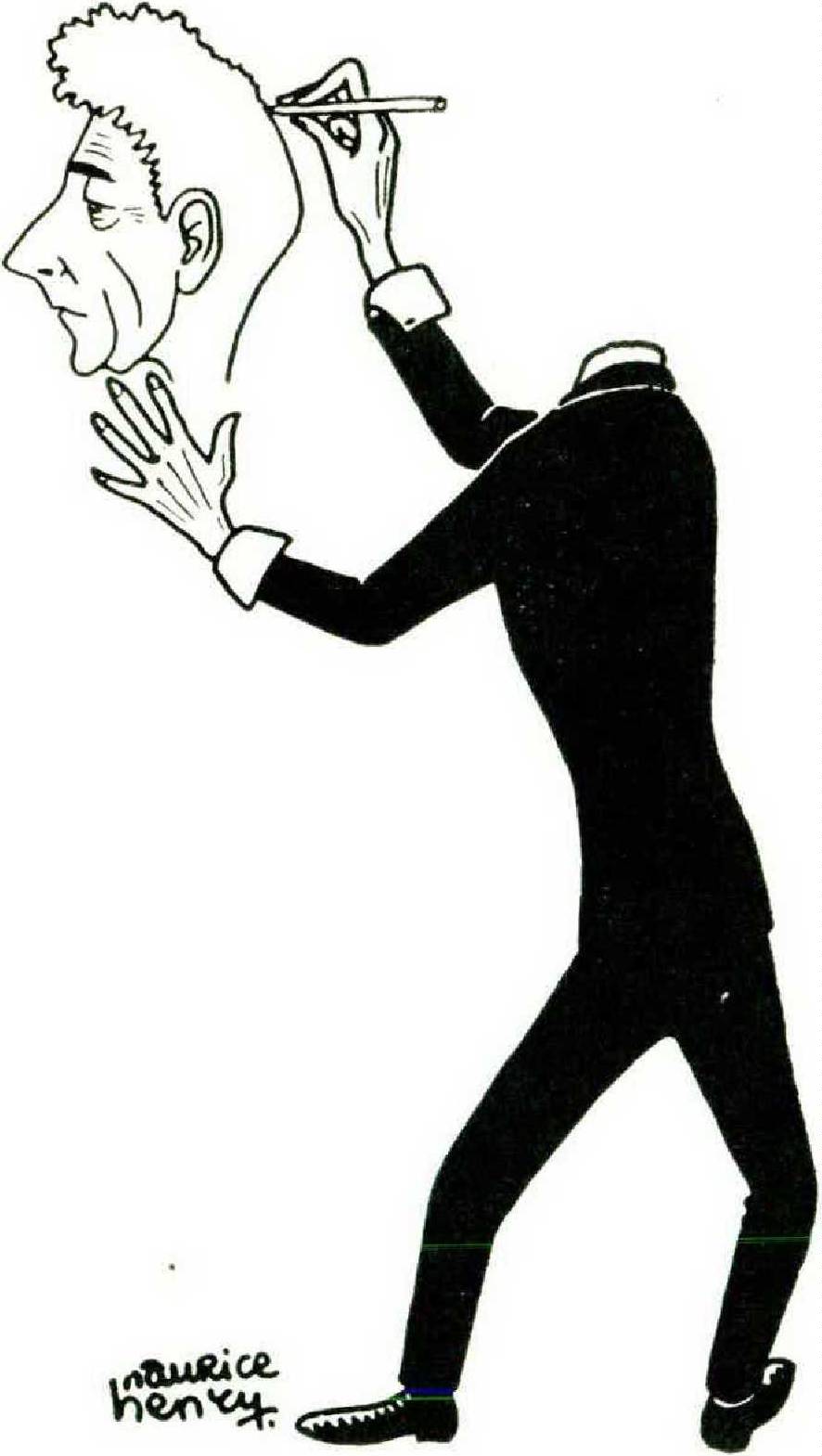
Known as the eminence grise of French literature, Paulhan has been a force in the N.R.F. for thirty years. His influence is widespread, his friendships are famous, but no one pretends to know him. A great friend of the painters Braque and Dubuffet, he often invites writers to his house to play pingpong, bowls, or dominoes. He is frequently the butt of jokes on account of his thin, high-pitched voice, but it comes not from any affectation but from the fact that he was gassed in World War I. He has the reputation of being a playboy, but he was one of the few French writers to have been arrested by the Gestapo, His bons mots are legendary, and the hatreds he arouses inextinguishable. Only recently some young writers had a post card printed up which they sent around to their friends. One side of it contained nothing but the words: “Jean Paulhan does not exist.”Paulhan, however, was flattered by this delicate attention. “This has never been said except of God and myself,” was his characteristic retort.
Next to his office in the rambling town house on the Rue Sébastien-Bottin is a large, oval salon looking out over a lovely eighteenth-century garden. This is the inner sanctum, where the Gallimards work at two different desks: Gaston and his son Claude, Raymond and his son Michel. Like persons of royal blood, they are addressed by their first names, and sometimes, when unpaid authors grow too impatient and importuning over the telephone, they beat a skillful retreat behind their namesakes and explain that it is not they, but their brother, their uncle, their cousin, or their father to whom the complaint should be addressed. Inseparable companions all of them, they buy the same kind of country houses, boats, and automobiles. Gaston, however, who has always remained a bit of a Bohemian, still lives among half-opened crates of books in the old family apartment building near the Gare Saint-Lazare. He, who at the age of twenty was bent on doing nothing, is surprised today at the extent of his own labors. Though the hair on his handsome head has turned a venerable white, he still retains an astounding vitality and visits his office every day. The one notable defect, perhaps, in a gentleman of exquisite courtesy and rare elegance is a trait that one might expect in a young editor: he cannot stand the idea of an author of talent being published by anyone but himself. It was thus with a sense of ironic amusement that he accepted an invitation in March to serve as best man at the marriage of Françoise Sagan, the international best seller whose works he has not published. He knows better than anyone that the hypercritical readers’ committee who constitute his high command at the N.R.F. would probably have rejected Bonjour Tristesse, if it had been offered them, as not being good enough.
Despite Gallimard’s commercial power, despite its impressive collection of Nobel laureates and Prix Goncourt winners, despite its galaxy of twentieth-century classics, this is the great challenge now facing it: how to preserve that spirit of curiosity, innovation, and adventure which marked the early years of the N,R.F. Editing fiftyvolume encyclopedias or financing new translations of the Bible and the Thousand and One Nights. as has been done recently, is not enough to make aspiring authors feel at home in the great literary factory that the house of Gallimard has become. Even the huge sales assured by a noisy publicity and the award of important literary prizes (the latest Prix Goncourt winner, Roger Vailland’s La Loi, has sold 300,000 copies) are not enough to dazzle conscientious authors, whose greatest joy is to know that their works have been read and approved by Gallimard’s formidable brain trust.
Years ago, when André Gide wrote his famous letter asking Proust’s forgiveness for his casual rejection of Swann, Proust answered him: “I sent my manuscript to the N.R.F. because I thought it was the only way of getting it read by you.”Nothing could better express the ideal relationship which should exist between Gallimard and aspiring young authors; but inevitably it raises the question whether our age is still capable of finding and launching new Prousts and new Gides.