Paint an Elephant
Artist and writer, VINTON LIDDELL PICKENS recently spent two years on the island of Ceylon sketching and painting. In January the Ceylon Embassy sponsored a showing of her oils and water colors at the Franz Bader Gallery in Washington.
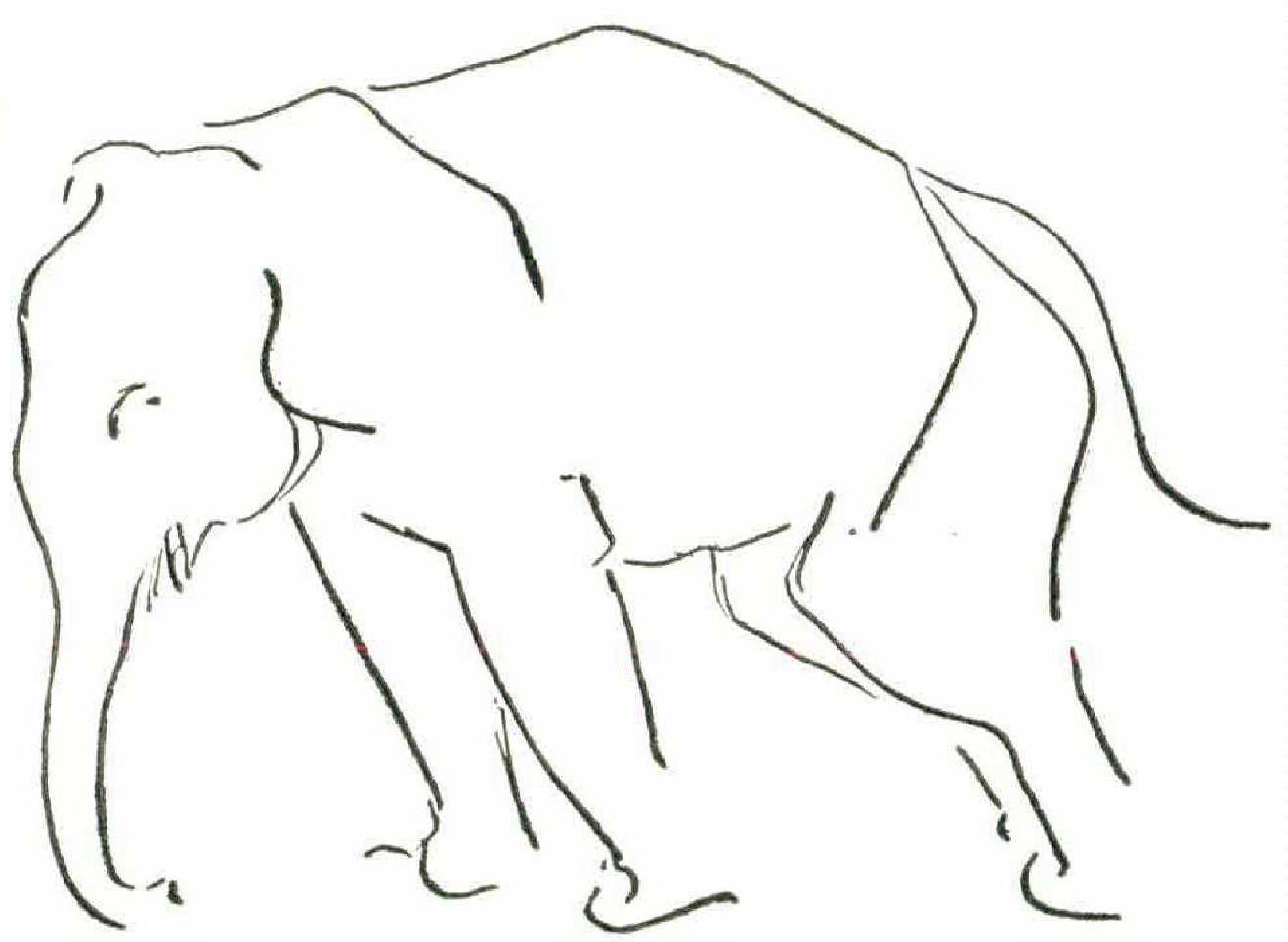
WE HAD gone back to Ceylon for a second winter so that I could paint elephants, and were in Akuressa because it was the nearest place to the Dediyagala sawmill where elephants worked. Seeing elephants at the Dehiwela Zoo on our first trip had shown me their value as subjects for painting. A canvas can be organized to include other animals — elephants organize the canvas. An elephant is a mass, a form, an area of color in himself. Only the bison approaches him in sculptural quality. He was worth traveling to Ceylon to know, well worth going there to paint.
Most Americans, familiar with him only in zoos or circuses, would not name as his salient characteristic either his protective coloring or the arboreal quality of his motion. They consider him as slate gray or, in circuses, dust colored. Dust color, of course, varies widely, even in the United States. Elsewhere excited people frequently report sighting white, red, or yellow elephants, but none have actually been found. To get rid of insects, elephants spray themselves with sand gathered up by their trunks and so unintentionally disguise themselves, but the hide is invariably the neutral, allreflecting gray. As to the arboreal motion, in nontropical zoos the nearest trees are likely to be oak or maple or even Norway spruce — stiff, northern trees scarcely bending to the wind at all, not primarily suggestive of any movement. Perhaps even in Ceylon only a painter or sculptor would be struck by the similarity of the elephant’s curving trunk and the taller curve of the trunk of the palm tree, or by the resemblance to the swaying palm fronds in the lithe roll of the elephant’s walk. These are secondary impressions, but anyone would notice at once the shifting reflections of jungle hues on the so-called gray skin.
Read any book on elephant hunting in either Asia or Africa for references to the big beast’s invisibility under his native foliage. His hide carries the warm colors of sun and leaves. Nature has protected him almost as fully as the chameleon.
He stands, never quite still, in vegetation of lightly stirring, sinuous forms. He takes on the colors of his surroundings, but in Ceylon he has one color that never changes. In Ceylon his trunk, his long, wiggly nose, is salmon pink and freckled. Otherwise, but for slighter build and stature, he is like the elephants of India. Naturalists may know the significance of this trunk coloring. To painters it is interesting because the pink color of the elephant himself is found repeated in the light upon the palm trees and, especially, on the rubber trees.
Painting abroad holds traps for the unwary. The painter must continually ask himself, Will this be a good picture or merely a record of sights now new to me? If he can paint good pictures in one place, he can paint them in another. Travel adds interest to his work only if his sense of the varying light quality from one area of the earth to another brings into play a recognition of new conditions that inspires new uses of color. The elephant in the Bronx and the elephant in Colombo demonstrate fully the meaning of difference in light quality. The Colombo elephant may be twin to the one in New York, but the air in which he moves transforms him. He is part of the shadow, light, color, and motion of the tropics. Black and white can scarcely suggest him.
Each country (not meaning nation) has its own “clue color.” Skies are everywhere a sort of blue, leaves a sort of green. It is the sort that counts, and it is the clue color that determines the sort. Amédeé Ozenfant once remarked that one cannot paint in France without using cobalt —le bleu de France. In Ceylon there is no cobalt. The Indian Ocean, far more turquoise than ultramarine, lacks entirely the warm, rich azure of the Mediterranean. At Colombo the sea beyond the breakers often resembles an expanse of cool, solid jade. The landscape itself is by contrast warm and rich in color, varying from deep, subdued tones to brilliant, depending on location and season. Viridian, that jack-of-all-trades for Western greens, is too blue for Ceylon, except for occasional use in sky color. The Ceylon yellows are warm; there is much burnt sienna and some vermilion amid the yellowgreen. In coconut groves the burnt sienna is often the clue color, even when as little of it shows on the canvas as on the palm trees themselves. Whatever the clue color, the elephant fits right into the scene.
Few painters have thought much about elephants. In Indian art their appearance is incidental, and in Western art — well, few village geniuses could get their start sketching elephants.
An elephant appears in a small drawing in Rembrandt’s House in Amsterdam. One wonders where he saw it. No doubt some forerunner of the modern circus was touring the Netherlands. Elephants had been objects of interest in Europe ever since Hannibal’s war elephants scared the Romans. They are probably occasionally visible in large battle paintings. Another elephant appears — at least part of an elephant - in a church fresco in San Miguel de Allende in Mexico, serving as a symbol accompanying an also symbolic figure of Temblanza (moderation). These are the only elephants I can recall seeing in art in my Western travels. No doubt there are many more, but the proportion is small compared to the numbers of asses, horses, dogs, or even lions and camels in American and European galleries. How different if one of the Three Wise Men had ridden an elephant instead of a camel! But the Three Kings “out of the East” were not Eastern enough. They were camel men.
Few Westerners even now see elephants at their provocative best. To do so involves sacrificing a disproportionate amount of Western-style comfort. An elephant near a de luxe hotel is necessarily in captivity, and the elephant in captivity, poor thing, is not himself.
By captivity I mean in cages. A domesticated elephant has a different mien from a wild one, but he is a beast of purpose. He meets and solves problems. He does not stand all day in a pen, and the difference shows. His routine involves the occasional unexpected. One can never be quite sure what he is going to do.
At Dediyagala — which you will not find on the map, because it is only a sawmill in the jungle above Akuressa — the elephant could be seen as the best expression of animal power at man ‘s command, and it was hard to know where elephant intelligence ended and man’s took over. It was not hard to realize, after only a little study, that the seemingly ignorant elephant boys — mahouts in India and Ceylon, oozies in Burma — had to know more than the most accomplished horseman.
Even the amateur of riding is familiar, under one name or another, with the “aids.” Press with the left knee, horse bears to the right; press with the right knee, horse to the left. Even people who do not ride know what “bridle-wise” means. An elephant is trained to a comparable, though far more complicated, pressure system. The illiterate boy on his shoulders must know not only the location of all points where a touch of the goad will bring response but the exact amount of pressure with which the goad may be applied. In certain spots firm pressure of the goad immobilizes the elephant; deep pressure kills him. The goad must be handled like a surgical instrument.
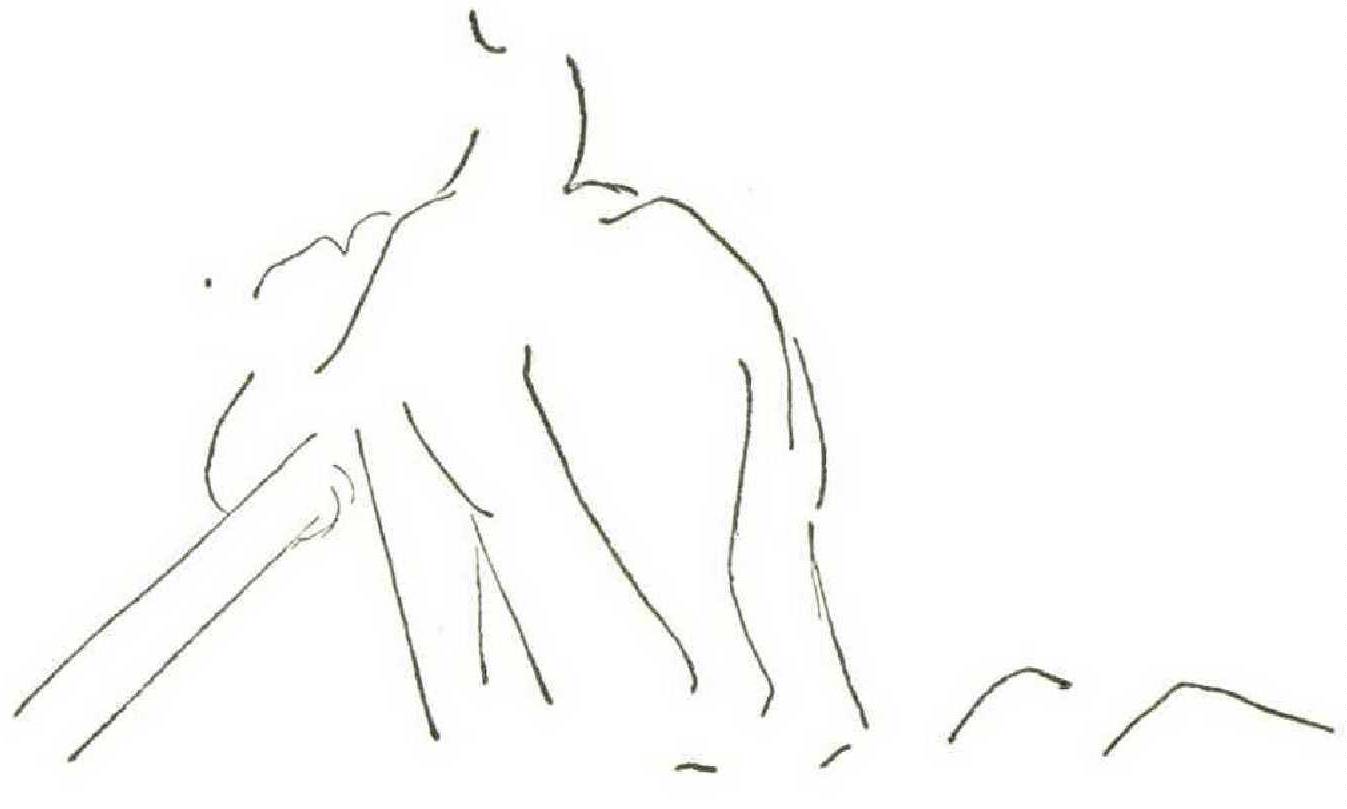
Old palm-leaf manuscripts describe the nila (nerve centers) and what pressure on each of them will make an elephant do. Divide the posterior margin of the ear into two, the manuscript says. This gives three nerve centers for enforcing obedience. In mounting an elephant, one seizes the obedience nilé of the ear tip with one hand, presses a shoulder nile with the other, a foot nilé with one foot, a leg nilé with the other foot, and mounts. Once up, one can press a nilé in the cheek to make the elephant run. Should he bolt, there is a nerve center in his neck to use in stopping him. Even handier information: To make a wild elephant kneel, prod the nerve center at the ankle under the Vambidi. (Remember this if attacked.) I do not know how many nerve centers a modern mahout must know, but Dr. Paul Dereniyagala, in his book on elephants, lists eighty-six with their uses.
That centuries of study have resulted in skillful control of the earth’s greatest beast does not mean that the beast is an automaton. Literature and history—even leaving out the great religious legend the Muslims celebrate on the Day of the Elephant — are filled with proofs that elephants are sagacious. Countless books give well-established proofs of their profound likes and dislikes. It is not always well to read these books. One of them caused my only uneasiness at Dediyagala.
FROM Akuressa we drove every morning to the sawmill, following a road that ended there. Even leaving the resthouse after breakfast, we had ample time on arrival to set up easels, get out paints, and do some work before the elephants returned. The elephants had already climbed to the highest ridges, where the trees were being felled. They came down to the sawmill, following a stream bed, around eleven o’clock. We painted during the hottest part of the day.
From ten days at Dediyagala, working from three to four hours a day, I brought back two 24by 36-inch paintings, one 24 by 30, and one 20 by 24. They were not sketches to be worked up later; they were paintings. Because the time between the elephants’ arrival and their nearly complete disappearance under water for bathing was in each case less than twenty minutes, and no elephant was ever made to stand still or repeat an action for me, my system of work may interest other painters.
After deciding where in my landscape I wanted an elephant doing what, I indicated his place on the canvas by a color of approximately the proper tone. This was done before the first elephant came into view on the trail. The minute he was there, I dropped my brushes and reached for my ink sketch pad. From then until the last of the eleven had dragged in his log, unloaded it at the sawmill, and had his bath, I did nothing but pen sketches. I did them one after another, scarcely looking at the paper at all and with no thought of the future elephant in the painting. Among the twenty-five or thirty resulting sketches were always several I could use. With the elephants still before me lolling in the stream or standing in it munching the palm fronds brought daily from the low country — by truck, incidentally —and my mind still intent on all that they had just been doing, I worked from memory, with the aid of selected sketches, to paint the needed elephants where the canvas called for them. This is a radically different procedure from reconstructive painting in the studio from stale sketches.
Dediyagala painting was hot work. Too far inland for sea breezes, not high enough for the coolness of altitude, the sawmill stood, in its piles of pink and gold sawdust, in a deep valley no moving air could reach. The most intense painting period began at the time when, in Colombo or even Nuwara Eliya, people knocked off for lunch and a siesta. We usually started home about one o’clock, sweaty and exhausted.
One day I had set up my easel in an unusual position, downstream from the sawmill, where I could paint the elephants dragging the great pink logs up the sawdust-covered banks. The elephants on that day were rather more upstream than usual, except for one, who placidly chewed his palm fronds about forty feet from me. I had paid no attention to the boy who lingered near him, although all the other boys, their elephants carefully scrubbed, were now scrubbing themselves. Not until our driver, Appuhamy, who usually stayed at the road with the car, came down the hill toward me did I pay attention to anything but my painting. I had not seen the nearby elephant boy signal to another, who had in turn signaled to another to call Appuhamy.
Appuhamy speaks quite good English — so far as it goes. It does not go into detail. Appuhamy said, “This boy thinks you better go. That is a bad elephant.”
I had just finished reading Elephant Bill. I recalled very well that bad elephants are as rare as bad horses, but I also recalled circumstances in which even good elephants became fractious. They were irritable when tired from heavy exertion; the elephant in question had dragged logs all day. They were often startled by unusual sights; the sight of me in slacks, shirt, and sun-visor headdress startled even my husband. I recalled the incident in Elephant Bill in which Colonel Williams’ head oozie apologized thus for his elephants’ unsatisfactory behavior, “What could you expect? There were dogs and horses and white women there.”
At least I had no dogs or horses with me. Watching the elephant in thoroughgoing uneasiness, I gently — oh, so gently and quietly! — folded up the easel and packed the paints in the aluminum sketch box. Appuhamy took both of these. Turning the canvas — it was one of the large ones — so that the brown underside was toward the elephant, I said as calmly as possible that I was ready to leave. Appuhamy seemed unconcerned. He led the way across the narrow space between the almost perpendicular mountainside and the stream. The elephant boy smiled cheerfully as we passed, and the elephant kept on chewing palm fronds.
“He is all right when the boy is there,” said Appuhamy, a little late with his reassurance.
The elephant that really bothered me was a very gentle one. His rider desperately wanted not only to be in every painting but to have special portraits made of himself and his mount. In the sawdust the elephants were even more soundless than usual, and a sudden black trunk swinging inches from my face wrecked several ideas for masterpieces. Above the trunk and fanning ears was always a grinning, beseeching human face. The obvious friendly intent of both man and beast counteracted the initial shock, but an unexpected elephant is startling.
Understanding elephants is a lifetime affair, but even superficial knowledge of them is interesting. What pride I experienced at Akuressa in correctly surmising that the one kept at the resthouse was not like the others I knew! He came from the north of Ceylon and had noticeably longer legs. He seemed as different from the others as a Morgan from a thoroughbred.
Knowing horses under saddle and in harness, and seeing how differently they move from horses running loose in a field, I can gauge the difference between elephants at Dediyagala and wild elephants. It must be greater than that between zoo elephants and work elephants. Had dock strikes not altered shipping schedules, I might already know the difference at firsthand, but we had to leave for home without carrying out all our plans.
On my next application for a passport, how will “to paint wild elephants” look as “purpose of trip”? However it looks, that will be my only possible honest answer.