The Mounties at Fort Walsh
It is the West of Remington and Charles Russell which fires the imagination of WALLACE STEGNER,who as a very young boy lived in a rough and unregenerate hamlet in Saskalchewan. Novelist and short-story writer, Mr. Stegner is professor of English and director of the Creative Writing Center at Stanford University.
BY
WALLACE STEGNER
ONE of the things we forget about the frontier experience is that it was likely to be discontinuous. On the High Plains and in the Rockies, for instance, the men who made the fur frontier were seldom around to adapt to the cattle and horse ranches and the mining camps that followed, and the cowboys in turn were not often the fathers of the homesteaders who succeeded them, but another breed. And so families which, like mine, came in the last wave to file on wheatland or to provide the services for new towns were cheated of a past just as surely as hunter and cowboy were cheated of a future.
That is why the Old Timers’ Association of Maple Creek, Saskatchewan, on the edge of the Cypress Hills where I spent my boyhood, did the present a real service when in 1942 they planted historical markers at old Fort Walsh, on Battle Creek, and at the long-vanished trading post known as Farwell’s, and at the site of a bloody battle between some Montana wolfers and the Assiniboin braves of Chief Little Soldier in 1873. That “Cypress Hills Massacre,” so called, focused the eyes of all of Canada on the lawlessness of the western plains, and brought on the decisions that very shortly changed the course of western Canadian history. The entire character of that history after 1873 is very different from that of the American West, primarily because of the Royal North-West Mounted Police, whose headquarters from 1878 to 1883 was at Fort Walsh, a few miles from my home town. In a real sense this was the capital of the last frontier.
I wish I could have known it early, that it could have come to me with the smell of life about it instead of the smell of books, for there was the stuff of an epic there, and still is for the man who knows it right. Fort Walsh saw its last act; this was where the irreconcilables gathered in hope of a last stand, where the last hope flickered out for Cree and Assiniboin and Blackfoot, who belonged here, and for Sioux and Nez Percé and Gros Ventre, who had fled here across the Medicine Line pursuing safety and the last of the buffalo. A way of life, savage but rich in satisfactions both physical and spiritual, came to an end in these hills; from Fort Walsh a hundred-odd red-coated men patrolled its final agonies. Only a few years after all was over for the Indians, the métis, who lived by the same skills and were partly shaped by the same culture, broke out in their own last throes, and that could be another epic. All this was legitimately mine, I walked that earth, but not a whisper of any of it was known to me or to anyone I knew.
I wish I had seen the pictures (they existed) of Fort Walsh’s log stockade with its inward-facing buildings, officers’ and non-coms’ quarters, powder magazine, blacksmith and carpenter shop, kitchen, bakery, stable, guardroom, and quartermaster’s store, all whitewashed clean and shining under the jack-pine hills. I wish I had seen the Union Jack obeying the prairie wind from a tall pole, and heard the commands of drill and parade in the compound, and seen the spit and polish of the post emerge in full-dress parades in red coats, white helmets, pipe-clayed buckskin breeches, glittering boots. When a champion was prepared, his supporters sometimes carried him across the parade ground to keep him from getting a wrinkle or a dust fleck on him.
We were not informed in school that the first graces of Saskatchewan civilization appeared at Fort Walsh: amateur theatricals, pets, music, sports. The first play, Dick Turpin, was acted by constables who had been out on patrol to pick up Four Jack Bob for manhandling an Indian and who barely had time to throw Bob in the guardhouse and get into costume before the curtain. The pets were young antelope, baby buffalo, a Canada goose who alerted the guard whenever men tried to sneak in late from a pass and who finally made the mistake of chasing an Indian dog, which killed him. The music was provided by men from F Troop, transferred from Calgary after Fort Walsh was made the headquarters of the force in 1878; the band died a riotous death when its members, celebrating a British victory in Afghanistan, on the other side of the world, were betrayed by Commissioner MacLeod’s special issue of grog and began beaning one another with the instruments.
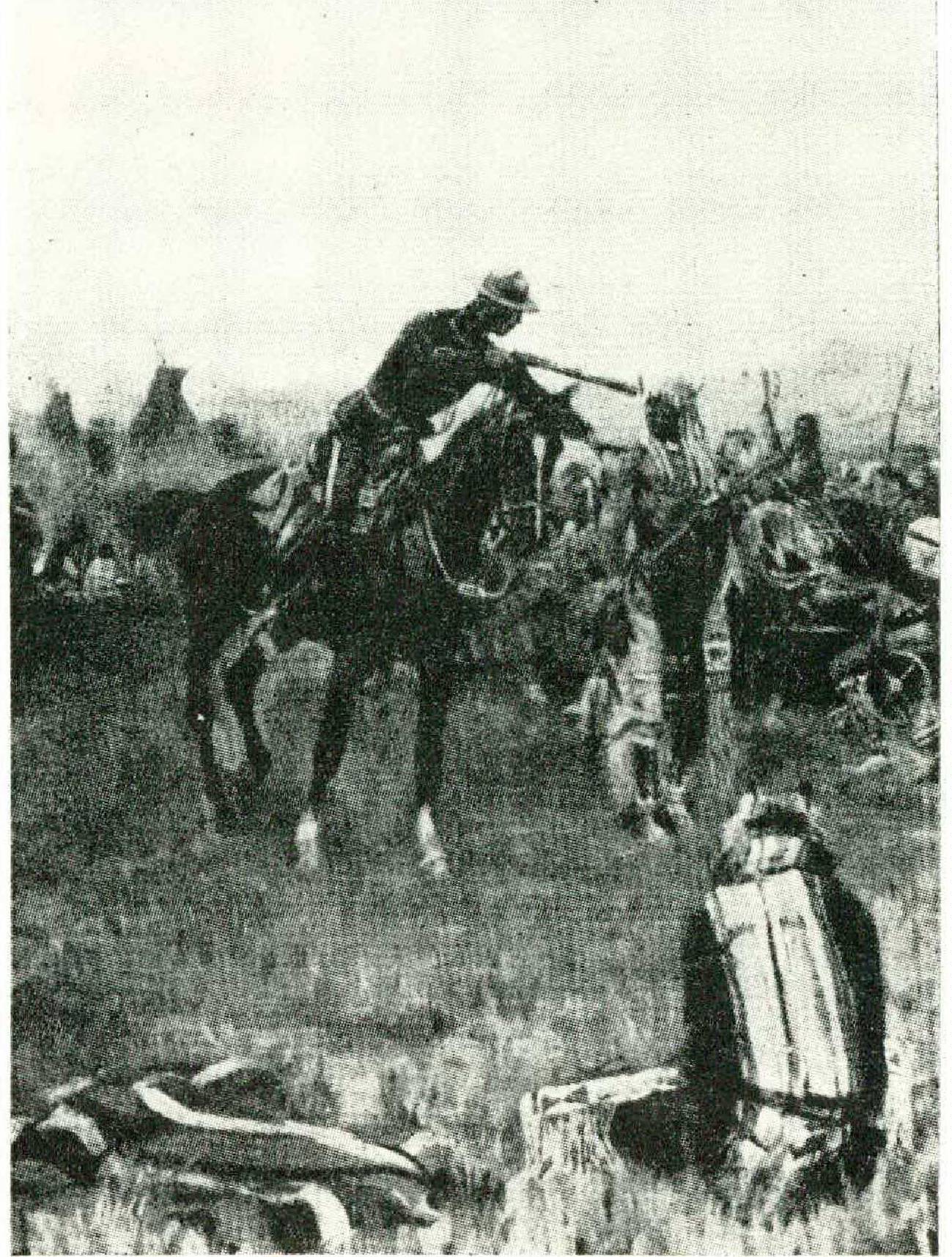
The games, like the parades, often had the fulldress ceremonial quality that reputedly keeps men British in a far land. There is something essentially improbable in the notion of cricketers and tennis players in white flannels strolling across that compound, or of bare-kneed constables lining up for a scrum at rugger. Sometimes they enlisted métis or Indians in their games, and educated them in how to take a body block or a kick in the shins without going for a knife. They had horse races, Indian style, outside the stockade; they kept an eye on the sun dances where youths tore themselves from boyhood into manhood by hurling themselves against the rawhide thongs threaded under their breast muscles. They celebrated Christmas and the New Year with banquets, even with dances. The village that by the late seventies had gathered round the walls contained three hundred families, mainly métis, and boasted a hotel, a restaurant, a pool hall, a barbershop, even a photographer, for whose presence the historian has reason to give thanks. In the valley ringed by timbered hills there might at any time be hundreds of Indians. As the buffalo grew scarce and hunger came to look in the lodge flaps, the hundreds grew into thousands.
THE SIMULTANEOUS presence of many tribes could mean trouble: hereditary hostility might be exacerbated by competition for the few buffalo, or hereditary enemies might possibly join against the whites. It was the Mounties’ job to forestall trouble if they could, settle it if they had to. They patrolled southward to the line at Kennedy’s Crossing on Milk River, and eastward through a chain of detachment posts to Wood Mountain. My home town took its name from one of these posts; its first recorded inhabitants were Sitting Bull and a band of his Teton Sioux, who made their winter camp on its site, among the bends of the Whitemud River, in 1879; its name of Eastend came from the post that the Mounties established at the east end of the Cypress Hills to keep an eye on Sitting Bull. The site of that post was the same as that where Alexander Cowie had built a short-lived Hudson Bay post in the winter of 1871 — 1872. The chimneys of the police cabins were still standing on the edge of Chimney Coulee when I went berrying there as a boy. It would probably have shocked my Fenimore-Cooper-trained sensibilities to know that they were the relics, not of savagery, as I thought, but of law.
Still, I wish I had known it. I wish someone had told me about how the Sioux rode northward after annihilating Custer’s five troops on the Little Big Horn, a whole nation on the move, driving the buffalo before them, and with soldiers from every army post in the West on their trail. In December, 1876, three thousand Ogalalas, Minneconjous, Hunkpapas, Sans Arcs, and Two Kettles were camped near White Eagle’s one hundred and fifty lodges of Canadian Sissetons on Wood Mountain, and these were only the beginning. Sitting Bull was then at Red Water, south of the line, and a big camp of Yanktons under Medicine Bear and Black Horn, though technically agency Indians responsible to the Fort Peck agency on the Missouri, were threatening to cross the 49th Parallel from a place called Burnt Timber, where the Whitemud River crossed into Montana.
I wish somebody had made drama for us of how the tough Irishman Walsh, friendly to Indians, a good policeman, absolutely without nerves, rode in on the first camp of three thousand hostiles on Wood Mountain. With twelve men he rode through warriors, some of whom carried carbines wrenched from the hands of Custer’s dying cavalrymen; past a horse herd, many of whose horses and mules bore the United States Army brand; among lodges where American scalps still hung drying in the smoke; and in a conference with White Eagle, Black Moon, Spotted Eagle, Little Knife, Long Dog, and their surly warriors, he told them how they would behave if they wanted to stay in the Great Mother’s country. If, as they said, they were tired of war, this was what they would do: They would do no injury to man, woman, or child, white or Indian; they would steal nothing, not so much as a horse; they would keep the peace among themselves; they would not hide behind the Medicine Line for the winter and then go raiding below it as soon as the prairies dried; they would not hunt across the Medicine Line; they would not smuggle ammunition across it to their friends on the other side.
How bold a speech, how sublime a faith in the strength of law, considering that these Indians had hardly cooled from a bloodletting of white soldiers unmatched since General Braddock, and that the police, twelve among thousands, had no support nearer than several hundred miles. He told them the rules and they said they would obey them. They asked, almost humbly, for ammunition to hunt the buffalo, which they were now forced to lasso or to kill with lances made of knives bound to poles. As if he really possessed the power he assumed, Walsh granted to Jean Louis Legaré, the Wood Mountain trader, the right to sell the Sioux ammunition they could have taken by force any time they chose to.
Walsh repeated his lecture on law several times: to fifty-seven lodges of Tetons under Four Horns, intercepted just as they crossed into Canada along the Whitemud, and finally to Sitting Bull himself, near Pinto Horse Butte. Having clamped the lid on the kettle, Walsh and later his replacement Inspector L. N. F. Crozier held it on.
The Sioux were not the only American Indians wandering north of the line. Two months after Sitting Bull slipped across in the spring of 1877 there came two hundred and fifty lodges of South Assiniboin under Crow’s Dance, who announced their arrival by roughing up a camp of Canadian Salteaux and demanding that the Salteaux submit to the Assiniboin hunting rules. Instead, Little Child, the chief of the Salteaux, went to Walsh, and Walsh with seventeen men went straight to the lodge of Crow’s Dance. Arriving early in the morning, he left the surgeon and three men to build a barricade upon which they could fall back if a fight started. Then he and the other thirteen rode into the camp, entered the lodges, came out with twenty-two chiefs as prisoners, and bluffed their way back to the barricade, from which they stood off the Assiniboin rage without firing a shot. Crow’s Dance and Crooked Arm, the head men, spent some months in a Mountie jail; the rest learned what the Sioux had the wit to accept early: the law applied to everyone.
IT WAS not a job for the timid. Time after time a handful of constables and scouts plucked horse thieves or stolen horses out of the midst of threatening clots of warriors. The daughter of the Wood Mountain trader had the experience of being held with a knife at her throat while her Sioux captors demanded flour from her father and her father stood with a cocked pistol at a powder keg threatening to blow them all up if the Sioux made a move. That lurid stalemate was broken by a group of Mounties and ex-Mounties who burst in and threw the Sioux out — a procedure for which Walsh himself had set a precedent when he once threw Sitting Bull out the door, seizing the greatest chief of the Sioux nation by the seat of his blanket and pitching him out into the dirt and then defying the furious stir of rage and threats until it subsided.
Through the five years of the Sioux visitation, from the winter of 1876 to the summer of 1881, the Mounted Police were magnificently effective in preventing trouble, and all the time they were working to persuade the hostiles back across the line onto American reservations. In their patrols they noted the passage of every stray Indian or métis, every stray horse, every unfamiliar brand.
Their most serious crisis came after the word spread northward that Chief Joseph and his Nez Percé were headed for the Wood MountainCypress Hills area pursued by Generals Howard and Gibbon. To the Sioux, wild to get another crack at the American cavalry, Walsh said flatly that if they went they would not be back: under those circumstances they would find the red coats hunting them as the blue coats did now. But when the refugees from Chief Joseph’s long running battle limped in, exhausted, wounded, stripped of everything but gun and horse and life, there was need of every ounce of authority Walsh had.
The Nez Percé to whom he gave sanctuary in August, 1877, were Chief White Bird and ninetyeight men, fifty women, and about fifty children, a pitifully wasted remnant of the tribe that their conqueror General Miles called “the boldest men and the best marksmen” he had ever known. They had been friends of the whites since Lewis and Clark first met them under their other name of Chopunnish. Half Americanized, some of them Christians, house dwellers, and farmers, they had been cheated and abused until they made one of the last, the most desperate, and surely the most heroic of the Indian revolts against the system that was destroying their life.
The pitiful Nez Percés were not in themselves likely to add to the police burden; they were simply, like the other American Indians who kept drifting in, part of the ethnic junk heap that was piling up between Wood Mountain and the Cypress Hills as the plains frontier worked toward the end of its first phase. But their condition so infuriated the Sioux that the camp was full of war talk, and when Walsh brought word that General Alfred Terry and an American commission wanted to talk with the Sioux leaders at Fort Walsh, it took all the prestige Walsh had built up to persuade the Sioux even to attend. They went only under red-coat protection, and they promised nothing.
With twenty of the Sioux chiefs Walsh left their camp near Pinto Horse Butte, and midway between there and Fort Walsh they met Commissioner MacLeod coming from the west, and they camped and feasted together. I think I know how that October river bottom would have looked and smelled, with the skin lodges and the willow fires and the roasting meat — the smells of evening and muddy shores, the Indian summer pungency of drying leaves and rose hips, the special and secret smell of wolf willow, the glint of yellow and red leaves shaking down across the fires.
THE conference for which Sioux, Mounties, and American commissioners assembled at Fort Walsh on October 17, 1877, was one of the briefest and least productive on record. They held one meeting. General Terry offered the Sioux amnesty, reservations, cattle, and allotments, and suggested that they come on home. The Sioux rose one by one and said that the Americans were liars, that they had never kept a promise, that they would be false to these as they had been to all the others. They ironically introduced the squaw of BearThat-Scatters, and this in itself was an insult, for women did not belong in council. The squaw had been coached in a brief speech. She asked the Long Knives to go on home and let her alone and give her time to breed; she would like to stay here in peace and have some children. The chiefs, saying all the time that they wanted to be Canadian Indians, shook hands many times with MacLeod and Walsh; they pointedly wrapped their robes around them when it might have been time to shake hands with Terry. When the commissioners gave it up and went home, the Sioux chiefs stayed around Fort Walsh and made themselves sick on plum pudding and other items that MacLeod had brought with him for the occasion.
But whatever their wishes, the Sioux were not Canadian Indians. They were not entitled to payments under any of the seven treaties by which Canada had pacified the tribes, and when Crec and Salteaux and Assiniboin came to Fort Walsh for treaty money, the Sioux were left out. During their first years there, the buffalo were plentiful along the Whitemud, but by 1879 they were suddenly almost gone, and with no right to draw rations, Sioux and Nez Percé suffered most. Moreover, by the persistent tactic of never dealing with Sitting Bull as head chief, but undercutting his authority and dealing with others, Walsh and Crozier whittled the great magician of the Tetons down to smaller and smaller size. By 1880 they had whittled away more than 1200 of his followers and persuaded them to return to the States. By 1881 Sitting Bull was a defeated, bitter, and powerless old man. On July 11 he and his last followers, quarreling over a few bags of flour and dressed practically in rags, started out from Willow Bunch with the trader, Louis Legaré, and made a scarecrow march southward through the whitened bones of the buffalo. A week later they met Captain Clifford at the place now called Plentywood, Montana. The day after that, the gates of Fort Buford closed behind them and their guns were stacked in the yard and the American plains were finished.
Fort Walsh was almost finished too. It had never been a healthful site. Unexplained fevers swept it and its satellite village; the water from Battle Creek, polluted by buffalo or horse carcasses in the swamps above, brought typhoid into tin cups and canteens. And two great movements of history, one just closing and one about to begin, united in persuading the police that another headquarters would now serve better, and that even as a post. Fort Walsh should not be long maintained. The starving winters of the early eighties indicated that reservations farther north, in the fertile belt along the North Saskatchewan, would provide more opportunity for farming and Indian selfsufficiency than the high Cypress Hills with their summer frosts. More than that, the hills were too close to the border: desperate and vengeful Indians might be tempted to raid southward and return to the hills as a refuge. Finally, the Canadian Pacific was coming westward swiftly, and one police job would be protecting the men who built it.
In May, 1883, Fort Walsh was dismantled. As much of its building material as could be salvaged was hauled to Maple Creek, on the northern edge of the hills and directly on the main line of the C.P.R., and there made into another post. From there, patrols could still ride the old trails to Eastend, Pinto Horse Butte, and Wood Mountain, or the trail south to Kennedy’s Crossing. But the wild and explosive frontier that the Mounties had marched west to bring under control in 1874 had gone out like a blown match. Except for the desperate outbreak of Indian and métis dissatisfaction in the second Riel Rebellion in 1885, the Mounties would find themselves now less concerned with taming wild men in wild places than with protecting civilized men in places rapidly becoming tame. Headquarters went farther from Fort Walsh than Maple Creek; it went all the way to Pile o’ Bones Creek, also on the G.P.R., where there was now forming the raw settlement that would be called Regina after the Queen.
As for the Cypress Hills, from Medicine Lodge Coulee on the west to Chimney Coulee on the cast they lay empty, cleared of their grizzlies and elk, their flanks swept clean of buffalo, their ravines and wooded valleys emptied of Indians. Only a few transitional settlers remained in the whole region. Several Mounties who had served their terms and taken their allotments of land, certain métis who had squatted along the creeks, certain old buffalo hunters or wolfers who had seen the handwriting on the wall and settled down — these made a thin and scattered population; and little by little, especially after the railroad was completed, came cattle to replace the buffalo. Some were whiteface and shorthorn, good stock; some were ringy old longhorns driven all the way up from the Rio Grande to stock the northern ranges.
Now for twenty-odd years the hills and plains that had concentrated the last flicker of the buffalo economy would be part of the cattle economy. There was room in its brief and telescoped history for one cowboy generation, which like the hunter generation was made of many kinds: drifters from Montana, Wyoming, Kansas, Texas; Irish immigrant boys; venturesome English youths with too many elder brothers or too much ambition or too little self-control; made-over Mounties; French aristocrats; métis squatters; reformed whisky traders. They would have this kingly range all to themselves until 1906, when one devastating winter would sweep it clean again for a new wave, this time of men with plows.
I wish I had known some of all this. Then, sunk solitary as a bear in some spider-webby, sweaty, fruit-smelling saskatoon patch in Chimney Coulee on a late summer afternoon, I might have felt as companionship and reassurance the presence of the traders, metis, and constables whose old cabins made rude rectangles of foundation stones and whose stone chimneys still stood, half smothered in long grass and chokecherry bushes. Kicking up an arrowhead at the Z-X ford, I might have peopled my imagination with a wild camp along the bends of the Whitemud and had the company of Sitting Bull, Long Dog, Spotted Eagle, Walsh, MacLeod, Lèveillé, some Indian summer evening when smoke lay flat along the willows and the swallows were twittering to their holes in the clay cutbanks and a muskrat came pushing a dark-silver wedge of water upstream. I was at ease with the swallows and the muskrats, we were part of the same timeless world; but Time, which man invented, I did not know. I was an unpeopled wilderness, I possessed none of the associations by which a human tradition defines and enriches itself.
Many times I have sat all alone just inside the edge of one of the aspen coulees that tongued down from the north bench, and heard soft puffs of wind rattle the leaves, and felt how sun and shadow scattered and returned like disturbed sage hen chicks; and in some way of ignorance and innocence and pure perception I have bent my whole attention on the purity of white anemones among the aspen boles. They were rare and beautiful to me, and they grew only there in the dapple of the thin woods.
Those are most peaceful images in my mind. I don’t know why, recalling them, I think of Marmaduke Graburn, a boy I never heard of until much later. Perhaps he is associated with those images because his grave lies under the same sky with the same light and the same quiet spread over it. He died in such a coulee as one of these, and he died young.
He was nineteen years old, a rookie subconstable recently recruited in Ottawa, a boy with an itch for adventure and a name that might have come out of a magazine romance. Graburn Coulee, back of Fort Walsh a few miles, is the name the maps now give to the draw where he rode alone after an ax he had left behind, and was followed and shot in the back of the head by Star Child, a Blood Indian with a grudge. Graburn died alone and uselessly, the victim of brainless spite. Métis trackers led by Jerry Potts and Louis Lèveillé found first the tracks of his shod horse where they had been joined by two barefoot Indian ponies; then his pillbox cap lying beside the trail; then his body dumped into a ravine.
He was not the first Mountie to die in the course of duty. Others had drowned in floodswollen rivers, died of fever. But Marmaduke Graburn was the first of the force to die by violence. Throughout their first five years, from the time of their march westward from Fort Dufferin to pacify a frontier 900 miles in extent, 300,000 square miles in area, and populated by 30,000 of the most warlike Indians on the continent, the Mounted Police had neither killed nor been killed. When Star Child raised his gun behind the unsuspecting boy in an aspen-whispering coulee in 1879 he took symbolic revenge for the ending of the Indian heritage, but he also emphasized the heroic effectiveness of the law that Canada had sent into the Northwest. The Mounted Police came to the West in 1874, and to the Cypress Hills one year later, to smother a hornet’s nest. In 1883 they left the hills and the entire border pacified and safe, almost as peaceful as when I wandered through the coulees with a .22 and found nothing more dangerous than snowshoe rabbits and anemones.