A Village Tragedy
The author of three novels, JOHN EARNK grew up and was educated in Jamaica, an island whose customs and people he describes with dramatic force. His most recent book, THE EYE OF THE storm, was published this past spring under the Atlantic Little, Brown imprint.
JOHN HEARNE
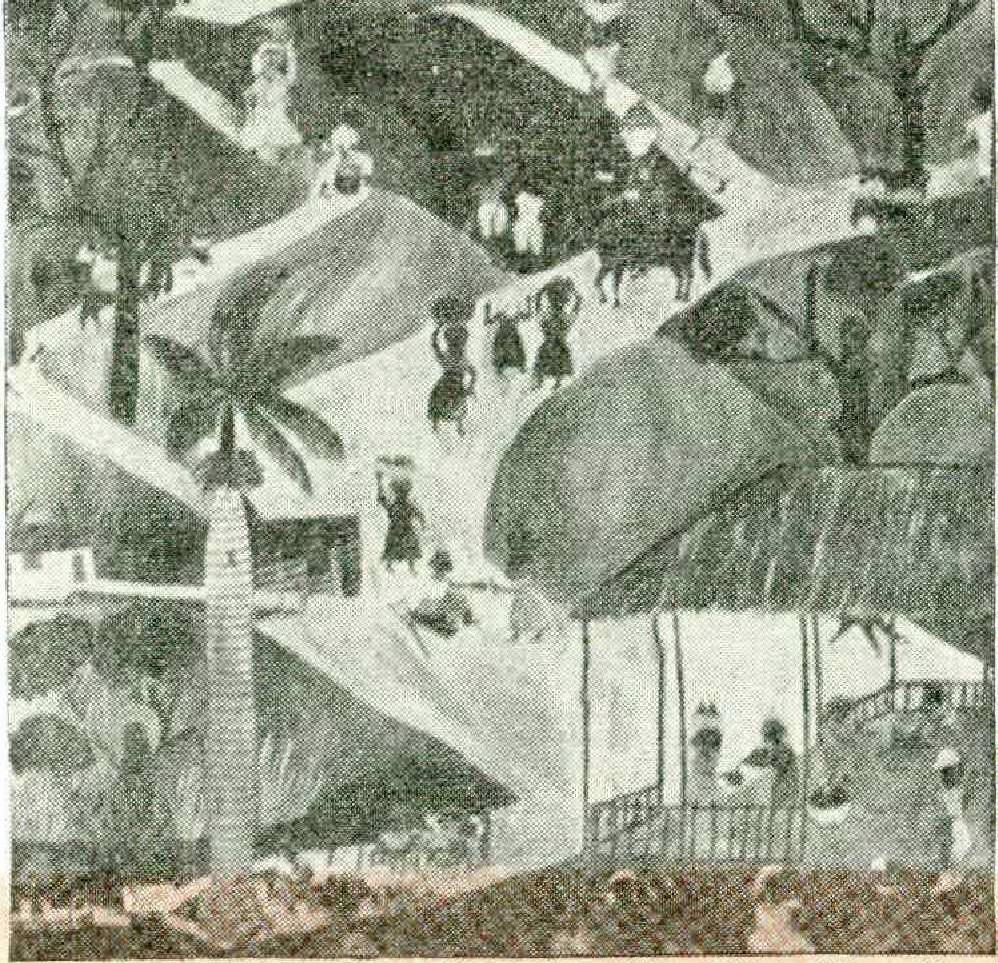
THE old boar slashed Ambrose Beckett across the top of his thigh, almost severed his private parts, and dragged three feet of his gut out on the tip of one tusk. It was done between one brazen squeal and another, while Ambrose Beckett still turned on the wet clay of the path and before the echo of his last, useless shot wandered among the big peaks around the valley.
The men with whom Ambrose Beckett had been hunting turned and saw the ridge-backed, red-bristled beast vanish like a cannon ball into a long stretch of fairy bamboo. Before they reached him, they saw Ambrose Beckett’s wildly unbelieving face, like gray stone beneath the brown, and the dark arches of his spurting blood shining on the wet dull clay under the tree ferns. Then he had fallen like a wet towel among the leaf mold, clutching the clay in his slack fingers, with one distant, protesting scream sounding from the back of his throat.
They bandaged him, after stuffing, inexpertly, bits of their shirts and handkerchiefs into his wounds. Nothing they did, however, could stop a fast, thick welling of blood from where he had been torn. And no comfort could stop his strangled, faraway screaming. They made some sort of stretcher from two green branches and a blanket. They covered him with another blanket and began to carry him across the mountains to the village. The trail was very narrow, and the floor of the rain forest was steep and wet. Each time they slipped and recovered balance, they jolted the stretcher. After a while, they forced themselves not to shudder as Ambrose Beckett screamed. Soon he began to moan, and the slow, dirty blood began to trickle from his mouth, and they knew that he would never reach the village alive.
When they realized this, they decided to send Mass’ Ken’s half-witted son, Joseph, ahead of them to tell the doctor and the parson. Joseph was the biggest idiot any man could remember being born in the village. He inhabited a world of halfarticulate fantasy and ridiculous confusion. He was strong enough to kill a man with his hands, and he wept if a child frowned at him. In Cayuna, the children do not, as yet, throw stones at their naturals, but they tease them, and often Joseph, who loved to wait outside the school and watch the children going home, would be seen crouched between the roots of the cotton tree, weeping disconsolately because the boys had scowled as they passed and said: “Joseph! What you doin’ here, man?" He could learn nothing, and remembered little from one minute to the next unless you dealt him a blow across the head when giving him the simplest instructions. But he was marvelous on the mountains: tireless as a mule and much faster.
Now, with Ambrose Beckett dying on the blanket, the men standing around gave Joseph his instructions. “Doctor!” said Mass’ Ken, his father, and cuffed him across the head. “Doctor! You hear?” He hit him again. “Tell doctor an’ tell parson dem mus’ come quick. Fell dem come quick, you hear! Tell dem Mass’ Ambrose sick bad. Sick! Sick! You hear!” Joseph’s big, stone head rocked again under a blow, and his odd, disorganized face closed its askew planes into a grin of pure understanding. He went off among the huge trees and thick wet bush and into the mist. When he had gone ten steps they could no longer hear him.
It was twelve miles and four thousand feet down to the village, and he did it in four hours. At ten o’clock that night he started to bang happily on the door of the manse and kept it up until the Reverend Mackinnon put his head out of the window. When he heard the shutter slamming against the wall, Joseph ran to the middle of the lawn, capering and shouting.
“What?” called the Reverend Mackinnon. “What is it, Joseph?”
He could see nothing but a vague, starlit blur, bounding up and down on the lawn, but he recognized the manner and the voice. Joseph jumped higher and shouted again, his voice tight and brazen with self-importance.
Finally the Reverend Mackinnon came downstairs and cuffed the boy until he became calm. Then he got the story.
“Doctor!” he said, turning Joseph around and giving him a push. Leaving the parson, Joseph ran across the damp Bahama grass of the lawn to where he could see the deep yellow of a light in one window of a big house along the road. Doctor Rushie was still up; it was one of the nights that he got drunk, as he did, regularly and alone, twenty times a month.
“Good God!” said Rushie. “How far up did it happen?”
Joseph gestured. Distance, except in terms of feet and yards, was not of much importance in his life.
“Have you told parson?” the doctor asked. He was drunk, but not much. Had the news come a little later he would have been very drunk and quite incapable. He went to the window and bawled for his servant. “Saddle the mule,” shouted Doctor Rushie, “and put on your clothes. Bring a lantern. Hurry up!”
In about five minutes the doctor was riding out of the village, with his manservant trotting ahead, the circle of light from the lantern sliding quickly from side to side across the path and making the shadows of the hillside and valley drop deeper. There was a stand of golden-cup trees along this stretch of the bridle path, and the dropped fruit broke wetly under the hoofs of the mule, and a thick, sugary scent came up on the cold air, cutting through the hot, oily smell of the lantern.
They overtook the Reverend Mackinnon, who had no manservant and who was riding his stubby, gray gelding alone in the dark. By the lantern light Doctor Rushie could see the parson’s very pale, long face and his lank gray hair fallen across his forehead and full of burrs from the long grass of the steep bank beside the narrow path.
“You’ve heard?” the doctor said. It was not really a question, and they were riding on in the darkness behind the bob and sway of the lantern while the parson was nodding his head.
BACK on the road, Joseph sat on a big stone outside the doctor’s house. Nobody had told him what to do after delivering his messages, and he felt confused and restless. The doctor’s house, and the Reverend Mackinnon’s, were up the road from the village. Neither man had thought to inform the people down there as to what had happened on the mountain. Soon Joseph rose from the stone, ran down to the village, and began to race about the street from side to side, talking loudly to himself. It was not long before he had awakened every household within sound of his voice.
“Joseph, you bad boy,” screeched Mr. Tennant, the schoolmaster. “What are you doing here? At this hour.” Joseph flapped a big dirty hand at him excitedly. “Boy, if I bring a switch out to you . . .” Mr. Tennant said. Joseph shot away down the street like a dog, but he continued to talk very loudly.
Mr. Tennant, with a tight, moist smile on his plump lips and carrying a long supplejack cane, came from his house. Joseph bolted for the shoemaker’s doorway. Only Elvira, Joseph’s smallest sister, could get as much sense from his clogged speech as quickly as Mass’ Emmanuel, the shoemaker.
“Joseph,”said Mass’ Emmanuel, as the natural found refuge in his doorway, “why you not sleepin’, eh? What a bad boy. I’ve a good mind to let teacher flog you.”
He put an arm across the boy’s trembling shoulders and drew him close.
Joseph told him about Ambrose Beckett, imitating with great vividness the terrible, ripping twitch of the boar’s head, writhing enthusiastically on the ground to show what it had been like with Mass’ Ambrose. Mass’ Emmanuel translated as people began to come from the houses. Then they all looked up to the hill at the other end of the village, to where Ambrose Beckett’s house stood. They began to move toward the house.
“Lawd King!” said Miss Vera Brownford. “Fancy! Mass’ Ambrose! A fine man like dat. Poor Miss Louise !”
She was the center of the older women of the village as they went up the hill to the house where Ambrose and Louise Beckett had lived for thirty years. Vera Brownford was ninety-eight or maybe a hundred. Perhaps she was much more. Her first grandchild had been born before anyone now alive in the village, and only a few people could still remember her, dimly, in early middle age. Her intimate participation in every birth, death, and wedding was, for the village, an obligatory ritual. She had lived so long and so completely that she had grown to want nothing except freedom from pain. She had even transcended the brief, fierce resurgence of the child’s longing for recognition which had assailed her again when she was about seventy. At times the shadow line between life and death was not very distinct to her expectation, her desire, or her feeling, but she understood the terror and confusion that the crossing of the line brought to those younger than herself. And understanding this, she gave comfort as a tree gives shade, or as a stream gives water to those who fetch it, with a vast, experienced impartiality. It was her occupation.
Among the younger men and women Joseph was still the center of interest as they went up the hill. His mime performance of Ambrose Beckett and the boar had begun to acquire the finish of art. In all his life he had never experienced such respect for his ability and knowledge. He was almost gone out of his poor mind with happiness.
“Joseph,” said Mass’ Emmanuel suddenly, coming back down the path which was leading them to Louise Beckett’s darkened house, “Joseph. I forget. We gwine to need ice fe’ pack Mass’ Ambrose. Tell dem to give you ice. Ice, you hear. At Irish Corner.”
He gave a five shilling note to the boy and hugged the huge, smoothly sloping shoulders and smiled at him. Only for two people, Elvira and Emmanuel, would Joseph remember anything unaccompanied by a blow.
Joseph turned and raced down the path. He seemed to weave through the murmurous crowd like a twist of smoke. Before he was out of earshot they heard him singing his own chant, which was a mingle of all the hymns and songs he had ever listened to. He was always adding to it, and though it had no more conscious structure than a roll of thunder, it had a remarkable, pervasive quality, coming to you from a dozen points at once, with odd limping echoes.
THH Reverend Mackinnon and Doctor Rushie met the party of returning hunters about five miles from the village. They heard the dogs barking and saw the lantern lights jump along the pines on the saddle between the peaks ahead of them. This was on the side of a great valley, on a trail worn through a stretch of ginger lilies. The night was very cold, and mist was coming down from the sharp, fuzzy peaks and piling into the valley below, and the air was full of a thin spicy tang as the hoofs crushed the long ginger-lily leaves against the stones.
“Ho-yah!” shouted the doctor’s manservant when they saw the lights. “Is dat you, Mass’ Ken?”
“Yes.” The answer rolled back slowly, thin and lost in the air of the huge valley. “Who dere?”
“Doctor. Doctor and parson. How Mass’ Ambrose stay?”
“Him dead!”
He was dead, right enough, when the two parties met. In the glare from the lanterns his skin was the color of dough and earth mixed, quite drained of blood. The blankets between which he lay were dark and odorous with his blood. His mouth had half opened, and one eye had closed tightly, twisting his face and leaving the other eye open. It gave him an unbelievably knowing and cynical leer.
“Well, I’ll be damned,” Doctor Rushie said, and then, seeing Mackinnon’s face, “Beg your pardon; but look at that.”
“Look at what?” the Reverend Mackinnon said stiffly. He had never liked Rushie much, and now he did not like him at all.
“His face. How many dead men have you seen?”
“I don’t know. As many as you I suppose.”
“Exactly,” Doctor Rushie said. “Probably more. But how many have you seen die with one eye closed? You know, it’s generally both eyes wide open. Sometimes both closed, but not often. Damned odd, eh?”
“I hardly think it’s important, doctor,” the Reverend Mackinnon said. His long, ugly, Scots face was tightly ridged with disgust. Only the presence of the villagers kept him polite.
“No,” the doctor said, “it’s not important. I just noticed it. Well, no point hanging around here. Let’s get him home, eh?”
Going down the track, the doctor and the parson rode behind.
“What a dreadful thing to have happened, eh, doctor?” said the Reverend Mackinnon. “I can hardly believe it.”
He always felt guilty about not liking Doctor Rushie; and he constantly asked himself wherein he as a minister had failed to contact the drunken, savagely isolated creature who rode behind him.
“I can believe it,” the doctor said. “Do you know how many ways the world has of killing you? I was adding up the other night. It comes to thousands. Simply thousands.”
The Reverend Mackinnon could find no answer to this. There were answers, he knew, but none that he cared to risk with the lonely, brutal man who, more or less, cared for the health of their village and a score of other villages in the district.
He’s not even a very good doctor, the Reverend Mackinnon thought, and felt a cold flush of shame because the thought gave him satisfaction.
“He was such a strong, vital man, too,” the Reverend Mackinnon said a little later. He was unable to bear the night with the mist blowing damp and cold across his face, and the bobbing lanterns lighting up the silent men as they scrambled awkwardly with the stretcher on the narrow track.
“He was a strong man,” the doctor said dryly.
“Why, the other day I saw him clearing that land of his up by the river, with his sons. He was doing twice as much as they, Mackinnon continued.
“Oh, he was a good farmer, all right,” the doctor agreed, in the same dry tone. “He ought to have been, with what he had acquired these last few years. He knew what he wanted, all right.”
“He was an example to his community,” Mackinnon said with solemn emphasis. “God-fearing and responsible. An example. If only he had had an education. They would have made him a justice of the peace. He was an example. A Christian example.”
“Well, maybe the boys will become examples, too,” the doctor told him.
“The boys,” said the Reverend Mackinnon, “the boys have fallen far from the stem. Thomas has his father’s sense of duty, but he is weak. Weak. And Sidney cares only for himself, his pleasures, and his land. He caused Ambrose Beckett a great deal of worry. Which one of them do you think will get the holding, eh? Thomas or Sidney?”
“Couldn’t say,” the doctor replied. “I was only Beckett’s doctor, not his lawyer. Probably they’ll have equal shares. He had enough, God knows, for these parts.”
The Reverend Mackinnon frowned and shifted uneasily in the saddle. Oh, God, he said to himself, make Thomas get the holding. He looked somberly over the nodding head of his beast and at the vague blur of the stretcher. The men were moving fast now, because Ambrose Beckett was dead and they could heave the stretcher about quickly.
Twenty years before this, Ambrose Beckett had rented land from the church. It was the first move in a program which had made him the largest peasant farmer in the parish. It had been good land, and he had paid a good rent. But since the war, when everything had gone up, the rent had fallen to a fraction of the land’s value, and the Reverend Mackinnon had been looking for some way to increase it. He was, essentially, a timid man, who felt courage and confidence only on Sunday, when he stood unassailable in the pulpit, beyond interruption, with God and the Hosts at his back.
His method of attack in the matter of the rent had been to mount a series of hints. Veiled and offhand at first, they had evolved, after three years, into frequent references about the difficulties and embarrassments of a priest in the modern world. Pride and timidity had kept him from stating an open claim. These and the reasonable certainty that Ambrose Beckett would, at first, refuse to pay more. Would refuse with the plausibility and righteousness of a man who valued an acre, really, more than he regarded a wife and who knew his own usefulness as a parishioner.
I am not covetous, the Reverend Mackinnon told himself in the darkness. I do not want it for myself. But the manse is falling to bits, and if I send Jean home next year she will need clothes. Perhaps two sets within the year; girls grow so fast at her age.
Given time, he knew, he could have persuaded Ambrose Beckett. It would have been painful, but it would have come. Now he would have to begin again with the sons. If Thomas were the heir, it would be easy. He was a gentle, almost girlish lad, very devout and proud of his family’s influence in the church. But Sidney. Sidney would be difficult. Difficult and slow. And arrogant. He had always treated the Reverend Mackinnon with a casual politeness more infuriating than hostility. A bland indifference which onlyon occasion became genially ferocious. The afternoon, for instance, when Mackinnon had caught him making love to a little East Indian girl under a huge rock by the river. The lad had raised his head from beside the girl’s blind, contorted face and stared at the parson with cool, amused malice. And the next day, Sunday, while Mackinnon was preaching a sermon on the sin of fornication, he had looked down from the pulpit to the front pew where Ambrose Beckett sat in a hot, high-buttoned black suit among his family and seen such a sparkle of conspiratorial intimacy in Sidne’s eyes that he had floundered in his speech.
WHILE they were bringing the body of Ambrose Beckett down from the mountain, Joseph had reached the market town of Irish Corner. He knocked on the zinc fence around the shop until the Chinese keeper came down and a small crowd gathered. Then he told the story of Ambrose and the boar again, giving a really practiced and gigantic performance. He had great difficulty in making them understand what had happened, or what he wanted, but they finally got it. Then they cut a great block of ice, wrapped it in a crocus bag, hoisted it onto his head, and set him on the road back to the village.
He had hardly stopped running since the late afternoon, and he streamed with sweat as if he had been put under a hose; but he was not tired and he was crazy with excitement. He had never played such a central part in anything before.
Suddenly he slowed his long, effortless jog trot up the steep road. He stopped. The ice in its wrapping of crocus bag was cool and wet between his hands and on his huge, idol’s head. From his great, heaving lungs there burst an ecstatic grunt. Ice ice . . . ice. If he got back quickly,
they would chip a white, glittering, jagged lump for him. A piece with a point around which he could curl his tongue. A bit to hold above his opened mouth, so that the cold, unimaginable drops would hit the back of his throat. A bit with edges he could rub across tightly shut eyelids and then feel the cold water drying on his skin. He danced with happiness, balancing the huge block as if it were a hat. As far up as his village, ice was still a luxury for all but the doctor, who had a machine which made ice cubes.
THE people at Ambrose Beckett’s house heard the dogs as the men came up the hill. Louise Beckett rushed from the house and down the path toward the light from the lanterns. When she saw the stretcher she began to cry and moan wildly, covering her face and clutching her body. Her two sons came close to her.
“Mother . . . Mother,” Thomas said. He embraced her tightly and began to cry too.
Sidney put his arm around her shoulder and said softly: “I will take care of you, Mother. I will take care of you. Don’t cry. Don t cry.”
Inside the house, the body was laid out on the kitchen table. The table was too short, and the feet hung over the edge. Doctor Rushie shut the people out and by the light of four lamps sewed up the hideous openings in Ambrose Beckett’s body. Once during this operation he spoke, as if to the corpse. “You poor devil,”he said, “this must have hurt like blazes. But the other thing would have hurt you more, and it would have lasted longer.”
Outside, in the tiny, stiffly furnished drawing room, Vera Brownford sat on the old-fashioned, horsehair sofa. Louise Beckett sat close up beside her, resting her head on that old, indestructible breast which, thin and hard as a piece of hose pipe, was yet as hugely comfortable as a warm ocean.
“Cry good, child,” Vera Brownford said. “Cry good. If you don’t cry you will get sick. Oh, Lawd, it hard to lose a man. It hard to lose a good man like Ambrose. Cry good, child. It much easier.”
The old, dry voice flowed smoothly, uttering banalities that sheer experience gave the weight of poetry. Louise Beckett cried noisily.
The women of the village stood around the sofa; the men gathered near the door and outside, each group around one of the hunters, who told in whispers what it had been like. The children waited on the fringes of each group; some of them looked with wide stares toward the locked kitchen door.
The Reverend Mackinnon hovered between the men and the women. Finally he went across to Louise Beckett. “Louise,” he said, “you must take comfort. Remember your beloved husband is not gone. He only waits for you in our Master’s house. He was a good man, Louise. A true Christian man. Take comfort in that and in the promise of everlasting life.”
Louise Beckett raised her stunned face and looked at him from red eyes. “ Thank you, parson,” she whispered, and burrowed her head against Vera Brownford’s breast.
Among the men, Sidney was saying in a hard unbelieving voice: “Jesus, it happen so quick. I tell you, Mass’ Emmanuel, it happen before we even see it.”
“How things happen so, eh?” Emmanuel said. “Truly, it is like the Bible say: in the midst of life we are in death.”
“That is true, Emmanuel,” said the Reverend Mackinnon, joining them. “ That is very true.”He laid a hand on Sidney’s shoulder and gave it a little squeeze. “But remember, as Christians we need not fear death if we live so that death finds us prepared for God. We must remember the life God showed us through His only son, and, in our turn, live so that each day we can say to ourselves: Today I did God’s will.”
He looked closely at Sidney as he spoke, but the young man’s face was closed, sullen with grief, unreadable.
Mr. Tennant, the schoolmaster, cleared his throat. He thought very highly of the Reverend Mackinnon, but he also felt that, in the village, he should reinforce the parson. Provide the practical epilogues to the more refined utterance of the church.
“It is you and Thomas now, Sidney,” Mr. Tennant said. “You must act like men. Work the land as diligently as your father. Look after your good mother . . .”
They heard a hard, heavy grunting outside in the dark, and then Joseph stepped into the room. He was lathered about the lips, with sweat and water from the ice mingled on his face and staining his clothes. Everyone stopped talking when they saw the ice.
Mass’ Ken, Joseph’s father, took the boy by the arm and led him into the bedroom. Four of the men who had hunted that day with Ambrose Beckett followed him. They stripped the clothes and mattress from the springs and spread old newspapers under the bed. They unwrapped the coarse, shaggy crocus from the ice, and one of the men split it into five great lumps with an ice pick. Then they spread old newspapers on the bare springs and waited awkwardly in the half-dark of the little bedroom where Ambrose Beckett had lain with his wife for thirty years.
Outside, one of the younger men who had been on the hunt laid his hand shyly on Sidney’s arm. “Sidney,” he said, “I sorry, you see. If it was me own Papa I couldn’t sorry more. Lord, Sidney, don’t worry. I will help you. You gwine to need anoder man fe’ help you wid dat lan’ you an’ Mass’ Ambrose was clearing. What you gwine to put in it, bwoy? It is one nice piece of ground.”
Tears shone in Sidney’s eyes. He was remembering how powerful and comforting his father had looked in the sunlight as they cleared the land by the river. His friend’s words were sweet and warm and made him feel comforted again.
“T’ank you, Zack,” he said, “t’ank you. Thomas an’ me will need a help. Papa did want to put citrus in dat piece. Dat is de crop pay well now, you know. Since de war over, everybody want orange oil again.”
Thomas looked suddenly and with disturbance at his brother.
“When Papa say we was gwine put citrus in?” he asked. “You know we only talk about it. Las’ time we talk, you remember I say we should plant ginger. I like ginger. It safe.”
“Everybody plant ginger, Thomas,”Sidney said gently and inflexibly. “Papa did always say too much ginger was gwine to kill de small holders. Time some of us plant somet’ing else.”
The door to the kitchen opened, and they saw Doctor Rushie framed in the opening, with the lamplight yellow behind him. Sidney and Thomas, Mass’ Ken and Emmanuel went into the kitchen and brought the body out. Some of the women began to wail. Louise Beckett set up a long howling cry and ran across the room. She held the dead face between her hands. She was twitching like an exhausted animal.
“Mass’ Ambrose,” she cried, “Mass’ Ambrose.”
After they had packed the body among the ice lumps, the Reverend Mackinnon led them in prayer around the bed. Then the people started to go home. All went except Vera Brownford and three of Louise Beckett’s closest friends, who stayed to watch the body.
It was now the blackest part of the morning, before the sun began to touch the mountaintops and make the sky glow with pink and green.
The Reverend Mackinnon went home and tiredly unsaddled his stumpy gray gelding. He went up to bed and thought about the gentle, exhausted wife he had buried two years before, and worried about the plump, soundly sleeping daughter a hundred miles away in boarding school.
Doctor Rushie went home, and his manservant led the mule away while the doctor sat down to finish the bottle he had been drinking when Joseph came. He thought about the wounds in Ambrose Beckett’s body and whether, if he had got to him right away, he could have saved a life. He thought, also, about the sliver from Ambrose Beckett’s rectum which he had sent down to Queenshaven for analysis a week ago and which, he was sure, showed the beginnings of cancer.
Lying in the bed they had shared from childhood, Sidney and Thomas clung to each other and sobbed in the painful, tearing manner of grown men. In between grieving for their father they argued fiercely and quietly as to the wisdom of planting citrus or ginger.
In the room with the body, the women sat and watched. Once Louise Beckett leaned forward and touched the damp sheet wonderingly.
“Mass’ Ambrose?” she asked softly. “You gawn? You really gawn?”
In the kitchen of his home, Joseph snuggled into bed beside Elvira, his little sister, and began to cry bitterly. She woke when she heard him crying and asked him what was the matter. He told her how he had run all the way to Irish Corner, and back, with the ice, and of how no one had thought to give him a little piece. The ingratitude and thoughtlessness of the mourners shocked the little girl profoundly. She wiped the tears from his big, sweaty face and hugged him, rocking him in her thin arms and kissing him with little quick maternal pecks.
Very soon he was fast asleep.