Father Damien's Village
The author of THE NUN’S STORY, KATHRYN HULME interrupted the preparation of her new book long enough to pay a flying visit to Honolulu and to Molokai, the isolated leper colony which, thanks to the new drugs, is now a more hopeful settlement than was ever possible in the days of Father Damien.
WHEN I first flew over Molokai, the old battleground of Father Damien, and heard the airline stewardess say, “The Hansen’s disease settlement,” as she pointed down to the peninsula of Kalaupapa, I thought she was showing off her medical vocabulary. Most of the passengers gazing momentarily at the surf-fringed peninsula never realized they were flying over the most famous and once most isolated sick colony in the Pacific. Nor did the stewardess explain that Hansen’s disease means leprosy. Seen from aloft, the Kalaupapa peninsula on Molokai, home of the lepers since 1865, looked like a scarred thumb thrust into the creamy line of smashing surf.
Although medical opinion now generally concurs in the belief that the Biblical scourge described in the Old Testament is not the Hansen’s disease which we know today, it is nevertheless certain that man’s first fear of leprosy was crystallized by the thirteenth chapter of Leviticus, wherein the Lord spoke to Moses and Aaron, telling them what to do when “a man shall have in the skin of his flesh a rising, a scab or a bright spot.” Segregation was made the law for lepers from that time onward. More than twenty centuries had to wear away before the causative bacillus of the disease was found, in 1874, by a young Norwegian physician named Gerhard Armauer Hansen. Some seventy years later, in the early 1940s, the sulfone drugs were discovered, along with their peculiar properties of clearing up the leper’s visible skin ulcerations and, eventually, rendering him noncontagious, therefore free to return to society. In 1949, the Territory of Hawaii, by legislative act, changed the name of leprosy to Hansen’s disease, as the medical profession had long been calling it.
I had not planned to visit Molokai when I flew to the Hawaiian Islands. But a letter of introduction which I carried made my detour to Molokai compelling. It was addressed to a noted doctor, scholar, and writer, resident of the islands for more than thirty-five years, who was stationed in the Molokai settlement in the 1920s and knew all of its history before and since. As soon as he learned that I and my traveling companion, a nurse, were interested in leprosy, he fired us up for an immediate trip. He loaned us out-of-print books on leprosy, missionary and medical diaries, memoirs and current pamphlets. Finally he urged us to visit the Hansen’s disease institution on the outskirts of Honolulu, Hale Mohalu. There since 1949, when the Navy released this extensive WAVES barracks to the territory, newly discovered cases have been sent for treatment with the new sulfones and for rehabilitation training to prepare them for their certain return to society. They will return after an average stay of five years; less when the disease is detected early.
I read avidly, beginning with Dr. A. A. Mouritz’s first great study of the disease in the Pacific, entitled The Path of the Destroyer; I read Ernie Pyle’s letters written for the Honolulu Advertiser in 1937, and Robert Louis Stevenson’s letters from his eight-day stay in the settlement and his famous white-heat defense of Father Damien after the ill-judged, inaccurate defamation by the Rev. Dr. McEwen Hyde. I read cool medical pamphlets, Brother Dutton’s memoirs and letters, Edward Clifford’s account of his long friendship with Father Damien, Charles W. Stoddard’s Diary of a Visit to Molokai in 1884.
Ernie Pyle wrote in a mood of pity and hopelessness. “Kalaupapa,” he said in his first article, “has been dramatized and fictionalized until it is known all over the world today as a spot of veiled mysticism, a cursed place where men are banished to await death and a place where martyrs sacrifice their lives in a beautiful attenuation of human suffering.” But Kalaupapa is no longer “a cursed place.” In the Hansen’s disease institution of Hale Mohalu, a half hour by bus from the center of Honolulu, out where the winds from Pearl Harbor blow fresh in your face, we saw in a small rubbercapped bottle an average daily dose of Promin, the derivative of the sulfone drug that is injected intravenously, and in other small bottles the sulfone tablets, Diasone and Promizole, which are taken by mouth. We were looking at substances, tea-yellow in liquid form, snow-white in tablet form, which have made obsolete such literary expressions as “walking sepulchers.”
THE medical director of Hale Mohalu is a woman, slight in stature, with blue eyes, wavy brown hair, and serious mouth which pushes dimples into her cheeks when she smiles. She takes up each small bottle and tells you how the medicine is administered daily to every patient, how most respond better to the tablet than to the intravenous form, how within several weeks to six months after a new case is started on the daily dosage the clinical response to it may be seen with your own eyes. Open sores and red spots disappear; lepromatous lumps start to subside. The doctor shows you pictures taken before and after. She talks in the quiet uninflected voice of the dedicated worker, making all this magic sound not only believable but commonplace.
She escorts you through her extensive domain: operating, dental, and X-ray rooms (during the years while patients are under treatment for Hansen’s disease, their other maladies must be cared for as well); through hospital wards and clubrooms, a new movie theater, the kitchens and dining rooms with tables seating four to six persons, each table with its central cluster of sugar, catsup, and mustard containers, all neat as a pin. On one table is a small object folded in a twist of paper. The doctor explains that some patient probably forgot to take his daily tablet during the preceding meal; the patient-waitress has left it at his place where he will find it next time he comes to table. They help each other not to forget.
Vegetable and flower gardens maintained by patients with gardening experience surround the barracks with rows of lettuce, an orchard of papayas, flaming red ti leaves, and taro for their basic poi food. There are workshops to encourage vocational interests: automotive repair, sewing, ceramics, weaving, electrical repair. The habit of working must not be lost during the years of isolation. Every patient in this place will eventually be returned to society to earn his living and pay his taxes. Unless, as the doctor explains, the patient finds the prejudices of “outside” too tough to buck and the baseless skepticism about his noncontagious state too unbearable. This is still a major problem — to educate the outside to receive the permanently released and give them jobs.
The younger released find their way back into normal society more easily than the old. They still have family connections to aid them and, more importantly, they are less blemished when released because the disease was caught early. The disfigured nose, the contracted fingers, or a hand with one or more fingers gone are recognized all through the islands for what they once signified, and the age-old recoil works in the beholder like an involuntary reflex. But another modern miracle, the doctor explains, is coming more and more into use to eradicate the telltale signs of the disease — plastic surgery.
The doctor leads you to a visitors’ washroom after you have toured her establishment. You wash your hands thoroughly and dry them on paper towels. Decades of research have proved that leprosy is acquired by direct contact either with the diseased person or with the things he has touched, but only after long and intimate contact. “We call it a household disease,” the doctor says. The common sleeping mats, the common poi bowl of the Hawaiians were ideal transmitters. We ask her, as she scrubs beside us, if she ever worries about her daily contact with active cases. She gives us a calm glance.
“If I showed fear, I could do nothing with my nurses. No, I’m not afraid. But I have a very healthy respect for any disease. I take every reasonable precaution and urge them to do the same.” Unobtrusively she teaches you to do likewise. “Please let me open the doors for you on your way out,” she says. You don’t notice until you have passed through several swinging doors that she has a piece of Kleenex covering the fingers that push them open for you. She accompanies you to the gate which is never locked, remarking in passing that the patients could walk out into the town at any moment, but they never do.
To the left of the unlocked gate was a long porchlike enclosure, roofed, open on the street side and screened on the side facing the isolation grounds. On a table running the length of it five or six fat brown babies were lying on their backs, gurgling over their milk bottles or simply gurgling with contentment as the women beside them patted their stomachs. The women talked with the fathers of the babies who were on the isolation side of the screen. The babies had been removed from the contagion at birth and were being raised outside by their own mothers or by foster mothers if both parents were inside. This is another aspect of Hansen’s disease, perhaps the strangest. (Even Father Damien in his time could not believe it possible.) Children born of leprous parents never contract the disease if removed at birth, a positive indication that it is not hereditary.
We had chanced upon the visiting hours when the isolated fathers could view their offspring. Not a finger poked or waggled through the screen as the infants were held up to be admired. The give-and-take from both sides of the screen was light and easy, sometimes laced with laughter. The multiple vowels of the Hawaiian tongue made it sound a bit like song.
“Don’t forget what you have seen here when you fly to Molokai,” the doctor said at parting. “Remember — over there we have many of our older cases, unfortunates whose malady was far advanced before the era of the sulfones. You will see some disfiguring, crippling, blindness, quite different from the average of our patients here.”
THE plane for Molokai takes off daily at noon from Honolulu airport, flying time twenty-eight minutes. Our pilot was a young man in a flowered sport shirt. He had that day one other passenger besides us, a released patient who sat in the rear seat of the small cabin among stacked cartons of perishables being flown over to Kalaupapa . We passed over Waikiki beach, then Diamond Head, and in no time saw the western tip of Molokai across the channel, flat as its surrounding ocean and discernible, at first, only for the fringe of surf that outlined it. Around the point, on Molokai’s northern side, the pali which becomes a twothousand-foot isolation wall behind the settlement at Kalaupapa began its rise. Back of it we saw the pineapple fields sloping southward to the tourist spots of Molokai: the Halawa Valley waterfalls, the famous stone fish ponds of Hawaiian kings, and Kaunakai, home of Kamehameha V. Then Kalaupapa was beneath our wings, a finger of brown and green land outlined in black and white by its lava-stone beaches edged with foam.
“I’ll be back for you around four thirty,” said the pilot. “You’ll have a longer visit than the regular tour. There’s your car for you at the airport. It takes about two hours to drive around the peninsula, then you’ll have the rest of the time for visiting.” A church was below us. “Father Damien’s,” said our pilot. “That’s Kalawao below, the first settlement. Nobody living there now.” He swung out to sea to come in for the landing. “We’re flying right over a basking whale,” he said. “Look out my side.”
But we were looking at the grassy airstrip below, at the small open-fronted terminal coming so quickly into focus that we could see the rail running down its middle and read the signs to right and left—“Visitors” on one side, “Patients” on the other. Two lonely-looking figures waited for the plane to taxi back to where they stood Father Gustave, whom we had asked to meet, and a young Hawaiian man, our driver for the day, a permanently discharged patient who had chosen to remain in the settlement to help sightseers such as ourselves.
On the Father’s advice we decided to take the ride around the peninsula first. After lunch we would rejoin him at his house to visit the Franciscan sisters in the infirmary and in the Bishop Home for female patients. Our driver ushered us into a polished blue sedan which, he informed us, was never used to transport patients but was for visitors only. He owned a second car that he used for driving his friends about. The majority of the inhabitants, he said, were car owners and, as we could see, they were also owners of TV sets. Imposing TV aerials were visible among the trees shading the small village of Kalaupapa ahead of us.
Our driver heard our exclamation of surprise. “Oh, we have some radio hams here too,” he said. “We go often to their homes to listen to them talking to hams all over the world. Surprising the things you hear. Our hams often handle lastminute communications between the division’s medical in Honolulu and here.”
“Here” had become abruptly a village street, such as you might expect to find in New England, with small white cottages set back in gardens behind white picket fences, and the sound of the sea just a step away. Only the tropical trees and flowering shrubs in the well-tended gardens — hibiscus, plumeria, oleander, jasmine — belied the New England atmosphere. There were the same tidy appearance of grassy lawns beneath shade trees, the same somnolence undisturbed by children’s voices, the same feeling that only old or ill folk lived here now, drowsing behind their shutters while their innumerable cats and dogs drowsed amid the orchid pots on their small private porches. This is the palimpsest. Layers of heartbreak history lie beneath the pleasant surface story, so effectively buried now that only with great force of imagination can you see that Kalaupapa landing as it was in 1873, when Father Damien came to the treeless peninsula.
We drove through the sleepy streets of Kalaupapa to register in the administration building, a verandaed cottage like all the other dwellings of the settlement. Inside was a business office, large and efficient-looking, whose smiling employees were patients. The register showed few visitors from the outside; a public health nurse from Chicago had signed in the day before. A blackboard gave the population figures of the settlement for that day:
| Registered at Kalaupapa: | 226 |
| Active patients: | male 49, female 28 |
| Arrested cases: | male 95, female 54 |
| In home and infirmary: | 67 |
| In outcottages: | 136 |
| Total present: | 203 |
| Total absent: | 23 |
Some of the absentees we had seen at Hale Mohalu, reporting there for special surgery, optical or dental work. The others, arrested cases, were probably visiting friends on other islands or had “gone topside,” our driver informed us. “Topside” was the way the Kalaupapans referred to the plateau of Molokai which lay above their rock-walled pali.
The two-thousand-foot cliff, blue-green with its dense vegetation, dominates every view from the settlement unless you turn your back to it deliberately and look seaward. A perilous foot trail slants up it to where there used to be a locked gate at the top. Clouds seem to spring directly from just behind its stony crest, as if manufactured there in some colossal caldron. The primeval cliff stops all thought of exit from the base of the peninsula as effectively as does the surf breaking against black lava beaches around its other three sides.
IN TEN minutes you can drive through just about every street in Kalaupapa, but we took it more slowly, stopping often to photograph beautiful little private gardens or public greenswards under curving coco palms. There were so few figures in the landscape that we did not have to worry about the official request that no pictures be taken of patients. The few patients we saw were either working in offices or gardens or motoring about on mysterious errands which could be guessed at only when you saw fish nets hanging from the car windows.
Our driver chatted about the advantages of marrying in the town. Then you could sign up for a cottage of your own and get it, eventually, when its present tenants died or departed. You could do your own housekeeping and cooking instead of living in the unit homes and eating in community dining rooms. Many patients had married, since admission to Kalaupapa, in order to qualify for a private dwelling. He showed us the newest married couples’ homes near the foot of the pali — trim small tract-type houses, each with its own front gate and garden, each with its own landscaping touch. One had brightly painted coconuts suspended all around its view porch, a variation of the painted-gourd decoration popular in certain southern California bungalow sections.
Around the unit homes which house unmarried men and women and the more disabled patients, the number of dogs and cats multiply. “They take the place of children with our people,” said our driver. “You know we have no children here.”
The dogs and cats slept side by side, their ancient grudge forgotten in this village of no visible strife where every need of its slowly diminishing population is taken care of. The driver tells us that deaths are far-spaced nowadays, what with the care the people are receiving. Old age or illnesses natural to old age are the most frequent causes of death. They toll a bell when one of the patients dies, as they used to do in Father Damien’s time, when death was a daily visitor.
The driver went slowly past England’s rose marble column in memory of Father Damien and past the white marble memoriam to Mother Marianne, who came with her Franciscan nuns to help Father Damien in his last days and to continue the work for another thirty years until her death in the settlement in 1918. We stopped to look at the government store. Several cars were parked in front of its veranda. The customers — housekeeping patients who may draw ten dollars’ worth of provisions each week — came out laughing just like any bargain-happy shoppers from any community store. The illusion of normal living is so pervasive everywhere that it takes a few moments to comprehend an occasional fact the driver gives — as, for example, passing the post office, he tells you that all mail is fumigated before transmission to the outside world.
Work, we learned, was optional for those physically fit; for services to the community, they were paid wages ranging from fifty to seventy cents an hour on jobs averaging from four to six hours daily. The driver estimated that about one hundred were employed at the time of our visit — a bit better than half the total patient population. Considering that all patients are paid a small monthly allowance during their compulsory isolation in Kalaupapa and that they are housed, fed, and clothed at government expense, whether they choose to work or not, these statistics of employment are a triumphant sign of the will of the people to be like other men, able to buy radios, cars, and TV sets if they wish, or better clothing than charity provides. Many are saving against the day when they will be declared medically free of contagion, able to return to normal society.
“We can average about sixty dollars a month,” said the driver. “Some of our workers have saved up quite a little sock over the years.” He detoured to show us the house of a patient who owns a thousand chickens and supplies the settlement with eggs and fowls. The chickens, I noted, were housed off the ground in wire-floored runs with roofs over them, just as they are in any modern big chicken business. Patients also own the cattle, several hundred head of them, which provide the beef for the settlement. At roundup time all the able-bodied men pitch in to help the cattlemen. The driver then turned into the rural road leading across the peninsula to Kalawao, three miles distant from Kalaupapa.
Kalawao, the site of the first leper settlement on the peninsula, is a name to reckon with. It was the dateline address of Dr. Mouritz’s first official medical reports to the Board of Health in Honolulu on the situation of the leprous outcasts of Molokai and of Father Damien’s voluminous letters to the Honolulu authorities. Charitable societies all over the world began to hear of his voluntary exile with his leprous “children” after the Queen Regent of the islands, Liliuokalani, decorated him as a Knight of the Royal Order of Kalakaua in September, 1881, eight years after his arrival on Molokai and eight years before his death from the disease whose devastation he was trying to alleviate.
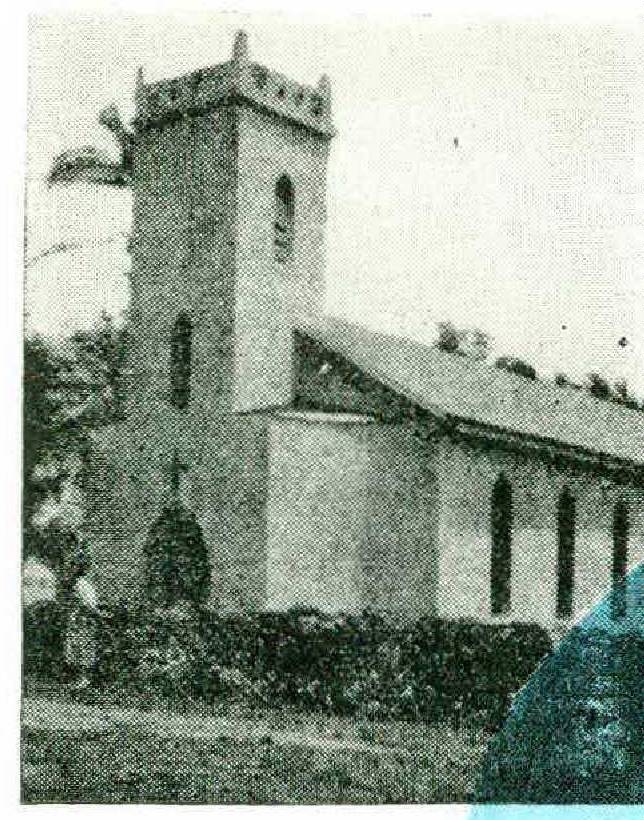
Kalawao is now uninhabited, a place of remembrance. Yellow day lilies grow rampant beside the low lava-stone walls that once marked the roadway’s entrance to the original settlement. Brown cattle graze in the meadows around the Protestant church of Siloam, built in 1871, with its gabled porch and pointed white wood spire diminutive against the rearing background of the pali. Father Damien’s church of St. Philomena lies a few paces nearer to the sea. Its square stone bell tower is silent these days except twice a year, when memorial Masses are celebrated there. Beside the black marble cross marking Damien’s original grave to the right of his church are a dozen or so gray sepulchers with headstones all facing out to sea. Here fie his first helpers in the task that confronted him after his arrival in May, 1873.
The lava subsoil in which he helped to hack their graves is covered with lawn now, and coco palms bend over it to make arched frames for the view of the blue Pacific beyond. The greensward continues unbroken to the edge of rugged lava cliffs that drop in rough black chunks to the creaming surf below. This wide sloping greensward beyond the two churches is named Baldwin Park. The ambulatory patients of Kalaupapa come here often on Sundays for special festivals and barbecues. Church services are held in the small pavilion erected on the highest point, where Catholic, Protestant, and Mormon clergy take their turns on the festival days.
The trade winds drive hard upon you as you stand gazing at the wild and lonely seascape. Imagination strives to revive, and cannot, the terrible scenes that took place on this land’s end when a thousand hopeless sufferers peopled it. It is all so quiet now, so exceedingly beautiful with its flowered meadows running down to the sea. In the wooded folds of the towering cliffs live the only creatures continuous since Father Damien’s time — the wild goats. Nowadays, says our driver, the livelier citizens of Kalaupapa sometimes climb those cliffs and capture a baby goat, which they bring back to the settlement and domesticate.
THE village of Kalaupapa seemed somehow much busier when we returned to it from the memory garden of Kalawao. A maintenance crew of stalwart patients was trimming palm trees in a shady street. We ate our lunch of hard-boiled eggs and bananas on the porch of a visitors’ cottage near the landing. There was a noonday hum in the air, and occasionally we heard the sound of dishes. Behind the screened windows of nearby cottages the more helpless patients were being fed by their housemates.
It was wise to leave the visit to the infirmary and the Bishop Home until the last. Father Gustave received us in his cottage and told us, by way of introduction, that he was the first Belgian priest to be assigned to Kalaupapa since 1897. He had been just two months in his new post and was still learning his way around the parish, which, apart from its singular location, had certain health restrictions; he was not, for instance, permitted to enter into any active patient’s house. He did, however, visit every Catholic patient daily in the infirmary and the Home, bringing them Holy Communion and what spiritual solace he could.
On the way to the infirmary, we paid our respects to his church just across the quadrangle of lawn on which his cottage fronted. It was like any other small well-kept parish church save for one detail. It had no confession boxes. The confessional was a frame of wooden lattice set up just behind the communion rail at the foot of the main aisle. “Easy for the blind to get to it without needing anyone to lead them,” said the Father. Many of his sighted parishioners would have preferred the privacy of a closed confessional, but as long as there were blind among them who knew their way to this familiar old setup, he supposed that it would remain. The racks behind every pew, overflowing with well-thumbed missals, testified to his large and faithful flock. We had no awareness of segregation in his church until the Father caught us kneeling in the regular pews, and gestured to four short rows up front on a side aisle which were reserved for the nuns and for visitors.
Had there been a patient in the church, he explained, that patient would doubtless have done the same thing. It was extraordinary how watchful they were over the healthy who came to visit them. He related an event of his first days when he was making the acquaintance of his people. He was attending a barbecue, playing cards with three patients, of whom one was a temporarily arrested case. This man kept a small pad of wet paper beside his place, on which he moistened his thumb when his turn came to deal the cards. Though he no longer carried the contagion, he took no chances in the presence of a newcomer.
“You’ve probably noticed their charitable watchfulness over you,” said Father Gustave, “when you’ve impulsively extended your hand upon introduction. They have such gracious ways of avoiding the proffered handshake.” We recalled a young woman in the administration building to whom we had been introduced. Now we understood why she had excused herself from taking our hand, remarking that her own was soiled from the mimeograph work she was doing.
In the infirmary, and later in the Home, we visited some of the older patients whose malady was far advanced before the era of the sulfones. These were the living witnesses to what leprosy, long unattended and unchecked, can do to its victims. Some of these advanced cases had been there for a decade or more; most of them would probably die of old age, thanks to the great care given to them now.
For us, their physically devastated bodies were like the living artifacts of Kalaupapa’s yesterday. They were reminders of the time when all who were cast upon this island became sightless, fingerless, sometimes throatless (but tracheotomies permit them to breathe now); when this was the fate of nearly everyone in whom the corruptive Mycobacterium was found. These cases, I am sure, are not for the average tourist to see; many indeed would not wish to. But for those who do there comes a terrific upsurge of faith in the progress of mankind. The true wonder of the peaceful, unscarred, New England-like village outside the infirmary windows becomes overwhelmingly apparent here as you see what might have been, had generations of medical men not had the courage to find a way to conquer the dread disease.
The quiet nuns who accompanied us spoke up vivaciously in the presence of their blind patients. Their familiar voices, describing their visitors, brought to the ruined faces they addressed expressions which you must learn to call smiles here. Their own smiles, framed in starchy coifs, had by contrast an unearthly beauty as they bent over their charges to rearrange a dress collar slightly askew or to pat a crippled hand outstretched to them. You need see only one of these pre-sulfoneera patients to understand the battle lines drawn up before so many areas on our earth today, where — by current census — only some 10 per cent of the estimated four million victims of Hansen’s disease have been brought under care. The statistics of the great leprosy foundations, national and international, come alive in these quiet rooms with terrible urgency.
As we took our last walk through the settlement, we seemed to be seeing it as Father Damien might have at that moment — with a shock of thankful surprise that it was all so exceedingly peaceful now. The almost total absence of any sign of suffering on the faces of his erstwhile “children,” the sense of hope pervading the efficient little community, the pride and the privacy of these set-apart souls — all these things struck with fresh wonder.
We said our real good-by to Molokai Ahina — Molokai the Gray —from our plane aloft. There was no gray anywhere on the Kalaupapa peninsula. The late afternoon sun turned the fronds of the coco palms to clusters of gold swords, which the trade winds seemed to be shaking at the purpling pali. The sea around the bright finger of land “where martyrs live forever” was a deep delphinium blue.