Research Project
A down-East editor widely known for the pungency of the columns he wrote for the Lisbon Falls ENTERPRISE, JOHN GOULD is also the author of many books and articles about life in Maine.
Being an old down-East beachcomber from ‘way back, I’m astounded to learn that the American Philosophic Society has been publishing reports from college professors who have recorded the “folklore” of the old coots in the State of Maine. I’ve been reading what one of the professors has just brought out as his findings.
One of the worst things you can do is wave a professor in front of a down-Easter. It makes the professor giddy, and is a bad thing. Particularly in the summertime. Anyway, this professor got a grant and a tape recorder, and he went to Jonesport for three weeks in the wonderful month of July — when Jonesport is abloom on every hand, and the ferocious lobster sings in the pot, and the sea and sky are a symphony of unbridled beauty, and anybody can have a good time whether he is a professor or not. If it ever befalls me to have a grant from the American Philosophic Society, I hope it comes at a time when Jonesport is having July, and I am free to participate for three lovely weeks. This professor refers to his three weeks in Jonesport as a “field trip,” and I am willing to do that, too.
But this business of making academic grist from the down-East giveand-take bothers me. For some little time I’ve been fraternizing with these same good people who are now in the clinical amphitheater of the folklore set. And the one thing I have learned, if I may be permitted a flourish or two with the demonstrator’s scalpel, is that you have to belong before you can play. Any situation which insinuates a nonmember into the line-up creates an automatic artificiality. A professor with a tape recorder is not likely to bring away the real thing — however good his catch appears to his patrons.
This professor reports that he heard of “a humorist with considerable local reputation,” which is a tipoff. He then cultivated this humorist and got him to yarn off a slew of well-worn stories, after which he set up his sound equipment and had the humorist repeat everything for scientific analysis. You can tell, because the professor introduces each specimen with a query like this:
“What was the time you won a horse on a raffle?”
The story about winning a horse on a raffle is standard with these humorists with considerable local reputations, and any legitimate Stateo’-Mainer instantly knows what’s coming. The professor is now filling his tape with a doozie most of us have been trying to suppress. The gist is that a man with a dead horse sold raffle tickets on him, and the winner discovered the defunct state of his prize only when he came around with a halter to lead it home.
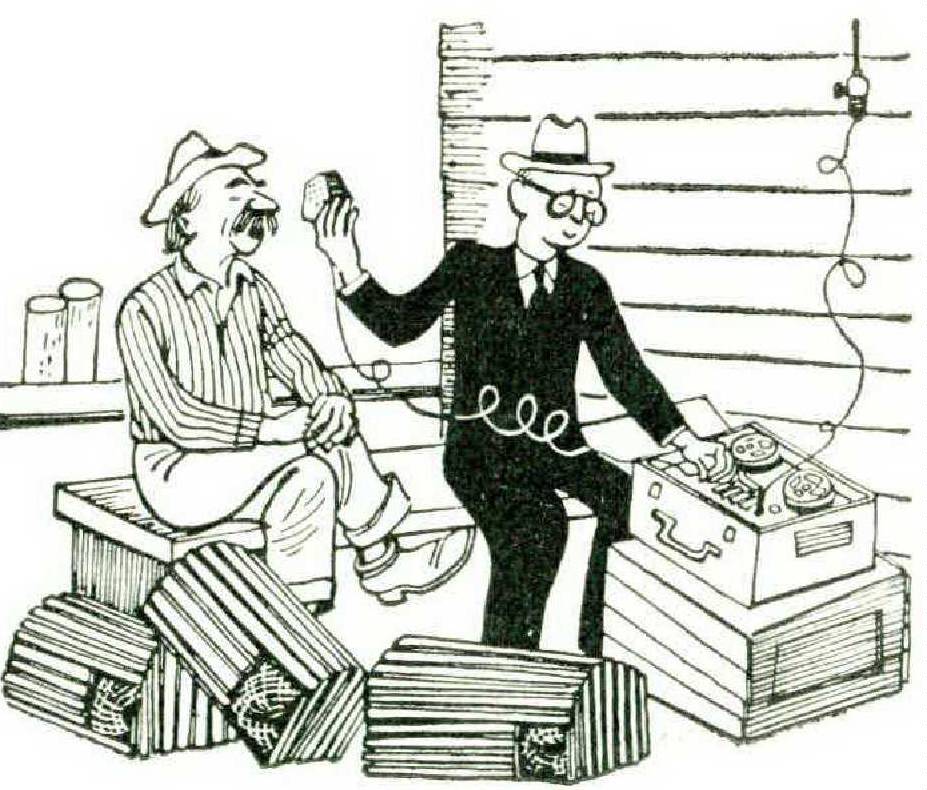
One of the saddest things in my life has been the number of times I’ve set up a conversational opportunity which I hoped would prove productive of another chapter in a downEast book, and had some humorist with a considerable local reputation waste it by the recitation of the deadhorse raffle. Only by the exercise of great generalship have I been able to save such situations. From Kittery to Fort Kent, from Passamaquoddy to the Magalloway, this story of the dead horse has been a plague to all Maine authors since earliest times. Sometimes it is a pig, or a cow. But mostly it is a horse. One of the first things to know, around these parts, is never, never, never to ask, “What was the time you won a horse on a raffle?”
The raffle of the dead horse has now been published, however, and the surging-forward motion of American scholarship has been given new momentum. The only thing we can do is study the version recorded and published, and I am disappointed. There is only one damn in it, and nothing else to give it thorough down-East authenticity.
All Maine writers have lamented consistently that so much of what is said up and down the coast runs to unprintables. Our hardest job is to take some simple, expressive, even poetic effusion by one of our better folklorists and rephrase it so an untutored editor in a distant city will print it. This professor has come up with a simon-pure version of the dead horse which none of us veterans has ever heard before. This is a fraud on the American Philosophic Society, in a way, and a deceit on the listening public. If I were to submit the horse raffle the way I’ve always heard it, it would run more like this:
Professor: What was the time you won a horse on a raffle?
Humorist: Well, you see, this ......., he sure...... me good and proper. Sunday, twas, and a ......................if he didn’t. This...........sells me a...... ........ticket. .... horse, and they. . and.........and I won. I took a........halter ......and........ horse was dead.
Perhaps the American Philosophic Society would like to make me a small grant, enough for three weeks in Jonesport in July, so I might compile a complete list of down-East folklore words to be inserted, with directions for inserting, in the published results of other folklore scholars. Although the same list could easily be done in two weeks at Cutler or Columbia Falls. Either way suits me.