Contemporary Italian Writers: A Survey of the Literary Scene
1
EVER since the late Middle Ages, Italy has been giving the world great works of literature, but books were for centuries chiefly the concern of the more prosperous, and, to a degree, this is still true today. Although our novelists may often write about working people and the country villages, their reading public is found among the middle classes. It is a growing public, but not a large one when compared with those in England or France. Nevertheless, Italian publishers are enterprising, and, since the War, the intellectual climate has been stimulating and favorable to serious, highquality literary production.
The two decades of Fascism were a difficult period for Italian writers. The regime supported the myth of a culturally superior “Latin race,” which should not be corrupted by the “decadent.” new movements then evolving in other countries. It discouraged the circulation of ideas which did not serve the interests of an inflexible social order. The result, for the reading public, was a vacuum in which mediocrity was, more often than not, the rule. Of the writers who would not conform, some, like Silone or Borgese, went into exile; others remained in Italy, writing for themselves and their friends, or publishing little. In spite of censorship, there existed throughout the Fascist era an informal “underground" of writers and readers who kept in touch with the international currents of modern literature. Though their circulations were small, such magazines as La Ronda (1919—23), Solaria (1926-36), and Letteratura (published since 1937), and, to a certain extent, Pegaso (1929-33) and Pan (1933-35) were oases of free artistic expression and the encouragement of originality.
In those dark years, the role of certain poets — Saba and Montale, for example — was especially significant. Their withdrawal from the world of the real, from the world of politics into the intimacy of their verse was made in manifest opposition to the regime and provided a key for understanding their deeply felt quarrel with that moment in Italy’s history. This applies also to the so-called prosa d’arte, a form of narrative, remote from politics, which flourished during the same period. These writings were most often inspired by travels or autobiographical experience. They were characterized by an intense lyricism and sometimes by an extraordinarily refined and sophisticated style. Emilio Cecchi and Antonio Baldini have been outstanding in this genre.
With the collapse of Fascism came a vigorous renaissance, a reawakening of our literature’s social conscience which was gradually matched by a liberation in the taste of the reading public. The relation of culture to society was posed in new terms. Our writers were again able to assume their first responsibility — to be active interpreters of a world whose values were rapidly changing. The return to our press of free political debate—even the stimulus from the extreme Left — has had a vitalizing effect on the literary scene.
It is always rash to oversimplify, and especially so with Italian culture, which varies so much from region to region. However, it may help to place the main trends of our contemporary writing if we narrow down the literature of this century to two main currents, one represented, among the forerunners, by Giovanni Verga (1840-1922), the other by Gabriele D’Annunzio (1863-1938). Let us assign to Verga the formula “word = thing” and to D’Annunzio “word = music.”
In his two great novels The House by the Medlar Tree and Mastro-Don Gesualdo (the finest produced in Italy after Manzoni’s classic The Betrothed), Verga established the school of Verismo (realism) which, carried further by such masters as Matilde Serao (1856-1927) and the Nobel prize winner Grazia Deledda (1871-1930), today includes such names as Moravia, Pratolini, Berio, Vittorini, and many others. Inevitably, political factors have played a certain part in the development of this trend. It was only natural that writers who detested Fascism and who were sympathetic to the ideologies of the Left should concern themselves with the realities of the lives of the poor. Since the War, the novelists stemming from Verga have been exploring working-class and provincial environments, as well as urban middle-class mores, seeking to express the truth about life with frankness and stark sincerity.
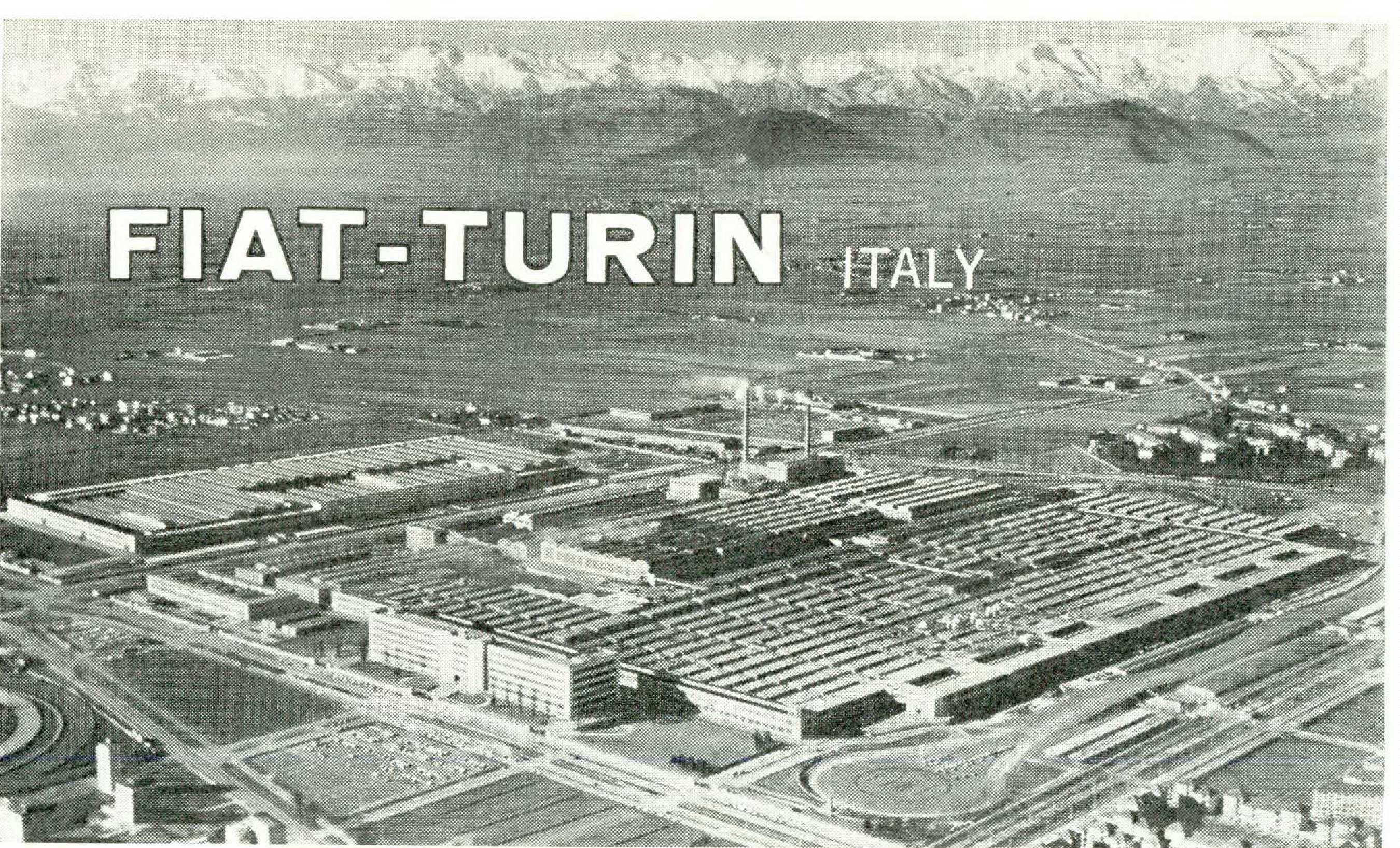
The colorful D’Annunzio — poet, playwright, novelist, and political adventurer — set a pattern of rhetorical formalism which reached its final flowering in the person and work of Curzio Malaparte (1898-1957). This tendency, with its emphasis on the sensuous possibilities of language, on musicality and stylistic refinement, has not ceased to attract gifted writers to whom the realistic approach seemed inadequate to convey the subtleties and complexity of experience. The elegance and eloquent dignity of centuries of Italian belles lettres are still a compelling force. Today, Italy may be best known abroad for her realist novels and neorealist films; it would be wrong, however, to infer from their popularity that the tradition of Verga has completely carried the day over that of D’Annunzio. Though the two main streams run parallel, there are many connecting branches, and often, in individual writers, their waters are mixed. A general view of the Fiat Mirafiori automobile plant in Turin. Fiat has 18 other plants where trucks, tractors, marine engines, airplanes and aviation engines are made. In sixty years the Fiat work force has grown from 50 to 80,000 employees. For the last two years, after having first set up a network of dealers, service stations and stocks of spare parts, and having
In a short article I cannot do justice to the work of all of our leading writers. Let me speak, then, of some few who may serve to exemplify the various trends. Many, of course, do not fit into any “school" and deserve an ampler individual treatment than is possible here. I shall cite titles available in English translation even though they may not happen to be a given writer’s best books.
A towering figure in the older generation is Riccardo Bacchelli (born in 1891), whose great historical trilogy The Mill on the Po is the one truly majestic novel produced in this century in Italy which is in the tradition of Manzuni’s classic The Betrothed or of the nineteenth-century French and Russian masterpieces. It is the saga of three genfitted out three ships to transport cars. Fiat has been selling its automobiles in the United States, where it is represented by the Fiat Motor Company Inc., 500 Fifth Ave., N. Y. C.
erations of a family living on the banks of the Po River; against a carefully drawn historical background, both rural and urban, Bacchelli has created in depth a varied group of characters whose stories are rich in meaning because of the moral seriousness with which he has developed them.
The work of another older writer is less well known abroad than it deserves to be; few reputations in Italy are more solidly established than that of Aldo Palazzesehi (born in 1885) a novelist and storyteller of inexhaustible vitality. A subtle satirist, Palazzeschi blends laughter with melancholy in tales which are a genial mockery of man and the world.
Alberto Moravia (born in 1907) is a consummate master of narrative technique. He has published five distinguished novels (The Time of Indifference, The Woman of Rome, The Conformist, A Ghost at Noon, and Two Women), such impressive short novels as Conjugal Love and Two Adolescents, and many short stories, including some that are surrealistic or satirical. The central vein of Moravia’s work reveals an acute penetration of the moral fabric of the contemporary world, most often that of the Italian bourgeoisie. With merciless detachment, he pinpoints the many kinds of malaise which gnaw at human beings, making them strangers to each other, enfeebling them even when they seek purification.
Moravia deals with crude but very real themes drawn from everyday life. Some readers are repelled by Moravia’s work; they tell us that his inspiration feeds on squalor and that he is preoccupied with sex to the exclusion of other motivating factors. True enough, perhaps, but few writers have explored the psychological labyrinths of modern man with so much insight. Like that earlier great Italian psychological novelist, Italo Svevo (1861-1928), the author of The Confessions of Zeno and As A Man Grows Older, Moravia cultivates an objective, simplified, almost flat style which scorns all decorative artifice.
Corrado Alvaro, who died in 1956, has left an indelible mark on contemporary Italian writing. In such novels as his Man Is Strong, he brought to the realist tradition a rare feeling for the poetry in simple things and a delicate, almost lyrical touch for characterization. His chronicles of the impoverished but stoical peasants of Calabria, such as Gente in Aspromonte, are infused with a gentle sadness that is deeply moving.
With Elio Vittorini (born in 1908), realism took on a decidedly social character, though, as with Alvaro, the approach was highly personal, and imbued with a tone of melancholy, yet ever humorous, fatalism. Vittorini had been translating Saroyan and Hemingway in the period when he wrote his little masterpiece In Sicily (1938), and the influence of the Americans is evident in his studied simplification of style and use of repetitive rhythm. In Sicily was an important landmark in the transition to modern writing. It broke sharply with the convention of a strong plot line for fiction, making its impact more through atmosphere than act ion. The book’s Italian title was “Conersations in Sicily,”and, like Hemingway, Vittorini relies heavily on dialogue to create a verbal tone which establishes the background mood of his stories.
Since In Sicily, Vittorini has published a number of impressive books, including The Red Carnation (the story of a young student who becomes emotionally involved with a prostitute), The Twilight of the Elephant (a wonderfully comic fable of the optimism of the unemployed), the as yet untranslated major novel Women of Messina, and La Garibaldina, to be published here next year.
It should be noted that there is an avid interest, both among Italian writers and readers, in the contemporary American novel. Almost all of the leading serious novelists of the United States are quickly translated and published here. Cesare Pavese, a brilliant and tragic figure who took his own life in 1950, was another important novelist who learned his craft while translating American fiction. Pavese’s The Moon and the Bonfires and Before the Cock Crows, in which he attempted to “transform chaotic daily reality into thought and imagination,”were very popular.
In a sense, the realist tradition can also claim Vasco Pratolini (born in 1913), whose large-scale social frescoes A Tale of Poor Lovers and Metello depict the life of the working-class districts of his native Florence. But again, in Pratolini’s glowing human sympathy, there is a strong lyrical element.
Among the writers who are somewhat more politically oriented, Ignazio Silone (born in 1900) and Carlo Levi (born in 1902) are outstanding. One of the earliest exiles from Fascism, Silone published his Fontamara from Switzerland in 1931. It was at once a profound attack on the Fascist order and a passionate plea for the depressed and long-suffering peasants, the cafoni, of the Italian South. Silone was born in a little village of the Abruzzi and for nearly thirty years he has been writing about the people of that region whom he knows so well— most recently in the just published Secret of Luca.
Carlo Levi had a very different background from that of Silone. He was born into a cultured family in Turin and became a doctor. Under Fascism, he was obliged to live in a primitive village in Lucania. In his most famous book, Christ Stopped at Eboli, he described what he found there, and its success helped to focus public attention on conditions in the South. Levi’s temperament is so exuberant as to verge on the baroque. The “narrative essay” technique which he uses in his fiction is one of the more interesting variations on the form of the novel which have so enlarged its scope today.
Lack of space compels me to slight a number of distinguished writers who certainly deserve serious attention; but I must at least name a few who are representative of the various generations. Among the older masters we cannot pass over Massimo Bontempelli (born in 1878), who has created a “magic realism" all his own; Marino Moretti (born in 1885), author of some forty impressive novels; Bruno Cicognani (born in 1879), whose exquisitely Tuscan spirit defies translation; and Enrico Pea (1881—1958), whose Moscardino has been brilliantly translated by the poet Ezra Pound. These four writers are very different from one another, but they have in common a relentless power of inspiration which infuses their creations, be they naturalistic or surrealistic. Among somewhat younger writers, Carlo Emilio Gadda (born in 1893) and Bonaventura Teechi (born in 1896) have reached a place of importance in contemporary fiction: the former, with his extraordinary verbal inventiveness, the latter with his remarkable psychological insight.
For the middle generation I must mention at least eight names: if only to give some idea of the variety that now animates the Italian novel, short story and essay. There is Giuseppe Marotta (born in 1902), with his colorful sketches of Naples, and the allegorical Dino Buzzati (born in 1906), sometimes compared to Kafka. There is the filmdirector Mario Soldati (born in 1906), sensual and ironical in his own nov els, such as The Capri Letters, and Guido Piovene (born in 1907), who reveals an uncommon perception in essays, travelogues, and novels; Vitaliano Brancati (1907-1954), who has left us in his Bell’ Antonian bit ing satire of Sicilian middle-class life; Tommaso Landolfi (born in 1907), some of whose fantasies have recently appeared in Encounter; Pier Antonio Quarantotti-Gambini (born in 1910), with his tender stories of love among the very young; and Giuseppe Berto (born in 1914), with his poignant tale of children in wartime, The Sky Is Red. Among our group of accomplished women novelists, I would cite especially Gianna Manzini, who has reached, in certain pages, an exceptional lucidity of style and image. Natalia Ginzburg’s Light for Fools, Elsa Morante’s The House of Liars, and Alba De Cespedes’s The Secret have been published in the United States. Finally, among the youngest generation, the terse Carlo Cassola (born in 1917) and the powerfully satirical Italo Calvino (born in 1923) are outstanding.
2
FOR most educated Italians, poetry is still the heartblood of literalure. As has been pointed out, the refusal of our best poets to come to terms with Fascism had great symbolic impact during the black years. Yet it must be acknowledged that their stand often led them toward isolation from the general public. Withdrawing into themselves, their poetry became interior and commensurately difficult. In fact, the term which is most frequently used to designate the work of such men as Ungaretti, Montale, and Quasimodo, is “hermetic. And, although it might have been anticipated that the political liberation would signal a return to more open communication in poetry, this has become noticeable only to a limited extent among the most gifted of the younger generation. Poets such as Mario Luzi, though not lacking in originality, are extending the tradition of the hermetic school, pursuing the search for self-recognition in the intimacy of a personal world.
Giuseppe Ungaretti (born in 1888) wrote most of the poems of his finest collection, Joy (L’Allegria), during the first World Mar. Historically, he descends from the French symbolists, but, in broader terms, he is kin to all of the poets of this century, in so many countries, who have sought to restore directness and purity to the language of poetry. Like the Imagists, Ungaretti has returned to the essence of the word, eschewing all rhetorical superfluity. He employs, if you will, a kind of shock treatment on words to restore their freshness and impact; const met ing more by association than logic, he takes words out of the familiar contexts in which their force has been weakened by over-use; in his now patterns, the words themselves again become new, recharged with meaning. The evocative power of verbal sound is also exploited to the full. It is a poetry of highly personal statement, of instantaneous intuitions, which, for all its severe economy — some of his finest poems consist of only a few lines, or a few words— casts a deep spell. In his later books, such as Grief and The Feeling of Time, Ungaretti has moved toward more relaxed forms, and a somewhat more religious accent has become perceptible.
Of a more mystic than religious inspiration is the work of Eugenio Montale (born in 1896), who is sometimes compared to T. S. Eliot. The fame of this very gifted poet rests essentially on the collections Ossi di seppia (Cuttlefish Bones), published in the early years of Fascism, and Le occasioni, which dates from the outbreak of World War II. In a period of easy optimism fostered by Fascism, Montale created a vitreous world which hope could not enter, in which the symbols of a barren landscape represented the withered heart of man. In these poems the poet accepts the fact that his pain cannot be transmitted; he endures it, taking comfort in nostalgic recollection and in awareness of the dignity that remains in the “daily decencies" of life. Less revolutionary than Ungaretti in his technique, Montale is perhaps more so in the substance of his poetry. His influence on younger poets has been great.
Umberto Saha, a native of Trieste who died only last year, was a more traditional and a less “ hermetic" poet than Ungaretti and Montale. Consequently, his work, in the collection Il Canzoniere, had access to a somewhat larger public. The atmosphere of everyday life—both its sadness and its happiness — gave him his characteristic theme, and he painted a world of human affections, of melancholy and Heeling dreams with spontaneity and candor. His wealth of attitudes and tones might be mistaken for facility but it is, instead, an aspect of a rare and inexhaustible gift for song.
Salvatore Quasimodo (born in 1901) is assured of lasting fame because of his superlative translations of classic Greek and Latin poetry. He carries over into his original work a flawless verbal taste and the ability to recreate the idyllic aura of legend and myth. It is deplorable that he has occasionally permitted political interests to muddy his inspiration; a recent poem dedicated to the Russian sputnik is a sad example of this deviation from true poetry.
Among our older poets, I must mention Vincenzo C’ardarelli for his classical sense of measure and moral overtones, and among the younger group, the gifted lyricists Alfonso Catlo and Leonardo Sinisgalh, and among the poets of a social-political tendency, Pier Paolo Pasolini.
Although little of their work is available in translation, except for that of such important figures of the earlier part of the century as the philosophercritic Benedetto Croce (1866 1952), the spokesman for Catholicism Giovanni Papini (1881-1956), and the scholar-critic Giuseppe Antonio Borgese (18821952), I must at least mention a few of the leading names in the field of criticism, notably those of Pietro Pancrazi (1893 1952), for many years the most authoritative and equilibrated voice of militant criticism; Emilio Ceechi (born in 1884), a master of the essay form and a major critic of art and letters; Francesco Flora (born in 1891), a literary historian with remarkable insight into the nature of poetry; and Giuseppe De Robertis (born in 1888), w ho has applied a fine sensibility to both classic and contemporary Italian letters.
I hope I have managed, without too many grievous omissions, to convey something of the variety, as well as the vitality, of the contemporary Italian literary scene. However, we can only be amazed at its vigor when we examine the physical situation from which it springs. Although in an average year, some eight thousand new books are published in Italy, almost none of them sell well enough to support even the most famous aulhors. The bookbliving public simply is not large enough. I doubt if there are half a dozen first-rate creative writers in Italy who are able to live on their domestic book royalties alone. Thus, unless he has independent means, an Italian writer must have a profession or support himself by journalism, film-writing, radio work, and the like. This is hardly an encouraging picture, and yet, — interpret the phenomenon how you will it does not seem to discourage our writers, or to diminish their creativity.
Translated of by Ben Johnson