Drums, Dance, and Song
Research fellow at the University College of Ghana,J. H. KWABENY NKETIA is now in America on a Rockefeller koundalton fellowship. 1 composer and the author of several papers on musicology, Mr. Xkelia recently received the Cowell Award from the African Music Society for his monograph on funeral dirges of Ihe Akan people.
J. H. KWABENA NKETIA
THE techniques and repertoire of traditional African music are handed down by word of mouth. There are skilled musicians who make music their profession. However, participation in music is generally expected to be spontaneous and unrestricted. The professional musician receives gifts and payment in return for his services, and his role is to provide the required musical leadership. But the success of an occasion is judged by the display of techniques and knowledge and by the extent of group participation and general enjoyment.
Traditional music in Africa is thus essentially folk music organized and practiced as an integral part of everyday life. One hears music everywhere: the woman sings while fetching water from the well, grinding corn, or nursing her baby; the street vender attracts her customers with song; men at the beer shop make music themselves or listen to wandering musicians.
There are few formal occasions on which some type of music is not heard. In many parts of Africa a baby is named at a special ceremony on the seventh or eighth day after birth. Relatives and friends of the parents are present. The details of the naming ceremony vary but usually include rites of consecration, libation, and prayer, formal welcoming of the child into the system of kinship relations, formal acknowledgment of parental and kinship obligations, and the giving of gifts.
Transition from girlhood to womanhood is another event that is celebrated with music in many African societies. Eligible candidates of the Adangme of Ghana are admitted into the dipo (puberty) “institution” for instruction in mother craft, in the special music and dancing of the transition rite, and in the customs and history of the society. They are put on a fattening diet so that they may look plump and beautiful on graduation day.
Musical processions to ritual places, feasts in the home, drumming, singing, and dancing parties for young and old, and a series of public activities mark the end of the training. Each girl is richly adorned with precious beads, gold ornaments, and ankle buzzers, and there is a display of music and dancing in the market place. For several days afterwards the girls go around the town performing the dipo dance and collecting gifts of money from those who watch them.
Marriage celebrations, particularly among African peoples who do not have elaborate puberty rites, include much music and dancing. A wedding day is usually the culmination of intense negotiation, for the consent of kinsmen must be obtained and formally sealed before the wedding can take place. The music and dancing are primarily for entertainment, but in effect they make a public proclamation of the happy event.
The performance of music at weddings, however, is not as widespread as music at funerals, where there are ceremonial dirges and funeral songs and dances. If the deceased belonged to a band of musicians or to some social group with its own forms of music and dancing, the music in which he participated during his lifetime would be performed at his funeral. An African funeral is very rarely a quiet one.
When the last breath is drawn, the body is cleansed and the hair and nails dressed, because the corpse must be meticulously groomed for the inevitable journey. Messengers are sent to inform all relations. The body lies in state. The doors are flung open. Wailing does not become a man, but the women relatives flock to the bedside in grief, and the funeral wail is begun. Cries of “O Father, O Grandfather, O Uncle, O Brother,” depending upon the relationship of the mourners to the deceased, are heard. Grief is personal and private, yet African societies expect that at a funeral it should be publicly expressed through the singing of the dirge. Tribute to the deceased, sympathy for the bereaved, renewal of bonds of kinship, expressions of the worth and deeds, good or bad, of the deceased may be conveyed through the dirge. The singing is usually accompanied by gentle and graceful rocking of the body and head. The mourner turns left and right to greet the people and to thank them for their sympathy.
WITH the African, the dance is always an important consideration during the performance of music. He enjoys dancing and likes to express himself through it at a variety of social functions — at funerals as well as weddings, in times of crisis as well as on happy occasions. Such is the prestige of dancing that in some African societies chiefs are expected to dance at public functions, while priests and messengers of the gods are similarly expected to perform special dances on occasions of worship.
The organization of dancing in community life accordingly goes hand in hand with the organization of music. Indeed, sometimes a musical type may be identified by the dance form or style of dancing with which it is associated.
Many musical types are used in African societies. Spontaneous expressions or extemporaneous creations generally derive their inspiration from existing musical or dance forms. Each musical type may consist of several distinctive individual items or stylistic variations. Instrumental types are for the most part limited in this respect. In the case of a song type (for example, funeral dirges), however, the number of individual items may run into scores of verses. Some musical types are designated as recreational music and may be performed at any convenient time. Some are habitually used as incidental music to other activities, such as storytelling and manual labor, while others are restricted to special occasions.
Musical associations, or popular bands, specializing in one or more types of recreational music and dancing arc a feature of African social life. Occupational, heroic, and religious associations may each have its own musical type and forms of dancing. The royal courts of Africa have their own songs or instrumental music, which may be performed at the palace or on special occasions by trained musicians.
Vocal music offers the best opportunities for group participation. With a single drum to provide a background of rhythmic accompaniment, or a gong (cowbell) or clapping of the hands to outline the pulsation of the music, a community will go on singing and dancing interminably. The absence of an indigenous tradition of writing makes the song an invaluable medium for recording traditions and for creating social commentary and criticism. Accordingly, topical songs, songs of insult, and songs of incitement form part of the repertoire of many African societies, and the skilled singer is allowed to make spontaneous additions or re-creations of lines of familiar songs.
Such is the interest in the song as an avenue of verbal expression that even in cradle songs mothers have the liberty of making statements which are of no particular interest to the child.
If you divorce me, you cannot take away my child.
Little one, come for a feed.
But you are my own.
Someone wished she had you to nurse you on a good mat.
Someone wished you were hers:
She would put you on a camel blanket.
But I have you to rear on a torn mat.
Someone wished she had you, but I have you.
An African song can thus be judged not only by its tune but by its total expression. Words and melody are complementary, and one may compensate for the inferior quality of the other.
ALTHOUGH considerable importance is attached to singing, the development of instrumental music has not been neglected. In African societies one finds many musical instruments. Sometimes they are used alone, and sometimes in combination with voices to provide music for the dance. Though often made of simple materials, these instruments reflect the same kind of acoustical principles that underlie the manufacture of similar instruments in the West, except that they may be tuned differently or a different quality of tone may be sought in their construction.
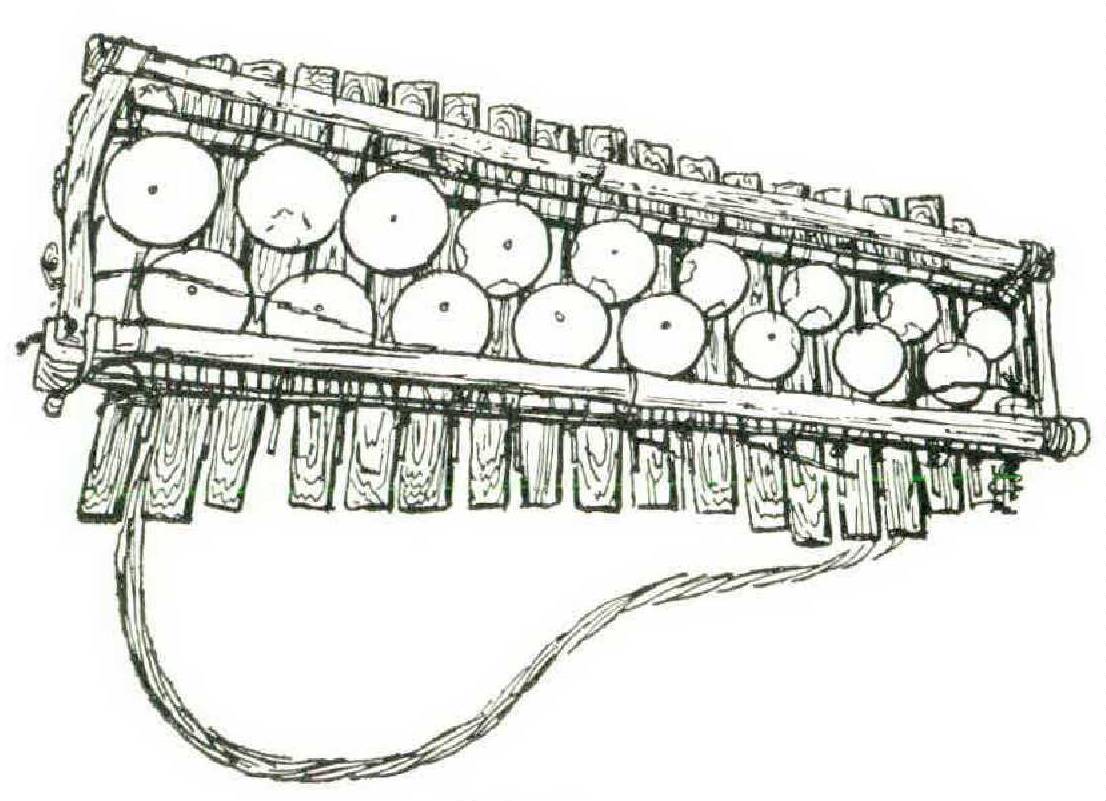
One of the most common types of musical instruments is the idiophone. The use of gongs (cowbells), rattles, stick clappers or wood blocks, and stamping tubes is widespread in Africa. On some occasions they may be reinforced or replaced by hand clapping or in dance situations by the noise of stamping feet, ankle bells, or buzzers worn on the body. The Caribbean and Cuban traditions of persistent percussion — maracas, wood blocks, cowbells — are derived from African music.
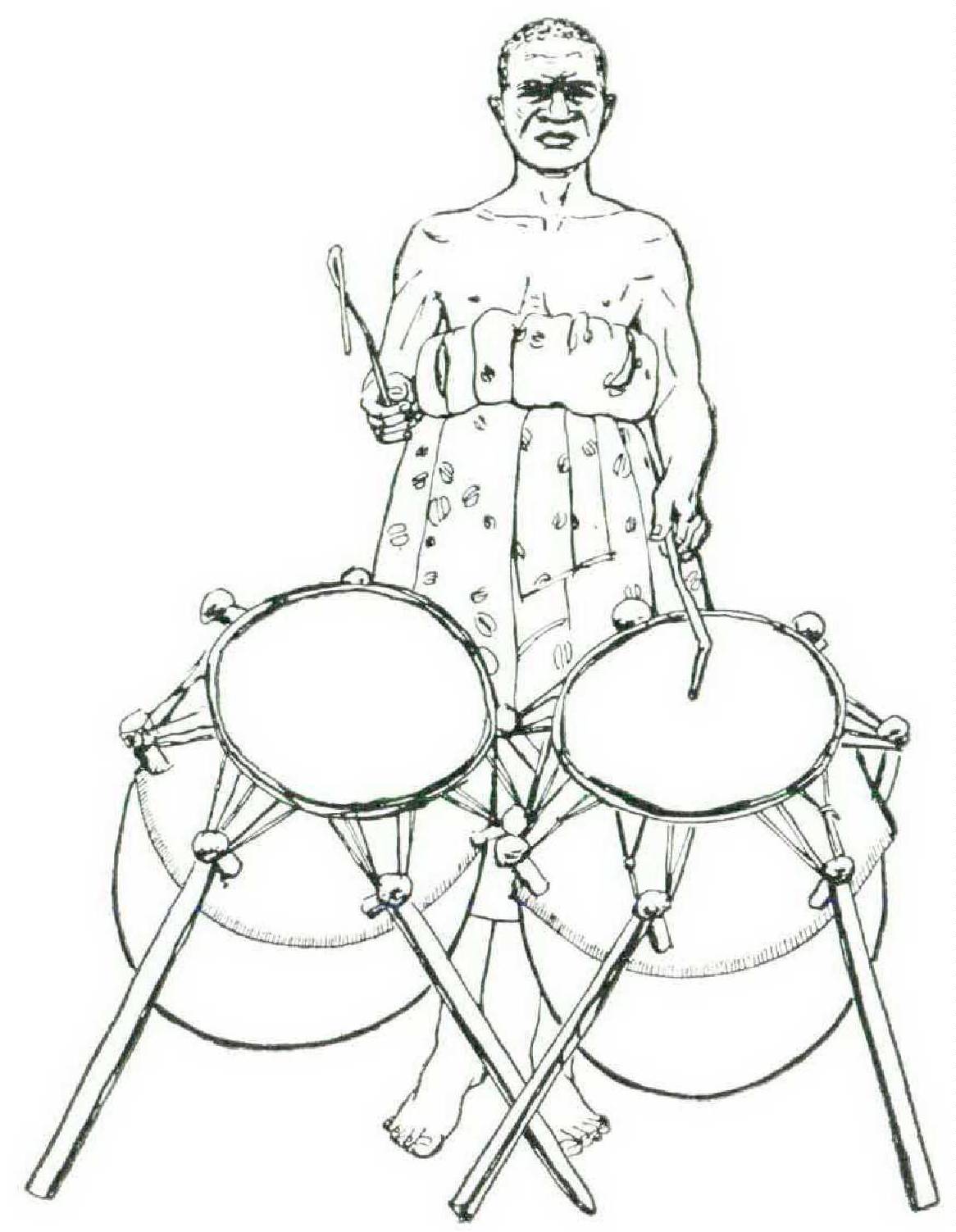
Of even greater importance than idiophones are drums. The Africans’ use of this instrument is unique when considered in terms of technique, rhythmic procedure, and the modes of meaning it can convey. Drums are usually graded in tone quality and pitch. There are hourglass drums, goblet drums, kettledrums, open and closed bottleshaped and cylindrical drums, pot drums, gourd drums, and frame drums. A number of different techniques are used to bring out the essential tone and rhythmic potentialities of each drum.
In addition to music, African drums may be used for giving signals — call signals, warning signals — or for reproducing speech. The latter is done by the drummer’s imitating the rhythm and intonation of speech texts. Such texts may be played alone or incorporated into a dance piece.
The following proverbs played on Akan drums form part of a dance piece. There are over seventy drum proverbs which may be used in this context.
The river has crossed the path.
Which is the elder?
We made the path and found the river.
The river is from long ago,
From the creator of the Universe.
Duyker Adawurampon Kwamena,
Who told the Duyker to get hold of his sword?
The tail of the Duyker is short,
But he is able to brush himself with if.
‘I am bearing fruit,” says Pot Herb.
T am bearing fruit,” says Eggplant.
Logs of firewood are lying on the farm,
But it is the fagot that makes the fire flare.
Duyker Adawurampon Kwamena,
Who told the Duyker to get hold of his sword?
The tail of the Duyker is short,
But he is able to brush himself with it.
I hesitate to explain these proverbs, owing to the saying in Ashanti: “Only to a fool must a proverb be explained.”
Drums and idiophones are the most widely used instruments, particularly in outdoor situations, but there are also a number of wind instruments. Horns are simple animal horns or the tusks of elephants treated and carved out for musical purposes. Flutes are either vertical or transverse and may be constructed out of wood, bamboo, or the bark of cane. Trumpets, found in some parts of Africa, are made of gourd or carved out of wood.
Wind instruments may be played alone or in combination with drums, drums and idiophones, or voices. They may also serve as background music. Like drums, they can be used as a vehicle of language. The following text is played by the horns of the chiefs of Ashanti:
Duodu killed in his valor.
See! The rain washes his parlor away.
Duodu, I am grieved by your death.
Alas! It is an ancient truth:
Once dead, you are gone and useless.
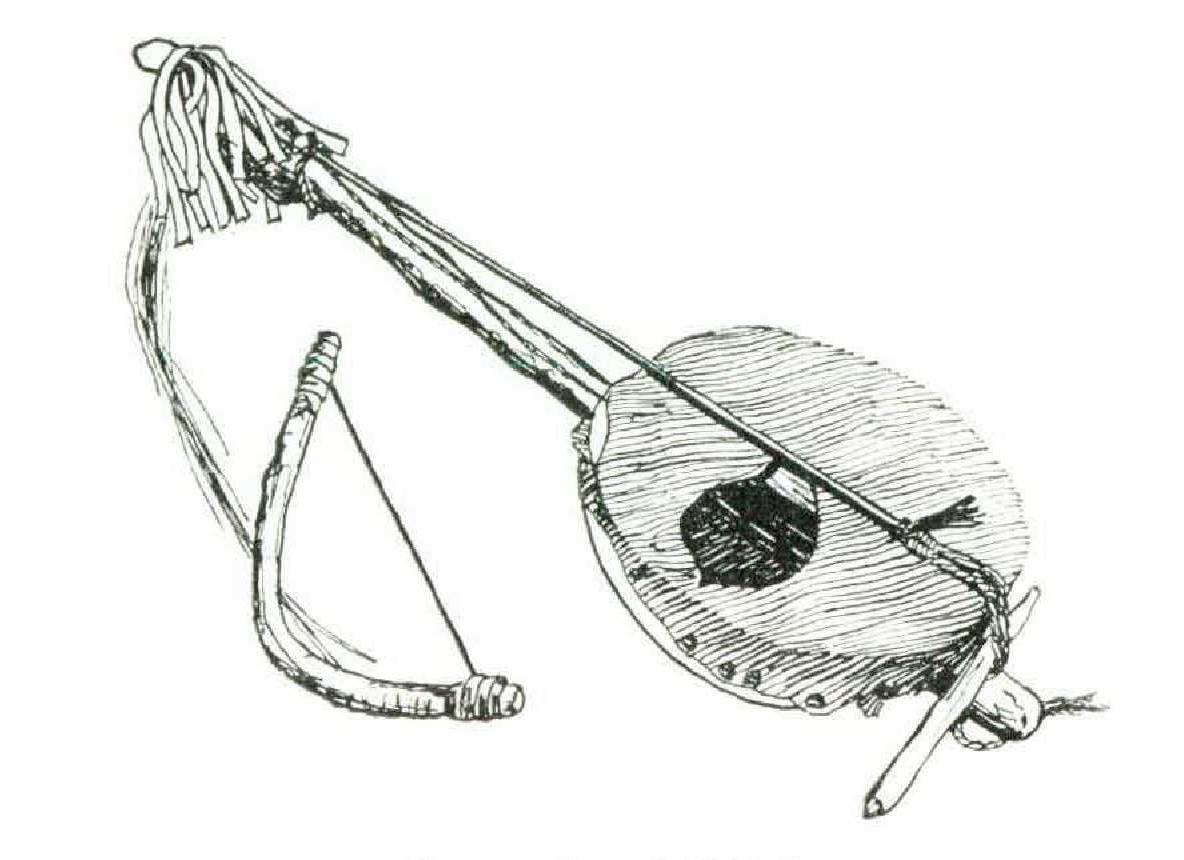
Stringed instruments include lutes of various types: plucked lutes and bowed lutes, such as the one-stringed fiddle of West Africa or the two-, three-, and four-stringed fiddles of the Congo. Varieties of zithers are found. One example is the musical bow resonated in the mouth or by means of an attached open gourd. Raft zithers and harps are used in a few places.
Stringed instruments are not as prevalent as other instruments. They tend to be played in the home for the pure enjoyment of their sound or in combination with voice. There are societies, like the Dagomba, Hausa, Tallensi. and Kusasi, which feature them for outdoor social functions.
The structural characteristics of African songs and instrumental music are derived in part from the social contexts in which they are used — which make it necessary to provide for the interplay of leading musicians and other performers or to provide for changing situations, varying forms of movement and dancing — and in part from an intensive cultural use of musical devices such as ostinato, sequence, repetition, and variation.
The interplay of leader and performers gives rise to sectional arrangement of pieces: in songs, it results in alternation of solo and chorus or antiphonal call and response parts; in drumming, the contrasting parts of the master drummer and one or more of the secondary drummers; in flute ensembles, alternating or sometimes intertwining parts of the leading flute and the response flutes; in the music of strings and chorus, alternation of string phrases and vocal parts or ostinato accompaniment. This arrangement gives the leadingsinger or player a free hand in improvisation and in determining the order of verses or variations, sequence of rhythm pattern, and the duration of the piece.
The sectional arrangement of pieces may also be determined by the dance routine. This is true of drum and other instrumental music in which dancers and master musicians collaborate in the unfolding of the dance drama. Considerations of movement determine the tempo and the metrical and rhythmic peculiarities of a piece. A song not intended for dancing, such as an Akan funeral dirge, may be metrically free, relaxed in rhythm, and lacking in regular pulsation.
There is a general tendency toward rhythmic complexity, which finds its greatest expression in drumming. Rhythm is commonly designed in terms of a series of interchanging duple and triple patterns arranged unilineally or multilineally. In the latter arrangement, cross rhythms are produced which heighten the rhythmic tensions and enhance interest.
The placement of the rhythmic phrase in relation to the beat is variable. It may start with the beat or before or after it. Offbeat phrasing is of particular interest to the African as a means of heightening the rhythmic tensions of a single line of music.
Melodies are built on varieties of pentatonic and heplatonic scales, and every African society specializes in one of these scales. The characteristic modality of African music and its simple harmonic usages are derived from these scales. Pentatonic peoples (Adangme, the Dagaraba, and the Frafra) sing in unison or octaves or make use of elementary quartal harmony — usually parallel fourths or fifths. Heptatonic peoples (the Akan, the Bulsa, the Ibo, and the Bemba) use elementary tertial harmony, dominated by parallel thirds and sixths. Triadic forms (that is, double thirds) and fifths or sevenths in contrary motion are not unknown to some of these peoples.
Melodic phrases tend to be stepwise and in a descending progression. Steep rise and fall within the phrase are generally avoided. Ornamental devices such as glissando, rising attack, or falling release may be used. Societies dominated by Islamic culture (Dagomba and Hausa) use ornamental shakes.
Interest in the verbal content of songs leads to the structural use of a variety of song styles, some lyrical or stanzaic, some declamatory or recitative in character.
In songs both the melody and the rhythm follow the outlines of the intonation and the relative duration of the syllables of the verbal text, though with some amount of freedom. Accordingly, linguistic differences between African societies tend to produce corresponding diversity in the tonal and rhythmic character of songs.
To understand African music one needs to look at it not from the viewpoint of artistic values implicit in Western music but from the point of view of values derived from African musical practice. In its setting, it is a part of a complex of activities; singing, drumming, dancing, and nonmusical activities may be taking place simultaneously, for traditional African music is essentially folk music organized and performed as part of the process of living together.