Box Score
WILLIAM O’HALLAREN lives in Hollywood, California, and is a news writer for the American Broadcast ing Company.
While the baseball season is still too young for any sweeping predictions, there seems reason to believe that it is going to be a line one, statistically, and by World Series time we will have seen a good many records shattered. Of course, it is not likely to match 1938, when sixty-seven different records were broken, giving the year an incredible average of .163 in record shattering, a feat none of us can ever seriously hope to see repeated.
Old-timers may moan for the days when a baseball season would not see more than seven or eight records done in, but they are wrong in grumbling that today’s livelier ball makes all the difference. The truth is that they just did not keep statistics as carefully in those days, and though our elders may grow indignant at this, the chances are a great many records were broken and they didn’t even notice.
Take Umpire Bacon McGurk’s unsurpassed showing in Chicago on July 8, 1953, when he was behind home plate in the Cubs-Cardinal game. We all know that was the day McGurk threw forty-two new balls into the game, an average of 4.667 an inning, an all-time major league record. Old-timers, if they are honest, will admit that before 1931 no one even counted the number of new balls thrown into the game, so the chances are that some long-forgotten arbiter actually topped the McGurk record, but because no one was counting he is lost to fame.
Carefully kept statistics prevent injustices like that and enable a feat to live on, no matter what happens to the doer. Take Tom-Tom Bentley. Few of us were at Briggs Stadium that afternoon in June of 1947 when he cracked the major league record for time consumed walking from the bull pen to the mound —an astounding eighty-three seconds — yet because the facts are preserved, we can all share in the event. Hundreds, thousands of pitchers have slowly come and slowly gone since then, but none has touched that mark. Tom-Tom’s fame is secure, even though he spent only three weeks in the majors and has since retired to his possum farm.
Many of Tom-Tom’s fans feel that if he could have been in the majors longer he might have threatened the famed seventy-two seconds for circling the bases after a home run, set by Mighty Jim Hawkins of the old St. Louis Browns on September 4, 1932. Those who saw Mighty Jim that day insist that he appeared to be in full dogtrot for every one of those seventy-two seconds. It is the sort of achievement only a Bentley could successfully challenge.
The last serious assault on the Hawkins mark was made by Frankie Whippletree, a 315-pound utility catcher for the Washington Senators, who sprained an ankle after a pinch homer in the bottom half of a twin bill against the White Sox on July 10, 1941. Despite the advantages of his weight and lameness, he still could limp across the plate in nothing better than fifty-two seconds. A creditable showing but nothing more. Yet if it were not for carefully kept statistics, many who saw Whippletree that day might have claimed it was the longest time ever taken in rounding the bases.
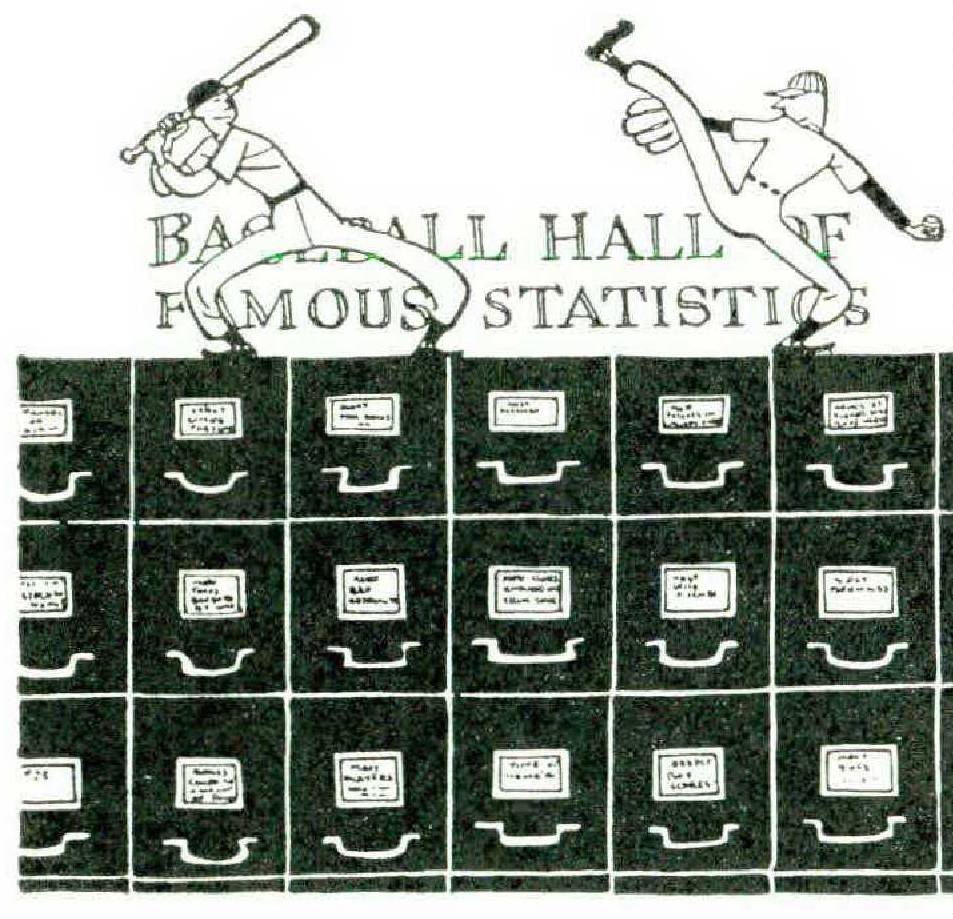
It is encouraging to note that serious consideration is finally being given to the much-talked-about Hall of Statistics at Cooperstown. True fans have long felt that the Hall of Fame was inadequate, especially because of its obsession with hitting and pitching and the results of games. All of these are worth while, but are only a part of the sport.
Present plans call for the hall to be built in the shape of a giant IBM machine with a suitable box score engraved above the entrance. There is already sharp dispute over which box score should be chosen. Fans agree it should be the game richest in statistics, but final selection has not yet been made. The BrooklynBoston game of May 1, 1920, went twenty-six innings and is certainly a contender. The Philadel phiaDetroit game of July 21, 1945, went only twenty-four innings but lasted fifty-eight minutes longer than the 1920 affair and is now slightly favored. Each was called because of darkness with the score tied (oneall, for those who care about scores).
The Hall of Statistics will be built of brick, and exact records will be kept of the number of bricks used, number broken, mason with the highest percentage of breaks, longest brick used, shortest, most bricks set with one trowel of mortar, and similar pertinent information. Plans call for copies of these figures to be sent to all fans who contribute to the construction of the hall, along with an autographed picture of the mason who achieved the most records during the construction period.