Juml
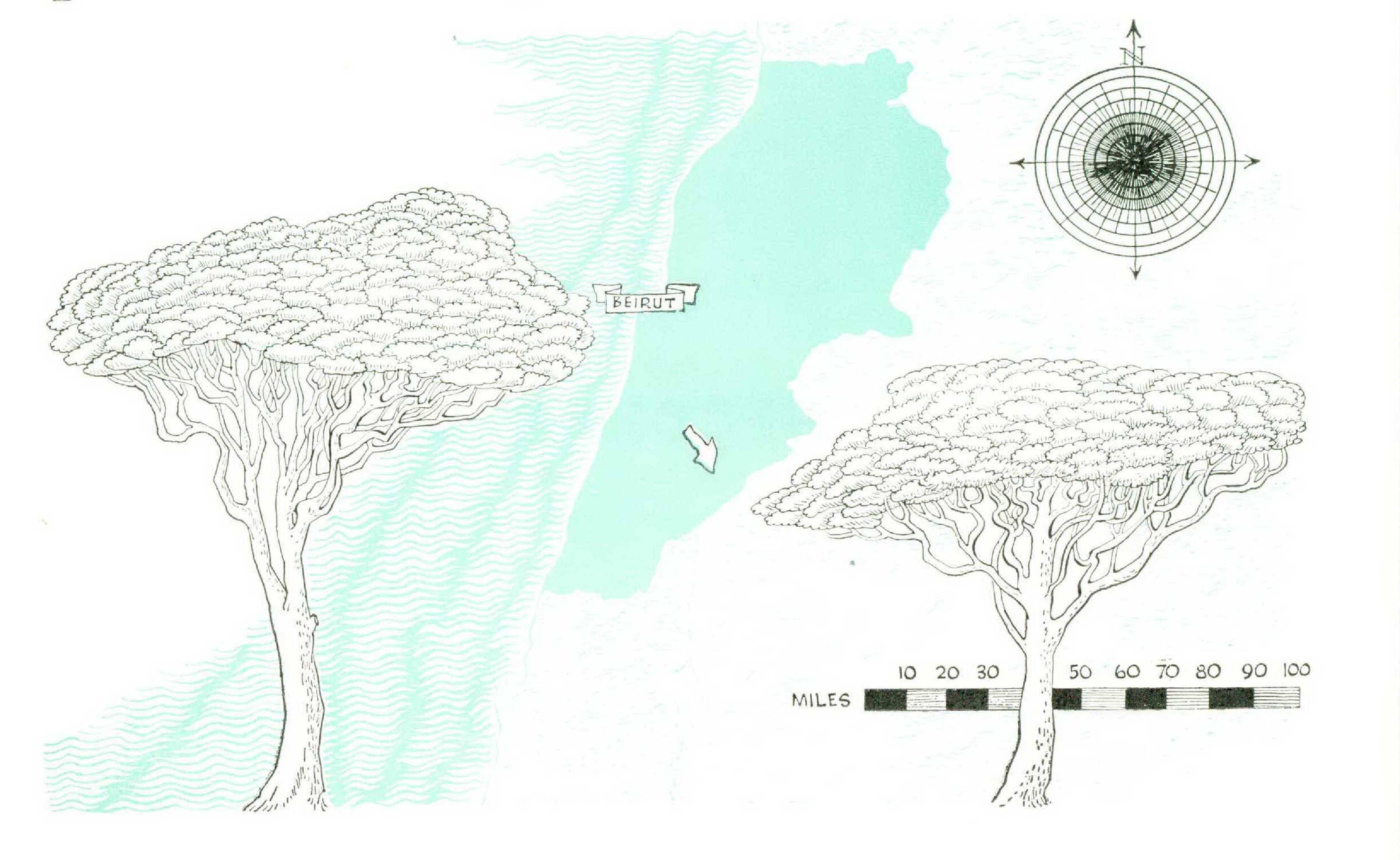
MY WIFE and I spent our twentyfifth summer in a place called Juml. I was a subsidized scholar, assigned to Lebanon to pursue Arab studies, and she was expecting the birth of our first child in November. In Beirut we had a large apartment overlooking the Mediterranean, but when the university, where I took courses, was about to go into summer recess, the company which employed me decreed that it could not subsidize mere gracious living in the metropolis and directed me to summer with a tribe in Iraq or Syria. Only compassion for my wife, whose condition my employer called “delicate,” rescued me from a hard summer in the black tents. A Lebanese village would do nearly as well, he decided, but with a mixture of chivalry and puritanism he circumscribed our choice severely. Our village would have to be Muslim —people spoke too much French in the Christian villages. It had to be high, since an expectant mother should not suffer from the heat. Finally, and rather arbitrarily, it had to be in the South, where the Lebanese were still Arabs and not, as in the Frenchified North, good Mediterraneans with a taste for brandy, pretty unveiled girls, and the records of Mademoiselle Piaf.
The mountains which crowd close to the shore of the eastern Mediterranean are shared by Syria, Lebanon, and Israel, with by far the highest ranges, reaching to ten thousand feet, in Lebanon. With its combination of sea and mountains and the characteristic climate and vegetation of the better-watered parts of the Mediterranean coast line, Lebanon is a sort of Oriental Riviera. It is tiny, almost no part of it farther than two hours by car from the center, Beirut. With its high backbone and narrow beam, it is only a slight exaggeration to say that Lebanon is nearly as tall as it is wide.
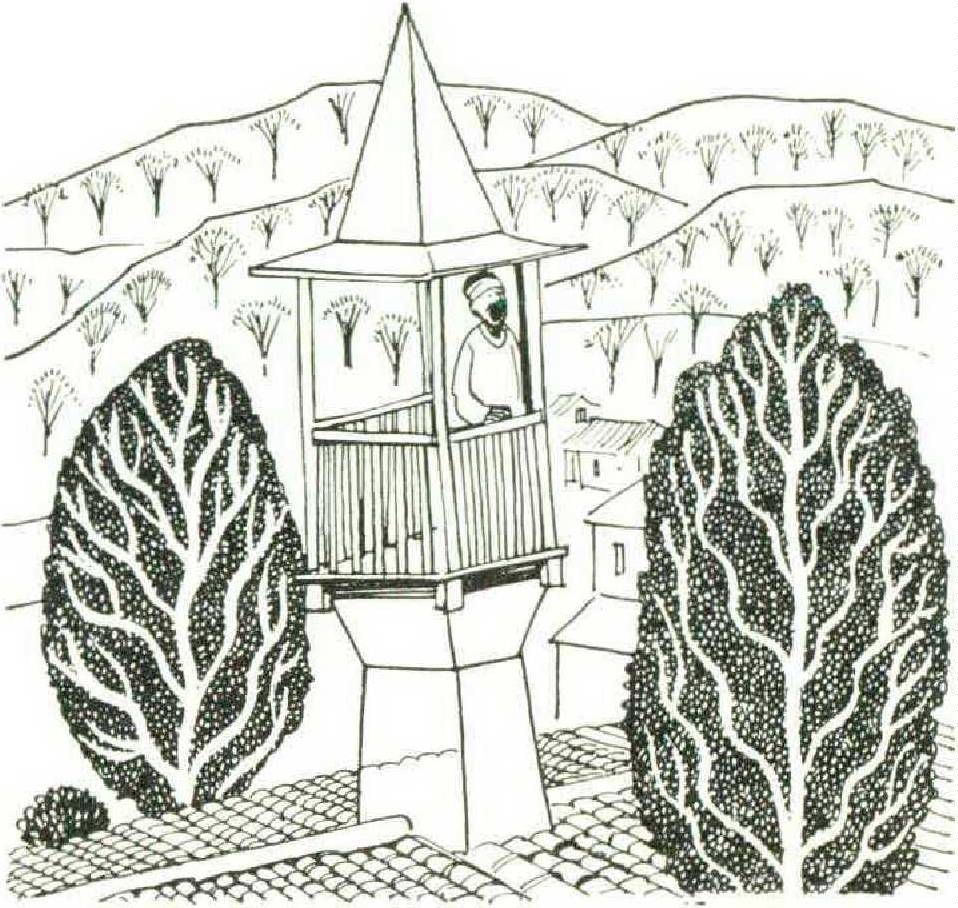
One day in May we went village hunting in our old Citroën Quinze and found Juml. The road led south from Beirut to Sidon, then east through Roum to Jezzine, then south again along the flank of a mountain through umbrella pines and fig trees — and we saw it. Below us, amidst blossoming fruit trees and shiny little spring-fed brooks, the village stood on top of a ridge shaped like the breast of a reclining caryatid, with its houses ranged neatly and concentrically around the sides. The needle of a minaret stood near the top of the ridge. Above, a satisfactorily Gothic peak, like something in an old print, loomed up in what would be the path of the rising sun, and, below, the landscape fell away into a mosaic of foothill villages to Sidon and the sea. When we descended into the village square and found that the people were Shi’ite Muslims, we knew that my employer could not fail to approve. It was Southern, Muslim, and high.
But after our first tour of the narrow manure-paved lanes, we could not be sure that we approved. We had been abroad only six months, and our standards of housing and sanitation were aggressively American. No screens, no refrigeration, no electricity, and the foreignness and primitiveness of the people dismayed us a little, but we could see that Juml was moderately green. There were fig and nut and apple trees, grapevines, and continuous terraces of cereal and vegetable cultivation among the springs. On our first visit everyone told us proudly that there were three hundred and sixty-five springs, ‘’one for every day of the year.”
That first visit was a short one, only an hour or two to find and engage a house. The place we liked best had four rooms around a courtyard overhung with grapevines and fig trees, and was painted inside and out in pink. One of its three water taps was arranged as a flusher for the courtyard privy, and none of them was in the room we decided to use as a kitchen. Besides the taps there were walls, floors, ceilings, windows, doors — and absolutely nothing else. The owner would not budge from the figure of eighty dollars for the season, and although we knew it was high, we concluded the deal.
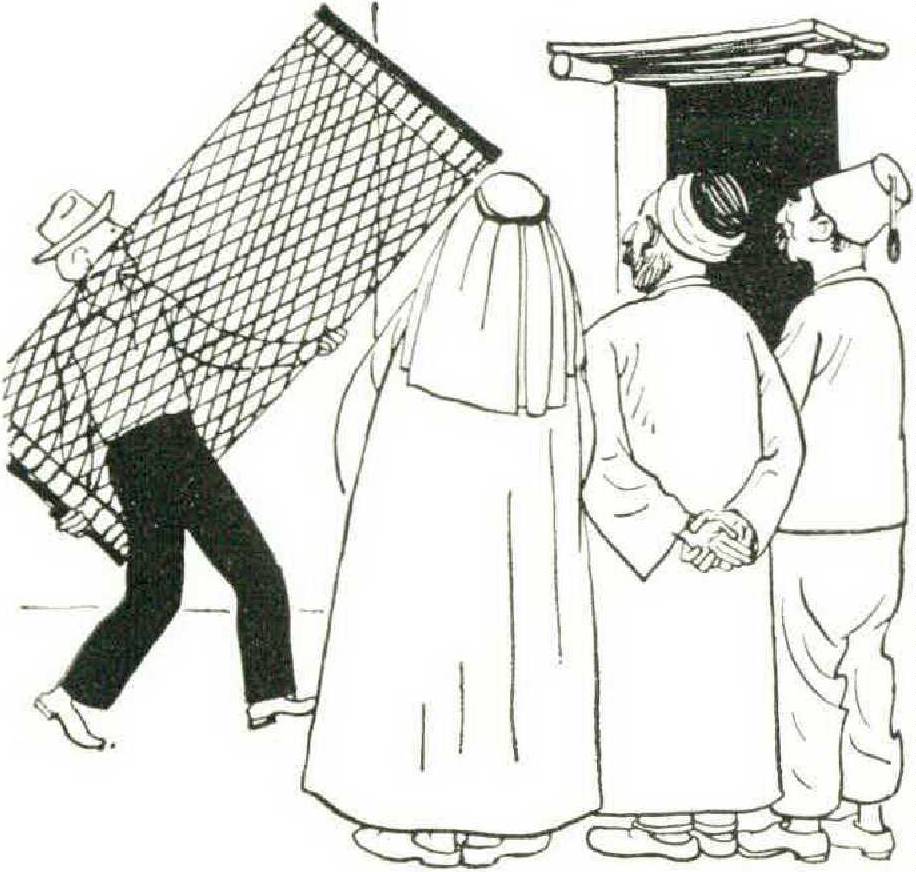
On a perfect day in June we returned to Juml. A big Mercedes truck with part of its bed filled with castoff furniture followed the Citroën down the narrow track from the main road to the village square. The people of Juml had seen us coming on the road above and turned out in force. The women stood veiled and staring on balconies and roof tops, the young men were carefully bored and made a great show of paying strict attention to their card games in the coffeehouses, and the old men, the sheiks, majestic in their beards and turban-wrapped tarbooshes, maintained an aloof reserve over little white coffee cups. Only chattering small boys, bold as all Mediterranean urchins seem to be, gathered around the car. The mayor broke the spell as, escorted by a couple of other graybeards, he advanced to bid us welcome.
As porters were installing our furniture in the house, we learned that the village had already named us. I was al-Mister, a pretty exalted title which ranked me with al-Mister Tsharashal (Churchill), al-Mister Eden (this was 1953), and al-Mister Ayznhoor, and my wife was “Sitt Mary,” the “Sitt” for “lady” and the “Mary” because the double “d” of “Maddie” sounded like a trilled “r” to our neighbors.
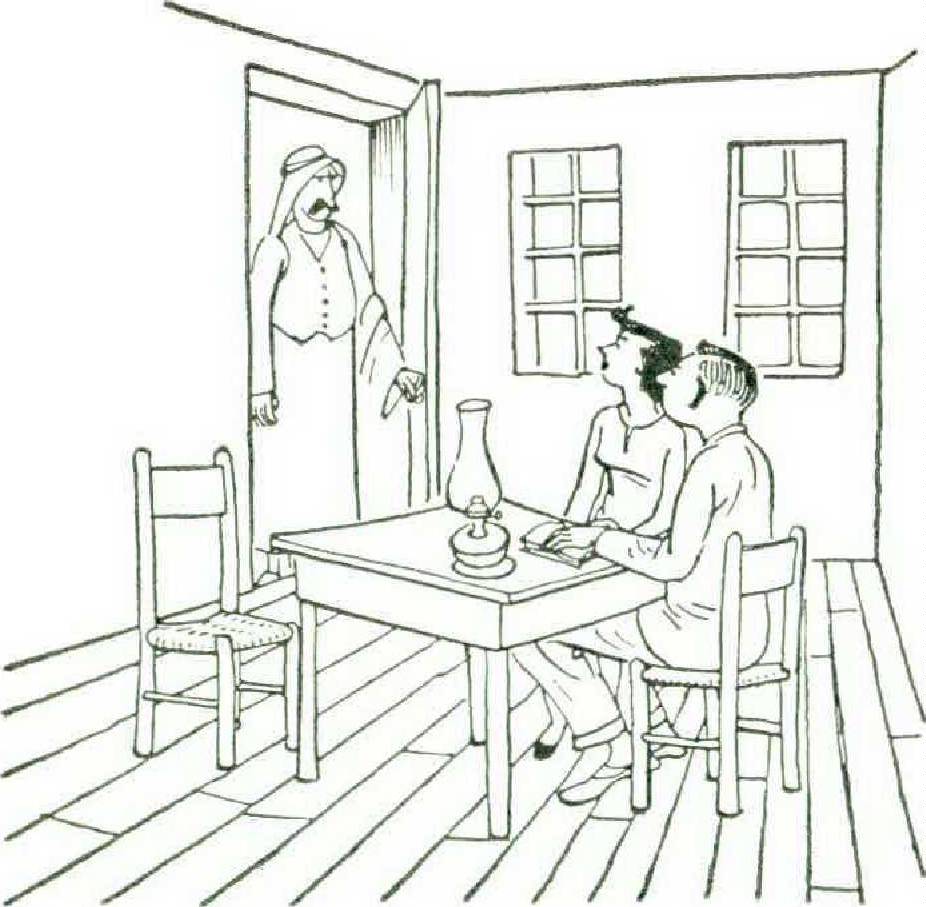
For appliances we had brought kerosene lamps and one pump-up lantern for reading and a singleburner kerosene stove which was so complex that it cost three dollars. In the living room we put down two or three straw-seated Damascus chairs, a straw floor mat, and a little table to eat from and to support the pressure lamp. The bedroom had a bed and a mosquito net and nails in the wall for hanging up clothes. It sounds simple, but the people of Juml thought the place lavishly chic and would find excuses to come and view all the magnificence. We realized that most people in the world have no use for furniture and use the floor for almost every purpose — sitting, sleeping, cooking, eating, beginning babies and having them — but after the first two or three days the novelty of camping out wore off, and we realized that we were uncomfortable. The constant sociability became wearing, too. Every man in the village with the right to be called sheik, approximately 85 per cent of the adult male population, felt it his duty to make frequent courtesy calls, and until we worked up courage enough to insulate ourselves from too much company, Maddie was little more than a coffeemaking machine.
A young sayid, or holy man, presented himself for employment the first day. He had served the summer before as guide-translator-companion to a Welsh anthropologist and thought he had a right to me. I asked the sayid how much the Inglizi had paid him, and with a straight face he named a figure which would be a princely income for a holder of a chair in anthropology. I offered him sixty pounds (seventeen dollars) a month, apologizing that I was not a rich British professor but only a poor American student. All I needed was a tutor in Arabic for a couple of hours, morning and afternoon. He knew I had him, because I was the only possible source of folding money in the village, but we bargained along for an hour or so before he capitulated.
The sayid soon became a good friend and constant companion. He was remarkably broad-minded and soon came to accept Maddie as a person, not just a woman, and would walk unembarrassedly through the village with her. He was not much over thirty and had a shock of black hair and the features, build, and coloring of a Swiss. In his middleaged green suit, the only one he had, he was a prominent participant in village social and religious life.
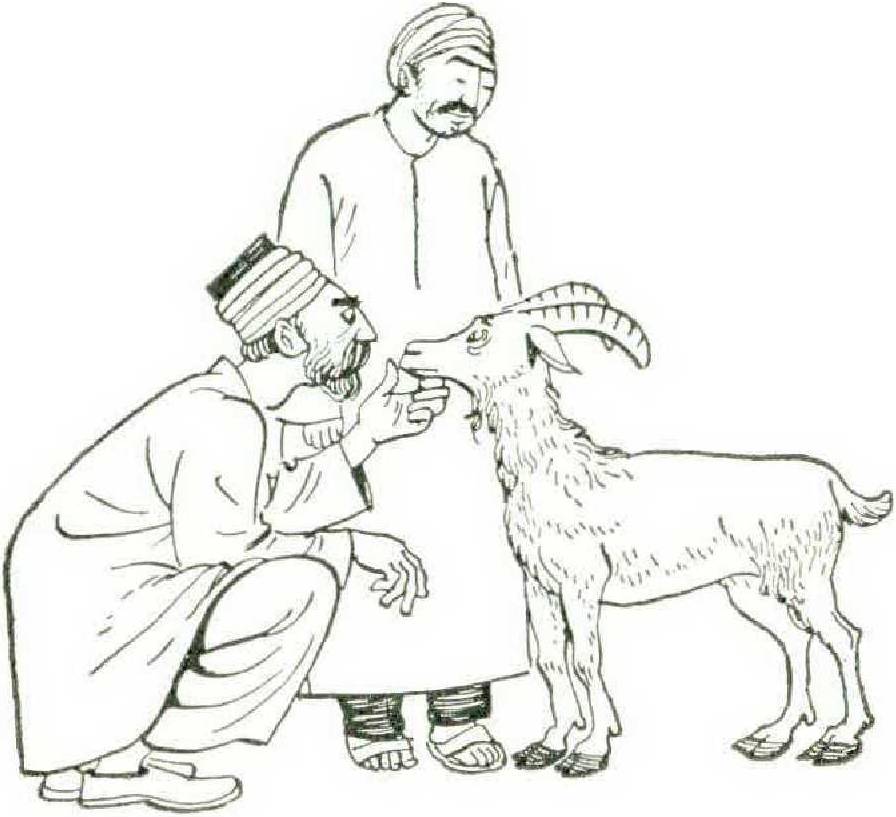
Down in the main square two butchers each killed a goat a day, hung both of them on hooks directly after slaughter, and cut chunks off the carcasses to order. People who were hungry for meat would congregate around the goat candidates each evening and discuss the animals’ personalities, brightness of eyes, and general appearance, as a prelude to deciding upon the butcher they would patronize tlie next day, Muslims require that their meat be killed on the same day it is consumed, if possible, and that slaughtering be done by throat slitting and slow bleeding. Pork is forbidden by the religion and so is alcohol. Muslim dietary rules resemble the Jewish ones, but there are no professional priests or rabbis in Islam to kasher. On feast days, when everyone would be ordering meat, the main square in the early morning was crowded with expiring animals. Open sanitation trenches with water running through them carried away the blood, and the village dogs fattened on what little else was not salable. Our initial impression of squalor soon changed as we saw illustrations of the village’s own brand of cleanliness, achieved by cold running water. They had plenty of it, and every house had a flush toilet and a washroom. The people of Juml of necessity lived closely with their animals, but cows and donkeys are not dirty to peasants. Little by little our airconditioned chrome-plated American prejudices fell away from us as we saw every item of food carefully washed and every house scrubbed clown daily.
Juml had only one baker, a commerce-hating individualist who required some propitiation before he would consent to supply the staff of life in round unleavened loaves. His oven was used for individual cooking enterprises as well; a housewife, having put together a combination of ground and pounded meat, oil, onions, garlic, parsley, tomatoes, cinnamon, and pine nuts, all on a doughy base, would send a daughter clip-clopping on wooden clogs down to the furn to have it baked. Maddie once fabricated an apple pie and sent it down with instructions to bake it a half hour. The charcoal temperature of the oven was so high that the pie burned up in fifteen minutes. The spilled juices messed the oven floor and burned there, and the sayid had to buy bread clandestinely for us for some time.
Crops ripened and the summer became hot, even at our four-thousand-foot altitude. My beard, which I let grow, turned out an unbecoming red and was removed. Sitt Mary cooked and washed and read and took walks and complained far less often than she felt like doing. Our next-door neighbor, a crazed old man who ten years before had been retired from the job of village muezzin, shouted the call to prayer from his roof, right over our courtyard, every morning at first light, between three and four o’clock, and it always took us some time to get back to sleep. The sayid’s knock would come at our back door every morning at exactly nine and every afternoon at exactly four, bringing us out of books and back to Juml, Our tutoring sessions were not wholly successful; for an hour or so the sayid could be kept on dictations or corrections of my halting reading of the Koran, but his attention span was short, and he would soon in spirit have left our magnificent living room and be in one of the open-air coffeehouses. His restlessness would communicate itself to me, and I would soon suggest a trip downtown, or sometimes a walk with Maddie to a particularly green spot of garden on the hillside. In the coffeehouses, under temporary sunshades rigged from tree branches, the young men would be congregated, mustachioed and double-breasted to a man and infinitely sophisticated and world weary. Arab young men (shabab) are a class in themselves, combining the functions of clubmen, debutants, drugstore cowboys, and anarchist cells. Sometimes we would play cards, elementary games involving huge scores kept on slates.
At about noon I would start home, past the egg seller’s and the oven, and for the next four hours we would lunch, nap. and read. Between four and dusk came a repetition of the morning’s schedule, terminated at evening prayer time. The outdoor praying place was under some big walnut trees only a few steps from the downtown coffeehouses. At night, after dinner, I would sometimes rejoin those natural clubmen of the coffeehouses, to whom now would be added laborers and peasants in Eastern, non-double-breasted attire (full Turkish pantaloons and embroidered shirts), and spend two or three hours under the hissing pressure lamps and over the cards. Sometimes there was tricktrack or backgammon, played at lightning speed. My tricktrack was slow and my grasp of the rules of the village variety of whist rather nebulous, but I kept up my popularity by regularly losing vast sums, sometimes as much as a half dollar in a single evening, and by exhibiting my amazing quick shuffle of the cards. None of the Juml bons vivants had seen a haystack shuffle before.
Most weekends we would drive down to Beirut for some luxurious living. Lying on the beach while a maid did our laundry, we would hear some of our friends ask knowingly, “Still sticking it out?” as if we would soon be creeping defeatedly back to Beirut. Others would say, ‘"Oh. how we envy you!” Little by little we stopped telling our cynical friends rueful anecdotes about the horrors of the village and took to agreeing with our starry-eyed ones. By the middle of August we had come around to acknowledging it to ourselves: Juml was rather fun.
The Immolation Feast, when Muslims all over the world slaughter a sheep as a gesture of solidarity with the pilgrims who do the same at Mount Arafat near Mecca, fell on my twenty-sixth birthday that year. The first day of the feast, that is; Muslims think holidays of only one day hardly worth while. On the fourth and last day a big party designed to raise funds for the new mosque on the square was held in the coffeehouse on the road above the village, and Christian minstrels were brought in as a sort of floor show. They did improvisations to guitar accompaniment and drank powerful anisette ('araq) out of teacups to conciliate the sensibilities of the Muslim sponsors. The minstrelsy was chiefly humorous, and it was as much over our heads as the boffolas of an American stand-up comedian would be to a Lebanese villager. After paying our subscription we left as soon as we decently could, and from our balcony watched the whipped-cream clouds roll in from the sea and pile up in the valley between the dark village and the noisy, brightly lighted coffeehouse above it. It was a beautiful moonlit night, with something of the nostalgia of autumn in the air, and we knew as we split a drink, under the silver-shining fig trees, that we would not forget Juml.
One day in late September, “that month in which,” in the sayid’s words, “we have more repose and delight than the other months of the year, from the bounty of the fruit and the clemency of the weather,” when the figs on the tree overhanging our balcony were yellow-ripe and the sayid every day for the past two weeks had brought bags of nuts, grapes, apples, and every kind of vegetable as gifts, the Mercedes truck came again to Juml. Clouds “to cook the fruit” hung on the mountainside, as they did every afternoon by then, and the previous morning it even rained briefly, something that happens only in winter in the eastern Mediterranean lands — indeed, the Arabic word for winter is the same as the one for rain. We packed our books and furniture, shook hands with several hundred people in the village square, and headed back for Beirut.
Two months later I came back. Juml was paralyzed by cold and rain. Everyone had a bad cold and felt and looked wretched. The sayid, caught unaware, could arrange only scrambled eggs and white goat cheese for the noon meal and had to run out and borrow coffee and sugar. All the coffeehouses except a mean little indoor one were closed; the free-spending estiveurs had gone back down to sea level, leaving the village with less than half its population in summer.
I have not seen Juml again, but I am sure that very little there has changed — certainly not the fig trees and the olives, or the coffeehouses, or the three hundred and sixty-five springs, one for every day in the year.