Weightlessness?
A former navy pilot who experiemeed zero gravity in the United States Air Force School of Aviation Medicine, ELIOT TOZEH is now farming in Tappan, New York.
Space doctors look forward eagerly to the day when the National Aeronautics and Space Administration will clamp a pilot into a capsule on the nose of an Atlas missile and blast him into orbit around the earth. Not until that day will they find out how the unearthly state of weightlessness will affect the crews of spaceships.
Science fiction writers have usually pictured weightlessness as a lotuseater’s dream. They have described the crew of Lunar Ship X-42 as space-happy, with eyes misted over, hearing gently dulled, limbs floating free. You get a mild and very brief indication of this euphoria when your automobile tops a rise and suddenly drops out from under you.
And it is true that some people are exhilarated by short periods of weightlessness. But an equal number become violently ill. The remainder get befuddled. The truth is that the scientists simply do not know how weightlessness will affect space men, especially over long periods of time. Nor can they find out. For of all the unpleasant and lethal forces that will wreak their fury on man in space, only weightlessness cannot be satisfactorily simulated and studied here on earth.
Since weight is a function of the pull of gravity, man can become weightless only when gravitational pull is canceled out. And he can accomplish this practically only by subjecting himself to an equal and opposite force. The space doctors at the School of Aviation Medicine, Randolph Air Force Base, Texas, do this by flying a jet plane in a vertical are so that the centrifugal force nullifies the force of gravity. But the plane must curve over into a dive shortly after it begins its climb. No one has been weightless much longe. than a minute.
So-called weightless experimenters shown floating in water or riding on columns of air are not weightless at all. They assume weight because they are supported against the pull of gravity.
We do not know, then, what will happen when NASA’s Project Mercury pilot slips into the never-world of weightlessness. If he orbits the earth twice, as expected, he will be weightless for at least three hours. Will he become wildly disoriented as he floats unsupported? Will he know which way is up without the reassuring tug of gravity?
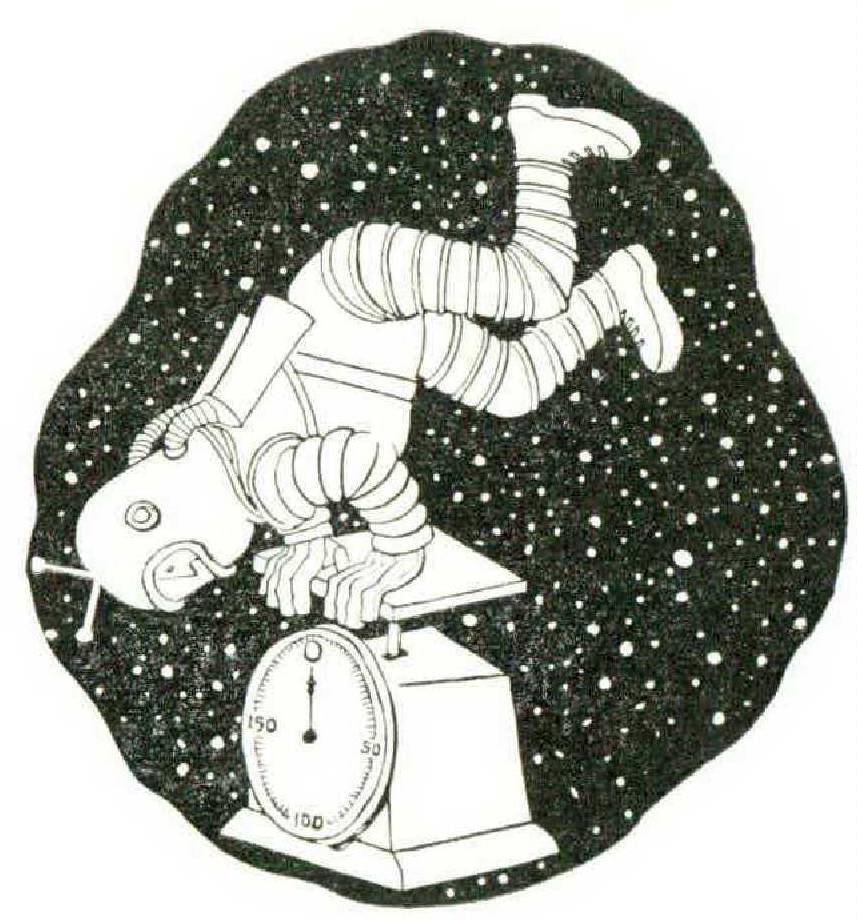
The space doctors think he will adapt to his eerie environment. But they are nagged by doubts.
Dr. Siegfried Gerathewohl, formerly of the School of Aviation Medicine, points out that five physiological mechanisms help us orient ourselves in space. They are the eyes (most important), the otoliths and cilia in the labyrinth of the inner ear, tiny pressure receptors in our skin, tension sensors deeply buried in our muscles, and the Pacinian corpuscles in our connective tissue. Significantly, only the inner car is affected by gravity or lack of it. Thus, under zero-gravity conditions, only one mechanism sends confusing signals to the brain. Could space crews be trained to ignore the garbled information coming from the inner ear and orient themselves with the help of the other four mechanisms?
Dr. Harold von Beckh, Aeromedical Field Laboratory, thinks so. Not long ago, he shone a bright light upward through the bottom of his home aquarium and clamped an opaque cover over the top, thus reversing, in a visual sense, top and bottom. The fish began to swim upside down. Happily, apparently.
Pilots flying on instruments in overcast skies have trained themselves to believe their eyes and not their inner ears when they turn, climb, or dive. Because the otoliths of the inner car react slowly, they sometimes tell a pilot he is still in a turn after he has straightened out. He soon learns to believe the needle he sees on his turn indicator.
But fish in tanks and pilots in airplanes are not weightless. The nagging doubt remains. Can weightless spacemen orient themselves by eye? Recently, Dr. von Beckh described an unusual experiment. Noting that test subjects were fully aware that they were about to enter the weightless state and could thus prepare themselves, he asked Lieutenant C. M. McClure, an air force jet pilot, to eat a heavy meal and fall asleep in the back seat of a jet so that he could be awakened in the weightless state without warning.
Despite his long flight experience, including several zero-gravity arcs, McClure, when awakened, thought that his arms and legs were 44floating away.” He felt a desperate need to pull them back and assume a “ normal posture.” Near panic, he grabbed for the canopy, unable to orient himself until his body once more assumed its normal weight.
There is also some doubt whether weightless crewmen will be able to coordinate well enough to push the right buttons and pull the right switches to navigate their craft. Some time ago, Dr. von Beckh flew a series of parabolic ares with a tank of turtles in his lap. It was not easy. The water drifted up out of the tank when it was weightless, and Dr. von Beckh had to continually fit the tank around it. But the turtles learned after several flights to depend on their eyes alone in striking at their food and, despite confusing signals from the labyrinth, soon hit it with normal accuracy.
Dr. Gerathewohl, in a series of experiments at the School of Aviation Medicine, had several subjects plunge darts into a small target at the height of the zero-gravity arc. Most soon learned fo hit the target as accurately when weightless as they did On the ground.
The doctors think that weightlessness itself will not affect crewmen physiologically. But the combination of high G-loads (forces due to rapid acceleration - as when you are forced back in your car seat when you step on the gas) with long periods of weightlessness may cause trouble. The Russians reported that the heart rate of Laika, the dog in Sputnik II, accelerated rapidly on take-off and that it “took about three times as long for the number of heartheats to reach their initial values as it did in laboratory experiments” on earth. Pilots black out much sooner in steep turns after being weightless. Blackout lasts longer, and the pain is sharper.
Space crews may suffer optical illusions. Several subjects complained that the afterimage of a point of light seemed to drift upward if they closed their eyes while weightless.
At aeromedieal laboratories at Wright Field, Ohio, at Holloman Air Development Center, New Mexico, and at the School of Aviation Medicine, Texas, the space doctors have subjected rugged pilots to nightmarish tests on centrifuges, in furnaces, and on gyrating disorientation platforms. As a result, they have learned how to filter out some of the force of high G-loads during blast-off. They can keep a pilot comfortably cool during the plunge into the atmosphere. And they know how to help him get back on the track if his ship tumbles violently out of control. But not until NASA’s Project Mercury pilot finally streaks into orbit around the earth will they solve the mystery of weightlessness.