All About Freighters
IF ONE likens big passenger liners to floating resort hotels, then freighters correspond to working dude ranches. All cargo ships may carry up to twelve passengers without a doctor on board, and nowadays most do. The fortunate dozen find themselves quartered in spacious, outside, midship cabins — equivalent to expensive first-class accommodations on liners — with a seat at the captain’s table and the run of practically the entire ship.
For all this, fares range roughly from $25 a day for short trips to a low of $7 for long round-voyage cruises lasting from three to six months. On freighters, cargo pays the way; passenger fares are so much extra gravy. A typical American freighter carries 12,500 tons of cargo and fuel.
A freighter sails the moment the last piece of cargo is aboard and not a moment before. It will go to any other port for cargo when sufficient inducement is offered. All this makes freighter itineraries extremely vague. One never knows exactly from which port a freighter will leave, and a passage ticket typically reads “from last U.S. port to first Japanese port.” Ports are added to or dropped from itineraries after the vessels sail. On one ship bound to London the entire cargo was sold in mid-Atlantic to a merchant in Hamburg, and the ship took it there instead. Often a shipmaster, Europe bound, does not know until twenty-four hours before arrival which Continental port he is to enter first.
Of all forms of transportation, freighters are the least predictable, least standardized, and least organized. Travel agents represent only some two thirds of all freighter companies and do not sell tickets on others, which, because they belong to nonconference shipping companies, frequently offer lower fares.
Freighter travel can be distinctly upsetting for anyone with limited vacation time, unless he can connect with one of a handful of Caribbean fruit companies whose vessels run to something approaching timetable schedule. One couple who booked an advertised twelve-day voyage to Europe were delayed eight days when the ship called at Newfoundland and Iceland; on arrival they had to cut their planned twelve-day sightseeing tour to a mere four days.
Yet the coterie of freighter addicts continues to grow. Qualifications are an elasticity of plans to conform to flexible freighter itineraries, a capacity to turn a change of plans into a memorable occasion, and more time than money. For example, during a transatlantic voyage recently I tobogganed down a mountain, fished for trout, and spent a weekend at a spa hotel, all long before setting foot in Europe. This seemingly curious phenomenon was achieved by taking passage from New York on a small Portuguese freighter which called at three Azorean islands and Madeira before reaching Lisbon. The seventeenday voyage cost $200, less than median cabin-class fare for a five-day crossing by liner, and, though far from luxurious, the little ship’s accommodation reflected a great deal of carefully studied comfort.
Getting on a freighter simply amounts to choosing the trip you want, booking passage at least four months in advance — either by writing direct or through a travel agent — and then being ready to go whenever the company sends its wire. One can find out which freighters are in service, where they go, and what they cost by consulting Ford’s Official Freighter Guide (no connection with author), which lists about three fourths of all sailings from the United States, and Harian’s Travel Routes Around the World, which gives every freighter and liner service throughout the world.
A great deal of the mystery and confusion surrounding freighter travel evolves from the neophyte’s unfamiliarity with the world trade routes. Freighters, in fact, operate only on well-defined trade routes between regions having a surplus of products and other regions which lack these same goods. Thus, since Australia needs nothing from South America, no freighters ply between these continents.
The best short trips are those in eastern Canada and on the Pacific Coast. From Montreal, several Canadian freighters sail on reasonably regular schedules to the mushrooming boom towns of the north St. Lawrence shore and to Newfoundland; a typical eight-day round cruise costs $166 in midsummer. From Los Angeles or San Francisco one may take a short six-day trip aboard some of the most luxurious of European flag freighters to Vancouver at a cost of $95 to $125. Here again, the vagaries of freighter travel are such that on many trips calls may be made en route at Coos Bay, Portland, or Puget Sound, extending the cruise to as long as fifteen days and calling for $20 to $100 more in fare. Actual voyage duration often remains unknown until a day before sailing, and one must simply take potluck on time and fare.
Very comfortable British, American, Scandinavian, and Philippine freighters cover the distance between New York and Panama in six days for an average fare of $150, and one may fly back in under twenty-four hours, return on another freighter, or change ships and make the eightday voyage up the Pacific Coast to California at a further cost of about $200. Not generally known is the fact that the through coast-to-coast voyage via the Panama Canal is permitted on American flagships only. This trip occupies about two weeks and costs an average of $350.
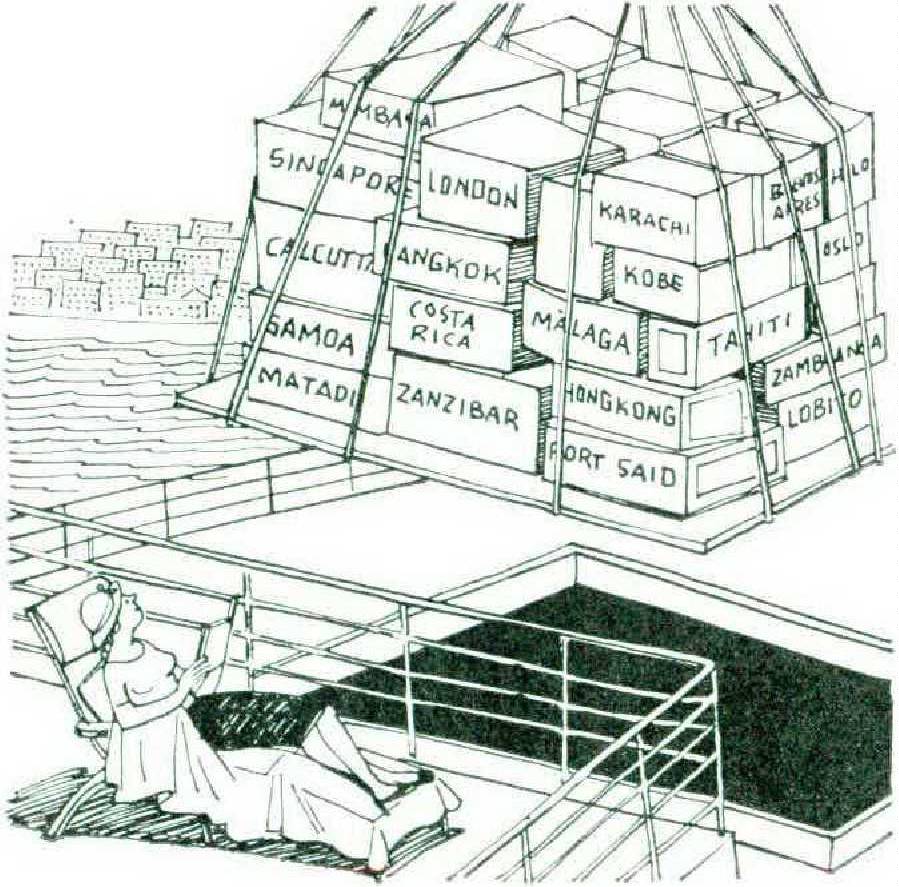
For those with limited vacation time and a yearning to sail under tropic skies, there are Caribbean round-voyage cruises which operate on surprisingly punctual schedules. From New York and the Gulf, smart yacht-like fruit boats sail weekly for sleepy banana ports in Central America: a sample nineteen-day itinerary takes one from New York to Nassau, Kingston, Port Limón in Costa Rica, Puerto Cortés in Honduras, and back, for $450. A brisk trade in sugar is responsible for short cruises to Cuba, Puerto Rico, and the Dominican Republic: a twelveday cruise from New York to San Juan and Mayagüez in Puerto Rico and to Ciudad Trujillo and return costs $280. Every week a score of freighters sail for Venezuela, Curaçao, and Trinidad, and the average fourteen-day round cruise costs $400. From Canada there are longer, twenty-eight-day island-hopping cruises through the British West Indies at $445 to $550, and a still longer summertime junket from Chicago down the Great Lakes to Cuba, Jamaica, Venezuela, and return costs $925.
A heavy trade in automobiles and machinery southbound, in coffee, hides, meat, grain, and sugar northbound, creates a steady stream of freighter traffic to South America’s east coast. From New York or the Gulf freighters take some fifteen days to reach Rio; they then touch into Santos and Montevideo and arrive at Buenos Aires in twenty-two to twenty-eight days. Both American and European freighters serve this route; among the best ships are the Norwegian Ivaran and Nopal Lines and the Danish Torm Line ships — all well-appointed vessels, spotless and immaculate, with cheerful cabins, lounge, and smoke room, and a really excellent Scandinavian cuisine which invariably includes midday smorgasbord. Fares average $325 to Rio, $425 to Buenos Aires, and about $800 for the round trip.
With confirmed advance reservations, one may complete a unique triangular voyage, sailing down to Buenos Aires on a Moore-McCormack freighter, going to Cape Town on a Dutch ship, and returning to New York on an American flag Farrell Lines freighter; all three lines allow a 10 per cent fare reduction, and the combined voyage yields some sixty-two days of cruising for $1205 to $1309. Naturally, a great deal of both South America and South Africa can be seen while awaiting connections.
Lighter trade with South America’s west coast results in somewhat fewer freighters sailing down to Valparaiso. From the East Coast or Gulf, ships transit the Panama Canal, then hug the Andean coast for 2500 miles. Calls are made at Buenaventura, Colombia; Guayaquil, Ecuador; Callao, Peru, eight miles from colonial Lima; and Valparaiso, Chile, as well as many smaller ports. From Callao, most passengers manage a quick flight to the Inca cities of Cuzco and Machu Picchu high in the Andes, while Chile’s mountain-rimmed capital, Santiago, lies at only a three-hour bus ride from Valparaiso. Fares to Valparaiso range from $300 to $500, and the voyage takes twenty-one to twentyfive days.
Freighters to North Europe sail from almost every port in North America. Thanks to the St. Lawrence Seaway, the Chicagoan can board a freighter almost at his doorstep and sixteen days later walk down the gangplank in England or Germany. From the East Coast, one may choose from comfortable German tramps charging as little as $125 to really excellent Belgian, German, Scandinavian, and Dutch vessels. Companies with solid reputations include the Belgian, Cosmopolitan, Red Star, Hamburg American, and Swedish American Lines, all taking nine to eleven days and charging $185 to $270. From the Gulf, I would suggest the Independent Gulf, Hamburg American, or Armamente Deppe Lines, which take fourteen to eighteen days, for $215 to $285. Most freighters sailing from California rank as true pocket-sized luxury liners. For example, the magnificently appointed Johnson Line Swedish ships carry five stewards and one stewardess. Other good freighters are those of the Royal Mail, Furness Pacific, Blue Star, East Asiatic, Hamburg American, Fred Olsen, and Interocean Lines. For the twenty-six-day voyage, fares average $500.
Round-the-world cruises run from ninety to a hundred and fifty days, cost between $1300 and $1600 (up to $3450 by de luxe American mariner-class ships), and are available from American, Japanese, Dutch, and British lines. Among the best are the luxurious British Prince Line ships, staffed by suave East Indian stewards. During the eighteento twenty-week voyage, the ships call at twenty-four ports for a fare between $1400 and $2000.
Few freighters actually girdle the globe. Some head east from New York into the Mediterranean and through the Suez Canal to India, Malaya, and Indonesia. Still others leave the Pacific Coast for Japan, the Philippines, Malaya, and India. As a result, one may leave California for Bangkok, Singapore, or Calcutta and change there to another freighter bound home through Suez. Several lines or their affiliates offer such round-the-world cruises with a single break of voyage midway. For an eighty-eight-day voyage from California to New York fares start at $956, running up to $1450 for a hundred-and-five-day cruise New York to New York. These arrangements are virtually unknown to most travel agents; the lines to contact are Barber, Hoegh, Maersk, and Nedlloyd — all European flag and widely known for their excellence.
By this same global route — Mediterranean, Far East, Orient, Pacific — one may take a freighter to the Mediterranean or beyond, or from the Pacific Coast to Japan and the Orient. From the East Coast or Gulf to the western Mediterranean fares average $250, and any recommendations would extend to the de luxe Spanish ships of the Aspe Line and the first-rate Concordia Line’s Norwegian freighters. Fiftyday round-voyage cruises to the eastern Mediterranean average $800 to $900; those via the more economical Hellenic Line (Greek), only $550 to $600. For India I suggest the truly superb British freighters of Ellerman and Bucknall Company; fares to Calcutta are $635 to $685 for a thirty-six-day voyage. Most other lines charge slightly less. The average freighter takes thirty-four days to Singapore, forty-four to Djakarta, and rates are $550 to $600.
Overlapping these services are the itineraries of some of the most splendid American and Scandinavian freighters, which sail west across the Pacific. From the Pacific Coast, most make a swing through Japan, Hong Kong, and the Philippines; others trade south to Thailand, Indonesia, Malaya, and India. From New York to Japan, fares average $500, to Manila (thirty-three days) $550 to $600, to Hong Kong $700, and to Bangkok (thirty-nine days) $600 to $675. From the Pacific Coast fares are $150 less and voyages approximately thirteen days shorter. Most freighters offer a complete round cruise of fifty to sixty days for about $850. Fall is the coolest season. Almost all lines can be recommended.
From the United States only one company’s freighters sail around Africa. Leaving California, the Nedlloyd Line Dutch ships transit the Panama Canal to Trinidad, cross the South Atlantic to Cape Town, and then trade their way north through Durban, Lourenço Marques, Dar es Salaam, Zanzibar, and Mombasa to Aden, Suez, Málaga, and New York. Fares run from $990 to $1160. All other freighters sail either to West Africa or else to Cape Town and up the east African coast to Mombasa.
West Africa bound, one first sights massive Cape Vert looming over modern Dakar. Freighters then trade along the coast, exchanging cotton goods, liquor, and machinery for latex, palm oil, ores, and other African products. Invariably the final port is Matadi on the Congo or Lobito in Angola. Travelers may choose between Belgian, American, French, British, and Norwegian ships; fares average $500 to $550 for the twenty-four-day voyage.
Prelude to South Africa is a sixteen-day ocean voyage from New York. On the seventeenth day Table Mountain appears, mantled in a shroud of drifting cloud. For the next twenty-four days, freighters call at some of the most exotic ports on earth: cosmopolitan Durban, continental Lourenço Marques in Portuguese East Africa, Beira, headquarters for safaris to Gorongoza National Park, and fascinating old Arab towns with dhow-packed harbors, such as Mozambique, Dar es Salaam, Zanzibar, and Mombasa. Round cruises of seventy to eighty days run from $920 to $1080, and during the ship’s Mombasa turnaround, travel agents have a variety of East African tours for five to twenty-one days. One-way fares to Cape Town are $475 to $500, Lourenço Marques $525 to $600, Mombasa $590 to $650.
That, briefly, is almost the entire list of freighter trips from North America. Each route is also served by more numerous, often more comfortable, and somewhat cheaper freighters from North Europe. With unlimited time, it is possible to take a freighter from, say, California to Valparaiso, cross by air to Buenos Aires, and catch another freighter to Europe for a fare only $300 or so in excess of that charged by other freighters sailing direct from California to Europe. One may also cross to Europe by freighter, spend some time on the Continent, and take another freighter to Africa or the Far East at a total fare below that charged by other freighters sailing direct from North America.
Above all, freighter voyaging requires time. For this reason, perhaps, freighter passengers are usually people able to name their vacation dates — business and professional couples, retired people, actors, writers, college professors, housewives. Time alone is sufficient screening process to guarantee fairly congenial company, a compensation not to be underestimated while living with 12,500 tons of erratic, untimed, undisciplined cargo on a slow boat to Zamboanga.