Stories of Childhood
Twenty years ago, GEORGE H. FREITAG first broke into print in the ATLANTIC with his story “Uncle Horace.” Since then his work has appeared in our pages from time to time, and his book, THE LOST LAND, was pub lished by Coward-McCann. A sign painter by profession, Mr. Freitag devotes part of each week to, writing.
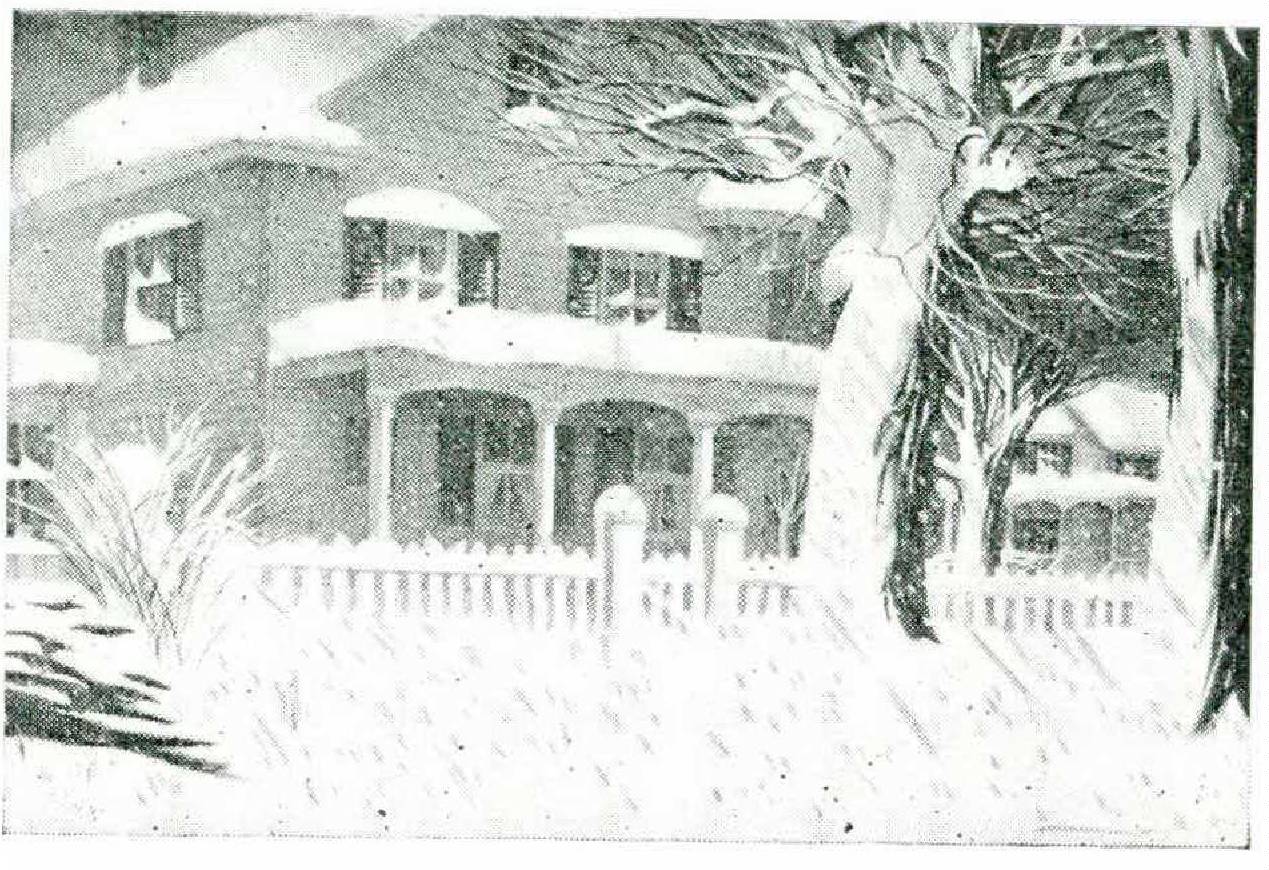
OUT WITH THE BOYS
ON CERTAIN dark nights in the house where I lived with my mother and father, my parents said very little to each other. They seemed to use other methods for conversation. If my mother sat sewing after dinner, after the dishes were washed, she very often dropped her thread. It would make a noise as it rolled across the floor and my father, upon hearing it, would look out over his glasses to see where it went, then pick it up and hand it to her.
Often, before or after something like this, my father would rattle the evening paper, making more noise with it than a person needed to, and my mother would look up and frown. Nobody said anything. They simply used noises. I used to sit doing my schoolwork at the kitchen table and wonder what they were saying back and forth to each other. Secrets. That was what they had. Finally one of them would smile at something, and the other one would smile too, but I don’t suppose one knew what the other was smiling at.
One such night, when the wind blew cold across the back yards and the snow was restless in the corners of fences and kept sifting from one neighbor’s house to another and from one window sill to another, my father stood up and stretched out his arms.
He had been reading the evening paper. My mother sat very still and took off her glasses and looked up at him. Then he glanced at the clock on the wall and walked to the back door to look out through the fastened curtain.
My mother followed him with her eyes. Wherever my father walked, my mother’s eyes went also. Then a look of concern came over her face.
“Surely you are not going out with the boys tonight?”
My father shrugged his shoulders, not speaking. He looked at the wall clock again, then outside, then at the wall clock.
“What can be so important that the wall clock needs to be consulted so often?” asked my mother.
I was doing my school homework on the kitchen table. My books and papers were strewn everywhere — pencils, erasers, a dictionary, things like that. The wind sang around the house. Sometimes it even sounded like people pretending to be wind. I didn’t want my father to go out at night. In the distance you could hear the trains, the wind crushing the sound, then straightening it out. There was a boy at school whose father went out at night and they waited until morning for him to come home and he never came. The boy’s name was Johnny and the night his father went away and never returned, Johnny was reciting “ Abou ben Adhem” before a couple of his aunts and uncles in the front room of their house and it was a cold dark night, too. His father said, “Well, I guess I will go down to the old barbershop and find a quartet to sing with.”
It was such a silly stupid thing to decide to want to do on a cold dark night; you could think of a thousand things to do other than sing. And the aunts and uncles and Johnny and Johnny’s mother were so engrossed that they never heard anybody leave the house, much less walk out across the porch that always screeched when the weather was zero, like the snow under the milkman’s wagon wheels.
But my father went upstairs and turned on the bath water and jiggled the flusher on the toilet and dressed in his starched shirt and opal cuff links and heavy police shoes and purple sleeve holders and red suspenders. Then he sprinkled bay rum on his hair and talcum powder on his face and a little of my mother’s perfume on the lapels of his coat, in place of a carnation or a rose, I guess, and walked back downstairs like a proud prince. My mother pretended to be busily engaged in her sewing. She was nervous and excited and kept stabbing herself with the needle. She put her glasses on, then took them off.
My father could tell she was terribly upset. He walked around in the kitchen a couple of turns, then lighted a brand-new cigar and blew the smoke all over the place. It seemed as if he were saying, “Here is a certain part of me to hold you together until I come back.” My mother gave him a hug and a kiss, and I did the same thing. My mother picked imaginary pieces of lint from my father’s coat and in every way tried to make him look like a dandy.
When he opened the door to go out, some of the snow came in and melted there on the kitchen floor and my dog Bob came out from under the stove and drank it up.
Then the house was still. We heard my father’s heavy walking in the snow and knew that he was being devoured by the dark, chewed up by it. I went on with my homework but I could not make the figures add or subtract, nor could I find any words in the dictionary. My mother’s sewing, at first so lovely, now looked like a ball of thread wrapped together by inexperienced hands. Two or three times it fell to the floor. Under my mother’s apron, forming a kind of hump, was the beginning of my brother, who was waiting for spring, and his name was going to be David. My mother allowed the sewing to rest on him, but he was not very level and things rolled off.
The wind moved back and forth in the yard. A fire siren screamed in the distance and a dog that lived across the alley barked at sounds that the dark made terrorizing. I thought of my teacher in school and of the kids who went there. Sometimes when my father went away he came home with a box of chocolate-covered cherries for my mother. On Saturday nights he often walked to a place in the center of town where a Salvation Army band played and threw ten, maybe fifteen cents on the bass drum and bought the chocolate-covered cherries for my mother and came home. One time he took me with him and made me wait outside a saloon while he went in and drank a glass of beer.
“ You stand still and give me just five minutes,” he said.
I stood still, giving him five minutes, give or take five, and finally he was one of those who came out the swinging door.
Suddenly in the kitchen of our house now there was a sound of windows rattling, first a rattling at one part of the house and then at another. My mother jumped up, startled, holding her hands to her face. Such noises as we had never heard before persisted at intervals to frighten us, and finally we ran to lock the doors and turn out the gaslights and went into a corner of the hall to hide, my mother hiding behind her own large black coat, so that to anyone coming in she was nothing more than that, and I behind her. Even my dog Bob, who had left the warmth behind the stove, barked twice, then scurried for a hiding place.
“It’s the Jefferies gang on the streets again,” whispered my mother. “On their way to the roller-skating rink they terrorize a whole neighborhood. You can tell there must be fifty.”
But our back door opened and a match was struck on a shoe after the door was closed again and there in the flickering light stood my father, all covered with snow and frozen to a chip.
My mother and I ran to him and helped him off with his shoes and his coat and shook the snow out of his scarf and spread his coat out to dry on the floor, and my dog came out of the dark hall to be the last to greet him. We helped him to his favorite chair and my mother rubbed his hands together to chase out the frosts and I hammered at his shoeless feet in order to warm them. And there he sat, still puffing on his cigar and lying back in the chair with his eyes half closed and smiling inside his face as well as on the outside.
He hadn’t been out of the house more than fifteen minutes. But watching him sitting there I thought that what we were doing to him to make him comfortable was the reason why he wanted to go out in the first place. He simply couldn’t wait to come back in.
How silly people who are married for a long time seem to be.
THE GAME
ONE time a bunch of us that lived near the park and went to the old Washington School on Ninth Street came to play in our front yard, seven or eight of us, I guess. It was during World War I and everything was in a state of frenzy at what was occurring in the world; even little black-andwhite dogs on their way to trees and fireplugs seemed frantic and disturbed by a number of things.
Then a boy who played with us, whose name perhaps was Milford, wanted to play a particular kind of game; it was counting a person’s buttons from just under his chin to the very bottom of wherever his buttons stopped, and Milford did the counting. The way he did it was to start at the top with the word “richman,” then the second button was poorman, the third beggarman, and so on. Johnny Frazer, who was my best friend, had his buttons counted and he was going to be a doctor, and he was very happy indeed that this was to come about in the future of our lives, and he even then went about pretending to hear our hearts and know, for instance, what our temperatures were and things like that.
And after a time, Milford came to me and said: “ Would you like to know what you are going to be when you grow up?” and I said: “Yes, I would like to know,” because knowing such a thing as what you will be is very interesting and vital.
So I opened my coat and Milford began to name the buttons, and when he got to the end of mine I was made out to become a doctor, too, and I did not want to be a doctor at all. I ran crying into my mother’s house, where everything was always protected from the outside world. My mother was cleaning wallpaper and the rooms smelled fresh and like April, and she had on a darkblue apron and her lovely black hair was hanging down in her face.
“ What on earth is the matter? my child, my child,” my mother said to me as she climbed down from the ladder and wiped her hands on her apron. So I told her what was wrong, saying that I did not want to be a doctor. It was a tragic thing, as tragic, you might say, as anything could be, to be named something you had no notion whatever of becoming. My mother held me to her, then went and got needle and thread and sewed another button to my shirtwaist and said: “Now go out and have your buttons counted, now see what you can be.” And I ran outside again laughing at the top of my lungs.
WHEN YOU RUN AWAY
THERE was a time when my brother David was a small boy and I was twelve years old or so that my mother seemed to favor him more than she did me. It seemed that she was always being nicer to him. He was a good-looking boy with large brown eyes and deep dimples and pudgy soft hands, and I did not have brown eyes or deep dimples or pudgy soft hands; not that I wanted them. I was tall and skinny and my face was starting to come out with pimples.
One time when I was out in the back yard I thought about my brother. I hid behind a bush and watched my mother spread a piece of jelly bread for him and noticed how tender she was and the way she not only handed him the jelly bread but kissed him on the forehead. It wasn’t that I wanted to be kissed on the forehead; it was just the fact that she didn’t have to do it to David. While I sat under the bush in the back yard I began to think how sad it would be if I ran off. I don’t mean how sad I would feel but how sad my mother would feel, losing her twelveyear-old son and all. I guess when you came right down to it I wasn’t much to have or not have; it was just that I was the older child and had been around a long time. I knew my mother would fret and be sorry. I don’t think she ever realized that she wasn’t spreading jelly bread for me any more. Maybe she thought I was old enough to do it myself. Just the same she never did it any more, but all David had to do when he wanted a slice of jelly bread was look hungry and undernourished and he got it.
In a way it made me a little sad myself at the thought of my mother’s feeling sad that I might leave. I spent some time drawing maps of ways to run away. I showed the icehouse and the train tracks and the large maple tree; things that would serve as specific places. The weather was nice; it was summer and the lilacs were in bloom and the nights were filled with lovely sounds and scents. There wouldn’t be any problem about it. I thought for a while that I might go around and say farewell to my friends. But I liked them too well to have them feel sad at my going. I was at an age when one is apt to make a very important decision quite by accident. And I did not want to let anyone know I was going. When you are old you make planned decisions, everything carefully worked out, but when you are a boy of twelve there is still time to make a few accidental decisions that change the course of your life.
I used to pity my father, who was tied so to my mother’s apron strings. He went about his life in such a calculated way, doing all the proper things like going to work and coming home and wiping his mouth with a napkin during meals, coming and going with punctual regularity. I guess the town clock was even set by his routine. He did not have a thought of his own. He went to work and worked. He came home and was home. On the lines that were woven across my father’s forehead was written the word “obligation.” Poor, poor man.
A fellow knows pretty much what he is about at twelve. So just to try out my brother, I asked him to fetch me things. I wanted him to refuse so that I would have more reason to run away. “Go fetch me my lousy shoes, David,” I yelled at him. He was four years old. He went to where I had hidden my shoes and brought them back.
“Here your shoes,” he said.
“Go fetch me a pencil and paper and an eraser and a box of crayons and don’t come back until you have everything.”
My little brother went out of the room and in about an hour he came back with everything; he even found the lost crayons. Then he made more trips and brought back things I never knew we had.
“ See what a nice brother you have?” my mother said, giving him a smack-kiss on the cheek, but I only glowered at my mother. Then I spent more time drawing maps and getting my clothes together, a shirt, a pair of sandals to keep from getting stone bruises, my spyglass that I got with breakfast cereal, the one where the magnifying glass came in one box and another part in a different box until after forty-three boxes of breakfast cereal I had the spyglass. You don’t know how many parts a spyglass has until you commence to eat breakfast cereal. I put my slingshot in the pack too, and a calendar to know what day it was and how long I was gone, and a picture of my mother and father taken coming out of the RitzBalou picture show carrying a potted fern that my mother had won. I had other things in the pack, too, things like rope and a candle and a piece of moving-picture film of Rin Tin Tin moving his head from one side of the picture to the other, and a harmonica. Everybody who runs away carries a harmonica and sometimes it is just on the strength of one that a fellow gets a free meal somewhere.
The night I went away was very quiet and peaceful. My mother and my brother had gone to bed early. My father had been marched off to work, carrying his dinner bucket, and was already doing his job because the whole sky was ablaze. My father worked in a steel mill and you could see the reflection of fire in the sky. That was my father opening the furnace doors of the mill. I looked into the sky and my father seemed to be all over it, skipping around in the fleecy clouds like a spirit. He was working hard just so he could come back home in the morning and walk down the street and nod good morning to all the neighbors who were getting up and having their breakfast and start the dogs to barking and the cats to scurrying over the back-yard fences.
Men coming home in the evening can be just as tired as men coming home in the morning, but in the evening the sun is going down and one docs not see the tiredness on a worker’s face. In the morning the sun is fresh and new and it seeks out all kinds of things about a man’s face and you can see fatigue on it then.
My father came home under the gaze of the new clean sun. Then he fitted himself back in the mold of being a husband and a father, of sprinkling the lawn and mowing it, of picking things up if my mother dropped them.
I was going to let myself down from the secondstory window of my bedroom, but even though my mother had forgotten to bring in the mattress that she had put out to air, the drop was too much for a fellow my age, and I tiptoed down the stairs with my sack of things thrown over my shoulder. When I got outside I turned around and looked the neighborhood over. I had never seen it that late except once when my father and I had to find a doctor for my mother. All of my father’s garden lay under a film of dew and was so still that you could hear the things grow. When a leaf died you could hear it drop from the stalk and fall to the ground. I remembered watching my grandfather die a year or so before. He had been a shoemaker. He lay in the long white bed and had his long tapered fingers spread out across his chest and he said to me in German: “It is like being a petal on a flower. First you are a part of the flower, then you are growing into a grandfather, and after you are a grandfather you commence to shrivel up and I am shriveling up now.” In the way the silence of the night spread itself across the expanse of yard, I remembered my grandfather’s voice as it died. I remembered the cold room and the fragrance of sickness in the room. I remembered the light that flickered by my grandfather’s bed. I never smell a pair of good shoes that I do not think of my grandfather’s hands.
I said good-by to the yard where my father’s garden lay. I said good-by to the alley and even the rotten clothesline post at the corner of the lot. I turned and grew sadder still at the darkness of the whole house and at the windows that looked empty and evil, like a toothless woman. As I walked in the direction of the railroad tracks, the light my father made in the sky, now pink, now a deep vermilion, followed me. It pranced about and cavorted with the clouds and rolled and billowed like a wave of fire. I wanted to wake everyone up and say to them: “That is my father doing the fire,” like you would say of someone on the stage: “The sound you hear is my brother making the wind blow.”
Finally I heard the train. I swung the pack over my shoulder and went through the back yards of houses until I saw the whirling, searching headlight of the train. Then the whistle blew, two long utterances of sound the way I always heard them while I lay in my bed in my own room and made up stories in my head about where the train would take me. And now I was there close to it, so close, in fact, that I could feel the suction of air and the pressure of steam and the vibration of its energy upon the ground. Then I got on and lifted myself into an open boxcar that didn’t really seem to want to belong to the rest, for it swayed and pulled always in opposite ways from the others, and I said to myself that it, too, was a part of a plan of things just like my lather.
The buildings of my own town went by, the back yards of houses went by, and the fences and street lights and churches. Then we went into a strange kind of place and I looked out again to find that the train was coming to a stop and all the boxcars were being sidetracked. We were in the freightyards and a man said, his face against the flickering lantern: “ I guess that winds it up for tonight.” Then the engine itself went somewhere and the engineer climbed down and soon the whole place, like my own back yard, was still. I crawled down out of the car and I knew the night was growing old. I looked into the sky; there was just a flicker of my father glowing there, just a flash now and then of him opening the furnace doors. I walked over to the engine. “ How do I get back to the place you found me?” I cried, but the engine was still. It gasped once or twice, as if from indigestion, but it was cooling down and resting. The thirty-one cars that had comprised the full train stood scattered at every conceivable angle, yellow cars, white and red cars, blue and black.
I began to follow the tracks; there were so many. Some did nothing more than circle; others went out and stopped. It was difficult to find the one I wanted. In the distance I heard a dog. The dog seemed to be calling for its master. Where could the master be? I walked in every direction for a short while, then doubled back. Then I sat down and rested. I opened the pack to get out my red sweater, the one I used to wear selling garden seeds house to house. My harmonica fell out, so I played a few tunes on it just to hear how a harmonica sounded in the freightyard. It sounded weak. When I put the harmonica back was when a sandwich that my mother must have fixed for me fell out, and an orange. I ripped off the wax paper and commenced to eat. It was my mother’s way, I guess, of fitting me to the mold; you never know what a woman has in her head. I ate the whole sandwich and the orange too and played my harmonica again. Then I stood up and commenced to run, wiping my mouth with the back of my hand. I don’t know why I was in such a hurry, unless I was afraid the sun would soon come out, the fresh, new, clean sun of morning, and show the homesickness written across my face.