A Party in London
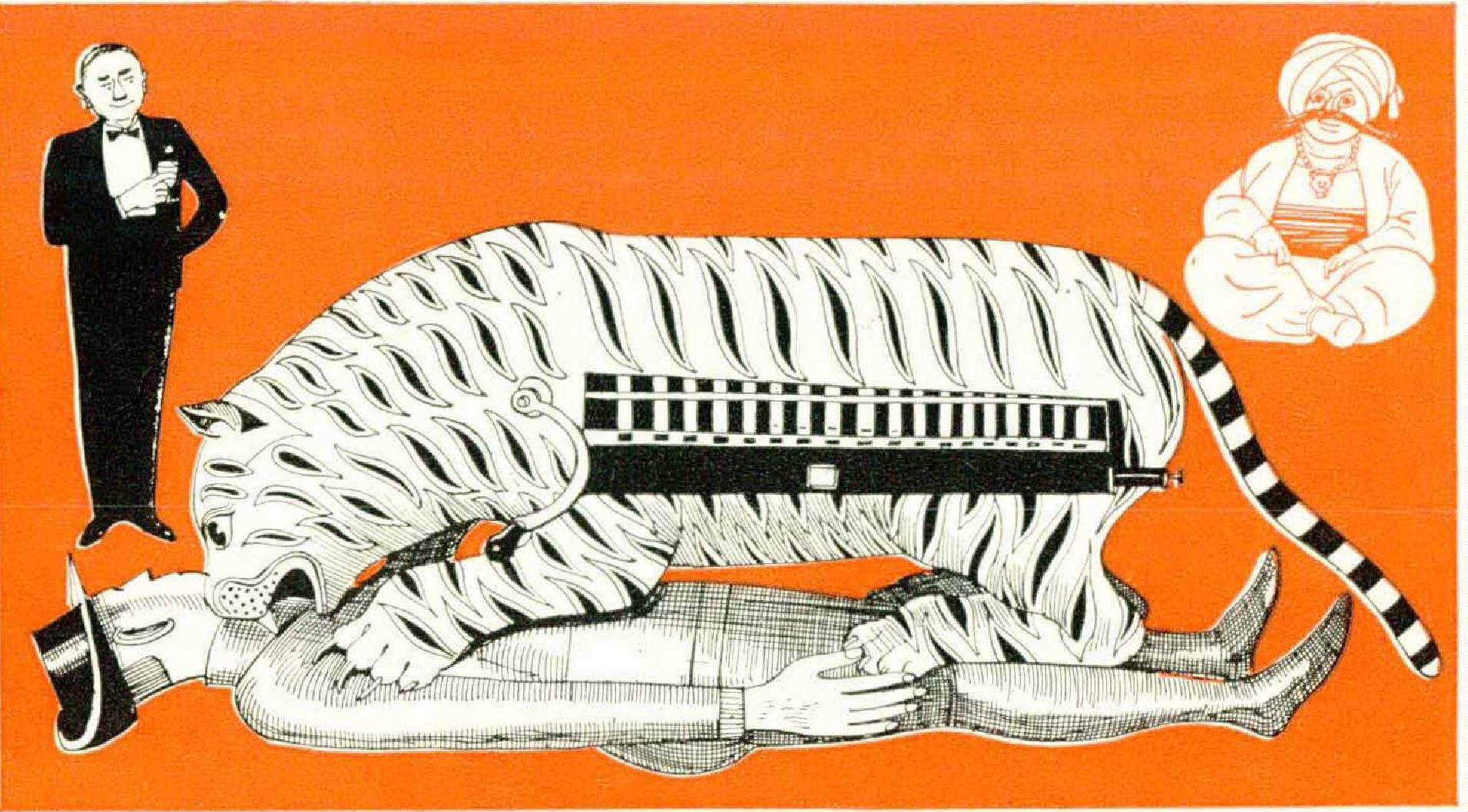
Not long ago, in a lecture theater of the Victoria and Albert Museum in London, I went to what had been classified on the invitation as a small sherry party. How the Victoria and Albert compares in size with our largest American museums, I would not know, but it is a colossal establishment, covering twelve acres and devoted to “Fine and Applied Arts of all countries and periods.” Among the countless treasures displayed there, one of the most popular is an eighteenth-century wooden figure of an Indian tiger, which measures nearly six feet from fangs to tail tip.
In 1955, this figure was in New York for a short while, on loan as part of an Indian exhibition which the Museum of Modern Art sponsored. To those readers who missed it on that occasion, a few words of description may be of interest. The tiger is not doing full justice to its potential height, because it is crouched in an eating position on top of the stylized figure of a man, who is lying on his back. The man’s body is about as long as the tiger’s, minus tail, and the man is wearing a low-crowned, wide-brimmed hat, a red coat with green and white roses painted on it, black knee breeches, white stockings, and black shoes. Inside the tiger and the man is an organ of the barrel type; on the tiger’s portside is a sickle-shaped crank for making the organ produce shrieks and roars. The ratio is four shrieks to one roar, and during their production the man agonizedly beats his left forearm up and down in the region of the tiger’s right ear.
This singular apparatus was captured in India’s Deep South by the British Army in 1799 at the close of the Fourth Mysore War, after the fall of Seringapatam. Seringapatam has declined to insignificance, but in those days it was a sultan’s magnificent capital, one of the most spectacular show places on the whole subcontinent. (Assault team alumni who took part in amphibious landings during the last war will remember the demolition device known as the Bangalore Torpedo; Bangalore is the modern capital of Mysore state, which is an area larger than North Dakota.) The publication of Tippoo’s Tiger, a monograph on the exhibit written by Mildred Archer and issued jointly by the museum and Her Majesty’s Stationery Office, was the occasion our sherry party was celebrating.
An added attraction for the guests was the presence in the lecture theater of the tiger uncaged. Normally, the exhibit is kept under lock and key in a large separate glass case in the museum’s Indian section; so, of course, there is no crank turning for the visiting public; but at our sherry party everybody was allowed to crank to his heart’s content. Having often seen the exhibit in its glass case and having read a little about it, I arrived expecting that the sound effects would be in keeping with the ferocity of the visual execution and at least rattle the lecture theater’s windows. When the crank was turned, however, the results were laughably, and somehow delightfully, disappointing., A gentle boop, rather like the opening note of a striking cuckoo clock, followed by four gentler beeps; the tiger roared like any sucking dove. Age has deteriorated the organ, and the fact that during the bombing of London a ceiling collapsed on the exhibit and smashed it into several hundred pieces can’t have added to its vigor.
Tippoo, the Sultan of Mysore (a tubby man with lustrous eyes, an aqualine nose, and a sweeping mustache), for whom the tiger was built, inherited the sultanate from his father, Haidar Ali, a hard-bitten, illiterate, shrewd, and able Muslim cavalryman, who by dash, courage, and guile had got control of the Mysore Army and usurped the throne from a weak Hindu dynasty. Some of the literature on the tiger describes the man’s recumbent figure as that of a European, but there can hardly be much doubt about what European nation he was supposed to belong to. During the thirtyeight years of their combined reigns, Haidar and Tippoo were constantly fighting the British, losing most of the engagements — and large chunks of Mysore — but winning one now and again and keeping their spirits up, and their hatred. As a zealous Muslim and defender of the faith, Tippoo issued a proclamation in 1786 calling on all true believers to “remove the cotton of negligence from the ears of their understanding” and join him in a holy war against the accursed British infidel.
When it came to infidels, Tippoo seems to have been a bit schizophrenic. By Muslim terms, the French were infidels too, but he was as pro-French as he was anti-British. The loss by France of the Seven Years’ War in 1763 was supposed to have wound up her aspirations in India; yet, for almost the next fifty years, Frenchmen were all over the place, stirring up the courts of Indian princes and fighting in their armies. The Nizam of Hyderabad, the state just to the north of Mysore, had a crack French contingent of 14,000 whose commander used to correspond secretly with Tippoo. Tippoo’s French correspondence was extensive. The British once intercepted a letter to him from Napoleon himself, who, of course, had had his eye on India when he invaded Egypt — only to have his Eastern dreams shattered by Nelson’s defeating the French fleet at the Battle of the Nile.
Although Tippoo’s own French contingent amounted to merely a few hundred officers and men, they were the apple of his rather bulging eye. As the ranking Muslim of Mysore, he was an ardent prohibitionist and enforced the dry laws right and left; but when the commander of the French asked permission to open a canteen for the sale of wines and spirits, he granted it readily. At Seringapatam there was a flourishing chapter of the Jacobin Club — about as revolutionary and antiroyalist a fraternity as existed in those times — and it conferred honorary French citizenship on him. An Oriental potentate known for his ruthless despotism, Citizen Tippoo, after a 2300-gun salvo, solemnly planted in his own soil a tree of Liberty surmounted by a Phrygian cap of Equality.
When I had digested Mrs. Archer’s admirable and excellently illustrated monograph (which can be obtained at small cost from the British Information Services, 45 Rockefeller Plaza, New York City),
I became interested in Tippoo’s personality and gleaned some additional facts about him from a couple of oldish books. Apparently, he had a puritanical streak. The population of Mysore was overwhelmingly Hindu, and it had long been the custom for females to go about with their bosoms uncovered; Tippoo made them cover them up. When he bathed, even in complete privacy, he always wore a sort of nightgown that reached from his chin to his insteps.
A man of tremendous energy, Tippoo was a tinkerer and loved innovations. He capriciously changed local place names, altered age-old systems of weights and measures, devised a new method for reckoning time, and renamed the months and certain memorable years — all of which must have confused quite a few people. He made elaborate plans for a Mysorean navy and wrote a military textbook. Edicts and letters on every conceivable subject kept gushing from the sultanic inkpot. Indeed, in contrast to his illiterate father, Tippoo was almost too literate.
The sultan was also tiger happy. Tippoo, in the Kanarese language spoken in Mysore, means “tiger.” His throne was supported by the lifesized figure of a tiger covered with gold, and the throne itself was festooned with ten golden tiger heads studded with precious stones. Tigerheaded were the muzzles of his cannon and hilts of his swords, and His mortars were cast in the form of tigers crouching. His turbans, jackets, and handkerchiefs bore the tiger stripe, known as bubberee. and his palace guards and regiments of the line wore special bubberee uniforms. At vantage points about his court, live tigers were chained, and into pits of them, unchained, from time to time the sultan would order the hurling of treacherous or inefficient bureaucrats. “I would rather be a tiger for two days,” he said, “than a sheep for two hundred years.”
Mrs. Archer, an attractive lady with reddish glints in her hair, offers an ingenious theory in her monograph to explain the how and the why of the barbarous machine. In 1792, a young British businessman named Munro, while deer hunting on an island near Calcutta, was killed by a tiger. His gruesome fate caused a stir in India as well as in Britain, for he was the only son of Sir Hector Munro, a British general who had commanded a division which ten years before had helped defeat Haidar Ali’s army, with the Mysore dead and wounded reaching ten thousand. Tippoo himself had fought in the battle. Given Tippoo’s Anglophobia and his tigermania, what could be more natural than the creation of this weird plaything, inspired by the death of a hated enemy’s son in such a manner? Tippoo may have regarded it as a symbol of patriotic aspiration; in the royal music room he probably used to crank it in the spirit of a voodooist sticking pins into the tar effigy of a loathed one. And what a conversation piece it must have been! Mrs. Archer and other experts believe that, though the figures of the tiger and the man are unquestionably of Indian workmanship, the organ is French-built. Not only did the sultan have French officers and soldiers in his army, he employed Frenchmen as glass blowers, armorers, watchmakers, ironworkers, and engineers. Likely, an itinerant French barrel-organ builder was among them and installed the shrieks and roars.
The sultan, when he was in his mid-forties, died gallantly at the fall of his capital, fighting alongside his troops. He was shot through the head; the museum possesses a quilted helmet of his, covered with darkgreen silk and lined with velvet of the same color; inside it, an inscription says that the helmet has been dipped in the holy well of Zum-Zum at Mecca and is therefore impenetrable. Tippoo became a martyr, and during the Indian Mutiny, almost sixty years after his death, his tomb served as a rostrum for anti-British oratory and a recruiting center for the mutineers.
A number of interesting byroads emanate from the central story. The future Duke of Wellington was a colonel at the siege and ordered hanging — seven gallows were in brisk operation — and flogging to stop the wild looting after the capital’s fall. General David Baird, the British commander of the action, had been captured in a previous Mysore War and had spent three years as a dungeoned prisoner in chains at Seringapatam; his hot temper was renowned, and when the news of his capture reached his old Scottish mother, her only comment was, “I’m sorry for anyone who’ll have to be chained to our Davy.” About twenty years after the siege, the poet John Keats, who had been studying surgery, saw the tiger when he went to Last India House to ask about a job as ship’s surgeon on one of its packets; he had been told that a long sea voyage might benefit his ailing lungs. Keats did not get the job, but he mentioned the ManTiger-Organ in The Cap and Bells, a satiric poem about the Prince Regent — scarcely one of his best. Another writer, Hector Hugh Munro (1870—1916), better known as Saki, was directly related to General Munro and surely must have known how the general’s son perished. (A popular early nineteenth-century Staffordshire pottery mantelpiece ornament, “The Death of Munrow,”
portrays an obviously hungry tiger starting to work on a late eighteenthcentury recumbent Nordic.) In any case, Saki, who had a miserable, parentless, aunt-ridden childhood, later wrote several hair-raising short stories in which objectionable humans were killed by animals — a werewolf, a hyena, hunted stags, wild swans, and a giant ferret named Sredni Vashtar.
Now, all of these things about Tippoo’s Tiger (or a considerable portion of them) that I picked up at our sherry party were certainly fascinating, but you could hardly call them deeply moving. Deeply moved, nevertheless, was a condition I suddenly found myself in. Not, I would like to assert, by the sherry. What moved me were the boffins. “Boffin” is an affectionate British slang term for an expert in government employ. The politicians depend on boffins for genuine expertise when they, the politicians, are called upon to produce some.
Anyway, there I was among those Tippoo’s Tiger boffins. About twenty of them attended the party — among them a lady Keats expert, a museum director from Brighton, a technician from the organ-building firm which has been coddling the exhibit’s shriek-and-roar machinery for more than seventy years. Some were old India hands who had served in, or known, Mysore. Male and female, they were all in middle or old age. Although they spoke in subdued tones, it was clear that they were having a wonderful time, for their faces all bore the same beatified look. They loved this outlandish contraption and everything pertaining to it; that Mildred Archer had got her monograph published was an occasion of joy in their lives. It was people like these who had stubbornly fished the hundreds of fragments out of the bomb rubble, after five years, and lovingly put them together again because they had thought it important to do so. “Dear Mildred must have more about Saki in her next edition,” a sweet-faced lady boffin was saying. “The Elton family round Bristol know all about the Munros.” It was fine to feel there was still some innocent enthusiasm and generosity left, even though young boffins all over the world were being made to concentrate on new ways to blow the human race to hash.
I hope the Victoria and Albert doesn’t scratch me off its small sherry list.