Albert Camus in the Sun
Ever since the founding of their firm, Blanche and Alfred A. Knopf have been a brilliantly successful team in the world of books. They began together in October, 1945; BLANCHE KNOPF ran the office, and through her sympathetic reading she discovered and helped to develop many of their European authors. She became vice president in 1921, and president of the firm in 1957, a unique record in publishing.
BY BLANCHE KNOPF
I MET him first in Paris in the early days of June, 1945. He had published The Stranger, which I had read and arranged to publish in America, and was about to complete The Plague (of which my office once queried: “A book about rats?”). He was thirty-one years old and had worked in the French Resistance all during the Occupation. The first group to edit Combat, the heroic fourpage manuscript-size Resistance newspaper, had been caught by the Gestapo and put to death. Camus joined the second group at the end of 1942 and stayed with it until 1947. In those hazardous years, some of his finest editorials were printed in the Underground print shop, which had to move almost every night. He helped deliver the newspaper himself, on a bicycle, sometimes dressed as a nun, sometimes as a priest, sometimes as a young boy, and sometimes in other disguises.
The best of the editorials, those he wished to preserve, appeared later in a three-volume work entitled Actuelles, and our company will publish selections from them under the title Resistance, Rebellion and Death.
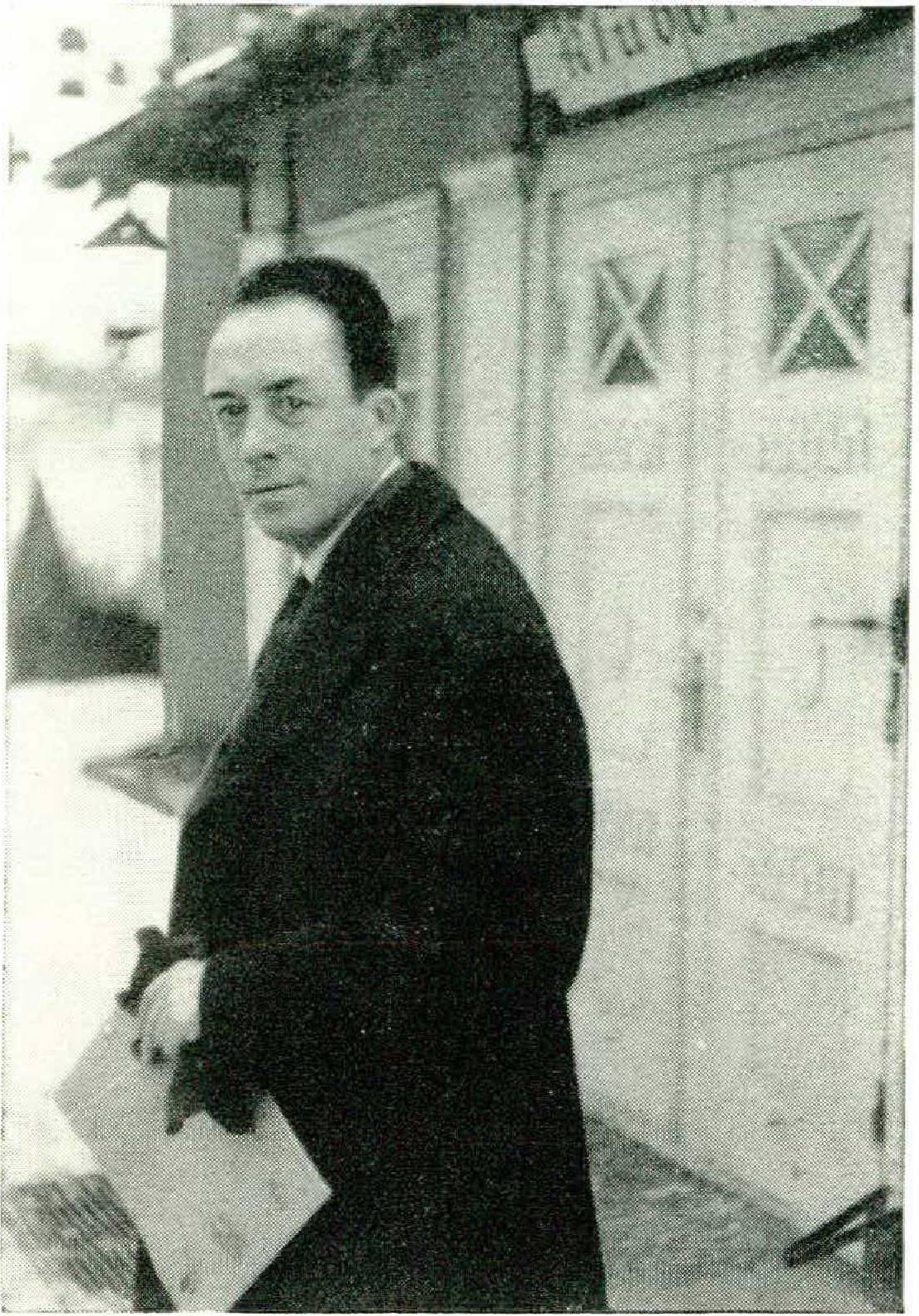
Camus was born of the sun and always had a yearning to be in it. He was neither tall nor short, was thin, with a very high forehead, a long, narrow face, and fine, regular features. I thought him beautiful. He was not dark because he had been born in the sun, nor was he fair, nor was he even olive. He was of a color most difficult, to describe, and of a rare neatness.
I remember that for many years he would go back to the south in the summers and get himself a little stone house at Cagnes. Cagnes, situated between the Mediterranean and the Alpes-Maritimes, is high, a very old village with old stone houses, and his house was the highest he could find. There was sun, and he could get down to the sea.
His mother, Katharine, was the great passion of his life. She was his most beloved lady, and he went to see her in Algiers, where he was born, as often as he possibly could, and this was often, especially when there were great troubles in Algiers.
In those early days of our first meetings, I had a sense of his greatness. In spite of his youth and the small amount of his production, his outlook on the world we were then in (three weeks after the end of the European war) was enough to show me his greatness as a philosopher and as a humanist.. That he was a writer, I knew. In short, I believed in him from the very beginning.
We saw much too little of each other then. He was working on Combat. I was seeing his young friends, and I was also seeing Jean-Paul Sartre, André Gide, and others. After going on to Germany to do various things, I came back and saw Camus again, and was more and more impressed by this brilliant young man.
We met again in Paris in early 1946, and then he came to the United States for the first time—and the last — in March of that year. He lectured. He spent a great deal of time in Greenwich Village amusing himsell. Camus could not have been the great man he was had he not been gay and happy and liked jazz and the things that appeal to youth. It seemed to me, watching him, that he embodied all that the youth of our era needed to emulate. In June, 1946, upon his return to France, he started working as an editor at Gallimard, his publisher; he continued with that firm until his death.
Our understanding, I believe, started from our first meeting at the Ritz in Paris in those June days shortly after the Liberation. The sky was blue and the nights were purplish and the Place Vendôme looked a dream, and the French women went clacking about in their wooden shoes and cotton dresses, made out of curtains or whatever there was, and looked enchanting. There were no automobiles except army cars, and everyone rode about on bicycles. Within that changing, transient Paris there was established between us a trust and an honesty I have rarely ieh with anyone else. i knew when he said something that it was so. When he recommended a book, it was worth the most serious consideration.
After his brief visit to New York I saw him at least twice a year, when I was in Paris. We never had very long sessions together, an hour or two several times, but they were intense and complete with understanding.
It was curious that he and I should have transacted a great deal of our business in the corridor of the Ritz Hotel in Paris. The corridor, with its deeper room in the center, is a teatime place for frivolous ladies and has always been this. But in the mornings there is no one there, and Camus and 1 would sit at the corridor end of the great room with no one around, discuss and transact and decide, This may seem a strange way to do business, and indeed it was. But it was not alone doing business; it was first getting to know one another, and then, as our relationship became much closer, discussing the ideas for his books. We drank coffee, bourbon, or Badois, and he smoked his elegant boxed Gauloiscs and I my Chesterfields, both of us incessantly. He carried a small notebook, and everything was put in it.
We talked about his writing, his future, his past, his plans, young writers in France, Pasternak, English writers, American writers, ourselves, everything, in these curious sessions we had together. We seldom talked about politics. I always had a feeling of being with a very close and intimate friend. I believe this was true. Camus said it very often himself. I remember once, in August. 1956, Hying from New York to Nice lor a brief swimming holiday and stopping on the way back in Paris. At that time of year there is not even a rnoitche in Paris, but Camus was there rehearsing Requmu for a A um which he had adapted from Faulkner’s novel, and during this visit we saw each other several hours each day. At that time I was worried about the gap between his last book, The Myth of Sisyphus, and Exile and the Kingdom, which was to be seven long stories connected in theme. They were not all ready, but one called The Fall had been completed. We discussed backward and iorward whether this should be published by itself, in order to bridge the gap until the appearance of Exile, or whether it was too short for publication by itself. We finally decided Yes, we would publish it alone. He went off and made further corrections in his minute and precise handwriting and gave me the manuscript. He wrote the jacket copy in my little sitting room at the Ritz, worked out publication plans for the book, and I brought it back to New York with me. It is one of his finest. To date it has sold just under fifty thousand copies in our edition.
Sometime in 1948 or 1949, when I was in Paris, Camus desperately wanted an American raincoat and drew a picture of himself with all the necessary measurements. When I returned to New York, I went to Brooks Brothers, handed over the drawing, and said I wanted a raincoat for a Frenchman and these were the measurements. Paying no attention to the sketch, the charming salesman turned up with seven Frenchmen, all clerks, short, wide, tall, thin, none of them bearing any resemblance to Camus’s measurements. We finally found a young American who looked about right. The raincoat was bought, although I had failed to ask Camus whether he wanted a heavy or a light one, I discovered, and it was sent over in due course. This, curiously enough, is the famous raincoat that he wore when CartierBresson took the fine photograph used so widely in connection with the publication and promotion of The Fall in early 1957.
AGAIN, in November, 1956, I happened to be in Paris. It was a bad moment. The Hungarian revolt was going on, and intellectuals in Budapest sent messages to Camus beseeching him for help. Although he was working, he dropped everything. It meant getting messages quickly to writers all over the world, asking them to join in pleading the cause of these unfortunates. The efforts were of no avail, but a curious thing happened. The young intellectuals in Paris became Camus’s slaves. They took more of his time, time that he needed to devote to his writing, and lie gave it willingly. I bis was always true of Camus. He was indeed “the conscience of our generation,” a phrase repeated so often that I dislike using it again, but I must. It is true. From the beginning I had believed this about him. He, in turn, trusted me as people rarely trust one another. We seemed almost always to agree, and I admit I did pressure him to go on with his writing; knowing how slowly he wrote and how tiring it was for him, I resented anything that took him away from it. Always there was the leeling that there was too little time for him.
Another indelible memory of Camus is of August, 1957. I was in Stockholm, and the gossip was of nothing but who would win the Nobel Prize for Literature that year. Many names were tossed about, and once I caught that oft Albert Camus and asked whether there could be any such possibility. People shrugged their shoulders and knew nothing, of course. When I returned to Paris I mentioned this to Camus. We both laughed — it seemed impossible to us. I will never forget the evening the news came through that indeed Albert Camus had won the Nobel Prize.
Camus was the eleventh Nobel Prize winner to be published by us, and I decided to go to Stockholm for the ceremonies for the first time. I went to Paris a little before the date we had to be in Stockholm, hoping to fly from there to the Swedish capital. But there was a cotton fog, and the two Gallimards, who were going by train with their wives, and Camus were all afraid I would be stuck in Paris, so I took the boring two-nightsand-a-day Nord Express with them. We left Saturday night at eight and arrived on a freezing Monday morning at eight. 1 was very grateful to have a red-carpet gentleman traveling with us, because the snow was cold and damp, and we could actually walk on a red carpet when we arrived. We were picked up just outside of Copenhagen, where Otto Lindhardt, head ot Gyldendal, Camus’s Danish publisher (whom he had never met, but who is a friend of mine), gave a small, gay dinner party. Then we boarded the train for Stockholm. The Swedes are enchanting people, but extremely formal, and the welcome at the Stockholm station with the French ambassador and other officials, early in the morning, was quite impressive.
It was a crowded week for poor Camus. He had no time to himself whatever, and on the great day, Tuesday, the tenth of December, the anniversary of Alfred Nobel’s death, festivities started at half past three in the afternoon — white tie, full decorations for the men, and long white satin for the ladies — in the concert hall, where the awards are made, each preceded by a long speech. Then to the magnificent town hall —evening slippers in the snow. The King and Queen and the whole court were present; there was a long dinner, quite magnificent; and then the various speeches of the prize winners, the last and longest always being given by the winner of the Prize for Literature. Camus’s is one of the great speeches of our time and very much embodies his thinking, his character, and his beliefs.
On that great evening of the tenth of December, one of the most beautiful sights was that of the students of Stockholm, who came in after the banquet, after the speeches. We were all on the balcony, looking down on a scene of splendor: young girls in pink, pale-green, and blue tulle dancing with young students in blue uniforms with white-lined capes, and, of course, our young Albert Camus was cha-cha-chaing with the best of them all night. This is part of what made him so beloved by everyone — the combination of the great writer, the great humanist, and his love for youth and gaiety. I do not believe he could have been the man he was without that love.
The days were filled with receptions, lunches, dinners, and high spirits, but Camus had to make speeches and was beset on every side. His week ended with a trip to Uppsala University, where he gave his final, very long address. I must add that during that week he was heckled by young Algerian students, but he never lost patience. He spoke to the high school students, who asked why the war had gone on, why this, and why that. He look all these young people very seriously and answered them with great care.
Weeks before the actual presentation, in Paris, Camus was approached by every kind of person for articles, photographs, books, every conceivable kind of work. Everyone wanted to see him, to shake his hand, to get a glimpse of him. In restaurants people said, “There he is, the Nobel Prize winner.”
But we did manage to get two hours together in my tiny room at the Grand Hotel, where we worked out publication plans for Exile and the Kingdom—jacket copy, promotion, all the rest of it. He was shy and extremely modest and was embarrassed by what he regarded as the absurdity of his receiving the Nobel Prize at that time. He stated this over and over again — “I am not ready.” But he was.
Camus went into a deep depression in the winter of 1958, from which he emerged after a few months. It was the feeling that he was not worthy, that he had not accomplished what he had wanted to. At forty-four, who has?
He had for several years been at work on his very big novel, The First Man, and he returned to it. Pasternak’s Zhivago worried him, because he regarded it as a challenge to him to explain his philosophical position to the world. He had torn up a hundred and fifty longhand pages of the new novel, and this meant a year’s work down the drain. Camus had not been well as a young man, had recovered, but was never very strong, and time was always of the essence to him.
That winter he had been adapting for the theater Dostoevsky’s novel The Possessed, which was produced in Paris early in 1959. I believe it is one of the greatest plays in Camus’s thinking and words that I have ever seen; much more than a play, because the combination of Dostoevsky and Camus is a perfect marriage. I think it will live as one of the most extraordinary of Camus’s works. He was devoted to the theater. “I have one péché,” he once said to me. And indeed this was true, for it took up a large part ol his time.
This love was a passion; he could not, even though perhaps he wanted to at times, keep away from it. This he knew, and this prevented him from writing as much as he really wanted to, because he not only wrote his plays but took over all details of production, direction, and casting.
I remember our meeting for lunch one, to us, quite calm day, May 13, 1958, when he had left a message for me that we had better lunch a little early, at 12:30. When he arrived, he said, “You see, the streets will be barricaded by 2:30, and I must be back at Gallimard’s by then, or I will not be able to get through.” I had forgotten about the barricades. This was the great May 13 which none of us will forget who lived through it: the street fights that night, and several thousand hurt and killed.
I SAW him several times again, particularly in November, 1959. He had bought a little house at Lourmarin in the Vaucluse. This had been a dream of his. Here he could live quietly and write. It had been a frequent joke between us, because I had begged him to finish The First Man so that I could publish it before I was dead — “a mon âge.” He would laugh and say, “Yes, you will. Indeed, I had a letter from him a fortnight before he was killed, saying:
Jesuis â Lourmarin depuis longtemps en plein travail sur Le Premier Homme et je n’irai meme pas à Paris avant Janvier. C’est vous dire qu ‘il n’est pas question que j’aille a New York pour les repetitions de Caligula.
Moi aussi, j’ai regrette de ne pas vous voir a votre re tour a Paris. Mais je travaille pour vous parce
que je sais le prix que votre affection attache àa ce livre où je suis plongé. Et je pense a vous, comme toujours, de tout coeur.
He had also said, laughingly, “I will come to New York when you publish the book, and we will have ourselves photographed together with the book between us.” This was to be his great work. But his great work has been written by him in all of his works, in the deep influence that he has had on the young of every country, and particularly in the United States. And this, I believe, was one of the things he was happiest about, That we could sell a hundred and fifty thousand copies of our Vintage paper edition of The Stranger all, he hoped, to students — and tens of thousands of The Myth of Sisyphus and The Rebel as well. These are not easy books to read, but they have been read. They are being bought, and will be, I think, for generations to come, because their influence is not only ol today. Their impact on youth will continue. All ot his books are being discovered by young people each year— The Stranger. The Plague, The Myth of Sisyphus, The Rebel, The Fall, and Exile and the Kingdom.
The absurdity of Camus’s death still shocks the world. He had a recurrent dream of sudden death, that it was always there, staring at him. That was the pressure that time put on him. On the other hand, his slow writing and his meticulousness about everything concerning his work contradicted this feeling that time was running out. But his recurring dream came true. Curiously enough, on the third of January, 1960, Camus, who had spent the holidays at Lourmarin, bought himself a ticket for Paris, planning to leave the next morning. But he changed his mind, drove with the Michel Gallimards, and his ticket was found on his body after the accident that killed him.
His death, in my opinion, is the greatest loss to the youth of our world. He was the conscience of the post-war era, and so very much of his work lay ahead of him. And so much of it might have bridged the differences between so many people. As Jean-Paul Sartre said to me a few weeks ago, when I told him what an excellent piece he had written about Camus in L’Observatoire, “If we had been left alone a few years, our political differences would have worn themselves out, and we would have been the great friends that we had been before.”
To me an era has passed with the death of Camus. His friendship, his trust, his beauty in every respect I will not find again in this world. Our kind of relationship I will not find again. I can only say that to me the absurdity of his death is an instance of the absurdity of the times we are living in.