The Pressure of Numbers
A rugged canoeist whose holidays are spent exploring with his wife the more remote areas of wilderness of North America, PAUL BROOKSis deeply concerned with the preservation of these areas in our national parks. Mr. Brooks is the editor in chief of Houghton Mifflin and a frequent contributor to theATLANTIC.
PAUL BROOKS
AN OCCASIONAL camping trip such as my wife and I have made to our national parks and forests is no basis for grand generalizations, yet there is one impression I carry back from every trip, from the Appalachian Trail on the crest of the Great Smokies, from the Border Lakes canoe country, from the alpine meadows of the Olympics, or the hot sands of the Virgin Islands: it is simple wonder — and gratitude — that such places still exist, that such experience is still possible. This has not come about by chance. The very concept of a national park was revolutionary a hundred years ago. In Europe, parks were originally royal preserves, for the sport of a tiny minority. The idea of parks for all the people was of American origin. It is profoundly democratic. And it has worked so well that it now threatens to work its own destruction.
Taken all together, the national parks cover less than 2 per cent of the continental United States, and the annual number of visitors amounts to about one ninth of our population, a number that will certainly increase. Theoretically, this is fine. Actually, it can be catastrophic. Those of us who avoid the most populated spots during the peak loads never see the worst of it, but the fact of overcrowding is everywhere evident. So, alas, is the prescription that may kill the patient — over-development.
Fortunately, the millions who visit the parks do not have identical objectives. There are some people whose spiritual metabolism requires an occasional dose of what Thoreau called “the tonic of wildness.” They are generally willing to work for what they get. Others go for fishing, for climbing, for photography, for nature study. Still others use the parks to give the whole family a week’s inexpensive holiday in beautiful, healthy surroundings; they are probably happiest in a campground with close but congenial neighbors (I find that most people at a park campground are congenial), where there are other children for theirs to play with. All these concerns are equally legitimate. Unhappily, there is also a very different type of visitor — the type that comes looking for ready-made entertainment. He stops his car among the redwoods, rolls the window down for a closer look, and complains, “Yeah, I see ‘em, but what do you do here?”, as if he expected the forest to put on a floor show. He will never find what he wants in the parks while they remain parks.
The need to accommodate the crowds has inevitably led to compromise in preservation of the natural landscape. Let’s face it, this hurts. Since the Great Smokies Park is easily accessible to those of us who live in the East, my wife and I have camped there oftener than anywhere else. Twenty years ago Cades Cove was one of our favorite spots. You reached it by a narrow, twisting road over the mountain; the campground was a level spot beside the river with three or four picnic tables and a privy. Today a wide, graded road comes down the valley, and there is a city of tents with all modern conveniences and firewood for sale. Something has been lost, but an awful lot of people are being made—or, rather, are making themselves — happy. I like to think that their children are learning to love the outdoors and unconsciously preparing themselves to defend it.
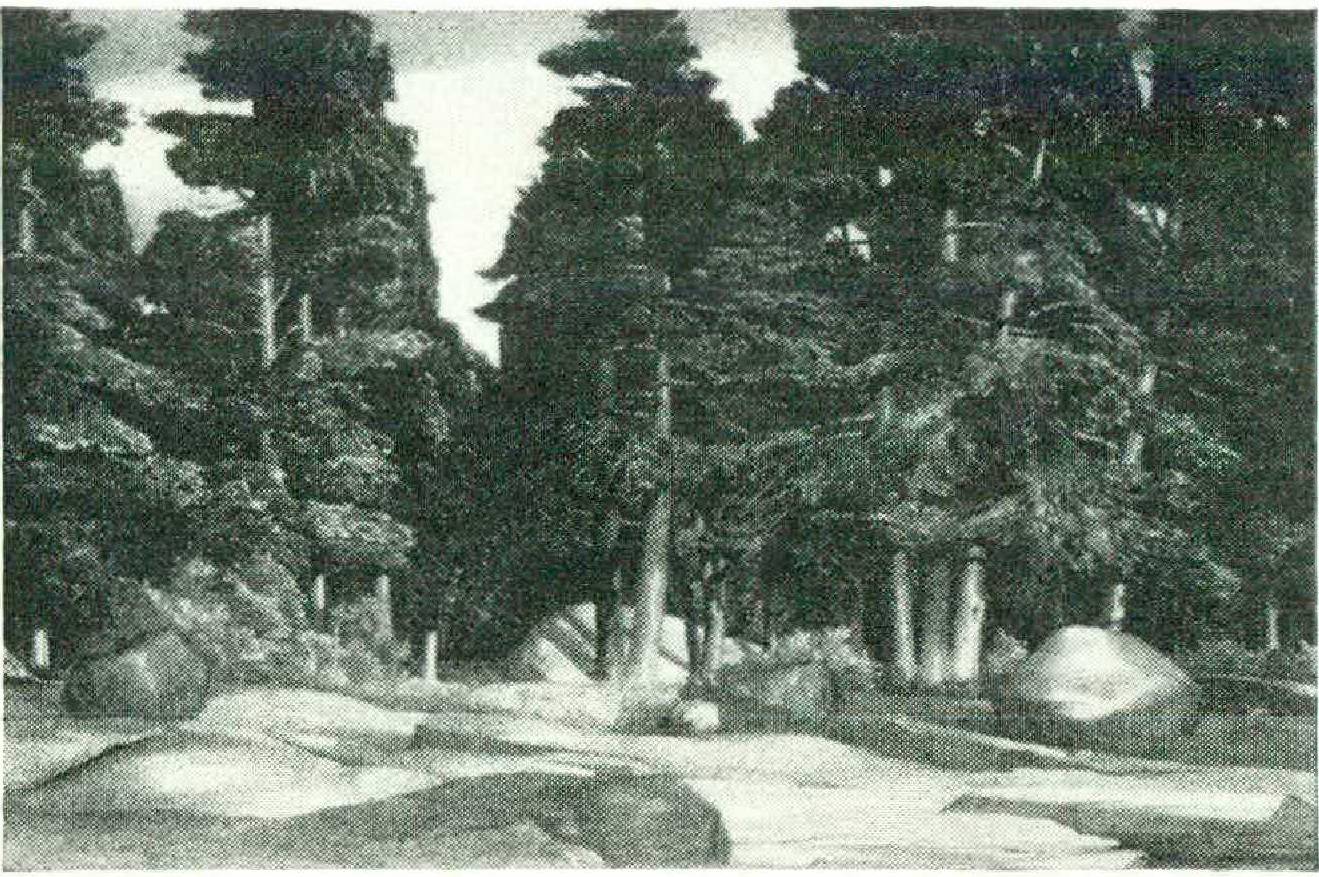
Lithograph by
Some development is necessary; the danger today is that, under pressure, it may be going hog-wild. I venture to suggest that much of this activity — particularly the building of roads for fast cars and marinas for fast boats — is based on a mistaken premise. It is assumed that the public (as distinguished from the automobile and motorboat industries) demands these things and that the parks cannot be used without them. Is this true?
Let us go back a moment to the initial problem: the space available in the national parks is not big enough for all who want to use it. But the size of a park is directly related to the manner in which you use it. If you are in a canoe traveling at three miles an hour, the lake on which you are paddling is ten times as long and ten times as broad as it is to the man in a speedboat going thirty. An hour’s paddle will take you as far away as an hour in a speedboat — if there are no speedboats. In other words, more people can use the same space with the same results. Whenever we return from a canoe trip, someone is sure to ask us how many miles we traveled. We never know, and we couldn’t care less. I do know, however, that every road that replaces a footpath, every outboard motor that replaces a canoe paddle, shrinks the area of the park. And don’t let anyone tell you that this attitude means discrimination in favor of the young and athletic. The man who is too feeble to paddle a canoe should never go tearing off in an outboard motorboat; after all, he may have to paddle home.
Highways, of course, can shrink parks faster than anything else; from my limited experience, I think that they represent the greatest danger to the park system. Walking for three consecutive days along the high ridge of the Great Smokies, through dark forests of virgin red spruce and sunny “ balds” flaming with azalea, I have shuddered to recall that a “scenic” highway was once planned for the whole length of this trail (in addition to the adequate highway across Newfound Gap and up to Clingmans Dome.) Camping on the ocean strip of Olympic Park, westernmost tip of the United States and the last remaining bit of roadless coastline, I was acutely aware that only the heroic efforts of men like Olaus J. Muric, William O. Douglas, and other devoted conservationists have kept this wild beach from degenerating into another speedway. Our last two trips were in the two national parks that are islands, Isle Royale and the Virgin Islands National Park. Both are blessed with the absence of automobiles. On Isle Royale there is only a foot trail, and in the Virgin Islands a rocky jeep road runs along the spine. Both islands would be spoiled il a highway were ever to be built.
Obviously, some roads are essential to the enjoyment of the parks. The test is, will a road destroy the very thing—the basic value — it is supposed to give access to? In wartime parlance. “Is this trip necessary” at fifty miles an hour? One thinks ol the Chinese philosopher who will spend an entire day on a hillside, listening to the ripple of a brook, contemplating the shifting light on a distant mountain peak, and studying the profile ol the wind-blown pine above his head. He has not covered much distance, but he may have traveled far.
Since our parks are not used principally by Chinese philosophers, there is bound to be a demand for “improvements,” as evidenced by the much-disputed Mission 66. This project, however legitimate its objectives, is sometimes being carried to excess. One can only hope for restraint, in both central planning and local execution. To paraphrase the poet, unless we use the snaffle and the curb all right, there won’t be any bloody horse. This is not a military operation; we do not have to build the Burma Road before frost, or even get our trenches dug before dawn. We are not at war with the wilderness.
IN OUR travels, my wife and I have come to recognize among the park personnel — perhaps especially among the men in the naturalist branch — a sense of mission of a very different sort. It is not advertised on the billboards; since it involves brains rather than bulldozers, the results are not so evident on the landscape. In my book, however, it is Mission Number One. The objective will not be achieved by 1966, or any other date, because it is a continuing process: the education of the public to the true uses of its parks. By contagious enthusiasm, rather than by preaching, the men in the field are making the visitor aware of the values (including the spiritual values) he should expect to find in a park. These men have what can only be called a dedication to their job; in fact, nothing less could attract and hold the class of person that one finds everywhere in the service. Join a nature walk in the Olympic rain forest or among the alpine flowers: likely as not it will be led by a young ranger-naturalist who is raising a family on a liny budget while he works for a Ph.D. in botany, not in anticipation of an academic career, but to serve in the parks. Talk to the older men: you will find experienced scientists whom any university would be proud to hire, men who have made original contributions in every branch of natural history, ecologists following in the footsteps of Aldo Leopold, botanists whom Bartram and Michaux would have enjoyed as fellow explorers. Show the slightest interest in what they are doing and they will respond far beyond the call of duty. They know that the ultimate answer to the problem of the parks is not so much in physical development as in education. The coming generation will decide the fate of the parks; hence, the need to extend these services beyond the parks themselves into the schools — a mission for broadening minds, not roads.
If there is a keystone in the whole complex structure, it is, I believe, the concept of the wilderness area, the object of which is to preserve for present and future generations some part of our country in its original state, unaltered by man. The scientific and cultural value of such areas is immeasurable; they are to our national park and forest system what libraries, laboratories, and museums are to a great university. Here there can be no compromise. You cannot selectively cut a rain forest and still have a rain forest; you cannot bring a gasoline engine, on wheels or afloat, into a wilderness and still have a wilderness. Today the Wilderness Bill, which would protect such areas for the future, is still awaiting action by Congress.
THE passage of the Wilderness Bill is one clearcut and immediate objective, but this alone will not solve the problems of crowding and consequent deterioration with which the Park Service is heroically wrestling. In an era of exploding population, if we are to preserve the parks without enforcing quotas on visitors, the park system itself must be enlarged, to provide more space for more people, to save the finest natural features oi our landscape from commercial development, to protect areas of historic significance. For example, the Cape Cod National Seashore Park, under discussionin Congressbut not yet voted, would accomplish, to a limited extent, all three objectives. Though its area is not great, it is a still unspoiled bit of the Atlantic seashore rich in history, in folklore, in bird life, in spectacular natural beauty.
In addition to new parks such as this, we desperately need more room, outside the existing park system, to relieve the pressure on that small area of our national heritage which we are morally obligated to preserve in its primeval state. Cannot Congress establish a system of supplementary park areas under some different designation (preferably adjacent to the national parks themselves) which will be specifically intended for camping and outdoor recreation, in which ski tows and motorboats and other amusements will be permitted, and in which there will be adequate accommodations for large numbers of people amid attractive surroundings? The land already exists within our national forests, and surely the problems of its administration, whether by the Park Service or Forest Service, are not insuperable.
But I am straying into the realm of high-level administration, where these matters are no doubt being urgently discussed. One thing I do know from personal experience: there are innumerable opportunities for outdoor adventure, from an hour’s walk in a Town Forest to a week’s backpacking trip on a mountain trail, which do not involve the use of the national parks at all. One way to relieve crowding in the parks is to develop these local alternatives. Take our waterways, for example. Many rivers throughout the country provide quick escape from the mechanized world, but infinitely more would do so if they were redeemed from their present uses as dumps and open sewers. We hear much today about urban renewal. A program of rural renewal and an accelerated program of open-space acquisition near our centers of population would provide closer to home many of the values that people now feel can be found only in the national parks.
The parks themselves have been aptly called “living museums.” Like a work of art, the natural Scene is something that can be used without being used up. How we use it in America will have a very real bearing on the sort of people we become.
When I think of the parks, I recall a scene one July evening on Hurricane Ridge, which overlooks the whole vast range of the Olympics. For several nights we had had the campground to ourselves: a meadow at snowline, on the edge of the glacier lilies. We were slightly disappointed when a large family group settled in opposite us; the peace would be destroyed, the spell would be broken. We were wrong. They had come to enjoy the wilderness, not to dispel it. Their quiet voices didn’t reach across the grassy space between us. The black-tailed deer that grazed every morning and evening within steps of our tent were not disturbed. While we were cooking supper we looked up to see the whole group standing quite motionless, like a tableau in the setting sun, around the ribbon of blue smoke from their campfire. They were saying grace.