They Shall Have Music
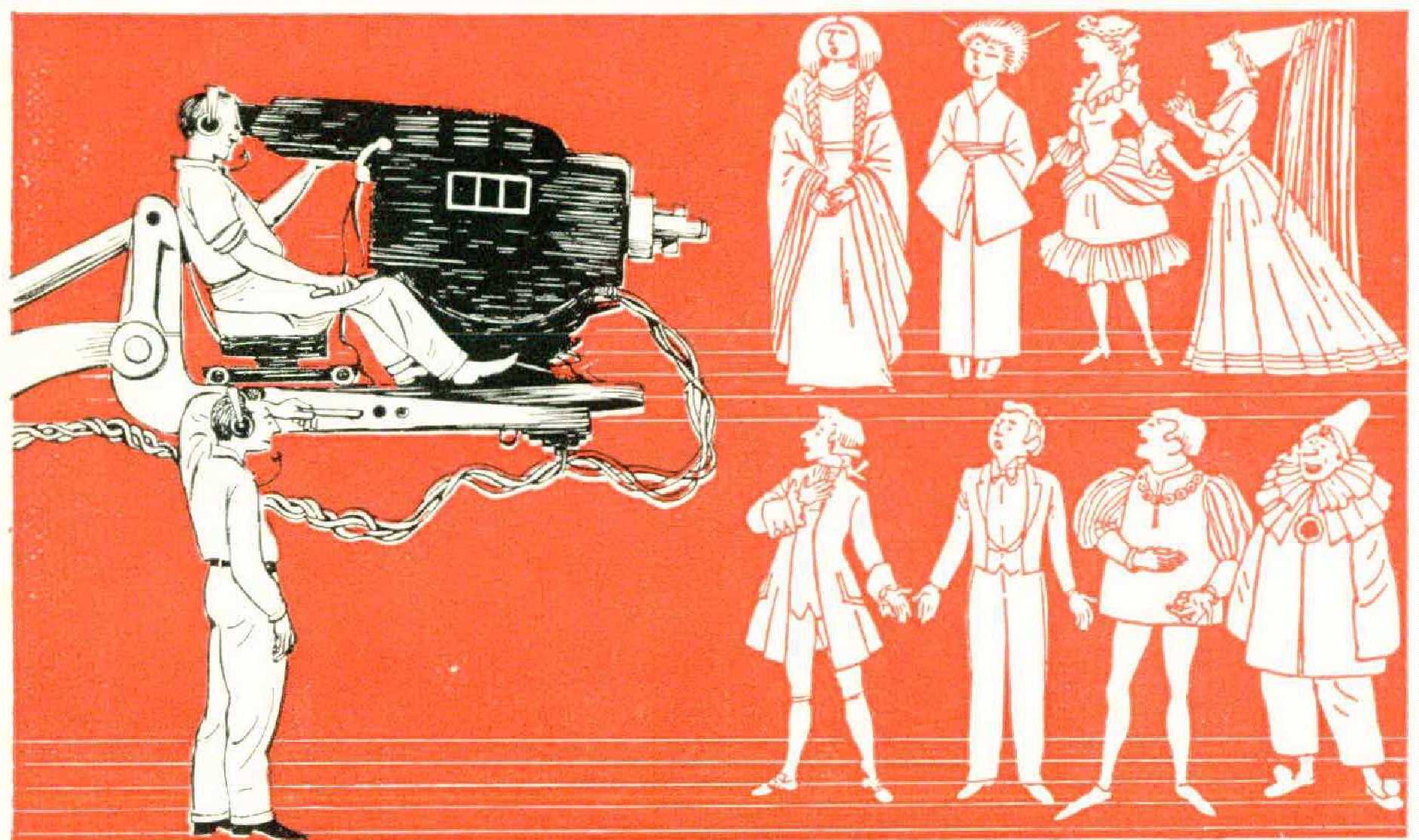
In 1949 there was hardly any television audience, let alone a television opera audience; but Mr. Samuel Chotzinoff at NBC thought there was going to be. Since Mr. Chotzinoff’s words have long been heeded in the company’s high echelons, there was formed what was to become the NBC Television Opera Company. That year this nascent organization lavished upon Sunday afternoon viewers, if there were any, scenes from The Barber of Seville and Menotti’s The Old Maid and the Thief.
There was no thunderous public response, but none had been expected. and the opera project began to grow by itself. It developed its own principles: the operas should be performed in English and in accord with techniques best suited to television, so that people experiencing opera for the first time could make sense of it.
It may be pointed out here that this was no minor aim. The Italian state television network, according to my (very unofficial) Italian sources, has failed rather miserably to sell opera to the traditionally operaloving Italians. They can’t understand the words; they can’t follow what’s going on; it lasts too long; and they would sooner have soccer games. American viewers of the NBC Opera always can understand the words and what’s going on. And I have never heard an unfavorable comment about an NBC Opera Theatre production, except one from an old gentleman who frequents a cigar shop I go to, and who didn’t like Poulenc’s Dialogues of the Carmelites because, he said, it was too damn sad.
Spurred by curiosity about this outfit, which now has set forth fortythree operas for an estimated public of more than six million, I went to its working headquarters, at 150 West 56th Street, New York. This is almost opposite the back door of Carnegie Hall, and I should judge it to be a converted warehouse. The actual telecasts do not come from there. They used to originate in the old Center Theater; now they are made in one of NBC’s huge outlying studios, in Brooklyn. But the rehearsals take place on 56th Street. When I arrived, on an early March morning, the preparations concerned Boris Godunov, to be presented three weeks later. Behind a door at the side of the office a powerful tenor voice was throbbing the troubles of the false Dmitri, to piano accompaniment.
“Frank Porretta,” said a young woman with glasses, later identified to me as Maude Brogan, assistant to the producer. From behind her I got a wave from a tall, athletic-looking man in a knitted T shirt, who was telephoning. He came bounding out in a minute — he never seems merely to walk — and introduced himself as Kirk Browning, director of the program. We went to talk in the rehearsal studio, which was almost bare and looked like a place to hold ballet classes.
“Much too small,” he said. “Sometimes we tape up the floor, for positions, so the performers will know where there is supposed to be a door. They may not see the finished set, in Brooklyn, until a couple of days before we go on the air.”
He paused to wish that Chotzinoff and Peter Hermann Adler were there. The former, general music director for NBC, is producer of the Opera. Adler is musical director and conductor. Oddly, neither Browning nor Adler is now a full-time NBC employee. Browning is a freelance director; Adler is conductor of the Baltimore Symphony.
“Chotzinoff naturally has final sayon everything,” Browning explained, “but that doesn’t obstruct anyone else’s say; he’s the least dictatorial man I know. Adler is the perfect conductor for this job, a born theater man. He relaxes the singers, frees them, which is what you need for strong performances.”
A telecast performance by the NBC Opera is a strange spectacle. Camera trucks and moving microphones make it impossible for the orchestra to be anywhere near the singers. Accordingly, an “isolated" system was worked out by David Sarser, then audio director, now consultant to the program. The orchestra plays in a separate room, neither hearing nor seeing the singers. Adler can hear them through earphones, and they can see him on monitors. This allows plenty of room for action by both singers and rolling equipment. “But it is eerie,” Browning said, “to walk into the orchestra room and see all these men accompanying voices they can’t hear.” Enough orchestra sound does seep through the wall to the singers’ microphones, according to Sarser, to afford some sonic spaciousness and eliminate the need for echo chambers.
“Opera on television has to be really musical theater,” Browning explained, “rather than opera in the opera house sense. Beautiful sounds won’t do. It’s mainly visual, and must tell a story. There is much closer scrutiny, and there must be action. The beginning of Cavalleria we simply couldn’t treat as if we were working in the Met, because there is no action to watch; the principals don’t even show up for the first ten minutes. So we prerecorded the opening choruses and just used our chorus people as human scenery, getting shots as they moved around talking, jostling, doing anything that kept them moving.
“In some cases we can do things for opera that an opera house cannot. For example, if I had to choose our best-realized production. I think I’d choose Puccini’s Sister Angelica. It’s an opera not given very often on the stage, and for good reasons. There’s a lot of characterization in it, and drama, but neither is obvious. With the cameras we could bring the characters’ faces in close. Many things that impede effect on the stage suit us very well. In something like the waiting scene in the nunnery’s anteroom, a problem on the stage, a good cameraman has plenty of time to get facial expression.
“There are other advantages we have, too. Perhaps our most imaginative and radical departure was The Magic Flute. Sarser pretaped several parts of this, so we could maintain intelligibility and combine it with action. Thus, we could have the Three Ladies played by dancers doing a real witches’ dance, just miming the singing, which was really coming from a tape.
“Intelligibility is a must,”Browning went on, “when you’re bringingopera into a person’s living room, in his own language, for two hours.”
I broke in to tell him of the Italians’ experience.
“Yes,”he said, “I suppose they simply tried to come as close to a Teatro Scala style as they could. We did that a little to begin with, but we didn’t stay at it long. You can’t do it right in a studio, and a pure television technique is better anyway. Incidentally, another thing we have no need for is big voices.
If a big voice does come along, we cut it down; it gets in the way of diction.”
Maude Brogan poked her head in at the door and made a not very cryptic gesture, holding an imaginary telephone to her ear and assuming a woeful expression. Browning bounded from the room. He was back in a few minutes, apparently having extinguished the brush fire.
“This may be interesting,” he said. “We get many letters from all over the country, and it seems we’ve started a lot of interest in opera in English. People want to know about trying it locally. Maybe this would have happened anyway. But, you know, someone pointed out to me that when we gave La Bohème, more people saw it that afternoon than ever had seen it, year by year, since it was written. There would have to be some effect.”
Browning speaks high and clear. I asked if he had ever been a singer himself.
“No,” he said. “In fact, I never had any musical training except piano lessons, though once I tried composing popular songs. I was born right here in Manhattan, attended Cornell, then went to Texas, where I was a reporter on a paper named, believe it or not, the Waco News-Tribune Times-Herald. Then I came back and worked for an advertising agency. Chotzy, a neighbor of ours in Connecticut, got me into NBC, working in the music library. Television was just starting then, and I applied for a job as a floor manager, a sort of utility assistant stage director. When the Opera was started, I asked for that. The first job I worked on was The Old Maid and the Thief, and the first I actually directed by myself was The Barber of Seville. I’ve done them all since; I suppose nearly forty.
“I like singers,”he said suddenly, as an afterthought. “They’re fine to work with, and most of them take to television very readily, even established stars like Siepi, Leontyne Price, and Giorgio Tozzi, who’s singing this Boris for us.”
“Have you, meaning the Opera, launched any stars?" I asked.
“I couldn’t say that,” he replied. “I hope we’ve helped some that came to us pretty young, like Elaine Malbin. What an artist! Leontyne Price calls NBC Opera her alma mater. We have really enjoyed working with young singers, and, of course, we have to, on television.
I he characters have to look believable. It’s unfair to single any of them out, I suppose. Mac Morgan, maybe, Gloria Lane, Johnny Alexander, David Lloyd, Chester Watson; I could go on all day, but you wouldn’t have the space.”
I wondered aloud if he would have the time, anyway. I happened to know that, along with launching Boris, he had been preparing an Omnibus show about the young Abe Lincoln; the times actually overlapped. And Miss Brogan had informed me that his lunch usually consisted of a hasty malted milk. However, at thirty-nine he looks extremely healthy.
He may be healthier than the Opera Company itself. Each year, when the season ends, as it did this time with Boris Godunov, a murmur of speculation goes around the staff: Will they still be in business next year? David Sarser says this used to be the case with the NBC Symphony, too. The Opera certainly earns prestige for NBC. (And, as Browning says stoutly, “Even if they did discontinue it now, they’d still have done better than anyone else.”) But it has not brought in profits. Its audience is small compared with that of the popular Westerns. On the other hand, it is an elite audience, and, I suspect, from the upper income brackets, too.
There has been only intermittent sponsorship of the Opera. Maybe the time salesmen boggle at trying to find just the right customer for a four-times-a-year opera program, although probably NBC would make the price reasonable. The staff does not blame them. Kirk Browning said, a little ruefully, “When a program’s been around as long as ours, it would be hard to get it identified with any product except NBC public service television.”
When I left, a baritone was at work behind the audition-room door. Miss Brogan was in there listening to him, and Browning was on the phone again, so I never did find out who the singer was. It sounded as if Boris Godunov was going to be pretty good, though, and it so turned out to be.
kindred facility. The recorded sound is good, though the piano is a little overprominent.
Mussorgsky: Pictures at an Exhibition
Sviatoslav Richter, piano; Columbia ML5600
Some irreverent remarks have been made here about Mr. Richter’s Brahms, but none ever will be about his Mussorgsky. Here is playing from the heart, with perfect comprehension and the fire that makes Russians the greatest interpreters of Russian music. Neither has there been trifling with the original, and difficult, Mussorgsky score. Instead, it has simply been mastered. The recording was a live one, made in Sofia (apparently Richter is subject to microphone chill). Bronchitis was rife in the hall, and the fi wasn’t very hi that day either; but no one is going to mind.