Chez Androuet
Though listed in the Guide Michelin, that Dun & Bradstreet of French eating, the Restaurant Androuët, 41, Rue d’Amsterdam, Paris (VIII), doesn’t rate even one star. Yet its fat guest book is bulging with testimonials from grateful clients, quite a few of them internationally famous, and most of those French. The opening page contains a paean in the somewhat shaky handwriting of the late Maurice-Edmond Sailland, who produced a number of delightful works on food and drink under the by-line of Curnonsky and was known as le Prince des Gastronomes. Did the Michelin restaurant raters (presumably small, begoggled men clad entirely in auto tires) muff this one?
No, because to the Androuëts (seventy-five-year-old Henri and his son Pierre) the restaurant is a side line. No mean side line, to be sure — the bifteck an poivre, the ponlet à la vallée d’Auge, various fish dishes, and the soufflés are delicious. And the onion soup must be among the best in Paris: they plop in a drop of cognac and have a way of handling the cheese crust on lop of the soup so that it does not reach the table in those gummy strings that make a man nervous.
Well, when it comes to any dish concerned in any way whatsoever with cheese, they should have a way. The restaurant is one flight up; on the ground floor is a cheese shop; below it are the cheese caves (the technician in charge of them is a caviste), and there the Androuëts have assembled prime selections of just about all the cheeses that matter to cheese lovers of the Western world. In any case, they mattered so much to Pierre, a graduate of the École des Beaux-Arts, that in 1935 he gave up an architect’s career to devote his whole time to them.
“We collect and cure,”Pierre said, as he led me into the cellar, where the cheeses were stored on shelves nine tiers high. A staggering blast of smells almost blew my hat out of my hand, but I became adjusted to it at once, for there was the wonder of shapes and crusts to goggle at. Touring wine cellars is, to me anyway, not much of a visual treat; the Androuët caves, however, were a fascinating kaleidoscope:
A gigantic roped-up smoked sausage of a cheese, taller than a man; cheeses that looked like old potatoes, like pears, like pine cones, like rusty hitching weights from the horse-andbuggy era. Cheeses shaped in pyramids, in cones and truncated cones, and like rolling pins without handles; spheres, too, of course; flat rectangles, triangles, cubes, half moons. A mathematician could leave his tools at home and give a complete course in solid geometry here.
Cheeses aromatized with garlic, flavored with parsley and pepper, matured in charcoal, pickled in the local applejack, spiced with powdered cloves and tarragon. Cheeses each with a hole in the top for pouring in whatever you want. Others plastered with what seemed to be dead fir needles, but weren’t; still others coated with the skins, seeds, and twigs of grapes, the whole exterior a wonderful dark blue. There were oversized marbles of a beautiful red hue, known as Breeches Buttons.
Several of the cheeses had names of Rabelaisian caliber, such as the Soaked Stinker (Puant Macéré) from Flanders, and there was a small goat cheese from the Loire with a name even more robust and Rabelaisian than that. There was the Livarot (extra gorgeous when you drink Burgundy with it), its brown crust bound laterally with five bands of green reeds that support it as a girdle supports a woman. Its nickname is le Colonel because of the five parallel chevrons on a French colonel’s sleeve. “Sometimes they travel fifty or sixty kilometers to get exactly the right reeds,”Pierre said proudly. There was the Cantal, a big Cheddarlike cheese, the size and contour of a drum, coming from the top of the Auvergne, where the peasants arc famous for their dances to drumming — very old type of cheese this, supposed to be more or less what Pliny the Elder had in mind when he saluted the cheeses of the Gauls nearly two thousand years ago. Whenever anybody in Paris (for example, the editor of Larousse Gastronomique) wants to photograph a cheese layout, it’s the Androuëts who are always called on for help, and no wonder. Not only quality but variety made the family its reputation.
Just how much variety is there in French cheese? Old Curnonsky began his paean in the guest book: “Our France, paradise of gastronomes, offers for the delight of gourmets 800 cheeses, which concentrate their perfumes from the plains and from the mountains, and Androuët is their prophet.” Le Prince must have had an awfully good lunch under his belt when he wrote that sentence. Even the figure 300, which travel folders and the propaganda of the French dairy industry, a very zealous body, keep pounding on, is chauvinistic. Perhaps there are that many different cheese names in France; but when it comes to taste, many arc so much alike as to be virtual twins.
Take, for instance, Camembert, the French cheese with the greatest international reputation. As every Francophile or cheese buff knows, it comes from Normandy. But it is such a superb invention that other outstanding dairy regions (for example, Champagne, Alsace, the Loire) have produced their own Camembert versions, under different names and shapes. These versions are so excellent that in a blindfold test under optimum conditions hardly any American — unless he were a professional or happened to be that eminent caseologist Clifton Fadiman — could tell the difference. One skeptical expert has scaled the number of truly distinctive cheeses produced in France down to about six dozen, which, at that, is perhaps more than the total of true varieties produced by all the rest of the nations on the planet.
Pierre told me that before the war the shop (which has four branches in Paris and retail liaisons in Belgium, Holland, Germany, Switzerland, and Italy) kept about 200 types of French cheese in stock, counting virtual twins, kissing cousins, the lot. In those days a peasant with cows or ewes or goats took pride in inventing and producing his own sort of what Pierre called “nice little cheese,” and many of these were first-rate; but since the war, the big cheese manufacturers have been monopolizing regional milk supplies. Now the Androuets have trouble in obtaining as many as 150 types.
On our way out of the caves, we met the caviste, Georges Pissaie, who comes from the Jura on France’s eastern border, where the inhabitants have cheese genius; he has been with the Androuëts for the past quarter century. Pissaie was wearing a beret and washing the subclassification of soft pastes known as wash crusts (Livarot. Pont-l’Evêquc, Munster, Maroilles, and so forth) in a warmed saline solution: 30 grams of salt to a liter of water. They must be washed every two or three days, and Pissaie handled them as though he were Dr. Spock and they were incubator babies. Every two or three days the Camemberts and Bries require tending too; they don’t get washed, they get turned. Then there are the curing regimens to keep track of; these are complicated, and different for various cheeses.
Before the Androuëts sell Camemberts and Bries, they cure them ten days; Pont-l’Evêques, two weeks; Livarots, a month; Maroilles, six weeks; Époisses, the elegant small cheese from Burgundy, two and a half to three months. Roquefort is all right for release on arrival. Pierre added that they were havingtrouble with his father, who was supposed to have retired from all activity but couldn’t be restrained from descending to the caves at 5:30 A.M, and starting in on the washing and turning.
Henri Androuët arrived in Paris looking for work when he was only fourteen years old. But he was bright and sturdy and, having been raised on a farm in Brittany, knew how to handle horses; so he added a few years to his age and got a job driving a delivery wagon for Gervais. Around the middle of the last century, a widow named Madame Héroult, who ran a dairy farm at Auchy-en-Bray in Normandy, used to make a nice little cheese of the cottage type. A cowhand of hers, Swiss by nationality, suggested adding a small amount of cream just before the curds were kneaded. The sensational result was named Petit Suisse in honor of the cowhand, and there can scarcely be an American who ever visited France without eating one. Madame Héroult — not to be confused with Madame Harel, the alleged inventor of Camembert, who invented it about as much as Abner Doubleday invented baseball — sent her invention to Monsieur Gervais, a prominent cheesemonger at Les Halles, the great wholesale market in Paris, and eventually they went into partnership. Almost at once Petit Gervais, alias Petit Suisse, became as chic with Parisians as the Gorgonzolalike Bleu de Bresse is nowadays. By 1900, when the fourteen-year-old landed on its payroll. Gervais was a big operation.
Little Androuët became fascinated by what he was driving around. I like to think that if he had become a driver for, say, the Galeries Lafayette, he would have ended up as a department store magnate. Fortunately for cheese lovers, it was cheese conveyance that fate steered him into. To learn cheese, he toured France for six years as an apprentice cheese maker, working in all the great cheese-producing regions and studying their products. In 1909 he opened his first shop in the Rue de Pont Neuf; today he is probably the foremost cheese authority alive. A few years ago he was enthroned as Master Precursor by the Corifrérie Nationale Brillat-Saverine du TasteFromage, which is to the National Committee for Dairy Products Propaganda what the Shriners are to American Freemasonry. The cheese calendar that Monsieur Androuët devised, showing the best time of year to eat a particular cheese and what wine to drink with it, is renowned throughout the gastronomic world. But the greatest service he did for gastronomy was to popularize the regional cheeses of France. Most of them had been locally popular for centuries, but it was he who brought them from their regions and introduced them to Parisians.
Number 41, Rue d’Amsterdam is in a section of Paris as bourgeois as can be, back of the Gare St. Lazare and on the way up the hill to the Place de Clichy. The cheese shop is totally without chichi. strictly a neighborhood affair. It is usually full ol housewives, concierges, and a tart or two down from Montmartre; but there may also be a limousine at the curb with a countess getting out of it, and no simpleton she, cither.
When the cashier leaves for lunch, Monsieur Androuët likes to spell her at the cash register. He has a venerable peasant’s mustache and wears a cap on duty and a clean shirt with no necktie. When an old client appears for a meal in the restaurant, he will go up to the kitchen and cook it himself. Very devoted to his old clients, he was telling me about some of them, and when he mentioned the name of one who had got bumped off in the roughhouse that went on in Paris after the Liberation, Monsieur Androuet removed his spectacles, took out a bandanna handkerchief, and burst into tears.
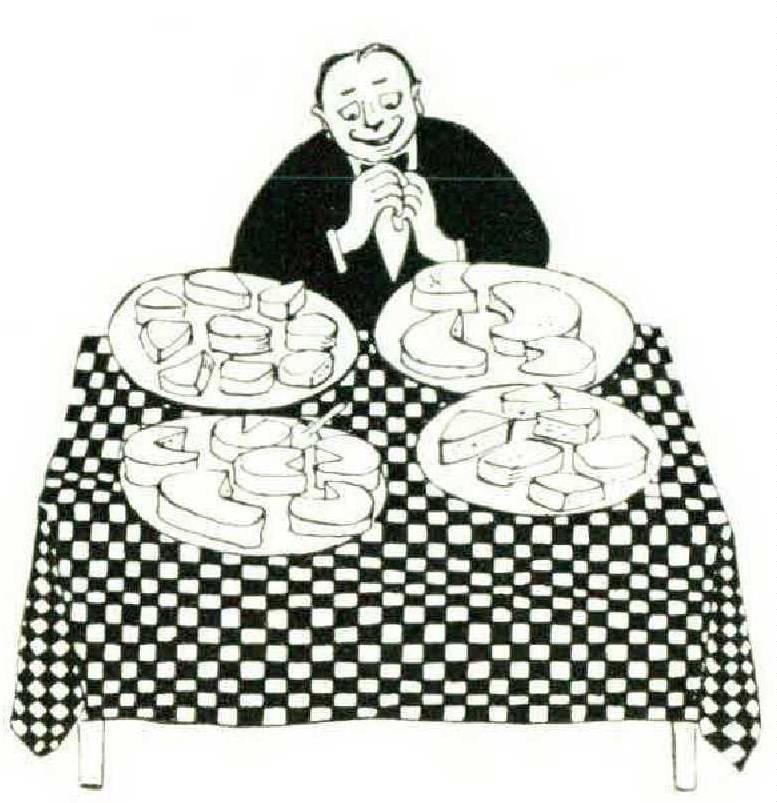
The real cheese lover in search of an unforgettable experience to tell his descendants about should try the Androuët Dégustation. It consists of eight platters, one after another, loaded with small cheese chunks, each chunk bearing a neat, identifying signpost. Every platter contains cheeses of the same school. For example, there will not be a blue cheese or an Emmenthaler on the same platter with a Camembert. The third platter consists of an entire Brie mounted on straw, and the wow at the finish is being allowed all the fondue you can hold.
We begin with the soft pastes: Grand Yatel, Suprème, Fin de Siècle, Brillat-Savarin, Trois Épis, Lucullus (78 per cent fat content). And now for the Roblochon, the Echourgnac, the Murol, and let’s not miss the Vacherin d’Abondanee over there. . . . Easy on that Brie, because here’s Number Four coming up with the Coulommiers and the Monsieur Fromagc for openers, and after that there’ll be the Goats, and after them, the Blues and the Swiss.
The eyes glaze, the limbs languish, the breath shortens, the ears buzz. Merely rising from the table becomes a problem, and so does limping downstairs sideways, holding onto the banister. But it’s something every true buff should go through at least once, and one can take comfort from what Colette wrote in the Androuet guest book in 1935: “If I had advice to give my daughter (but my daughter doesn’t ask my advice), I’d tell her, ‘Be careful not to marry a man who doesn’t love wine, music, and cheese.’ ”