The Struggle in the Cockpit
A professional arbitrator and mediator of labor disputes, SAUL WALLEN served as a member of emergency boards appointed by Presidents Truman and Eisenhower to deal with the disputes between the airlines pilots and the flight engineers. Mr. Wallen here gives us his proposals for a final solution to the differences between the pilots and engineers.
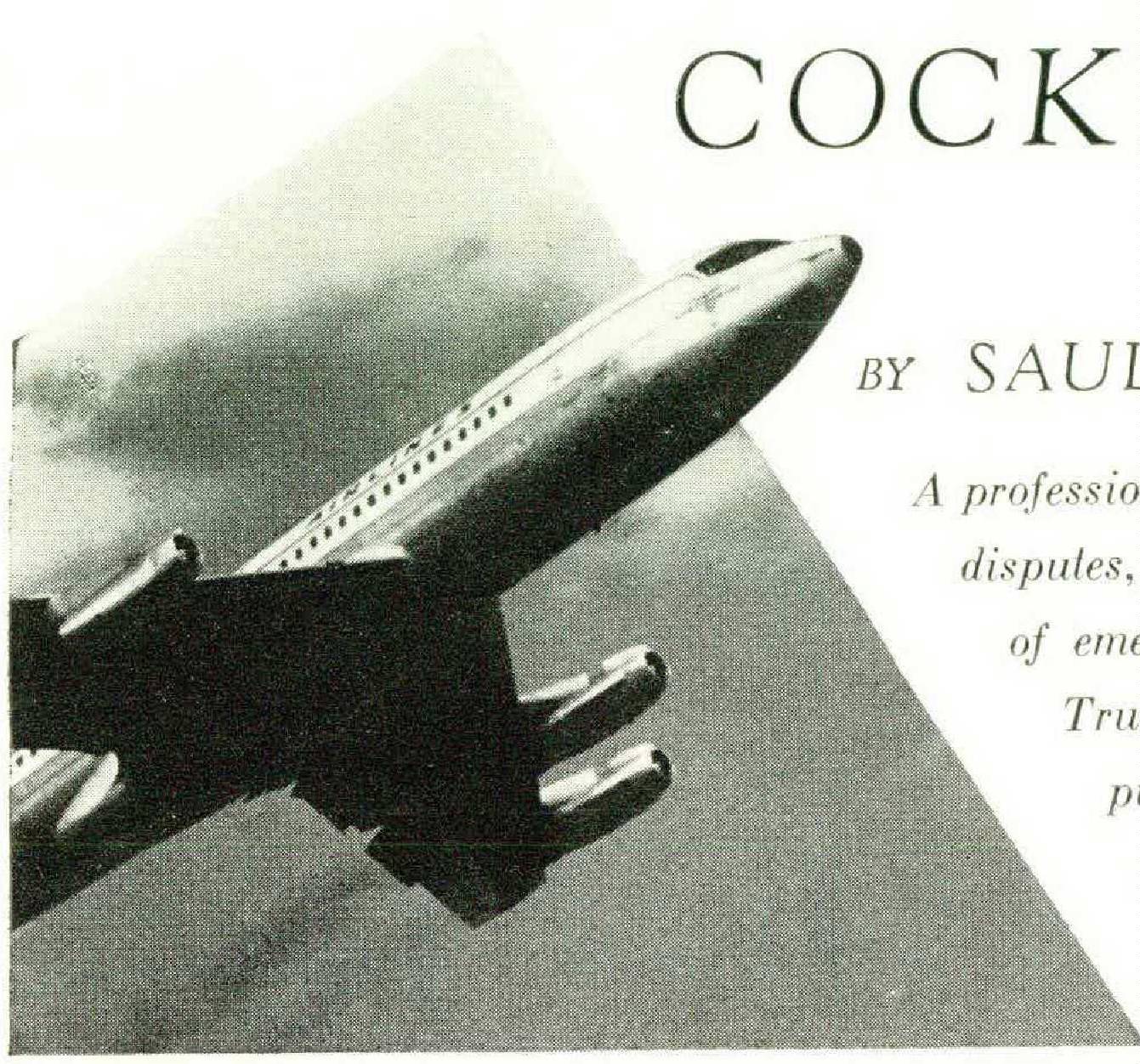
BY SAUL WALLEN
THE narrow door that separates the cabin from the cockpit of the airliner that takes you to Cairo or Chicago, to San Juan or San Francisco, conceals a contest of wills and a clash of egos that the government has so far been unable to conciliate and that the protagonists have so far been unwilling to terminate.
The flight crews on the nation’s major airlines are deeply divided over the interrelationship of their functions. The pilots contend that the conditions created by the introduction ot high-speed pure jet aircraft require a cockpit crew consisting of a pilot, a copilot, and a flight engineer, all of whom should possess the basic skills and orientation of a pilot, and that only with such a crew can Optimum safety be achieved. The flight engineers contend that the cause of safety is equally well served by carrying a flight engineer on the aircraft who has specialized training as an aircraft and engine mechanic, and that he need not possess pilot skills.
This issue of whether modern aircraft should be manned by a crew all of whom possess the same skill and pursue the same career or by a crew composed of men of separate skills pursuing separate careers has plagued the airlines for nearly a decade. In February, 1961, it manifested itself in the most comprehensive and costly strike in aviation history.
Allegedly of the wildcat variety, this strike involved the 3500 flight engineers belonging to the Flight Engineers International Association employed on the six major airlines which man their planes with flight engineers who possess the background and basic skills of aircraft mechanics. Unaffected and continuing to fly were the eight airlines whose flight engineers have the basic qualifications of pilots and who, along with the 14,000 pilots and copilots on all airlines, belong to the Air Line Pilots Association. Both unions are affiliated with the AFL-CIO.
According to Civil Air Regulations, the duty of a flight engineer during flight is to assist the pilots in the mechanical operation of an airplane. The flight engineer monitors the functioning of and makes adjustments in the mechanical, hydraulic, fuel, and electrical systems of the aircraft. He records signs of incipient or actual malfunction in a logbook for referral to the carrier’s mechanical maintenance department. Prior to take-off he makes an inspection of the aircraft to be certain that it has been properly serviced.
The pilot and copilot are responsible for flying the aircraft, plotting its course, receiving signals, and maintaining communications with ground stations.
In domestic commercial air transport, until 1947 aircraft were manned by a pilot and copilot. After the occurrence of several commercial airplane accidents in 1947, President Truman created a special board of inquiry which recommended that the Civil Aeronautics Board hold hearings to determine whether or not additional help in the cockpit was required to assist the pilots of commercial aircraft. The pilots, through the A.L.P.A., advocated adding to the flight crew a third man to assist the pilots in the operation of the large, four-engine aircraft then newly in use. In 1947, the C.A.B., over the initial objections of the carriers, issued a draft regulation requiring that, on aircraft certihecl for more than 80,000 pounds maximum take-off weight, “An airman holding a flight engineer’s certificate shall be required solely as a flight engineer.” This regulation affected various aircraft then in use, such as the Douglas DC-6 and Booing 377.
Some carriers objected to the use of the phrase “solely as a flight engineer” in the draft regulation because it would tend to restrict their “freedom of action in developing multiple function programs for flight crews and better utilization of crew time. . .”As a result, the phrase “solely as a flight engineer" was deleted. As the final regulation was phrased, the airlines could choose whether the man in the third seat should have the basic qualifications and training of a ground mechanic or the basic qualifications and training of a pilot.
OF THE major carriers, American, TWA, Eastern, Pan American, National, Continental, Northwest, and Western utilized mechanic-qualified engineers. On the other hand, Braniff. Capital, Delta, Northeast, and Panagra elected to recruit flight engineers qualified to become pilots and to progress them from flight engineer to copilot to captain. United Airlines maintained a mechanic qualification for its flight engineers until 1954, when it announced a switch to die pilot-qualified flight engineer program. Continental switched from mechanicto pilot-qualified engineers in 1959, and Western Airlines is in the process of doing so now . These latter three carriers were involved in costly strikes of flight engineers as a result.
The carriers which chose the pilot-engineer route developed flight crews with integrated duties and a career goal in which there was a line of job progression. Those which chose mechanic engineers developed flight crews with specialized and delimited duties and functions and with separate and specialized career goals. The flight engineer’s job was a dead-end job.
The development of the mechanic-engineer specialty and the granting of separate jurisdictions for purposes of collective bargaining have created conflicts of status and clashes of ego. Since their career aims were not integrated with those of pilots, the engineers tended to try to enhance their specialty and play up its importance in order to justify their demands on the carrier for higher pay. On their part, the pilots, keenly aware that the engineer was placed in the cockpit to assist them, were increasingly irked by the pursuit by the flight engineers of separate economic and career goals. The captain has command responsibility, and while the mechanic engineers have always acknowledged it, the increasing rigidity of the job structure of the cockpit crew fostered psychological and emotional tensions among crew members. These tensions broke out into open conflict in 1955, when the mechanic engineers on United struck for fifty-one days against that carrier’s decision to require its engineers to become qualified as pilots, and the pilots, ignoring F.E.I.A. picket lines, continued to fly during the strike.
But the truly sharp conflict between the pilots and the engineers broke out with the advent of the jets. Whereas the fastest previous commercial aircraft operated at a speed of 350 miles per hour, the new pure jet planes were designed to cruise at nearly 600 miles per hour. The introduction into the nation’s air lanes of these much faster planes created concern about the ability of the traffic control system to handle the jets.
The pilots maintained that the pure jets would impose on the pilot and copilot a significantly greater burden of work and responsibility in flight planning and communications and that the work load involved in monitoring the instruments associated with the plane’s flight and in establishing radio fixes to keep the plane on course would be greatly intensified. At the same time, they contended. the new aircraft were designed with many alternative systems and relays which would become automatically operative in the event of a mechanical malfunction, and as a consequence, the work load of the flight engineer would diminish. In addition, the pilots argued that the new planes raised to a critical level the problem of a replacement for the pilot, the copilot, or the flight engineer in the event one was incapacitated in flight. In the negotiation of the new collective bargaining contracts on the major airlines in 1957 and 1958, the A.L.P.A. demanded a provision that the flight engineer be pilot-qualified and that pilots be offered an opportunity to obtain flight engineer certificates.
The F.E.I.A. responded by serving the same carriers with a demand that the contracts contain a provision that no man would occupy the flight engineer’s seat who did not possess, in addition to a flight engineer’s certificate, an Aircraft and Engine License issued by the C.A.A, to those who qualify in aircraft and engine overhaul and maintenance. They blasted the A.L.P.A. demand as an attempt by the pilots to force the engineers out of the third seat, so that the pilots, faced with unemployment under the first impact of jet service, could take their jobs.
The carriers were caught in the middle. Each side threatened to strike if its demand was not met. The issue came to a head first on Eastern Airlines, and to forestall a strike President Eisenhower appointed an emergency board under the Railway Labor Act to hear the disputes and make nonbinding recommendations on the merits. In a proceeding which lasted nearly six months, this board heard all parties, took testimony from experts, and recommended that flight engineers who serve on pure jet equipment “be required to have pilot qualifications to the extent of a commercial license and instrument rating and the ability to fly and land the airplane in case of emergency.”The carrier was to provide the training at no expense to the flight engineer.
Eastern Airlines and the pilots agreed to accept this recommendation, but the flight engineers balked, maintaining that it would dilute their skills and deprive those unwilling or unable to obtain a commercial license and an instrument rating of an opportunity to fly as flight engineers on the jets. In October, 1958, the flight engineers on Eastern struck, grounding the planes with the aid of the mechanics, whose union, the International Association of Machinists, went on strike in behalf of their own wage demands as well as in support of the engineers.
The other airlines flying with mechanic engineers were in the same dilemma as Eastern. All were finally rescued from it by the action of American Airlines. American, anxious to be first in the air with the jets and wishing to avoid a strike of pilots on the crew complement issue (it had signed a contract with the engineers on substantially their terms on that issue while the Eastern case was pending), advised its pilots and engineers in December, 1958, that its experts had concluded that the problems of jet operation and the work load on the jets for pilots would call for the services of a third man with pilot qualifications, but that since it was committed to carry a mechanictrained flight engineer, it proposed to place a third pilot in the cockpit of the jet. American’s crew on jets would consist of three pilots and an engineer.
This move was calculated to meet the pilots’ demand for a fail-safe crew without monkeying with the status or qualifications of the mechanicqualified engineer. With this proffer, American assumed a multimillion-dollar per year extra payroll cost for what the engineers promptly dubbed a “feather-bird.”
This solution was the pattern followed by the other airlines flying with mechanic-qualified engineers, including Eastern, where the engineers’ strike was settled on the basis of this arrangement. The result has been that, since the advent of the jets, American, Eastern, TWA, Pan American, Western, and Northwest have had four men in a jet cockpit designed for three crew members and an observer. Those airlines which had from the beginning manned their planes with pilot-qualified engineers or which, like United, had switched from a mechanic to a pilot qualification were able to put their jets in the air with three crew members in the cockpit instead of four.
THE latest phase in the pilot-engineer struggle opened early in 1960. The A.L.P.A. argued that, since the flight engineers on United are pilotqualified and since their duties are part and parcel of the duties performed by the pilots, the unit for collective bargaining should be the flight deck crew. It petitioned the National Mediation Board for a ruling that would declare the three stations in the cockpit a single class or craft for the purpose of selecting a collective bargaining agent.
The Mediation Board turned this hot potato over to a special committee consisting of three labor relations experts for determination. This committee held hearings over a six-month period, took over 5000 pages of testimony from the pilots, the flight engineers, and interveners, and on February 6, 1961, made the determination that “all flight deck crew members on United Airlines . . . constitute one craft or class for purposes of representation and collective bargaining under the Railway Labor Act.”
The flight engineers, outnumbered two to one in any election of this sort, took a dim view of this outcome. The wildcat strike, so-called, which began on February 17, 1961, and lasted for six days, effectively grounding the planes of American, Eastern, National, TWA, Pan American, and Western, as well as Flying Tigers, a cargo carrier, was a protest against this determination. Interestingly, United’s flight engineers, although immediately involved in the determination, did not strike. The great majority of them had taken flight training and had obtained, or were on the way to obtaining, a commercial license and an instrumentrating. While they continued to belong to the F.E.I.A., which still remained their bargaining agent, many also held membership in the pilots’ union. But the airlines flying with mechanic engineers were grounded, and it took all of Secretary of Labor Goldberg’s very considerable powers of persuasion and a promise from the President of the United States to set up a commission to take another look at the whole problem to get the strikers to return. And even the Secretary of Labor failed to persuade the president of Western Airlines to buy this stopgap solution. He tired his 130 engineers in the midst of the wildcat strike and announced his intention to train pilots as replacements.
The presidential commission, headed by Professor Nathan Feinsinger of the University of Wisconsin Law School, a skilled mediator and distinguished arbitrator of labor disputes, is now conducting an inquiry and trying to develop a solution. Its recommendations will not be binding. Nor does the commission have the power to set aside the determination in the United case made by the special committee appointed by the National Mediation Board.
WHAT are the prospects for a final solution of this thorny problem? A recommendation by the presidential commission either that the mechanic qualification for flight engineers be retained or that it be discarded in favor of a pilot qualification will not in itself solve the problem. So long as the two organizations, so sharply divided on this question, remain committed to their antithetical philosophies, such a recommendation is likely to continue to fall on deaf ears.
What about the Civil Aeronautics Board? Could it not exercise its rule-making power to establish either a pilot qualification or a mechanic qualification for flight engineers and, by eliminating the possibility of a choice on the part of the carriers, end the pulling and hauling by the two unions? This is theoretically possible, but highly unlikely. Ever since the Civil Aeronautics Board in 1947 ruled that the minimum safety standards it establishes for the industry would be met by having either a pilot-qualified man or a mechanic-qualified man in the third seat, it has found no reason to change its mind. It regards the running battle between pilots and flight engineers as a labor problem, not a safety problem. It is, no doubt, painfully aware that a move by it in either direction would raise a storm on half the nation’s airlines.
What about the AFL-CIO? Can it not get its affiliates to merge? President George Meany repeated twice during the recent strike that merger is the only solution to the problem. Two committees of the parent labor organization had previously recommended merger. The A.L.P.A. was willing to talk. The F.E.I.A. leadership, hiding behind a resolution passed by its governing body several years ago forbidding the officers to meet with the pilots on the matter of merger, has so far refused even to consider this solution. The AFL-CIO is a federation of autonomous unions. Its president and executive council can recommend, urge, exhort; they cannot compel an affiliate to take a course of action it does not wish to take. The only possible cudgel, expulsion, is not likely to be effective here.
It is the view of most detached observers that the acceptance of a pilot qualification and merger of the two unions remain the only answer. And although the F.E.I.A. leadership continues to be obdurate, there are indications of a rising awareness among flight engineers that the tide of events is running against them.
What are the underlying factors that make merger a greater possibility now than heretofore?
The first factor is the economics of the industry. When jet airplanes first hit the air travel market in 1959, there was no difficulty in filling their seats. And the jets proved to be more efficient and profitable than expected. As a result, the cost of carrying the fourth man, the carriers’ own answer to their immediate dilemma, could easily be absorbed.
But, with the addition of planes to the jet fleet, seat capacity is growing and load factors are declining. Profits from jet operations are becoming slimmer. The cost advantage enjoyed by United and the other carriers who, because they have pilot-trained engineers, carry three crew members, not four, in the cockpits of their jets begins to look extremely important. The result is the likelihood of increased management pressure for a solution based on a pilot qualification for engineers. Evidence of this trend lies in the decision taken by Continental Airlines in 1959 to drop its mechanic qualification for engineers and fly its jets with three men, all pilot-trained. The company won a strike by engineers on that issue. Further evidence lies in the course of action taken by Western Airlines, which several weeks before the recent wildcat strike announced its intention to require all its flight engineers to become pilotqualified by next July 1 and to train them to that end.
The second factor increasing the chances of acceptance of a pilot qualification for engineers and merger of the two groups is the growing recognition that the basic conclusions reached by the Eastern Airlines Emergency Board in 1958 and by the 1960 committee appointed by the National Mediation Board to make a unit determination on United are valid and proper. Underlying both these findings is recognition of the extra degree of safety inherent in a cockpit crew accustomed by training, inclination, and experience to the utmost of coordination and cooperation. Having the same orientation, such a crew can work together as a unit more effectively than a crew in which there are two separate and distinct specialties. And with three men in the cockpit able to land the aircraft in an emergency caused by the disability of one, an extra margin of safety is present.
Implicit, also, in these reports is the realization that the cockpit is just too small to house men with conflicting ambitions and aspirations who must make an almost conscious effort, once they step into the aircraft, to bottle up the resentments which their bitter dispute has engendered. Men whose work is as highly integrated and coordinated as that of flight engineers and pilots should have identical career aims, aspirations, and ambitions, not highly disparate ones.
The third factor that is edging the problem to a final solution is the growing resentment of public and congressional opinion against the parties to this fight. The public’s concern with safety has been heightened by the recent occurrence of a number of air tragedies. Public pressure for higher standards of safety on the airlines is mounting. Any condition in the cockpit tending toward disharmony and conflict, no matter how well sublimated by tlie sense of professional duty characteristic of both pilots and engineers, raises fears which thrust the problem into the public domain. A public solution may soon be imposed if a private one is not negotiated. And if one is imposed, the history and economics of the problem point toward the adoption of a pilot-engineer requirement.
A merger of the two unions is vital. To be accomplished, merger terms should embody the following ingredients:
First, they should provide present mechanic flight engineers with an opportunity to become pilot-qualified at the expense of the carriers and to progress to copilot and captain in accordance with the normal rules on each carrier. As pilots, these men would have seniority as of the date they fill a copilot vacancy.
Second, they should protect the job security of the present supply of flight engineers by assuring them that so long as flight engineer work remains to be performed on the aircraft, present flight engineer incumbents will have first claim on it, ahead of the present supply of pilots.
Third, present flight engineers unable to qualify as pilots should be permitted to fly as mechanicqualified engineers until their normal termination by quitting, retirement, or otherwise.
Fourth, merger agreements should be drawn in such a way as to ensure that their terms cannot later be changed by majority vote of the merged group to the detriment of the outnumbered flight engineers.
If the A.L.P.A. is not engaged merely in a job grab — and, F.E.I.A. claims to the contrary notwithstanding, there is no evidence that this is its motive — it can clearly assent to merger terms containing these ingredients. If the F.E.I.A.’s aim is not merely to retain a skill which no longer has a reason for a separate existence, but to protect and enlarge the career opportunities of the present supply of mechanic engineers while enhancing the safety of aircraft operation, it cannot refuse merger terms containing these ingredients without placing 3500 fine men in danger of losing their careers entirely.
If the carriers wish an end to a problem which they had a hand in creating and which has already cost them untold millions, they should be willing to cooperate with the two organizations in effecting such a merger and in shouldering the training costs involved.