Spot Announcement
WILLIAM O’HALLAREN now devotes all his time to writing, after long experience in radio and television work in Los Angeles.
Almost any of these evenings a certain actress of pleasant vintage is likely to show up on the television screen in a brief but absorbing drama. She enters, smiles, swirls about the room. Would you believe it? she asks. This is the gown I wore in −, and here she names a motion picture most of us will stoutly deny we were old enough to have seen in its original showings.
While we muse on the wonder that gown and actress have held up so well, she presses toward her big line. The reason I can wear it, she confides, is that I watch my weight. I drink Fig Juice. Now she glides to a counter and pours herself a stiff jolt of a dark liquid. She smiles again and belts it down. The scene ends with the camera closing in on the bottle of Fig Juice, upstaging our actress more fiendishly than John Barrymore ever could have.
The whole thing is over before we know it, and we probably think little more about it, unless the commercial happens to start a small brush war over whether it was Warren William or Warner Baxter who starred in the original picture, with the actress and gown, which perhaps we did see after all.
There might also be some musings to the effect: poor girl, once a star and now reduced to this. Our pity can be restrained. Selling Fig Juice on television may not be art, but it’s a mighty pleasant way to earn a living. The chances are our actress got about $25,000 for her Fig Juice role, which is probably more than she got for that far-off movie. While the tax situation has admittedly changed, still, there’s a good chance there will be a new version of the part in six months or so, with new fees.
In fact, the whole commercial is a rival in cost and complexity to complete movies of the not-too-distant past. The story line may not be as elaborate, and the cast may be smaller, but from there on, the differences narrow.
In Hollywood these days, there are a great many impressive studios which do nothing but produce television commercials. Actors and actresses batter at their gates almost as relentlessly as they do at MGM. If an unknown girl were to get to sip the Fig Juice, the role would probably be worth $5000 or better to her when the residuals were all in. The half dozen or so announcers whose voices conclude these commercials are in the $100,000-a-year bracket.
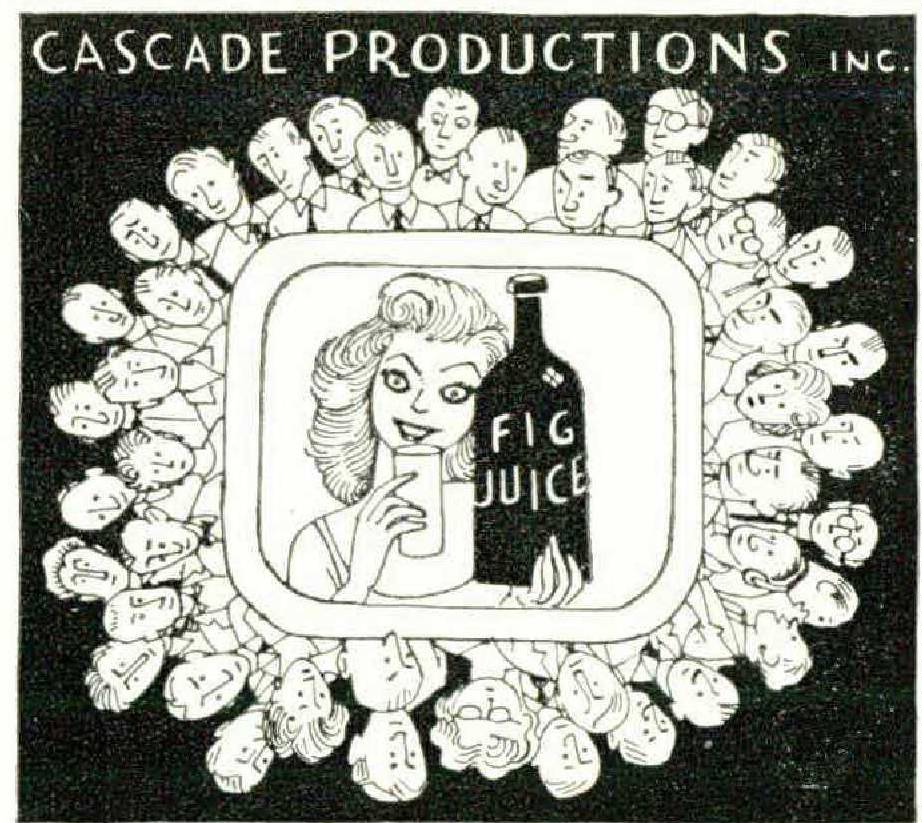
A typical firm is Cascade Pictures of California, Inc., formed by Bernard J. Carr and Roy Seawright. Seawright was responsible for those ectoplasmic effects in the original Topper pictures. Their commercials also go in for special effects, such as the one with Manners, the tiny butler, or the spot in which Kleenex jumps out of the box.
All this comes from a Hollywood studio complete with three sound stages, wardrobe and property departments, casting offices, animation departments, and all else that might be expected on any motion picture lot. Cascade has sixty-five on the basic payroll, and the studio is full of people scurrying around with scripts, music, costumes, and worried looks, for all the world as though Ben Hur were in production.
Commercials are made on orders from advertising agencies, but the entire production worry is in the hands of the studio. Production time for a single commercial will run from two to three months, depending on the story line. Final costs are a fiercely guarded trade secret, but it is no secret that many television commercials cost more than some half-hour shows.
Once the agency delivers a script, a director and assistant director are assigned, actors and extras are cast, animation is ordered, costumes are selected, and sets are built. The simple little commercial (to the viewer) is an epic in labor relations. Advance preparations must involve dealings with the Screen Directors Guild, the Screen Actors Guild, and the Screen Extras Guild, and possibly even the Screen Writers Guild. (A story doctor may have to be called in at the last minute, if the star has trouble with a line.)
After the weeks of casting, set building, rehearsal, final sponsor changes, and final, final sponsor changes, the moment of production arrives. Most firms hope to shoot a commercial in one day, two at the most, compared with three for halfhour dramas.
At the moment of shooting, technicians may be present from as many as thirteen locals of IATSE, the master alliance of film unions, including grips, props, electricians, painters, costumers, set designers, film technicians, sound technicians, and laborers. Woe to one and all if an assistant director should brashly move a glass that should have been moved by a grip with the advice and consent of a prop.
Later comes the editing, which must be microscopically exact. A one-minute commercial must be just that, sixty seconds, thirty-six feet of 16 mm. film, 1440 frames. As President Carr of Cascade puts it, “We deal in sprocket holes.”
This always means some desperate final decision, such as whether Miss Actress will be allowed two sips of Fig Juice, at the expense of the closeup of the bottle, or whether there will be more close-up and one of the sips consigned to the cutting-room floor. Such questions set teletypes to clacking between New York, Sponsorville, and Hollywood, and are eventually settled at the summit. The finished prints are then delivered to the agency, and in due time arrive in the projection booths of several hundred television stations.
The people who produce filmed commercials are stoutly of the opinion that the quality of their efforts is superior to that of most of the programs that surround them. They believe that they are getting more humor and appeal into their products each season, and aren’t so sure program producers can say the same.